

There really are things you can do to keep your body looking healthy and youthful for years to come. But before I discuss these things, I want you to answer the following questions honestly: Are you willing to make the hard sacrifices needed to be really healthy? Are you willing to commit yourself totally to a program of regular exercise, close medical supervision, and the elimination of all caffeine, alcohol, and rich foods, to be replaced by a strict diet of nutrition-rich, kelp-like plant growths so unappetizing that they will make you actually lust for tofu?
Or are you the kind of shallow, irresponsible person who wants a purely cosmetic change, a “quick and dirty” surface gloss that may make you look young and healthy, but actually has no long-term value? Me too.Dave Barry (b. 1947) American humorist, author, columnist
Dave Barry Turns 40, ch. 2 “Your Disintegrating Body” (1990)
(Source)
Quotations about:
self-sacrifice
Note not all quotations have been tagged, so Search may find additional quotes on this topic.

Political virtue is a renunciation of oneself, which is always a very painful thing. One can define this virtue as love of the laws and the homeland. This love, requiring a continuous preference of the public interest over one’s own, produces all the individual virtues; they are only that preference.
[La vertu politique est un renoncement à soi-même, qui est toujours une chose très-pénible. On peut définir cette vertu, l’amour des loix & de la patrie. Cet amour, demandant une préférence continuelle de l’intérêt public au sien propre, donne toutes les vertus particulieres: elles ne sont que cette préférence.]
Charles-Lewis de Secondat, Baron de Montesquieu (1689–1755) French political philosopher
Spirit of Laws [The Spirit of the Laws; De l’esprit des lois], Book 4, ch. 5 (4.5) (1748) [tr. Cohler/Miller/Stone (1989)]
(Source)
(Source (French)). Other translations:Virtue is a self-renunciation which is always arduous and painful. This virtue may be defined, the love of the laws and of our country. As this love requires a constant preference of public to private interest, it is the source of all the particular virtues; for they are nothing more than this very preference itself.
[tr. Nugent (1750)]Virtue is a self-renunciation, which is very arduous and painful. This virtue may be defined as the love of the laws and of our country. As such love requires a constant preference of public to private interest, it is the source of all private virtues [....]
[E.g. (1904)]Virtue is self-renunciation, which is always a very hard thing. This virtue may be defined as love of the laws and of the homeland. As this love requires a continual preference for the public interest over one’s own, it confers all the separate virtues: they are nothing more than this preference.
[tr. Stewart (2018)]
Every Man must seriously set himself to root out his Passions, Prejudices and Attachments, and to get the better of his private Interest. The only reputable Principle and Doctrine must be that all Things must give Way to the public.
John Adams (1735–1826) American lawyer, Founder, statesman; US President (1797–1801)
Letter (1776-04-16) to Mercy Otis Warren
(Source)

The life given us by nature is short; but the memory of a well-spent life is eternal.
[Brevis a natura nobis vita data est; at memoria bene reditae vitae sepiterna.]
Marcus Tullius Cicero (106–43 BC) Roman orator, statesman, philosopher
Philippics [Philippicae; Antonian Orations], No. 14, ch. 12 / sec. 32 (14.12/14.32) (43-04-21 BC) [ed. Hoyt (1896)]
(Source)
Asking the Senate to honor the Fourth and Martian legions for their victory over Antony at the Battle of Forum Gallorum.
(Source (Latin)). Other translations:Short is the life which nature has given us: but the memory of a life nobly laid down is eternal.
[ed. Harbottle (1897)]A brief life has been allotted to us by nature; but the memory of a well-spent life is imperishable.
[tr. Yonge (1903)]Brief is the life given us by nature; but the memory of life nobly resigned is everlasting.
[tr. Ker (Loeb) (1926)]
So glorious is the recovery of liberty that in regaining liberty we must not shrink even from death.
[Ita praeclara est recuperatio libertatis ut ne mors quidem sit in repetenda libertate fugienda.]
Marcus Tullius Cicero (106–43 BC) Roman orator, statesman, philosopher
Philippics [Philippicae; Antonian Orations], No. 10, ch. 9 / sec. 20 (10.9/10.20) (43-02 BC) [tr. Ker (Loeb) (1926)]
(Source)
(Source (Latin)). Other translations:The recovery of freedom is so splendid a thing that we must not shun even death when seeking to recover it.
[tr. Yonge (1903)]So glorious is the reclamation of freedom that not even death should be avoided when freedom must be regained.
[tr. @sentantiq (2017)]
Society has always to demand a little more from human beings than it will get in practice. It has to demand faultless discipline and self-sacrifice, it must expect its subjects to work hard, pay their taxes, and be faithful to their wives, it must assume that men think it glorious to die on the battlefield and women want to wear themselves out with child-bearing. The whole of what one may call official literature is founded on such assumptions.
George Orwell (1903–1950) English journalist, essayist, writer [pseud. of Eric Arthur Blair]
Essay (1941-09), “The Art of Donald McGill,” Horizon Magazine
(Source)
Be polite and generous, but don’t undervalue yourself. You will be useful, at any rate; you may just as well be happy, while you are about it.

And when you fast, do not put on a sad face as the hypocrites do. They neglect their appearance so that everyone will see that they are fasting. I assure you, they have already been paid in full. When you go without food, wash your face and comb your hair, so that others cannot know that you are fasting — only your Father, who is unseen, will know. And your Father, who sees what you do in private, will reward you.
[Ὅταν δὲ νηστεύητε, μὴ γίνεσθε ὡς οἱ ὑποκριταὶ σκυθρωποί, ἀφανίζουσιν γὰρ τὰ πρόσωπα αὐτῶν ὅπως φανῶσιν τοῖς ἀνθρώποις νηστεύοντες· ἀμὴν λέγω ὑμῖν, ἀπέχουσιν τὸν μισθὸν αὐτῶν. σὺ δὲ νηστεύων ἄλειψαί σου τὴν κεφαλὴν καὶ τὸ πρόσωπόν σου νίψαι, ὅπως μὴ φανῇς τοῖς ἀνθρώποις νηστεύων ἀλλὰ τῷ πατρί σου τῷ ἐν τῷ κρυφαίῳ· καὶ ὁ πατήρ σου ὁ βλέπων ἐν τῷ κρυφαίῳ ἀποδώσει σοι.]
The Bible (The New Testament) (AD 1st - 2nd C) Christian sacred scripture
Book 1. Gospel of Matthew 6:16ff (Matt 6:16–18) (Jesus) [GNT (1966)]
(Source)
No Synoptic parallels.
(Source (Greek)). Alternate translations:Moreover when ye fast, be not, as the hypocrites, of a sad countenance: for they disfigure their faces, that they may appear unto men to fast. Verily I say unto you, They have their reward. But thou, when thou fastest, anoint thine head, and wash thy face; that thou appear not unto men to fast, but unto thy Father which is in secret: and thy Father, which seeth in secret, shall reward thee openly. [KJV (1611)]When you fast do not put on a gloomy look as the hypocrites do: they pull long faces to let men know they are fasting. I tell you solemnly, they have had their reward. But when you fast, put oil on your head and wash your face, so that no one will know you are fasting except your Father who sees all that is done in secret; and your Father who sees all that is done in secret will reward you. [JB (1966)]When you are fasting, do not put on a gloomy look as the hypocrites do: they go about looking unsightly to let people know they are fasting. In truth I tell you, they have had their reward. But when you fast, put scent on your head and wash your face, so that no one will know you are fasting except your Father who sees all that is done in secret; and your Father who sees all that is done in secret will reward you.
[NJB (1985)]And when you fast, don’t put on a sad face like the hypocrites. They distort their faces so people will know they are fasting. I assure you that they have their reward. When you fast, brush your hair and wash your face. Then you won’t look like you are fasting to people, but only to your Father who is present in that secret place. Your Father who sees in secret will reward you.
[CEB (2011)]And whenever you fast, do not look somber, like the hypocrites, for they mark their faces to show others that they are fasting. Truly I tell you, they have received their reward. But when you fast, put oil on your head and wash your face, so that your fasting may be seen not by others but by your Father who is in secret, and your Father who sees in secret will reward you.
[NRSV (2021 ed.)]
The NRSV notes some early manuscripts have the Father rewarding you "openly," which the KJV uses.

So this idea of doing good to others only for their sake is absurd. You want to do it, not simply for their sake, but for your own; because a perfectly civilized man can never be perfectly happy while there is one unhappy being in this universe.
Robert Green Ingersoll (1833–1899) American lawyer, freethinker, orator
Speech (1886-11-14), “A Lay Sermon,” American Secular Union annual congress, Chickering Hall, New York City
(Source)
In a valiant suffering for others, not in a slothful making others suffer for us, did nobleness ever lie.
Thomas Carlyle (1795–1881) Scottish essayist and historian
Past and Present, Book 2, ch. 8 “Unworking Aristocracy” (1843)
(Source)
Besides justifying the transfer of wealth to kleptocrats, institutionalized religion brings two other important benefits to centralized societies. First, shared ideology or religion helps solve the problem of how unrelated individuals are able to live together without killing each other — by providing them with a bond not based on kinship. Second, it gives people a motive, other than genetic self-interest, for sacrificing their lives on behalf of others.
Jared Diamond (b. 1937) American geographer, historian, ornithologist, author
Guns, Germs, and Steel, ch. 14 (1997)
(Source)

So when, in future times, men ask you to prove patriotism and loyalty and affection for your native land — remember that these things are not always equated with a willingness to die or to kill.
Rod Serling (1924–1975) American screenwriter, playwright, television producer, narrator
Commencement Address, Ithaca College, New York (13 May 1972)
(Source)
Remember that you can’t necessarily sanctify a cause by virtue of the fact that men die for it. A death in a worthless or even questionable cause is a pointless, meaningless, tragically premature death.
Rod Serling (1924–1975) American screenwriter, playwright, television producer, narrator
Commencement Address, Ithaca College, New York (13 May 1972)
(Source)
You can always hear the people who are willing to sacrifice somebody else’s life. They’re plenty loud and they talk all the time. You can find them in churches and schools and newspapers and congresses. That’s their business. They sound wonderful. Death before dishonor. This ground sanctified by blood. These men who died so gloriously. They shall not have died in vain. Our noble dead.
Hmmmm.
But what do the dead say?
Did anybody ever come back from the dead any single one of the millions who got killed did any one of them ever come back and say by god I’m glad I’m dead because death is always better than dishonor? Did they say I’m glad I died to make the world safe for democracy? Did they say I like death better than losing liberty? Did any of them ever say it’s good to think I got my guts blown out for the honor of my country? Did any of them ever say look at me I’m dead but I died for decency and that’s better than being alive? Did any of them ever say here I am, I’ve been rotting for two years in a foreign grave but it’s wonderful to die for your native land? Did any of them say hurray I died for womanhood and I’m happy, see how I sing even though my mouth is choked with worms?
Nobody but the dead know whether all these things people talk about are worth dying for or not. And the dead can’t talk.Dalton Trumbo (1905–1976) American screenwriter and novelist [James Dalton Trumbo]
Johnny Got His Gun, ch. 10 (1938)
(Source)

He who gives only what he would as readily throw away gives without generosity; for the essence of generosity is in self-sacrifice.
Henry Taylor (1800–1886) English dramatist, poet, bureaucrat, man of letters
“Money,” Notes from Life (1847)
(Source)

I disapprove of what you say, but I will defend to the death your right to say it.
Voltaire (1694–1778) French writer [pseud. of Francois-Marie Arouet]
(Spurious)
(Source)
The words are not found in any actual Voltaire source. They belong to historian Evelyn Beatrice Hall, writing as S. G. Tallentyre, in The Friends of Voltaire (1906), describing an 1759 incident where Voltaire learned that Claude-Adrien Helvétius' book On the Mind [De l’esprit] had been burned (along with Voltaire's own On Natural Law) after condemnation by the Paris Parliament and the Sorbonne. Voltaire himself wasn't impressed by Helvétius' book, but thought a book burning was unjustified. Hall wrote:"What a fuss about an omelette!" he had exclaimed when he heard of the burning. How abominably unjust to persecute a man for such an airy trifle as that! "I disapprove of what you say, but I will defend to the death your right to say it," was his attitude now.
Hall later wrote that the actual words were her own and ought not to have had quotation marks.
Variations:For more detailed information, see Quote Origin: I Disapprove of What You Say, But I Will Defend to the Death Your Right to Say It – Quote Investigator®.
- I wholly disapprove of what you say -- and will defend to the death your right to say it.
- Monsieur l’Abbé, je déteste ce que vous écrivez, mais je donnerais ma vie pour que vous puissiez continuer à écrire. [Monsieur l’abbé, I detest what you write, but I would give my life to make it possible for you to continue to write.]

If you asked twenty good men today what they thought the highest of the virtues, nineteen of them would reply, Unselfishness. But if you asked almost any of the great Christians of old he would have replied, Love. You see what has happened? A negative term has been substituted for a positive, and this is of more than philological importance. The negative ideal of Unselfishness carries with it the suggestion not primarily of securing good things for others, but of going without them ourselves, as if our abstinence and not their happiness was the important point. I do not think this is the Christian virtue of Love.
C. S. Lewis (1898–1963) English writer, literary scholar, lay theologian [Clive Staples Lewis]
“The Weight of Glory,” sermon, Oxford University Church of St Mary the Virgin (8 Jun 1941)
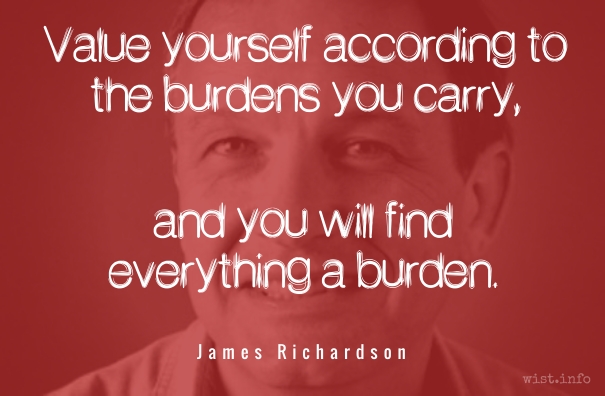
Value yourself according to the burdens you carry, and you will find everything a burden.
James Richardson (b. 1950) American poet
Vectors: Aphorisms and Ten-Second Essays, # 52 (2001)

Greater love hath no man than this, that a man lay down his life for his friends.
[είζονα ταύτης ἀγάπην οὐδεὶς ἔχει ἵνα τις τὴν ψυχὴν αὐτοῦ θῇ ὑπὲρ τῶν φίλων αὐτοῦ.]
The Bible (The New Testament) (AD 1st - 2nd C) Christian sacred scripture
Book 4. Gospel of John 15:13 (John 15:13) (Jesus) [KJV (1611)]
(Source)
No Synoptic parallels.
(Source (Greek)). Other translations:A man can have no greater love than to lay down his life for his friends.
[JB (1966)]The greatest love you can have for your friends is to give your life for them.
[GNT (1976)]No one can have greater love than to lay down his life for his friends.
[NJB (1985)]No one has greater love than to give up one’s life for one’s friends.
[CEB (2011)]No one has greater love than this, to lay down one’s life for one’s friends.
[NRSV (2021 ed.)]
To me, the democratic system represents man’s best and brightest hope of self-fulfillment, of a life rich in promise and free from fear; the one hope, perhaps, for the complete development of the whole man. But I know, and learn more clearly every day, that we cannot keep our system strong and free by neglect, by taking it for granted, by giving it our second-best attention. We must be prepared, like the suitor in The Merchant of Venice — and, I might point out, the successful suitor — to give and hazard all we have.
Eleanor Roosevelt (1884–1962) American politician, diplomat, activist; First Lady of the US (1933–45)
Essay (1961-04), “What Has Happened to the American Dream?” Atlantic Monthly
(Source)

I think that if the beast who sleeps in man could be held down by threats — any kind of threat, whether of jail or of retribution after death — then the highest emblem of humanity would be the lion tamer in the circus with his whip, not the prophet who sacrificed himself. But don’t you see, this is just the point — what has for centuries raised man above the beast is not the cudgel but an inward music: the irresistible power of unarmed truth, the powerful attraction of its example.
Boris Pasternak (1890–1960) Russian poet, novelist, and literary translator
Doctor Zhivago [До́ктор Жива́го], Part 1, ch. 2 “A Girl from a Different World” [Nikolai] (1955) [tr. Hayward & Harari (1958), US ed.]
(Source)
Other translations:I think that if the beast who sleeps in man could be held down by threats -- any kind of threat, whether of jail or of retribution after death -- then the highest emblem of humanity would be the lion tamer in the circus with his whip, not the self-sacrificing preacher. But don’t you see, this is just the point -- what has for centuries raised man above the beast is not the cudgel but an inward music: the irresistible power of unarmed truth, the attraction of its example.
[tr. Hayward & Harari (1958), UK ed.]I think that if the beast who sleeps in man could be held down by threats -- any kind of threat, whether of jail or of retribution after death -- then the highest emblem of humanity would be the lion tamer in the circus with his whip, not the prophet who sacrificed himself. But this is just the point -- what has for centuries raised man above the beast is not the cudgel, but an inward music -- the irresistible power of unarmed truth.
[tr. Hayward & Harrai (1958); edited version quoted by Ronald Reagan, Moscow State University (1988-05-31)]I think that if the beast dormant in man could be stopped by the threat of, whatever, the lockup or requital beyond the grave, the highest emblem of mankind would be a lion tamer with his whip, and not the preacher who sacrifices himself. But the point is precisely this, that for centuries man has been raised above the animals and borne aloft not by the rod, but by music: the irresistibility of the unarmed truth, the attraction of its example.
[tr. Pevear & Volokhonsky (2010), "A Girl from a Different Circle"]

Neither urge another to that thou wouldst be unwilling to do thyself, nor do thyself what looks to thee unseemly and intemperate in another.
William Penn (1644–1718) English writer, philosopher, politician, statesman
Some Fruits of Solitude, # 71 (1693)
See also Matthew 7:12.
The reason I don’t worry about society is, nineteen people knocked down two buildings and killed thousands. Hundreds of people ran into those buildings to save them. I’ll take those odds every fucking day.
Jon Stewart (b. 1962) American satirist, comedian, and television host. [b. Jonathan Stuart Leibowitz]
Interview, Rolling Stone (2007-11 )

Men who have offered their lives for their country know that patriotism is not the fear of something; it is the love of something. Patriotism with us is not the hatred of Russia; it is the love of this Republic and of the ideal of liberty of man and mind in which it was born, and to which this Republic is dedicated.
Adlai Stevenson II (1900–1965) American politician, diplomat, statesman
Speech (1952-08-27), “The Nature of Patriotism,” American Legion Convention, Madison Square Garden, New York City
(Source)
I do not say, and I do not believe, that Christians are as bad as their creeds. In spite of church and dogma, there have been millions and millions of men and women true to the loftiest and most generous promptings of the human heart. They have been true to their convictions, and, with a self-denial and fortitude excelled by none, have labored and suffered for the salvation of men. Imbued with the spirit of self-sacrifice, believing that by personal effort they could rescue at least a few souls from the infinite shadow of hell, they have cheerfully endured every hardship and scorned every danger.
And yet, notwithstanding all this, they believed that honest error was a crime. They knew that the Bible so declared, and they believed that all unbelievers would be eternally lost. They believed that religion was of God, and all heresy of the devil. They killed heretics in defense of their own souls and the souls of their children. They killed them because, according to their idea, they were the enemies of God, and because the Bible teaches that the blood of the unbeliever is a most acceptable sacrifice to heaven.Robert Green Ingersoll (1833–1899) American lawyer, freethinker, orator
Lecture (1874-05-03), “Heretics and Heresies,” Free Religious Society, Kingsbury Hall, Chicago
(Source)
Collected in The Gods and Other Lectures (1876).