There are two things that men should never weary of, goodness and humility; we get none too much of them in this rough world among cold, proud people.
Robert Louis Stevenson (1850–1894) Scottish essayist, novelist, poet
Novel (1886), Kidnapped, ch. 16 “The Lad with the Silver Button: Across Morven”
(Source)
This chapter was originally published in Young Folks Paper, Vol. 28, No. 811 (1886-06-12).
Quotations about:
indifference
Note not all quotations have been tagged, so Search may find additional quotes on this topic.
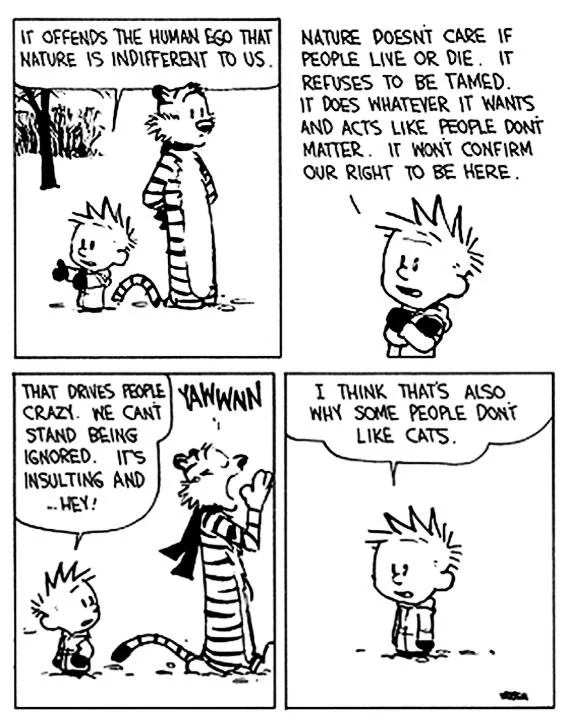
CALVIN: It offends the human ego that nature is indifferent to us. Nature doesn’t care if people live or die. It refuses to be tamed. It does whatever it wants and acts like people don’t matter. It won’t confirm our right to be here. That drives people crazy. We can’t stand being ignored. It’s insulting and … hey!
HOBBES: YAWWNN. [wanders off]
CALVIN: I think that’s also why some people don’t like cats.

Long ago, I made up my mind that, when things were said involving only me, I would pay no attention to them, except when valid criticism was carried by which I could profit.
Eleanor Roosevelt (1884–1962) American politician, diplomat, activist; First Lady of the US (1933–45)
Column (1942-01-14), “My Day”
(Source)

Besides, if a man is afraid of pain, he is afraid of something happening which will be part of the appointed order of things, and this is itself a sin; if he is bent on the pursuit of pleasure, he will not stop at acts of injustice, which again is manifestly sinful. No; when Nature herself makes no distinction — and if she did, she would not have brought pains and pleasures into existence side by side — it behooves those who would follow in her footsteps to be like-minded and exhibit the same indifference.
[ἔτι δὲ ὁ φοβούμενος τοὺς πόνους φοβηθήσεταί ποτε καὶ τῶν ἐσομένων τι ἐν τῷ κόσμῳ, τοῦτο δὲ ἤδη ἀσεβές: ὅ τε διώκων τὰς ἡδονὰς οὐκ ἀφέξεται τοῦ ἀδικεῖν, τοῦτο δὲ ἐναργῶς ἀσεβές: χρὴ δὲ πρὸς ἃ ἡ κοινὴ φύσις ἐπίσης ἔχει ῾οὐ γὰρ ἀμφότερα ἃν ἐποίει, εἰ μὴ πρὸς ἀμφότερα ἐπίσης εἶχἐ, πρὸς ταῦτα καὶ τοὺς τῇ φύσει βουλομένους ἕπεσθαι, ὁμογνώμονας ὄντας, ἐπίσης διακεῖσθαι.]
Marcus Aurelius (AD 121–180) Roman emperor (161–180), Stoic philosopher
Meditations [To Himself; Τὰ εἰς ἑαυτόν], Book 9, ch. 1 (9.1) (AD 161-180) [tr. Staniforth (1964)]
(Source)
(Source (Greek)). Alternate translations:Again, he that feareth pains and crosses in this world, feareth some of those things which some time or other must needs happen in the world. And that we have already showed to be impious. And he that pursueth after pleasures, will not spare, to compass his desires, to do that which is unjust, and that is manifestly impious. Now those things which unto nature are equally indifferent (for she had not created both, both pain and pleasure, if both had not been unto her equally indifferent): they that will live according to nature, must in those things (as being of the same mind and disposition that she is) be as equally indifferent.
[tr. Casaubon (1634)]To go on: He that's afraid of Pain, or Affliction; will be afraid of something that will always be in the World; but to be thus uneasie at the Appointments of Providence, is a failure in Reverence, and Respect. On the other hand; He that's violent in the pursuit of Pleasure, won't stick to turn Villain for the Purchase: And is not this plainly , an Ungracious, and an Ungodly Humour? To set the Matter Right, where the Allowance of God is equally clear; as it is with Regard to Prosperity, and Adversity: For had he not approved both these Conditions, He would never have made them: I say where the Good Liking of Heaven is equally clear, Ours ought to be so too: Because we ought to follow the Guidance of Nature, and the Sense of the Deity.
[tr. Collier (1701)]Besides, he who dreads pain, must sometimes dread that which must be a part of the order and beauty of the universe: this, now, is impious: and, then, he who pursues pleasures will not abstain from injury; and that is manifestly impious. But, in those things to which the common nature is indifferent, (for she had not made both, were she not indifferent to either); he who would follow nature, ought, in this too, to agree with her in his sentiments, and be indifferently dispos'd to either.
[tr. Hutcheson/Moor (1742)]Nay, he that is uneasy under affliction, is uneasy at what must necessarily exist in the world. This uneasiness, then, is a degree of impiety: and he who is too eager in his pursuit of pleasures, will not abstain from injustice to procure them. This is manifestly impious.
In short, as nature herself seems to view with indifference prosperity and adversity, (as she certainly does, or she would not produce them) so he who would follow nature as his guide, ought to do the same.
[tr. Graves (1792)]And further, he who is afraid of pain will sometimes also be afraid of some of the things which will happen in the world, and even this is impiety. And he who pursues pleasure will not abstain from injustice, and this is plainly impiety. Now with respect to the things towards which the universal nature is equally affected -- for it would not have made both, unless it was equally affected towards both -- towards these they who wish to follow nature should be of the same mind with it, and equally affected.
[tr. Long (1862)]Now, he that is afraid of pain will be afraid of something that will always be in the world; but this is a failure in reverence and respect. On the other hand, he that is violent in the pursuit of pleasure, will not hesitate to turn villain for the purchase. And is not this plainly an ungodly act? to set the matter right, where the allowance of God is equally clear, as it is with regard to prosperity and adversity (for had He not approved both of these conditions, He would never have made them both), I say, where the good liking of heaven is equally clear, ours ought to be so too, because we ought to follow the guidance of nature and the sense of the Deity.
[tr. Collier/Zimmern (1887)]Moreover, he who fears pain will some time fear that which will form part of the world-order; and therein he sins. And he who seeks after pleasures will not abstain from unjust doing; which is palpably an act of sin. Where Nature makes no difference -- and were she not indifferent, she would not bring both to pass -- those who would fain walk with Nature should conform their wills to like indifference.
[tr. Rendall (1898)]Again, he who dreads pain must sometimes dread a thing which will make part of the world order, and this is impious. And he who pursues pleasure will not abstain from injustice, and this is clear impiety. In those things to which the common nature is indifferent (for she had not made both, were she not indifferent to either), he who would follow Nature ought, in this also, to be of like mind with her, and shew the like indifference.
[tr. Hutcheson/Chrystal (1902)]Moreover he that dreads pain will some day be in dread of something that must be in the world. And there we have impiety at once. And he that hunts after pleasures will not hold his hand from injustice. And this is palpable impiety.
But those, who are of one mind with Nature and would walk in her ways, must hold a neutral attitude towards those things towards which the Universal Nature is neutral—for she would not be the Maker of both were she not neutral towards both.
[tr. Haines (Loeb) (1916)]He who fears pains will sometimes fear what is to come to pass in the Universe, and this is at once sinful, while he who pursues pleasures will not abstain from doing injustice, and this is plainly sinful. But those who wish to follow Nature, being like-minded with her, must be indifferent towards the things to which she is indifferent, for she would not create both were she not indifferent towards both.
[tr. Farquharson (1944)]And furthermore, one who is afraid of pain is sure to be afraid at times of things which come to pass in the universe, and that is already an impiety; and one that pursues pleasure will not abstain from injustice, and that is manifest impiety. But towards those things with regard to which universal nature is neutral (for she would not have created both opposites unless she was neutral with regard to both), it is necessary that those who wish to follow nature and be of one mind with her should also adopt a neutral attitude.
[tr. Hard (1997 ed.)]And moreover, to fear pain is to fear something that’s bound to happen, the world being what it is -- and that again is blasphemy. While if you pursue pleasure, you can hardly avoid wrongdoing -- which is manifestly blasphemous.
Some things nature is indifferent to; if it privileged one over the other it would hardly have created both. And if we want to follow nature, to be of one mind with it, we need to share its indifference.
[tr. Hays (2003)]Further, anyone who fears pain will also at times be afraid of some future event in the world, and that is immediate sin. And a man who pursues pleasure will not hold back from injustice -- an obvious sin. Those who wish to follow Nature and share her mind must themselves be indifferent to those pairs of opposites to which universal Nature is indifferent -- she would not create these opposites if she were not indifferent either way.
[tr. Hammond (2006)]And furthermore, one who is afraid of pain is sure to be afraid at times of things which come about in the universe, and that is already an impiety; and one who pursues pleasure will not abstain from injustice, and that is a manifest impiety. But towards those things with regard to which universal nature is neutral (for she would not have created both opposites unless she was neutral with regard to both), it is necessary that those who wish to follow nature and be of one mind with her should also adopt a neutral attitude.
[tr. Hard (2011 ed.)]
Patriotism, red hot, is compatible with the existence of a neglect of national interests, a dishonesty, a cold indifference to the suffering of millions. Patriotism is largely pride, and very largely combativeness. Patriotism generally has a chip on its shoulder.
Charlotte Perkins Gilman (1860–1935) American sociologist, writer, reformer, feminist
Herland, ch. 8 (1915)
(Source)

When I learn that husband and wife never quarrel, I know that indifference has set in, and after that — the deluge.
Minna Antrim (1861–1950) American epigrammatist, writer
Naked Truth and Veiled Allusions (1902)
(Source)
King Louis XV of France is attributed with saying, "Après moi, le déluge [After me, the flood]" to Madame Pompadour in 1757.

Thare iz a grate deal ov charity in this world so koldly rendered that it fairly hurts, it iz like lifting a drowning man out ov the water bi the hair ov the hed, and then letting him drop on the ground.
[There is a great deal of charity in this world so coldly rendered that it fairly hurts. It is like lifting a drowning man out of the water by the hair of the head, and then letting him drop on the ground.]Josh Billings (1818–1885) American humorist, aphorist [pseud. of Henry Wheeler Shaw]
Everybody’s Friend, Or; Josh Billing’s Encyclopedia and Proverbial Philosophy of Wit and Humor, ch. 155 “Affurisms: Ink Lings” (1874)
(Source)

“In society,” M… would say, “you have three sorts of friends: those who love you, those who couldn’t care less about you, and those who hate you.”
«Dans le monde, disait M…, vous avez trois sortes d’amis: vos amis qui vous aiment, vos amis qui ne se soucient pas de vous, et vos amis qui vous haïssent.»
Nicolas Chamfort (1741–1794) French writer, epigrammist (b. Nicolas-Sébastien Roch)
Products of Perfected Civilization [Produits de la Civilisation Perfectionnée], Part 2 “Characters and Anecdotes [Caractères et Anecdotes],” ch. 8 (1795) [tr. Parmée (2003), ¶343]
(Source)
(Source (French)). Other translations:“In the world,” remarked some one to me, “you have three kinds of friends: the friends who love you, the friends who do not trouble their heads about you, and the friends who hate you.”
[tr. Hutchinson (1902)]M— said, "In society you have three kinds of friends: your friends who are fond of you, your friends who don’t care either way, and your friends who detest you."
[tr. Merwin (1969)]"In the world," said M..., you have three sorts of friends: the friends who love you; the friends who don't care about you, and the friends who hate you."
[tr. Pearson (1973)]You have three sorts of friend in polite society, M— used to say. Friends who are fond of you; friends who are unconcerned about you; friends who detest you.
[tr. Dusinberre (1992)]"There are three sorts of friends in high society," M— used to say. "Friends who are fond of you, friends who don't care about you, and friends who detest you."
[tr. Dusinberre (1992), "Sampler"]

The biggest threat to our democracy is indifference. The biggest threat to our democracy is cynicism — a cynicism that’s led too many people to turn away from politics and stay home on election day. […] So if you don’t like what’s going on right now — and you shouldn’t — do not complain. Don’t hashtag. Don’t get anxious. Don’t retreat. Don’t binge on whatever it is you’re bingeing on. Don’t lose yourself in ironic detachment. Don’t put your head in the sand. Don’t boo. Vote. You’ve got to vote.
Barack Obama (b. 1961) American politician, US President (2009–2017)
Speech, University of Illinois (7 Sep 2018)
(Source)
Men are accomplices to that which leaves them indifferent.
George Steiner (1929–2020) Franco-American literary critic, philosopher, writer, educator
“A Kind of Survivor” (1965), Language and Silence: Essays 1958-1966 (1967)
(Source)

Indifference is the acid of life. It erodes all the spirit that’s in us and makes us useless to anyone else. We all have to stand for something, or our souls cease to breathe.
Joan D. Chittister (b. 1936) American Benedictine nun, author and lecturer
In a High Spiritual Season (1995)

A certain combination of incompetence and indifference can cause almost as much suffering as the most acute malevolence.
Bruce Catton (1899–1978) American historian and journalist
A Stillness at Appomattox (1953)
(Source)
Regarding prison camps during the US Civil War.

“What is truth?” Sometimes people ask this question because they wish to do nothing. Generic cynicism makes us feel hip and alternative even as we slip along with our fellow citizens into a morass of indifference. It is your ability to discern facts that makes you an individual, and our collective trust in common knowledge that makes us a society.
Timothy Snyder (b. 1969) American historian, author
On Tyranny: Twenty Lessons from the Twentieth Century, ch. 10 (2017)
(Source)

The vanity of man revolts from the serene indifference of the cat.

What makes people hard-hearted is this, that each man has, or thinks he has, as much as he can bear in his own troubles.
[Was die Menschen hartherzig macht, is Dieses, daß jeder an seinen eigenen Plagen genug zu tragen hat, oder doch es meint.]
Arthur Schopenhauer (1788–1860) German philosopher
Parerga and Paralipomena, Vol. 2, ch. 26 “Psychological Observations [Psychologische Bemerkungen],” § 325 (1851) [tr. Saunders (1890)]
(Source)
(Source (German)). Other translation:What makes a man hard-hearted is this, that each man has, or fancies he has, sufficient in his own troubles to bear.
[tr. Dircks]

It may well be that we will have to repent in this generation. Not merely for the vitriolic words and the violent actions of the bad people, but for the appalling silence and indifference of the good people who sit around and say, “Wait on time.”
This cold wilderness was utterly unfamiliar, but it did not feel hostile, just indifferent to her fate. If she fell off this path and was broken into a hundred pieces nothing up here would be one whit interested.
Kerry Greenwood (b. 1954) Australian author and lawyer
Phryne Fisher, Book 5, The Green Mill Murder, ch. 13 (1993)
(Source)

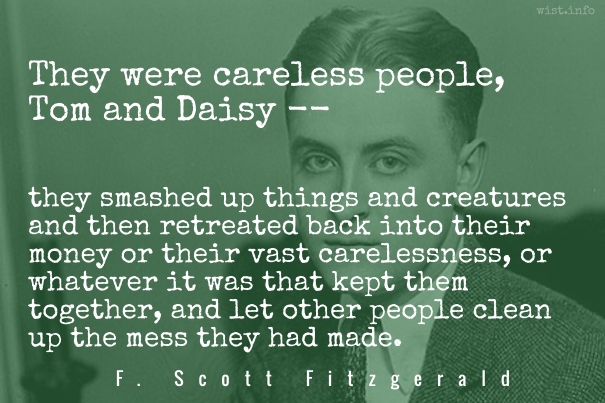
They were careless people, Tom and Daisy — they smashed up things and creatures and then retreated back into their money or their vast carelessness, or whatever it was that kept them together, and let other people clean up the mess they had made.
F. Scott Fitzgerald (1896–1940) American writer [Francis Scott Key Fitzgerald]
The Great Gatsby, ch. 9 (1925)

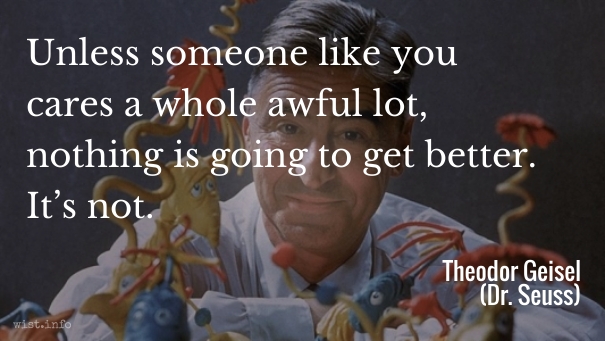
Unless someone like you
cares a whole awful lot,
nothing is going to get better.
It’s not.
Dr. Seuss (1904–1991) American author, illustrator [pseud. of Theodor Geisel]
The Lorax (1971)

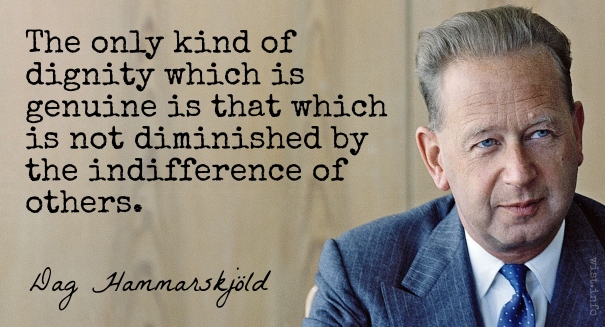
The only kind of dignity which is genuine is that which is not diminished by the indifference of others.
Dag Hammarskjöld (1905–1961) Swedish diplomat, author, UN Secretary-General (1953–61)
Markings (1964)


To me, the democratic system represents man’s best and brightest hope of self-fulfillment, of a life rich in promise and free from fear; the one hope, perhaps, for the complete development of the whole man. But I know, and learn more clearly every day, that we cannot keep our system strong and free by neglect, by taking it for granted, by giving it our second-best attention. We must be prepared, like the suitor in The Merchant of Venice — and, I might point out, the successful suitor — to give and hazard all we have.
Eleanor Roosevelt (1884–1962) American politician, diplomat, activist; First Lady of the US (1933–45)
Essay (1961-04), “What Has Happened to the American Dream?” Atlantic Monthly
(Source)
The death of democracy is not likely to be an assassination from ambush. It will be a slow extinction from apathy, indifference, and undernourishment.
Robert M. Hutchins (1899–1977) American educator and educational philosopher
Great Books: The Foundation of a Liberal Education (1954)
(Source)

It is one of the most difficult yet necessary things in life to learn to disdain. Disdain protects and crushes. It is a breastplate and a club. You have enemies? Why, it is the story of every man who has done a great deed or created a new idea. It is the cloud which thunders around everything, which shines. Fame must have enemies, as light must have gnats. Do not bother yourself about it; disdain. Keep your mind serene as you keep your life clear. Do not give your enemies the satisfaction of thinking that they cause you grief or pain. Be happy, be cheerful, be disdainful, be firm.
[C’est une des choses les plus difficiles et les plus nécessaires de la vie que d’apprendre à dédaigner. Le dédain protège et écrase. C’est une cuirasse et une massue. Vous avez des ennemis? Mais c’est l’histoire de tout homme qui a fait une action grande ou créé une idée neuve. C’est la nuée qui bruit autour de tout ce qui brille. Il faut que la renommée ait des ennemis comme il faut que la lumière ait des moucherons. Ne vous en inquiétez pas; dédaignez! Ayez la sérénité dans votre esprit comme vous avez la limpidité dans votre vie. Ne donnez pas à vos ennemis cette joie de penser qu’ils vous affligent et qu’ils vous troublent. Soyez content, soyez joyeux, soyez dédaigneux, soyez fort.]
Victor Hugo (1802–1885) French writer, journalist, human rights activist, politician
Diary (1845-12-07), “Villemain,” Things Seen [Choses Vues], Vol. 1 (1887)
(Source)
Dictated 1845-12-03 by Hugo to Juliette Drouet.
Sometimes attributed (in a shortened form) to Winston Churchill.
(Source (French)). Another translation:One of the hardest and most important things in life is learning to treat things with disdain. Disdain can protect, it can crush; it’s a breastplate and a club. You’ve got enemies? Why, that’s the story of every man who has done a great deed or come up with a new idea. It’s the thundercloud around everything that shines. Fame will attract enemies just as light will attract insects. Don’t fret about it. Treat it with disdain. Keep your mind calm, just as you keep your life clean. Don’t give your enemies the satisfaction of thinking that they’re hurting you and upsetting you. Be happy and cheerful and disdainful and strong.
[tr. Blackmore (2004)]

… the strange interdependence between thoughtlessness and evil ….
Hannah Arendt (1906–1975) German-American philosopher, political theorist
Eichmann in Jerusalem: A Report on the Banality of Evil, Postscript (1963)
(Source)

Indifference, to me, is the epitome of evil.
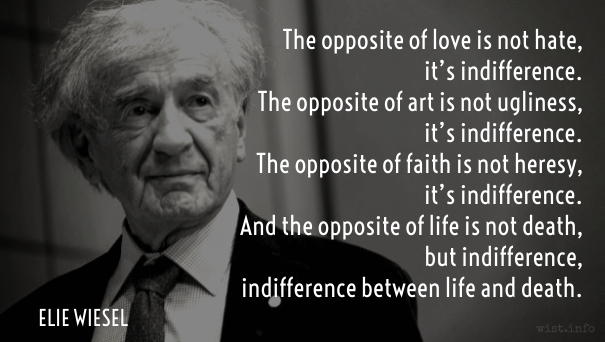
The opposite of love is not hate, it’s indifference.
The opposite of art is not ugliness, it’s indifference.
The opposite of faith is not heresy, it’s indifference.
And the opposite of life is not death, but indifference,
indifference between life and death.
Elie Wiesel (1928–2016) Romanian-American novelist, professor, political activist, Nobel Laureate.
“One Must Not Forget,” interview by Alvin P. Sanoff, US News & World Report (27 Oct 1986)
See also Nietzsche.

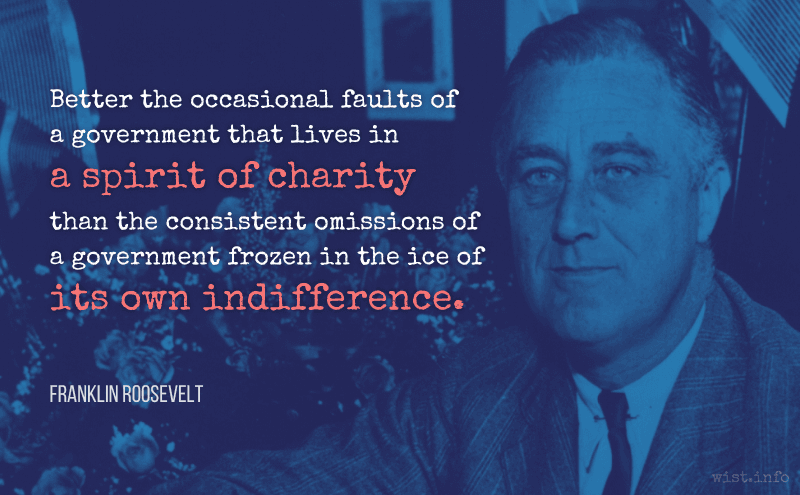
Governments can err, presidents do make mistakes, but the immortal Dante tells us that Divine justice weighs the sins of the cold-blooded and the sins of the warm-hearted on different scales. Better the occasional faults of a government that lives in a spirit of charity than the consistent omissions of a government frozen in the ice of its own indifference.
Franklin Delano Roosevelt (1882–1945) American lawyer, politician, statesman; US President (1933–45)
Speech (1936-06-27), Acceptance, Renomination for President, Democratic National Convention, Philadelphia
(Source)
(Source (Audio), 10:40)
We will have to repent in this generation not merely for the vitriolic words and actions of the bad people, but for the appalling silence of the good people. We must come to see that human progress never rolls in on wheels of inevitability. It comes through the tireless efforts and persistent work of men willing to be co-workers with God, and without this hard work time itself becomes an ally of the forces of social stagnation. We must use time creatively, and forever realize that the time is always ripe to do right.
Martin Luther King, Jr. (1929–1968) American clergyman, civil rights leader, social activist, preacher
Letter from Birmingham Jail (16 Apr 1963)
(Source)
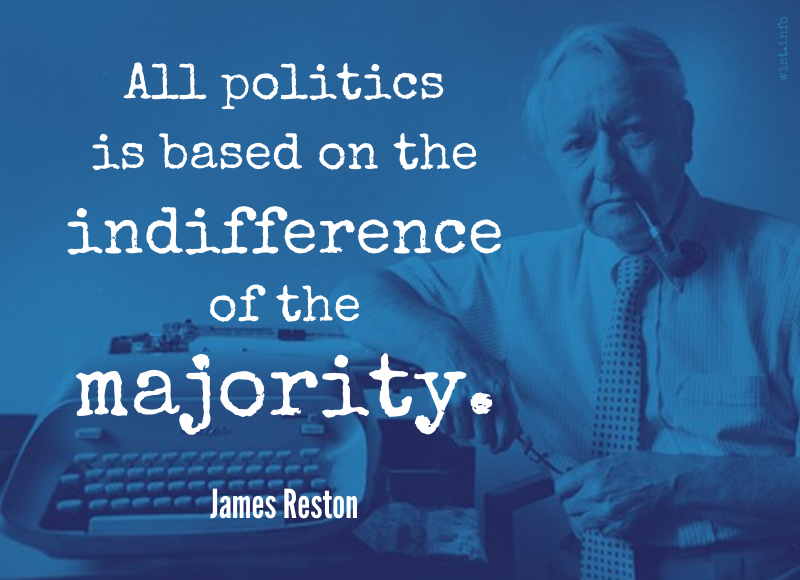
All politics is based on the indifference of the majority.
James "Scotty" Reston (1909–1995) Scottish-American journalist and editor
“New York: Rockefeller Comes Out of His Trance,” New York Times (12 Jun 1968)
(Source)
This is cited in multiple places to this 1968 op-ed, to which I don't have access. Reston also used the phrase in this 1972 op-ed.

A kingdom is not brought nearer to ruin by the tyranny of the sovereign than is a republic by indifference to the common welfare.
[La tyrannie d’un prince ne met pas un État plus près de sa ruine que l’indifférence pour le bien commun n’y met une république.]
Charles-Lewis de Secondat, Baron de Montesquieu (1689–1755) French political philosopher
Considerations on the Causes of the Greatness of the Romans and their Decline [Considérations sur les causes de la grandeur des Romains et de leur décadence], ch. 4 (1734, 1748 ed.) [tr. Baker (1882)]
(Source)
(Source (French)). Other translations:A monarchy is not dragged nearer to the brink of ruin by the tyranny of a prince, than a commonwealth by a lukewarmness and indifference for the general good.
[tr. B--- (1734)]The tyranny of a prince in an oligarchy is not so dangerous to the public welfare as the apathy of a citizen in a democracy.
[E.g. (1926)]The tyranny of a prince does no more to ruin a state than does indifference to the common good to ruin a republic.
[tr. Lowenthal (1965)]
Hate is not the opposite of love; apathy is.