People think that professional soldiers think a lot about fighting, but serious professional soldiers think a lot more about food and a warm place to sleep, because these are two things that are generally hard to get, whereas fighting tends to turn up all the time.
Quotations about:
priorities
Note not all quotations have been tagged, so Search may find additional quotes on this topic.

CALVIN: Miss Wormwood, I have a question about this math lesson.
TEACHER: Yes?
CALVIN: Given that, sooner or later, we’re all just going to die, what’s the point of learning about integers?
TEACHER: Turn to page 83, class.
CALVIN: (sulking) Nobody likes us “big picture” people.


My friend, there will come one day to you a Messenger, whom you cannot treat with contempt. He will say, “Come with me;” and all your pleas of business cares and earthly loves will be of no avail. When his cold hand touches yours, the key of the counting-room will drop forever, and he will lead you away from all your investments, your speculations, your bank-notes and real estate, and with him you will pass into eternity, up to the bar of God. You will not be too busy to die.
Abbott Eliot "A. E." Kittredge (1834–1912) American clergyman and Presbyterian leader
(Attributed)
(Source)
In Josiah Hotchkiss Gilbert (ed.), Burning Words of Brilliant Writers (1883). I could not find any primary source that Gilbert borrowed from.

But don’t all things,
virtue, a good name, honor, all that’s human and divine,
obey money, lovely money?[Omnis enim res,
Virtus, fama, decus, divina, humanaque pulchris
Divitiis parent.]Horace (65–8 BC) Roman poet, satirist, soldier, politician [Quintus Horatius Flaccus]
Satires [Saturae, Sermones], Book 2, # 3 “Si raro scribes,” l. 94ff (2.3.94-96) (30 BC) [tr. Fuchs (1977)]
(Source)
Damasippus (quoting the Stoic philosopher Stertinius?) on the mindset of a miser.
(Source (Latin)). Alternate translations:For all and every thinge (quod he) vertue, renoumne, and fame,
The corpes, the goste, dothe crouch to coyne and serue vnto the same.
[tr. Drant (1567)]For every thing divine and humane to
Virtue, wit, comeliness and honour do
Submit their Necks to riches splendid sway,
[tr. A. B.; ed. Brome (1666)]For Honor, Vertue, Fame, and all Divine
And Humane Things must follow lovely Coin.
[tr. Creech (1684)]For virtue, glory, beauty, all divine
And human powers, immortal gold! are thine.
[tr. Francis (1747)]All things in his esteem -- fame, virtue, health,
Human and heavenly -- bow to blessed wealth.
[tr. Howes (1845)]For every thing, virtue, fame, glory, divine and human affairs, are subservient to the attraction of riches.
[tr. Smart/Buckley (1853)]For merit, fame,
and glory, all things human and divine bow
low before fair Money's power.
[tr. Millington (1870)]For all things human and divine, renown,
Honour, and worth at money's shrine bow down.
[tr. Conington (1874)]Riches, you know, are the beautiful things: everything else, worth, repute, honour, things divine and things human, bow down to them.
[tr. Wickham (1903)]For all things — worth, repute, honour, things divine and human — are slaves to the beauty of wealth.
[tr. Fairclough (Loeb) (1926)]Everything else is the slave of gorgeous wealth:
Virtue, renown, moral dignity, all thing divine
And human.
[tr. Palmer Bovie (1959)]Virtue, fame, honor -- everything human,
Everything divine, is illuminated by money, shines only (to his mind)
In the beauty and glow of wealth.
[tr. Raffel (1983)]In fact,
everything -- virtue, a good name,
honor, human and divine values --
all bowed down to the beauty of riches.
[tr. Alexander (1999)]The fact is that goodness,
honour, reputation -- everything human and divine -- gives way
to the charm of money.
[tr. Rudd (2005 ed.)]He thought all things,
Virtue, reputation, honour, things human or divine
Bowed to the glory of riches.
[tr. Kline (2015)]
I have admitted that there are very few women who would put their job before every earthly consideration. I will go further and assert that there are very few men who would do it either. In fact, there is perhaps only one human being in a thousand who is passionately interested in his job for the job’s sake. The difference is that if that one person in a thousand is a man, we say, simply, that he is passionately keen on his job; if she is a woman, we say she is a freak.
Dorothy Sayers (1893–1957) English author, translator
“Are Women Human?” speech to a Women’s Society (1938)
(Source)
Collected in Unpopular Opinions (1946).

Indeed, it is easier for a camel to go through the eye of a needle than for someone who is rich to enter the kingdom of God.
[εὐκοπώτερον γάρ ἐστιν κάμηλον διὰ τρήματος βελόνης εἰσελθεῖν ἢ πλούσιον εἰς τὴν βασιλείαν τοῦ θεοῦ εἰσελθεῖν.]
The Bible (The New Testament) (AD 1st - 2nd C) Christian sacred scripture
Book 3. Gospel of Luke 18:25 (Luke 18:25) (Jesus) [NRSV (2021 ed.)]
(Source)
This passage is paralleled in Matthew 19:23 and Mark 10:23. Only Luke uses the camel/needle metaphor.
(Source (Greek)). Other translations:For it is easier for a camel to go through a needle’s eye, than for a rich man to enter into the kingdom of God.
[KJV (1611)]Yes, it is easier for a camel to pass through the eye of a needle than for a rich man to enter the kingdom of God.
[JB (1966)]It is much harder for a rich person to enter the Kingdom of God than for a camel to go through the eye of a needle.
[GNT (1976)]Yes, it is easier for a camel to pass through the eye of a needle than for someone rich to enter the kingdom of God.
[NJB (1985)]It’s easier for a camel to squeeze through the eye of a needle than for a rich person to enter God’s kingdom.
[CEB (2011)]

THE DOCTOR: Listen, listen, gotta dash. Things happening. Well, four things. Well, four things and a lizard.
Doctor Who (2005-Present) British science fiction television series, revival (BBC)
03×10 “Blink” (2007-06-09) [w. Steven Moffat]
(Source)

Man never gives up his desire for gain and aggrandizement; as death draws near, a prey to bile, with withered face and palsied legs, he will speak of my fortune, my situation.
[L’on ne se rend point sur le désir de posséder et de s’agrandir: la bile gagne, et la mort approche, qu’avec un visage flétri, et des jambes déjà faibles, l’on dit: ma fortune, mon établissement.]Jean de La Bruyère (1645–1696) French essayist, moralist
The Characters [Les Caractères], ch. 6 “Of Gifts of Fortune [Des Biens de Fortune],” § 51 (6.51) (1688) [tr. Stewart (1970)]
(Source)
(Source (French)). Other translations:There is no end to a Man's desire of growing rich and great; when the Cough seizes him, when Death approaches, his Face shrivel'd, and his Legs weak, he cries, My Fortune, my Establishment.
[Bullord ed. (1696)]There is no end to a Man's Desire of growing rich and great; the Cough seizes him, Death approaches, his Face is shrivel'd, and his Legs weak, yet he cries, My Fortune, my Preferment.
[Curll ed. (1713)]There is no end of desiring Riches and Grandeur; before the Rattle seizes him, and Death approaches, though his Face be shriveled, and his Legs totter, yet he is ever talking of, my Fortune, my Preferment.
[Browne ed. (1752)]All that a man wishes for is riches and grandeur; he falls very ill, and death draws near, and though his face be shrivelled and his legs totter, yet he is still talking of his fortune and his post.
[tr. Van Laun (1885)]

A society which reverences the attainment of riches as the supreme felicity will naturally be disposed to regard the poor as damned in the next world, if only to justify making their life a hell in this.
R. H. Tawney (1880–1962) English writer, economist, historian, social critic [Richard Henry Tawney]
Religion and the Rise of Capitalism, ch. 4: The Puritan Movement, sec. 4 “The New Medicine for Poverty” (1926)
(Source)
Originally delivered as Holland Lectures, Kings College (Feb-Mar 1922).
Depend upon it, as long as the church is living so much like the world, we cannot expect our children to be brought into the fold.
Dwight Lyman "D. L." Moody (1837–1899) American evangelist and publisher
God’s Good News, “Where Art Thou?” [Gen. 3:9] (1897)
(Source)
No man ever stood the lower in my estimation for having a patch in his clothes; yet I am sure that there is greater anxiety, commonly, to have fashionable, or at least clean and unpatched clothes, than to have a sound conscience.
Henry David Thoreau (1817–1862) American philosopher and writer
Walden; or, Life in the Woods, ch. 1 “Economy” (1854)
(Source)
The choicest garb, the sweetest grace,
Are oft to strangers shown;
The careless mien, the frowning face,
Are given to our own.
We flatter those we scarcely know,
We please the fleeting guest,
And deal full many a thoughtless blow
To those who love us best.Ella Wheeler Wilcox (1850–1919) American author, poet, temperance advocate, spiritualist
Poem (1896-10), “Life’s Scars,” st. 3, Frank Leslie’s Popular Monthly, Vol. 42, No. 4
(Source)
Originally published in Frank Leslie's Popular Monthly, Vol. 42, #4 (1896-10)

The older I get, the more wisdom I find in the ancient rule of taking first things first — a process which often reduces the most complex human problems to manageable proportions.
Dwight David Eisenhower (1890–1969) American general, US President (1953–61)
“Let’s Be Honest with Ourselves,” Reader’s Digest (Dec 1963)
The advice of a father to his son “Beware of entrance to a quarrel, but being in, bear it that the opposed may beware of thee,” is good, and yet not the best. Quarrel not at all. No man resolved to make the most of himself can spare time for personal contention. Still less can he afford to take all the consequences, including the vitiating of his temper and loss of self control. Yield larger things to which you can show no more than equal right; and yield lesser ones, though clearly your own. Better give your path to a dog than be bitten by him in contesting for the right. Even killing the dog would not cure the bite.

A century from now, nobody will know which way I drove to work, but that doesn’t mean I don’t have to keep my eyes on the road.
Graham Ericsson (b. 1961) American technologist, writer, aphorist
Journal (2012-03-21)

National budgets are a nation’s theology walking.
Joan D. Chittister (b. 1936) American Benedictine nun, author and lecturer
“From Where I Stand,” column, National Catholic Reporter (17 Feb 2005)
(Source)

Every gun that is made, every warship launched, every rocket fired signifies, in the final sense, a theft from those who hunger and are not fed, those who are cold and are not clothed. This world in arms is not spending money alone. It is spending the sweat of its laborers, the genius of its scientists, the hopes of its children.
The cost of one modern heavy bomber is this: a modern brick school in more than 30 cities. It is two electric power plants, each serving a town of 60,000 population. It is two fine, fully equipped hospitals. It is some 50 miles of concrete highway. We pay for a single fighter with a half million bushels of wheat. We pay for a single destroyer with new homes that could have housed more than 8,000 people.
This, I repeat, is the best way of life to be found on the road the world has been taking. This is not a way of life at all, in any true sense. Under the cloud of threatening war, it is humanity hanging from a cross of iron.Dwight David Eisenhower (1890–1969) American general, US President (1953–61)
Speech (1953-04-16), “The Chance for Peace,” American Society of Newspaper Editors, Hotel Statler, New York City
(Source)
Describing the cost of the Cold War. Also known as the "Cross of Iron" speech, it was delivered shortly into his presidency and just after Stalin's death.
CALVIN: I say, if your knees aren’t green by the end of the day, you ought to seriously re-examine your life.

I hate the idea of causes, and if I had to choose between betraying my country and betraying my friend, I hope I should have the guts to betray my country.
E. M. Forster (1879–1970) English novelist, essayist, critic, librettist [Edward Morgan Forster]
“What I Believe,” The Nation (16 Jul 1938)
(Source)
Sometimes misquoted as: "If I had to choose between betraying my country and betraying my friend, I hope I should have the decency to betray my country."
One of the symptoms of approaching nervous break-down is the belief that one’s work is terribly important, and that to take a holiday would bring all kinds of disaster.
Bertrand Russell (1872–1970) English mathematician and philosopher
Conquest of Happiness, Part 1, ch. 5 “Fatigue” (1930)
(Source)

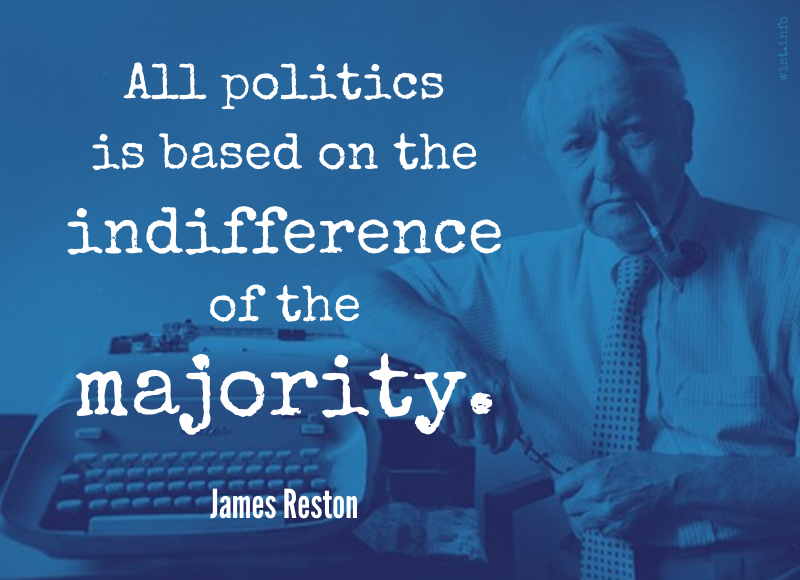
All politics is based on the indifference of the majority.
James "Scotty" Reston (1909–1995) Scottish-American journalist and editor
“New York: Rockefeller Comes Out of His Trance,” New York Times (12 Jun 1968)
(Source)
This is cited in multiple places to this 1968 op-ed, to which I don't have access. Reston also used the phrase in this 1972 op-ed.

Life is not so short but that there is always time enough for courtesy.
Ralph Waldo Emerson (1803–1882) American essayist, lecturer, poet
“Social Aims,” lecture, Boston (1864-12-04), Letters and Social Aims (1875)