The fact is, my sweet, every mother spends her time, so soon as her children are out of her sight, in imagining dangers for them. Perhaps it is Armand seizing the razors to play with, or his coat taking fire, or a snake biting him, or he might tumble in running and start and absess on his head, or he might drown himself in a pond. A mother’s life, you see, is one long succession of dramas, now soft and tender, now terrible. Not an hour but has its joys and fears.
[En effet, mon ange, durant le jour, toutes les mères inventent des dangers. Dès que les enfants ne sont plus sous leurs yeux, c’est des rasoirs volés avec lesquels Armand a voulu jouer, le feu qui prend à sa jaquette, un orvet qui peut le mordre, une chute en courant qui peut faire un dépôt à la tête, ou les bassins où il peut se noyer. Comme tu le vois, la maternité comporte une suite de poésies douces ou terribles. Pas une heure qui n’ait ses joies et ses craintes.]
Honoré de Balzac (1799–1850) French novelist, playwright
Letters of Two Brides [Mémoires de deux jeunes mariées], Part 1, letter 45 (1840) [tr. Scott (1897)]
(Source)
(Source (French)). Other translation:To tell the truth, my dearest, during the daytime all mothers invent dangers as soon as the children are out of sight. There are razors for Armand to play with, fire to catch his jacket, a slow-worm to bite him, a fall to bump his head, and ponds to tumble into. So you see that maternity is a series of poems, sweet or terrible as the case may be. There's not an hour which does not have its joys and fears.
[tr. Wormeley (1842), Memoirs of Two Young Married Women]
Quotations about:
catastrophizing
Note not all quotations have been tagged, so Search may find additional quotes on this topic.

If evils come not, then our fears are vain:
And if they do, Fear but augments the pain.Benjamin Franklin (1706–1790) American statesman, scientist, philosopher, aphorist
Poor Richard (1741 ed.)
(Source)

“Supposing a tree fell down, Pooh, when we were underneath it?”
“Supposing it didn’t,” said Pooh after careful thought.
Piglet was comforted by this.A. A. Milne (1882–1956) English poet and playwright [Alan Alexander Milne]
House at Pooh Corner, ch. 8 “Piglet Does a Very Grand Thing” (1928)
(Source)

I define anxiety as experiencing failure in advance.

Don’t panic. Midway through writing a novel, I have regularly experienced moments of bowel-curdling terror, as I contemplate the drivel on the screen before me and see beyond it, in quick succession, the derisive reviews, the friends’ embarrassment, the failing career, the dwindling income, the repossessed house, the divorce … Working doggedly on through crises like these, however, has always got me there in the end. Leaving the desk for a while can help. Talking the problem through can help me recall what I was trying to achieve before I got stuck. Going for a long walk almost always gets me thinking about my manuscript in a slightly new way. And if all else fails, there’s prayer. St Francis de Sales, the patron saint of writers, has often helped me out in a crisis. If you want to spread your net more widely, you could try appealing to Calliope, the muse of epic poetry, too.
Sarah Waters (b. 1966) Welsh novelist
In “Ten Rules for Writing Fiction,” The Guardian (20 Feb 2010)
(Source)

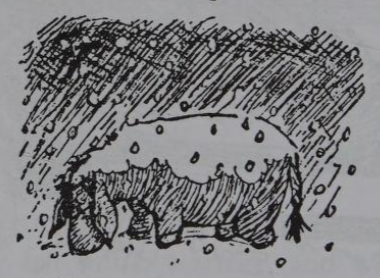
“It’s snowing still,” said Eeyore gloomily.
“So it is.”
“And freezing.”
“Is it?”
“Yes,” said Eeyore. “However,” he said, brightening up a little, “we haven’t had an earthquake lately.”A. A. Milne (1882–1956) English poet and playwright [Alan Alexander Milne]
House at Pooh Corner, ch. 1 “A House Is Built at Pooh Corner” (1928)
(Source)
Eeyore and Christopher Robin.
One of the symptoms of approaching nervous break-down is the belief that one’s work is terribly important, and that to take a holiday would bring all kinds of disaster.
Bertrand Russell (1872–1970) English mathematician and philosopher
Conquest of Happiness, Part 1, ch. 5 “Fatigue” (1930)
(Source)