The wicked flee when no man pursueth ….
נָ֣סוּ וְאֵין־רֹדֵ֣ף רָשָׁ֑ע
The Bible (The Old Testament) (14th - 2nd C BC) Judeo-Christian sacred scripture [Tanakh, Hebrew Bible], incl. the Apocrypha (Deuterocanonicals)
Book 20. Proverbs 28: 1 (Prov 28:1) [tr. KJV (1611)]
(Source)
(Source (Hebrew)). Other translations:The wicked man flees when no one is after him ....
[JB (1966)]The wicked flees when no one is pursuing ....
[NJB (1985)]The wicked run when no one is chasing them ....
[GNT (1992 ed.)]The wicked run away even though no one pursues them ....
[CEB (2011)]The wicked flee when no one pursues ....
[NRSV (2021 ed.)]A wicked person flees though no one gives chase ....
[RJPS (2023 ed.)]
Quotations about:
paranoia
Note not all quotations have been tagged, so Search may find additional quotes on this topic.

The nation that complacently and fearfully allows its artists and writers to become suspected rather than respected is no longer regarded as a nation possessed with humor or depth.
James Thurber (1894–1961) American humorist, cartoonist, writer
Essay (1958-12-07), “State of the Nation’s Humor: ‘On the Brink of Was,'” New York Times Magazine
(Source)
The fact is, my sweet, every mother spends her time, so soon as her children are out of her sight, in imagining dangers for them. Perhaps it is Armand seizing the razors to play with, or his coat taking fire, or a snake biting him, or he might tumble in running and start and absess on his head, or he might drown himself in a pond. A mother’s life, you see, is one long succession of dramas, now soft and tender, now terrible. Not an hour but has its joys and fears.
[En effet, mon ange, durant le jour, toutes les mères inventent des dangers. Dès que les enfants ne sont plus sous leurs yeux, c’est des rasoirs volés avec lesquels Armand a voulu jouer, le feu qui prend à sa jaquette, un orvet qui peut le mordre, une chute en courant qui peut faire un dépôt à la tête, ou les bassins où il peut se noyer. Comme tu le vois, la maternité comporte une suite de poésies douces ou terribles. Pas une heure qui n’ait ses joies et ses craintes.]
Honoré de Balzac (1799–1850) French novelist, playwright
Letters of Two Brides [Mémoires de deux jeunes mariées], Part 1, letter 45 (1840) [tr. Scott (1897)]
(Source)
(Source (French)). Other translation:To tell the truth, my dearest, during the daytime all mothers invent dangers as soon as the children are out of sight. There are razors for Armand to play with, fire to catch his jacket, a slow-worm to bite him, a fall to bump his head, and ponds to tumble into. So you see that maternity is a series of poems, sweet or terrible as the case may be. There's not an hour which does not have its joys and fears.
[tr. Wormeley (1842), Memoirs of Two Young Married Women]
Men are not against you, they are merely for themselves.
Gene Fowler (1890–1960) American journalist, author, and dramatist. [b. Eugene Devlan]
Skyline: A Reporter’s Reminiscence of the 1920s, ch. 8 (1961)
(Source)
These illustrations suggest four general maxims, which will prove an adequate preventative of persecution mania if their truth is sufficiently realized. The first is: remember that your motives are not always as altruistic as they seem to yourself. The second is: Don’t overestimate your own merits. The third is: don’t expect others to take as much interest in you as you do yourself. And the fourth is: don’t imagine that most people give enough thought to you to have any desire to persecute you.
Bertrand Russell (1872–1970) English mathematician and philosopher
Conquest of Happiness, Part 1, ch. 8 “Persecution Mania” (1930)
(Source)
And now, ladies and gentlemen, that we’ve enjoyed some good times this evening, and enjoyed some laughter together, I feel it is my obligation to remind you of some of the negative, depressing, dangerous, life-threatening things that life is really all about; things you have not been thinking about tonight, but which will be waiting for you as soon as you leave the theater or as soon as you turn off your television sets. Anal rape, quicksand, body lice, evil spirits, gridlock, acid rain, continental drift, labor violence, flash floods, rabies, torture, bad luck, calcium deficiency, falling rocks, cattle stampedes, bank failure, evil neighbors, killer bees, organ rejection, lynching, toxic waste, unstable dynamite, religious fanatics, prickly heat, price fixing, moral decay, hotel fires, loss of face, stink bombs, bubonic plague, neo-Nazis, friction, cereal weevils, failure of will, chain reaction, soil erosion, mail fraud, dry rot, voodoo curse, broken glass, snake bite, parasites, white slavery, public ridicule, faithless friends, random violence, breach of contract, family scandals, charlatans, transverse myelitis, structural defects, race riots, sunspots, rogue elephants, wax buildup, killer frost, jealous coworkers, root canals, metal fatigue, corporal punishment, sneak attacks, peer pressure, vigilantes, birth defects, false advertising, ungrateful children, financial ruin, mildew, loss of privileges, bad drugs, ill-fitting shoes, widespread chaos, Lou Gehrig’s disease, stray bullets, runaway trains, chemical spills, locusts, airline food, shipwrecks, prowlers, bathtub accidents, faulty merchandise, terrorism, discrimination, wrongful cremation, carbon deposits, beef tapeworm, taxation without representation, escaped maniacs, sunburn, abandonment, threatening letters, entropy, nine-mile fever, poor workmanship, absentee landlords, solitary confinement, depletion of the ozone layer, unworthiness, intestinal bleeding, defrocked priests, loss of equilibrium, disgruntled employees, global warming, card sharks, poisoned meat, nuclear accidents, broken promises, contamination of the water supply, obscene phone calls, nuclear winter, wayward girls, mutual assured destruction, rampaging moose, the greenhouse effect, cluster headaches, social isolation, Dutch elm disease, the contraction of the universe, paper cuts, eternal damnation, the wrath of God, and PARANOIA!!
George Carlin (1937–2008) American comedian
Show (1986-05-02/03), Playin’ with Your Head, “Things to Watch Out For,” Beverly Theater, Los Angeles
(Source)
KING HENRY: Gives not the hawthorn bush a sweeter shade
To shepherds looking on their silly sheep
Than doth a rich embroidered canopy
To kings that fear their subjects’ treachery?William Shakespeare (1564–1616) English dramatist and poet
Henry VI, Part 3, Act 3, sc. 5, l. 42ff (3.5.42-45) (1591)
(Source)

But to go mad with watching, nights and days,
To stand in dread of thieves, fires, runaways
Who filch and fly, — in these if wealth consist,
Let me rank lowest on the paupers’ list.[An vigilare metu exanimem, noctesque diesque
formidare malos fures, incendia, servos,
ne te conpilent fugientes, hoc iuvat? Horum
semper ego optarim pauperrimus esse bonorum.]Horace (65–8 BC) Roman poet, satirist, soldier, politician [Quintus Horatius Flaccus]
Satires [Saturae, Sermones], Book 1, # 1 “Qui fit, Mæcenas,” l. 76ff (1.1.76-79) (35 BC) [tr. Conington (1874)]
(Source)
(Source (Latin)). Other translations:To wake all nyghte with shiveryng corpse, both nighte and day to quake,
To sit in dreade, and stande in awe of theeves, leste they should breake
Perforce thy dores, and robb thy chests, and carve thy weasaunte pype:
Leste flickeryng fyer should stroye thy denne, and sease with wastefull grype
Uppon thyne house, leste runagats should pilfer ought from thee,
Be these thy gaines, by rytches repte? then this beheste to me
O Iove betake, that I may be devoyde of all those gooddes
That brews such baneful broyles, or brings of feare suche gastfull fluddes.
[tr. Drant (1567)]To sit up and to watch whole dayes and nights,
To be out of thy wits with constant frights,
To fear that thieves will steal, or fire destroy,
Or servants take thy wealth, and run away.
Is this delightful to thee? then I will
Desire to live without those Riches still.
[tr. A. B.; ed. Brome (1666)]But now to watch all day, and wake all night,
Fear Thieves and Fire, and be in constant fright,
If These are Goods, if these are a delight:
I am content, Heavens grant me sleep and ease,
If These are Goods, I would be poor of These.
[tr. Creech (1684)]But, with continual watching almost dead,
House-breaking thieves, and midnight fires to dread,
Or the suspected slave's untimely flight
With the dear pelf; if this be thy delight,
Be it my fate, so heaven in bounty please,
Still to be poor of blessings such as these!
[tr. Francis (1747)]But what are your indulgencies? All day,
All night, to watch and shudder with dismay,
Lest ruffians fire your house, or slaves by stealth
Rifle your coffers, and abstract your wealth?
If this be affluence -- this her boasted fruit,
Of all such joys may I live destitute!
[tr. Howes (1845)]What, to watch half dead with terror, night and day, to dread profligate thieves, fire, and your slaves, lest they should run away and plunder you; is this delightful? I should always wish to be very poor in possessions held upon these terms.
[tr. Smart/Buckley (1853)]Or, pray, is this your joy? To dread thieves' villainy, the firing of your house, or lest your slaves should steal your stores and run away? I'd ever pray to be extremely poor in blessings such as these.
[tr. Millington (1870)]What, to lie awake half-dead with fear, to be in terror night and day of wicked thieves, of fire, of slaves, who may rob you and run away -- is this so pleasant? In such blessings I could wish ever to be poorest of the poor.
[tr. Fairclough (Loeb) (1926)]Would you rather stand guard, half-dead with fright, and tremble
Day and night over sneak thieves, fire, or slaves
Running off with your loot? If this craven type seems to lead
The more abundant life, I prefer to be poor.
[tr. Palmer Bovie (1959)]Staying awake half-dead with terror, living night and day
in fear of ogreish theives, of fires, of slaves who might
rob you as they run away -- you like this life? Of such
advantages I hope I'll always be thoroughly deprived.
[tr. Fuchs (1977)]Is it pleasant, lying half dead with fear,
Day and night dreading thieves, and fire, and slaves
Who might rob you and run? With wealth
Like that, I'd choose to be poorer than poor!
[tr. Raffel (1983)]Half dead with fear,
night and day sitting vigil on your loot
to frighten off wicked thieves, arsonists,
slaves fleeing after having robbed you.
Does that please you? Of such benefits
I would always prefer to be most poor.
[tr. Alexander (1999)]Instead, you lie awake in bed half-dead and stiff
as a plank from fear of broad-daylight thieves,
dead-if-night thieves, fire, vengeful and fleeing slaves --
is this the bounty you foreswore pleasure for?
If so, let me be poorest of the poor.
[tr. Matthews (2002)]Or maybe you prefer to lie awake half dead with fright,
to spend your days and nights in dread of burglars or fire
or your own slaves, who may fleece you and then disappear? For myself,
I think I can always do without blessing like those!
[tr. Rudd (2005 ed.)]Does it give you pleasure to lie awake half dead of fright,
Terrified night and day of thieves or fire or slaves who rob
You of what you have, and run away? I’d always wish
To be poorest of the poor when it comes to such blessings.
[tr. Kline (2015)]
MORE: (looks at him: takes him aside: lowered voice) Have I your word, that what we say here is between us and has no existence beyond these walls?
NORFOLK: (impatient) Very well.
MORE: (almost whispering) And if the King should command you to repeat what I have said?
NORFOLK: I should keep my word to you!
MORE: Then what has become of your oath of obedience to the King?
NORFOLK: (indignant) You lay traps for me!
MORE: (now grown calm) No, I show you the times.
Robert Bolt (1924–1995) English dramatist
A Man for All Seasons, play, Act 1 (1960)
(Source)
In Bolt's 1966 film adaptation, this is slightly shortened:MORE: (arrests him; makes a display of looking about, conspiratorial) Have I your word that what we say here is between us two?
NORFOLK: (impatient) Very well.
MORE: And if the King should command you to repeat what I may say?
NORFOLK: I should keep my word to you!
MORE: Then what has become of your oath of obedience to the King?
NORFOLK: (sorts this out; then, astounded) You lay traps for me!
MORE: No, I show you the times.
The Rich knowes not who is his friend.
George Herbert (1593–1633) Welsh priest, orator, poet.
Jacula Prudentum, or Outlandish Proverbs, Sentences, &c. (compiler), # 865 (1640 ed.)
(Source)
PERICLES: I knew him tyrannous, and tyrants’ fears
Decrease not but grow faster than the years.William Shakespeare (1564–1616) English dramatist and poet
Pericles, Act 1, sc. 2, l. 91ff (1.2.91-92) (1607) [with George Wilkins]
(Source)
Any historian of warfare knows it is in good part a comedy of errors and a museum of incompetence; but if for every error and every act of incompetence one can substitute an act of treason, many points of fascinating interpretation are open to the paranoid imagination. In the end, the real mystery, for one who reads the primary works of paranoid scholarship, is not how the United States has been brought to its present dangerous position but how it has managed to survive at all.
We are all sufferers from history, but the paranoid is a double sufferer, since he is afflicted not only by the real world, with the rest of us, but by his fantasies as well.
But the modern right wing, as Daniel Bell has put it, feels dispossessed: America has been largely taken away from them and their kind, though they are determined to try to repossess it and to prevent the final destructive act of subversion. The old American virtues have already been eaten away by cosmopolitans and intellectuals; the old competitive capitalism has been gradually undermined by socialistic and communistic schemers; the old national security and independence have been destroyed by treasonous plots, having as their most powerful agents not merely outsiders and foreigners as of old but major statesmen who are at the very centers of American power. Their predecessors had discovered conspiracies; the modern radical right finds conspiracy to be betrayal from on high.
Richard Hofstadter (1916–1970) American historian and intellectual
“The Paranoid Style in American Politics,” Herbert Spencer Lecture, Oxford (Nov 1963)
(Source)
Reprinted in Harpers (Nov 1964).
The enemy is clearly delineated: he is a perfect model of malice, a kind of amoral superman—sinister, ubiquitous, powerful, cruel, sensual, luxury-loving. Unlike the rest of us, the enemy is not caught in the toils of the vast mechanism of history, himself a victim of his past, his desires, his limitations. He wills, indeed he manufactures, the mechanism of history, or tries to deflect the normal course of history in an evil way. He makes crises, starts runs on banks, causes depressions, manufactures disasters, and then enjoys and profits from the misery he has produced. The paranoid’s interpretation of history is distinctly personal: decisive events are not taken as part of the stream of history, but as the consequences of someone’s will.
Richard Hofstadter (1916–1970) American historian and intellectual
“The Paranoid Style in American Politics,” Herbert Spencer Lecture, Oxford (Nov 1963)
(Source)
Reprinted in Harpers (Nov 1964).
Sickness and sorrows come and go, but a superstitious soul hath no rest.

RICHARD: Suspicion always haunts the guilty mind;
The thief doth fear each bush an officer.William Shakespeare (1564–1616) English dramatist and poet
Henry VI, Part 3, Act 5, sc. 6, l. 11ff (5.6.11-12) (1591)
(Source)
Suspicion begets suspicion.
Publilius Syrus (d. 42 BC) Assyrian slave, writer, philosopher [less correctly Publius Syrus]
Sententiae [Moral Sayings], # 928 [tr. Lyman (1862)]
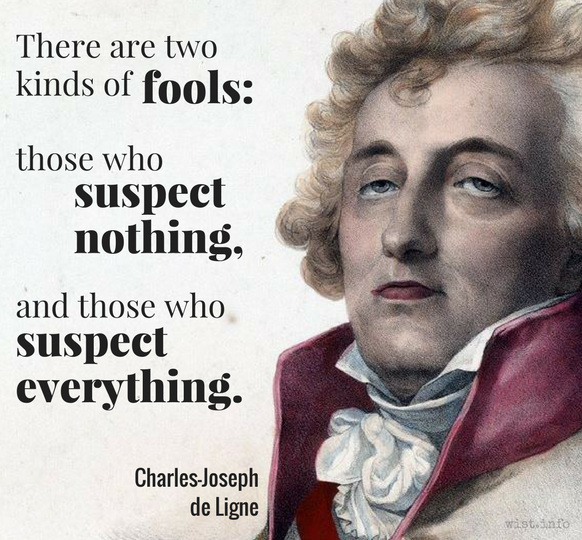
There are two kinds of fools: those who suspect nothing and those who suspect everything.
Charles-Joseph Lamoral, Prince de Ligne (1735–1814) Belgian military leader, noble, writer [Karl Fürst von Ligne, Charles-Joseph de Ligne]
Mes écarts, ou, ma tête en liberté
Captain, the problem is not that I’m paranoid. The problem is that the universe keeps justifying my paranoia.
John Scalzi (b. 1969) American writer
The End of All Things (2015)

It’s one thing to be aware of complex strategies and lies that might be going on around you. It’s another to let yourself become so worried about deception that you become paralyzed.
Steven Brust (b. 1955) American writer, systems programmer
Dragon (1998)
Once you get it into your head that somebody is controlling events, you can interpret everything in that light and find no reasonable certainty anywhere.
Isaac Asimov (1920–1992) Russian-American author, polymath, biochemist
Foundation’s Edge, ch. 12 “Agent” (1982)
It’s a police mantra that all members of the public are guilty of something, but some members of the public are more guilty than others.

The higher paranoid scholarship is nothing if not coherent — in fact the paranoid mind is far more coherent than the real world.
Richard Hofstadter (1916–1970) American historian and intellectual
“The Paranoid Style in American Politics,” Herbert Spencer Lecture, Oxford (Nov 1963)
Reprinted in Harpers (Nov 1964).
As a member of the avant-garde who is capable of perceiving the conspiracy before it is fully obvious to an as yet unaroused public, the paranoid is a militant leader. He does not see social conflict as something to be mediated and compromised, in the manner of the working politician. Since what is at stake is always a conflict between absolute good and absolute evil, what is necessary is not compromise but the will to fight things out to a finish. Since the enemy is thought of as being totally evil and totally unappeasable, he must be totally eliminated — if not from the world, at least from the theatre of operations to which the paranoid directs his attention. This demand for total triumph leads to the formulation of hopelessly unrealistic goals, and since these goals are not even remotely attainable, failure constantly heightens the paranoid’s sense of frustration. Even partial success leaves him with the same feeling of powerlessness with which he began, and this in turn only strengthens his awareness of the vast and terrifying quality of the enemy he opposes.
Richard Hofstadter (1916–1970) American historian and intellectual
“The Paranoid Style in American Politics,” Herbert Spencer Lecture, Oxford (Nov 1963)
(Source)
Reprinted in Harpers (Nov 1964).
There is a hate layer of opinion and emotion in America. There will be other McCarthys to come who will be hailed as its heroes.
Maxwell "Max" Lerner (1902–1992) American journalist, columnist, educator
“McCarthyism: The Smell of Decay,” New York Post (5 Apr 1950)
Lerner coined the term "McCarthyism" in this article. In 1954, he wrote, "For my own part I doubt seriously whether the word will outlast the political power of the man from whom it derives."
Bad rulers … are in constant fear lest others are conspiring to inflict upon them the punishment which they are conscious of deserving.
Niccolò Machiavelli (1469–1527) Italian politician, philosopher, political scientist
The Discourses on Livy, Book 3, ch. 6 (1517) [tr. Detmold (1882)]

Rabid suspicion has nothing in it of skepticism. The suspicious mind believes more than it doubts. It believes in a formidable and ineradicable evil lurking in every person.
Eric Hoffer (1902–1983) American writer, philosopher, longshoreman
Passionate State of Mind, Aphorism 184 (1955)
(Source)
If they can get you asking the wrong questions, they don’t have to worry about answers.
Thomas Pynchon (b. 1937) American novelist
Gravity’s Rainbow, Part 2 “Un Perm’ au Casino Harmann Goering” (1973)
(Source)
Sometimes misquoted as "... about the answers."
Labeled as Proverbs for Paranoids, No. 3.
Any manifest error on the part of an enemy should make us suspect some stratagem.
Niccolò Machiavelli (1469–1527) Italian politician, philosopher, political scientist
The Discourses on Livy, Book 3, ch. 48 (1517) [tr. Detmold (1882)]
The awareness of their individual blemishes and shortcomings inclines the frustrated to detect ill will and meanness in their fellow men. Self-contempt, however vague, sharpens our eyes for the imperfections of others. We usually strive to reveal in others the blemishes we hide in ourselves.
Eric Hoffer (1902–1983) American writer, philosopher, longshoreman
True Believer: Thoughts on the Nature of Mass Movements, Part 3, ch. 14, § 100 (3.14.100) (1951)
(Source)
I believe that that community is already in process of dissolution where each man begins to eye his neighbor as a possible enemy, where non-conformity with the accepted creed, political as well as religious, is a mark of disaffection; where denunciation, without specification or backing, takes the place of evidence; where orthodoxy chokes freedom of dissent; where faith in the eventual supremacy of reason has become so timid that we are not enter our convictions into the open list, to win or lose. Such fears as these are a solvent which can eat out the cement that binds the stones together; they may in the end subject us to a despotism as evil as any that we dread; and they can be allayed only in so far as we refuse to proceed on suspicion, and trust one another until we have tangible ground for misgiving,
Learned Hand (1872–1961) American jurist
“A Plea for the Open Mind and Free Discussion,” speech, University of the State of New York, Albany (1952-10-24)
(Source)
HOBBES: Do you think there’s a God?
CALVIN: Well somebody’s out to get me.

You probably wouldn’t worry about what people think of you if you could know how seldom they do.
Olin Miller (fl. early 20th C) American humorist
(Attributed)First quoted by Walter Winchell, "On Broadway" (7 Jan 1937)
Also frequently attributed to Mark Twain, Eleanor Roosevelt, and Ethel Barrett; the latter used it ("We would worry less about what others think of us, if we realized how seldom they do") in her 1968 book Don’t Look Now But Your Personality is Showing. See here for more information.
Variants:
- "You’ll worry less about what people think about you when you realize how seldom they do."
- "You wouldn’t worry about what people may think of you if you could know how seldom they do."
- "We wouldn’t worry so much about what folks think of us if we knew how seldom they do."
- "You wouldn’t worry so much about what people think of you, if you knew how seldom they do."
- "You wouldn’t worry so much about what other people think if you realized how seldom they do."
See also Johnson.

Hastur was paranoid, which was simply a sensible and well-adjusted reaction to living in Hell, where they really were all out to get you.
Terry Pratchett (1948–2015) English author
Good Omens, 6. “Saturday” (1990) [with Neil Gaiman]
(Source)

Par-runts of rugmonkeys everywhere are worrying that their children will want to become Force-wielding breath masked Sithlords? Sweet Cream-of-Jesus on TOAST POINTS, people!! So now we have to fear that every crib-lizard that loves Anakin Skywalker will become Evil Incarnate. It’s been a lovely planet, but I think I need to go, now.
(Other Authors and Sources)
Alan D. Swan