EQUAL, adj. As bad as something else.
Ambrose Bierce (1842–1914?) American writer and journalist
“Equal,” “Devil’s Dictionary” column, San Francisco Wasp (1884-05-24)
(Source)
Not collected in later books.
Quotations about:
pessimism
Note not all quotations have been tagged, so Search may find additional quotes on this topic.

MESSENGER: I have not now first learn’d that all
Th’ affairs of mortal men are a mere shadow:
Nor would I fear to say that those, who most
Boast of their wisdom and their deep research,
The widest in the paths of folly stray.
No mortal man is happy: if the tide
Of wealth flows in upon him, one may be
More fortunate than others, happy never.[ἌΓΓΕΛΟΣ: τὰ θνητὰ δ᾽ οὐ νῦν πρῶτον ἡγοῦμαι σκιάν,
οὐδ᾽ ἂν τρέσας εἴποιμι τοὺς σοφοὺς βροτῶν
δοκοῦντας εἶναι καὶ μεριμνητὰς λόγων
τούτους μεγίστην μωρίαν ὀφλισκάνειν.
θνητῶν γὰρ οὐδείς ἐστιν εὐδαίμων ἀνήρ:
ὄλβου δ᾽ ἐπιρρυέντος εὐτυχέστερος
ἄλλου γένοιτ᾽ ἂν ἄλλος, εὐδαίμων δ᾽ ἂν οὔ.]Euripides (485?-406? BC) Greek tragic dramatist
Medea [Μήδεια], l. 1224ff (431 BC) [tr. Potter (1814)]
(Source)
Having brought word to Medea of Glauce and Creon's tortured deaths.
(Source (Greek)). Other translations:Not now for the first time do I esteem
Human affairs a shadow: without fear
Can I pronounce, they who appear endued
With wisdom and most plausibly trick out
Specious harangues, deserve to be accounted
The worst of fools. The man completely blest
Exists not. Some in overflowing wealth
May be more fortunate, but none are happy.
[tr. Wodhull (1782)]But not now first I count the lot of man
A passing shadow: and I might say those
Of mortals who are very seeming wise
And fret themselves with learnings, those are they
Who make them guilty of the chiefest folly;
But no one mortal is a happy man,
Though, riches flooding in, more prosperous
One than another grow; yet none is happy.
[tr. Webster (1868)]Not now for the first time I think this human life a shadow; yea, and without shrinking I will say that they amongst men who pretend to wisdom and expend deep thought on words do incur a serious charge of folly; for amongst mortals no man is happy; wealth may pour in and make one luckier than another, but none can happy be.
[tr. Coleridge (1891)]But the affairs of mortals not now for the first time I deem a shadow, and I would venture to say that those persons who seem to be wise and are researchers of arguments, these I say, run into the greatest folly. For no mortal man is happy; but wealth pouring in, one man may be more fortunate than another, but happy he can not be.
[tr. Buckley (1892)]But man's lot now, as oft, I count a shadow,
Nor fear to say that such as seem to be
Wise among men and cunning in speech-lore,
Even these are chargeable with deepest folly;
For among mortals happy man is none.
In fortune's flood-tide might a man become
More prosperous than his neighbour: happy? -- no!
[tr. Way (Loeb) (1894)]Long ago
I looked upon man's days, and found a grey
Shadow. And this thing more I surely say,
That those of all men who are counted wise,
Strong wits, devisers of great policies,
Do pay the bitterest toll. Since life began,
Hath there in God's eye stood one happy man?
Fair days roll on, and bear more gifts or less
Of fortune, but to no man happiness.
[tr. Murray (1906)]Our human life I think and have thought a shadow,
And I do not fear to say that those who are held
Wise among men and who search the reasons of things
Are those who bring the most sorrow on themselves.
For of mortals there is no one who is happy.
If wealth flows in upon one, one may be perhaps
Luckier than one’s neighbor, but still not happy.
[tr. Warner (1944)]As for human life,
It is a shadow, as I have long believed. And this
I say without hesitation: those whom most would call
Intelligent, the propounders of wise theories --
Their folly is of all men's the most culpable.
Happiness is a thing no man possesses. Fortune
May come now to one man, now to another, as
Prosperity increases; happiness never.
[tr. Vellacott (1963)]I have often considered the human condition a shadow,
And I would not hesitate to say that those
Who seem to be wise and concern themselves with learning,
These risk being called the biggest fools.
For no mortal is truly blessed;
When wealth flows one may have more luck
Than another, but is not for that reason blessed.
[tr. Podlecki (1989)]As for our mortal life, this is not the first time that I have thought it to be a shadow, and I would say without any fear that those mortals who seem to be clever and workers-up of polished speeches are guilty of the greatest folly. For no mortal ever attains to blessedness. One may may be luckier than another when wealth flows his way, but blessed never.
[tr. Kovacs (Perseus); Kovacs / Zhang / Rogak]As for our mortal life, this is not the first time that I have thought it to be a shadow, and I would say without any fear that those mortals who seem to be clever and crafters of polished speeches are guilty of the greatest folly. For no mortal ever attains to blessedness. One may may be luckier than another when wealth flows his way, but blessed never.
[tr. Kovacs (Loeb) (1994)]As for the life of man,. I think and have often thought it is a shadow. I would not hesitate to say that those who pass for thinkers on this earth, for men of subtle reasoning, are guilty of being the greatest fools. For no one in this life of ours knows happiness. When fortune’s tide flows towards him, one man may surpass another in prosperity, but you should not call him happy.
[tr. Davie (1996)]As for me, I’ve said it often: All things accomplished by mortals are mere shadows. Nor am I afraid to say that those people who consider themselves philosophers and know the art of spinning good words and say that man can live in happiness, well, those men are stupid!
Wealth may make your life a little better than that of your neighbour but it will not give you happiness.
[tr. Theodoridis (2004)]Not for the first time I find our lives are a shadow,
and I am not afraid to say that people who think
they have everything figured out and are masters of logic
— they are responsible for the greatest folly.
No human being is happy.
Strike it rich and you are luckier
than your neighbor — but happy, never.
[tr. Luschnig (2007)]As for human life,
it seems to me, and not for the first time,
nothing but shadows. And I might say,
without feeling any fear, those mortals
who seem wise, who prepare their words with care,
are guilty of the greatest foolishness.
Among human beings no one is happy.
Wealth may flow in to produce a man
more lucky than another, but no man,
is ever happy, no one.
[tr. Johnston (2008)]This is not the first time that I find human affairs to be a shadowy, uncertain thing. Without any hesitation I would say that those among men who have a reputation for being sophoi, and who expend deep thought on reasonings, do incur the greatest charge of folly. No man among mortals is happy [eudaimōn]. Prosperity [olbos] may pour in and make one luckier than another, but not eudaimōn.
[tr. Coleridge / Ceragioli / Nagy / Hour25]
Will there be a future? We feel we might almost ask ourselves this question when we see so much terrible darkness. Grim confrontation between the selfish and the wretched. In the selfish, prejudices, the ignorance of a superior education, appetite fed by overindulgence, the insensitivity of an indurating prosperity, fear of suffering that in some extends to an aversion to those who suffer, relentless complacency, an ego so inflated it denies access to the soul. In the wretched, greed, envy, a hatred of seeing others enjoying themselves, the convulsions of the human beast within them seeking satisfaction, hearts befogged, sadness, need, fatalism, ignorance impure and simple.
[L’avenir arrivera-t-il? il semble qu’on peut presque se faire cette question quand on voit tant d’ombre terrible. Sombre face-à-face des égoïstes et des misérables. Chez les égoïstes, les préjugés, les ténèbres de l’éducation riche, l’appétit croissant par l’enivrement, un étourdissement de prospérité qui assourdit, la crainte de souffrir qui, dans quelques-uns, va jusqu’à l’aversion des souffrants, une satisfaction implacable, le moi si enflé qu’il ferme l’âme; chez les misérables, la convoitise, l’envie, la haine de voir les autres jouir, les profondes secousses de la bête humaine vers les assouvissements, les cœurs pleins de brume, la tristesse, le besoin, la fatalité, l’ignorance impure et simple.]
Victor Hugo (1802–1885) French writer, journalist, human rights activist, politician
Les Misérables, Part 4 “St. Denis,” Book 7 “Argot,” ch. 4 (4.7.4) (1862) [tr. Donougher (2013)]
(Source)
(Source (French)). Alternate translations:Will the future come? It seems that we may almost ask this question when we see such terrible shadow. Sullen face-to-face of the selfish and the miserable. On the part of the selfish, prejudices, the darkness of the education of wealth, appetite increasing through intoxication, a stupefaction of prosperity which deafens, a dread of suffering which, with some, is carried even to aversion for sufferers, an implacable satisfaction, the me so puffed up that it closes the soul; on the part of the miserable, covetousness, envy, hatred of seeing others enjoy, the deep yearnings of the human animal towards the gratifications, hearts full of gloom, sadness, want, fatality, ignorance impure and simple.
[tr. Wilbour (1862)]Will the future arrive? it seems as we may almost ask this question on seeing so much terrible shadow. There is a somber, face-to-face meeting of the egotists and the wretched. In the egotist we trace prejudices, the cloudiness of a caste education, appetite growing with intoxication, and prosperity that stuns, a fear of suffering which in some goes so far as an aversion from the sufferers, an implacable satisfaction, and the feeling of self so swollen that it closes the soul. In the wretched we find covetousness, envy, the hatred of seeing others successful, the profound bounds of the human wild beast at satisfaction, and hearts full of mist, sorrow, want, fatality, and impure and simple ignorance.
[tr. Wraxall (1862)]Will the future arrive? It seems as though we might almost put this question, when we behold so much terrible darkness. Melancholy face-to-face encounter of selfish and wretched. On the part of the selfish, the prejudices, shadows of costly education, appetite increasing through intoxication, a giddiness of prosperity which dulls, a fear of suffering which, in some, goes as far as an aversion for the suffering, an implacable satisfaction, the I so swollen that it bars the soul; on the side of the wretched covetousness, envy, hatred of seeing others enjoy, the profound impulses of the human beast towards assuaging its desires, hearts full of mist, sadness, need, fatality, impure and simple ignorance.
[tr. Hapgood (1887)]Will the future ever arrive? The question seems almost justified when one considers the shadows looming ahead, the sombre confrontation of egoists and outcasts. On the side of the egoists, prejudice -- that darkness of a rich education -- appetite that grows with intoxication, the bemusement of prosperity which blunts the sense, the fear of suffering which in some cases goes so far as to hate all sufferers, and unshakeable complacency, the ego so inflated it stifles the soul; and on the side of the outcasts, greed and envy, resentment at the happiness of others, the turmoil of the human animal in search of personal fulfilment, hearts filled with fog, misery, needs, and fatalism, and simple, impure ignorance.
[tr. Denny (1976)]Will the future come? We can almost ask this question, it seems, when we see such terrible shadows. Sullen face-to-face encounter of the selfish and the miserable. On the side of the selfish, prejudices, the darkness of the education of wealth, appetite increasing through intoxication, a stultifying of prosperity, which deafens, a dread of suffering taken, for some, as far as an aversion to sufferers, an implacable satisfaction, the self so puffed up it closes the soul; on the side of the miserable, covetousness, envy, hatred of seeing others enjoy, the deep yearnings of the human animal toward gratification, hearts filled with gloom, sadness, want, inevitability, ignorance impure and simple.
[tr. Wilbour/Fahnestock/MacAfee (1987)]

CHORUS:But why
Be sure of the worst, and weep too soon?[ΧΟΡΟΣ: μὴ πρόμαντις ἀλγέων
προλάμβαν᾽, ὦ φίλα, γόους.]Euripides (485?-406? BC) Greek tragic dramatist
Helen [Ἑλένη], l. 338ff (412 BC) [tr. Vellacott (1954)]
(Source)
Counseling Helen not to catastrophize about her fate or that of her husband until she has talked with the prophetess Theonoë.
(Source (Greek)). Other translations:Do not, dear lady, do not thus, in thought
Presaging ill, anticipate thy griefs.
[tr. Potter (1783), l. 370ff]Forbear these plaintive strains, my dearest queen,
Nor with presaging soul anticipate
Evils to come.
[tr. Wodhull (1809)]Do not, O dear one, anticipate lamentations like a prophetess of woes.
[tr. Buckley (1850)]Do not be a prophetess of sorrow, dear friend, anticipating lamentation.
[tr. Coleridge (1891)]Nay, forestall not, O friend, lamentation
Prophetic of grief.
[tr. Way (Loeb) (1912)]Lady, till the truth appear,
Gentle lady, grieve not so.
Weep not till you know.
[tr. Sheppard (1925)]Do not anticipate your grief,
dear lady, do not cry before you know.
[tr. Warner (1951)]Do not be prophetic of grief.
Do not, dear, anticipate sorrow.
[tr. Lattimore (1956)]Dear lady, do not prophesy sorrow yet nor weep too soon!
[tr. Davie (2002)]Dear mistress mine, be not a prophetess of sorrow, forestalling lamentation.
[tr. Athenian Society (2006)]Wait till you're certain, don't jump to conclusions.
[tr. A. Wilson (2007)]Why prophesy grief, Helen?
Why cry before you have to?
[tr. Theodoridis (2011)]As a prophetess of woe
do not, my dear, lament too soon.
[tr. Ambrose et al. (2018)]Do not be a prophetess of sorrow, dear friend [phila], anticipating lamentation.
[tr. Coleridge / Helen Heroization Team]
Blessed is he that expects nothing, for he shall never be disappointed.
Benjamin Franklin (1706–1790) American statesman, scientist, philosopher, aphorist
Poor Richard (1739 ed.)
(Source)
The earliest recorded usage of this phrase is actually Alexander Pope (1727), though Pope says he had devised it many years earlier. Modeled after the Beatitudes in the New Testament.
So far as we can see, both horror and pain are necessary to the continuance of life on this planet, and it is therefore open to pessimists like Swift to say: “If horror and pain must always be with us, how can life be significantly improved?” His attitude is in effect the Christian attitude, minus the bribe of a “next world” — which, however, probably has less hold upon the minds of believers than the conviction that this world is a vale of tears and the grave is a place of rest.
George Orwell (1903–1950) English journalist, essayist, writer [pseud. of Eric Arthur Blair]
Essay (1946-09), “Politics vs. Literature: An Examination of Gulliver’s Travels,” Polemic, No. 5
(Source)
I am persuaded that those who quite sincerely attribute their sorrows to their views about the universe are putting the cart before the horse: the truth is they are unhappy for some reasons of which they are not aware, and this unhappiness leads them to dwell upon the less agreeable characteristics of the world in which they live.
Bertrand Russell (1872–1970) English mathematician and philosopher
Conquest of Happiness, Part 1, ch. 2 “Byronic Unhappiness” (1930)
(Source)
I do not myself think that there is any superior rationality in being unhappy. The wise man will be as happy as circumstances permit, and if he finds the contemplation of the universe painful beyond a point, he will contemplate something else instead.
Bertrand Russell (1872–1970) English mathematician and philosopher
Conquest of Happiness, Part 1, ch. 2 “Byronic Unhappiness” (1930)
(Source)
KING: I am wrapp’d in dismal thinkings.
William Shakespeare (1564–1616) English dramatist and poet
All’s Well That Ends Well, Act 5, sc. 3, ll. 147ff (5.3.147) (1602?)
(Source)

I have always been — I think any student of history almost inevitably is — a cheerful pessimist.
Jacques Barzun (1907–2012) French-American historian, educator, polymath
Quoted in Thomas Vinciguerra, “Jacques Barzun ’27: Columbia Avatar,” Columbia College Today (2006-01)
(Source)
Barzun is being quoted in this particular instance from an unclear source, possibly the Independent Women's Forum in 2000.
There was a moment’s silence while everybody thought.
“I’ve got a sort of idea,” said Pooh at last, “but I don’t suppose it’s a very good one.”
“I don’t suppose it is either,” said Eeyore.A. A. Milne (1882–1956) English poet and playwright [Alan Alexander Milne]
House at Pooh Corner, ch. 6 “Eeyore Joins the Game” (1928)
(Source)
A thing I am not anxious to preserve
Is this frail life; for soon as one woe ends,
Others commence, and our weak eyes discern not
What evil fortunes yet remain behind.[αἰεὶ τὸ µὲν ζῇ, τὸ δὲ µεθίσταται κακόν,
τὸ δ’ αὖ πέφηνεν αὖθις ἐξ ἀρχῆς νέον.]Euripides (485?-406? BC) Greek tragic dramatist
Æolus [Αἴολος], frag. 35 (TGF) [tr. Wodhull (1809)]
(Source)
Nauck frag. 35, Barnes frag. 51, Musgrave frag. 15, 16. (Source (Greek)). Other translations:One ill is ever clinging;
One treads upon its heels;
A third, in distance springing,
Its fearful front reveals.
[tr. Peacock (1897)]One trouble alive and well, another gone,
as all afresh a new one comes our way.
[Source]
In order to not find life unbearable, you must accept two things: the ravages of time, and the injustices of man.
[Il y a deux choses auxquelles il faut se faire, sous peine de trouver la vie insupportable. Ce sont les injures du tems et les injustices des hommes.]Nicolas Chamfort (1741–1794) French writer, epigrammist (b. Nicolas-Sébastien Roch)
Products of Perfected Civilization [Produits de la Civilisation Perfectionée], Part 1 “Maxims and Thoughts [Maximes et Pensées],” ch. 2, ¶ 115 (1795) [tr. Parmée (2003), ¶ 95]
(Source)
(Source (French)). Alternate translations:There are two things to which we must become inured on pain of finding life intolerable: the outrages of time and man's injustice.
[tr. Mathers (1926)]There are two things that one must get used to or one will find life unendurable: the damages of time and the injustices of men.
[tr. Merwin (1969)]There are two things that a man must reconcile himself to, or he will find life unbearable: they are the injuries of time and the injuries of men.
[tr. Siniscalchi (1994)]

To everything there is a bright side and a dark side; and I hold it to be unwise, unphilosophic, unkind to others, and unhealthy for one’s own soul, to form the habit of looking on the dark side.
Lydia Maria Child (1802–1880) American abolitionist, activist, journalist, suffragist
Letter to Lucy Osgood (1865)
(Source)
Cheer up, the worst is yet to come.
Philander Johnson (1866–1939) American journalist, humorist, lyricist, playwright
“The Colyumist’s Confessional,” Everybody’s Magazine (May 1920)
(Source)
He refers to the phrase as a "rather unfeeling invitation to end a hard-luck story."

Things look different when seen in a different light. So look at them in the light of happiness. Don’t confuse good and bad.
[Hace muy diferentes visos una misma cosa si se mira a diferentes luces: mírese por la de la felicidad. No se han de trocar los frenos al bien y al mal.]
Baltasar Gracián y Morales (1601–1658) Spanish Jesuit priest, writer, philosopher
The Art of Worldly Wisdom [Oráculo Manual y Arte de Prudencia], § 224 (1647) [tr. Maurer (1992)]
(Source)
(Source (Spanish)). Other translations:One and the same thing, hath its good day, and its bad. Examine it on the fairest side. We must not give the contrary reines to good and evil.
[Flesher ed. (1685)]The same thing looks quite different in another light; look at it therefore on its best side and do not exchange good for evil.
[tr. Jacobs (1892)]For one and the same thing has very different faces, as seen in different lights; look upon it in its happiest light, and do not get the controls mixed, as to what is good and what is bad.
[tr. Fischer (1937)]

Blessed is he who expects nothing for he shall never be disappointed.
Alexander Pope (1688–1744) English poet
Letter (1727-10-16) to John Gay
(Source)
Pope referred to this, in the letter, as "The Ninth Beatitude." He may have used the phrase the previous year in a letter to William Fortescue (the letter is not given a date, but is grouped with a letter from John Gay to Fortescue of 23 Sep 1725). In both letters, Pope indicates he devised the saying many years previously.
Repeated by Benjamin Franklin, without attribution, in Poor Richard's Almanack for May 1739.

sometimes you climb out of bed in the morning and you think,
I’m not going to make it, but you laugh inside
remembering all the times you’ve felt that wayCharles Bukowski (1920–1994) German-American author, poet
“Gamblers All” (1990)
(Source)
Originally titled "8 Count and Up".
Good news goes unnoticed. This is a well-known property of the press in the free world. Improvements are never dramatic. Life improves slowly and goes wrong fast, and only catastrophe is clearly visible.
Edward Teller (1908–2003) Hungarian-American theoretical physicist
The Pursuit of Simplicity (1980)
(Source)
A pessimist looks at his glass and says it is half empty; an optimist looks at it and says it is half full.
Josiah Stamp (1880–1941) English industrialist, economist, statistician, banker
Comment (1935)
There is substantial evidence that Stamp used this now-cliched phrase, or variations of it, on multiple spoken occasions in 1935, the earliest references I could find.
- The Railway Service Journal (later Transport Salaried Staff Journal) mentions 1935 after-dinner remarks by Stamp: "After dinner, Sir Josiah Stamp defined an optimist as 'the man who looks at his glass and says it is half full,' and the pessimist as 'the man who looks at it and says it is half empty.'" [Source]
- Similarly, the Bristol Chamber of Commerce Journal mentions a 1935 speech: "A pessimist is a man who looks at the glass and describes it as half empty, and an optimist is a man who describes it as half full. It is all a question of the point of view." [Source]
- A New York Times article (12 Nov 1935) includes "I came recently upon a graphic distinction drawn by Sir Josiah Stamp between an optimist and a pessimist," followed by the phrasing noted at the top. [Source, Source]
“Supposing a tree fell down, Pooh, when we were underneath it?”
“Supposing it didn’t,” said Pooh after careful thought.
Piglet was comforted by this.A. A. Milne (1882–1956) English poet and playwright [Alan Alexander Milne]
House at Pooh Corner, ch. 8 “Piglet Does a Very Grand Thing” (1928)
(Source)
Hence it is that, though in every age everybody knows that up to his own time progressive improvement has been taking place, nobody seems to reckon on any improvement during the next generation. We cannot absolutely prove that those are in error who tell us that society has reached a turning point, that we have seen our best days. But so said all before us, and with just as much apparent reason.
Thomas Babington Macaulay (1800–1859) English writer and politician
“Southey’s Colloquies on Society,” Edinburgh Review (1830)
(Source)
Review of Robert Southey, Sir Thomas More; or, Colloquies on the Progress and Prospects of Society (1829).
The sad truth is that the truth is sad.
Lemony Snicket (b. 1970) American author, screenwriter, musician (pseud. for Daniel Handler)
The Carnivorous Carnival (2002)

Conservatives know the world is a dark and forbidding place where most new knowledge is false, most improvements for the worse, the battle is not to the strong, nor riches to men of understanding, and an unscrupulous Providence consigns innocents to suffering.
George Will (b. 1941) American political commentator
“The Cubs and Conservatism” (21 Mar 1974), Bunts (1998)
(Source)
Will is, somewhat tongue-in-cheek, describing the origin of his conservatism in his being a fan of the Chicago Cubs baseball team.

When did the future switch from being a promise to being a threat?
Chuck Palahniuk (b. 1962) American novelist and freelance journalist
Invisible Monsters (1999)
(Source)

Every New Year is the direct descendant, isn’t it, of a long line of proven criminals?
Ogden Nash (1902–1971) American poet
“Good-bye, Old Year, You Oaf, or Why Don’t They Pay the Bonus?” (1935)
(Source)

Pessimism about man serves to maintain the status quo. It is a luxury for the affluent, a sop to the guilt of the politically inactive, a comfort to those who continue to enjoy the amenities of privilege.
Leon Eisenberg (1922–2009) American psychiatrist and medical educator
“The Human Nature of Human Nature,” Science (14 Apr 1972)
(Source)
Based on an address at Faculty of Medicine Day, McGill University Sesquicentennial Celebration, Montreal, Canada (1 Oct 1971).
Things never turn out either so well or so badly as they logically ought to do.
William Ralph Inge (1860–1954) English prelate [Dean Inge]
“The Future of the English Race,” Galton Lecture (1919), Outspoken Essays: First Series (1920)
(Source)
Listen to the MUSTN’Ts, child,
Listen to the DON’Ts
Listen to the SHOULDN’Ts
The IMPOSSIBLES, the WON’Ts
Listen to the NEVER HAVEs
Then listen close to me —
Anything can happen, child,
ANYTHING can be.Shel Silverstein (1930–1999) American poet, singer-songwriter, cartoonist, children's author
“Listen To The Mustn’ts,” Where the Sidewalk Ends (1974)

An optimist isn’t necessarily a blithe, slightly sappy whistler in the dark of our time. To be hopeful in bad times is not just foolishly romantic. It is based on the fact that human history is a history not only of cruelty, but also of compassion, sacrifice, courage, kindness. What we choose to emphasize in this complex history will determine our lives. If we see only the worst, it destroys our capacity to do something. If we remember those times and places — and there are so many — where people have behaved magnificently, this gives us the energy to act, and at least the possibility of sending this spinning top of a world in a different direction.
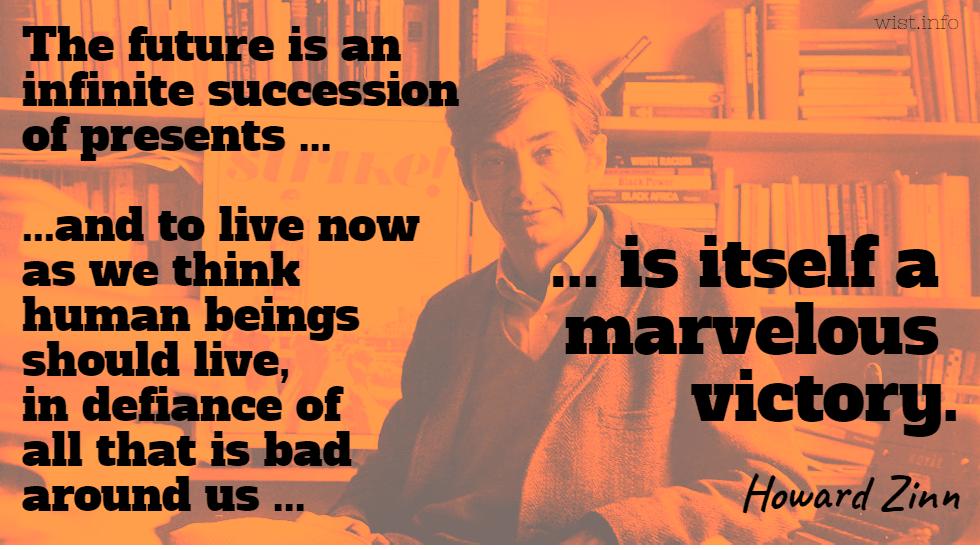
And if we do act, in however small a way, we don’t have to wait for some grand utopian future. The future is an infinite succession of presents, and to live now as we think human beings should live, in defiance of all that is bad around us, is itself a marvelous victory.
Howard Zinn (1922–2010) American historian, academic, author, social activist
Essay (2004-09-02), “The Optimism of Uncertainty,” The Nation
(Source)
Adopted from Zinn's essay of the same name in Paul Loeb (ed.), The Impossible Will Take a Little While (2004). See also Zinn, "A Marvelous Victory" (2004-02-23).

MARVIN: The first ten million years were the worst. And the second ten million, they were the worst too. The third ten million I didn’t enjoy at all. After that I went into a bit of a decline.
Douglas Adams (1952–2001) English author, humorist, screenwriter
Hitchhiker’s Guide to the Galaxy, Phase 1, “Fit the 5th” (BBC Radio) (1978-04-05)
(Source)
When adapted as a novel, Hitchhiker's Guide No. 2, The Restaurant at the End of the Universe, ch. 18 (1980), this line by Marvin the Paranoid Android remained the same.

One day I sat thinking, almost in despair; a hand fell on my shoulder and a voice said reassuringly: cheer up, things could get worse. So I cheered up and, sure enough, things got worse.
(Other Authors and Sources)
James Haggerty (1909-1981) Press Secretary to President Eisenhower

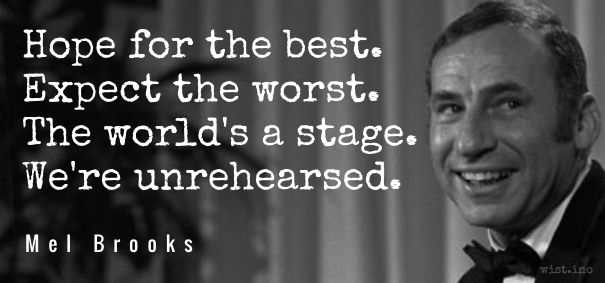
Hope for the best.
Expect the worst.
The world’s a stage.
We’re unrehearsed.
Mel Brooks (b. 1926) American comedic actor, writer, producer [b. Melvyn Kaminsky]
The Twelve Chairs, “Hope for the Best, Expect the Worst” (1970)
(Source)
(Source (Audio)). More information on composition of the song here and here.
See Cicero (44 BC), Shakespeare (1599), Heywood (1612), Billings (1877), O'Casey (c. 1940), Watterson (1993).
On a recent Sunday evening, Theo came up with an aphorism: the bigger you think, the crappier it looks. Asked to explain he said, “When we go on about the big things, the political situation, global warming, world poverty, it all looks really terrible, with nothing getting better, nothing to look forward to. But when I think small, closer in — you know, a girl I’ve just met, or this song we’re going to do with Chas, or snowboarding next month, then it looks great. So this is going to be my motto — think small.”
Ian McEwan (b. 1948) English novelist and screenwriter
Saturday (2005)
There is freedom waiting for you,
On the breezes of the sky,
And you ask “What if I fall?”
Oh but my darling,
What if you fly?

“Life is like a sewer — what you get out of it depends on what you put into it.” It’s always seemed to me that this is precisely the sort of dynamic, positive thinking that we so desperately need today in these trying times of crisis and universal brouhaha.
Tom Lehrer (b. 1928) American mathematician, satirist, songwriter
Introduction to “We Will All Go Together When We Go,” An Evening (Wasted) with Tom Lehrer (1959)
Those see nothing but Faults that seek for nothing else.
Thomas Fuller (1654–1734) English physician, preacher, aphorist, writer
Gnomologia: Adages and Proverbs (compiler), # 5021 (1732)
(Source)

He who laughs
Has not yet received
The terrible news.[Der Lachende
Hat die furchtbare Nachricht
Nur noch nicht empfangen.]Bertolt Brecht (1898–1956) German poet, playwright, director, dramaturgist
“To Those Born Later [An die Nachgeborenen],” (1938) [tr. Horton (2008)]
(Source)
Other translations: "He who laughs last has not yet heard the bad news," and "The man who laughs has simply not yet had the terrible news."
The title is also sometimes translated as "To Those Who Follow In Our Wake" and "To Those Born After."
Oddly enough, the German is sometimes given in paraphrase (or back-translated from the English): "Wer jetzt noch lacht, hat die neuesten Nachrichten noch nicht gehört." This German only appears to be found on quotation sites.
Both optimists and pessimists contribute to our society. The optimist invents the airplane and the pessimist the parachute.
G. B. Stern (1890–1973) British writer [Gladys Bronwyn Stern]
(Attributed)

Life’s under no obligation to give us what we expect. We take what we get and are thankful it’s no worse than it is.
Margaret Mitchell (1900–1949) American author and journalist.
Gone with the Wind, ch. 53 [Ashley] (1936)

Talking of the danger of being mortified by rejection, when making approaches to the acquaintance of the great, I observed, “I am, however, generally for trying, ‘Nothing venture, nothing have.'” JOHNSON. “Very true, sir; but I have always been more afraid of failing, than hopeful of success.”

Melancholy sees the worst of things, — things as they may be, and not as they are. It looks upon a beautiful face, and sees but a grinning skull.
Christian Nestell Bovee (1820–1904) American epigrammatist, writer, publisher
Intuitions and Summaries of Thought, Vol. 2 (1862)
A pessimist is a man who looks both ways before crossing a one-way street.
Lawrence J. Peter (1919–1990) American educator, management theorist
Peter’s Quotations (1977)
Pessimism … is in brief, playing the sure game. You cannot lose at it; you may gain. It is the only view of life in which you can never be disappointed.
Thomas Hardy (1840–1928) English novelist, poet
(Attributed)
In Florence Hardy, The Later Years of Thomas Hardy, ch. 7 (1930)
There is no sadder sight than a young pessimist, except an old optimist.
Mark Twain (1835–1910) American writer [pseud. of Samuel Clemens]
Mark Twain’s Notebook, 22 Dec 1903 [ed. Paine (1935)]

To the question whether I am a pessimist or an optimist, I answer that my knowledge is pessimistic, but my willing and hoping are optimistic.
Albert Schweitzer (1875–1965) Alsatian philosopher, physician, philanthropist, polymath
Out of My Life and Thought, An Autobiography, Epilogue (1933) [tr. Campion]
See also Gramsci.

When I look back on all these worries I remember the story of the old man who said on his deathbed that he had had a lot of trouble in his life, most of which had never happened.
Winston Churchill (1874–1965) British statesman and author
The Second World War, Vol. 2: Their Finest Hour, ch. 23 “September Tensions” (1949)
(Source)
Never give way to melancholy; resist it steadily, for the habit will encroach.
Sydney Smith (1771–1845) English clergyman, essayist, wit
Memoir of the Reverend Sydney Smith, by His Daughter, Lady Holland, Vol. 1, ch. 10 (1855)
(Source)
In chapter 11 is a parallel quotation from Smith: "Never give way to melancholy: nothing encroaches more; I fight against it vigorously."
But Lady Holland observes that in Smith's notebook he also wrote, "I wish I were of a more sanguine temperament; I always anticipate the worst."

No pessimist ever discovered the secrets of stars, or sailed to an uncharted land, or opened a new Heaven to the human spirit.

GARIBALDI: No boom?
SINCLAIR: No boom.
IVANOVA: No boom today. Boom tomorrow. There’s always a boom tomorrow. What? Look, somebody’s got to have some damn perspective around here! Boom. Sooner or later. BOOM!Christy Marx (b. 1952) American screenwriter, photographer, game designer
Babylon 5, 1×15 “Grail” (6 Jul 1994)
(Source)

“Good morning, Eeyore,” said Pooh.
“Good morning, Pooh Bear,” said Eeyore gloomily. “If it is a good morning,” he said. “Which I doubt,” said he.A. A. Milne (1882–1956) English poet and playwright [Alan Alexander Milne]
Winnie-the-Pooh, ch. 6 “Eeyore Has a Birthday” (1926)
(Source)
Don’t ever become a pessimist, Ira; a pessimist is correct oftener than an optimist, but an optimist has more fun — and neither can stop the march of events.
Robert A. Heinlein (1907–1988) American writer
Time Enough for Love [Lazarus Long] (1973)
ZATHRAS: Yes, Zathras is used to being beast of burden to other people’s needs. Very sad life. Probably have very sad death. But at least there is symmetry.
J. Michael (Joe) Straczynski (b. 1954) American screenwriter, producer, author [a/k/a "JMS"]
Babylon 5, 3×16 “War Without End,” Part 1 (13 May 1996)

You do not examine legislation in the light of the benefits it will convey if properly administered, but in the light of the wrongs it would do and the harms it would cause if improperly administered.
Lyndon B. Johnson (1908–1973) American politician, educator, US President (1963–69)
(Attributed)
Widely attributed to Johnson, and in keeping with his reputation as a wily legislator, but no actual source found.