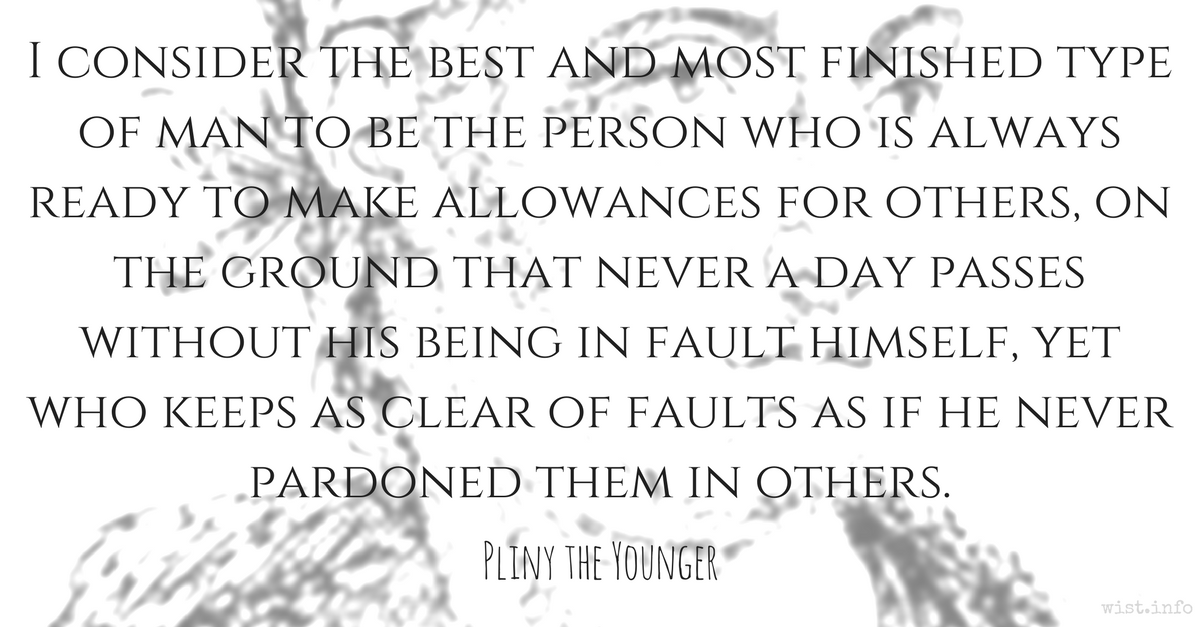
For my own part, I consider the best and most finished type of man to be the person who is always ready to make allowances for others, on the ground that never a day passes without his being in fault himself, yet who keeps as clear of faults as if he never pardoned them in others.
[Atque ego optimum et emendatissimum existimo, qui ceteris ita ignoscit, tamquam ipse cotidie peccet, ita peccatis abstinet tamquam nemini ignoscat.]
Pliny the Younger (c. 61-c. 113) Roman politician, writer [Gaius Plinius Caecilius Secundus]
Epistles [Epistulae], Book 8, Letter 22 “To Geminus” [tr. J.B.Firth (1900)]
(Source)
Alt. trans.: "The highest of characters, in my estimation, is his, who is as ready to pardon the moral errors of mankind, as if he were every day guilty of some himself; and at the same time as cautious of committing a fault as if he never forgave one."
Quotations about:
fault-finding
Note not all quotations have been tagged, so Search may find additional quotes on this topic.
Those see nothing but Faults that seek for nothing else.
Thomas Fuller (1654–1734) English physician, preacher, aphorist, writer
Gnomologia: Adages and Proverbs (compiler), # 5021 (1732)
(Source)

It is useless to try to adjudicate a long-standing animosity by asking who started it or who is the most wrong. The only sufficient answer is to give up the animosity and try forgiveness, to try to love our enemies and to talk to them and (if we pray) to pray for them. If we can’t do any of that, then we must begin again by trying to imagine our enemies’ children who, like our children, are in mortal danger because of enmity that they did not cause.
Wendell Berry (b. 1934) American farmer, educator, poet, conservationist
Essay (2003-02-09), “A Citizen’s Response,” sec. 4, Citizenship Papers (2003)
(Source)
The essay, including this passage, was also published in a longer form in Orion Magazine (2003-03/04), and collected in his Citizenship Papers (2003).