

We must come to the Principles of Jesus. But, when will all Men and all Nations do as they would be done by? Forgive all Injuries and love their Enemies as themselves? I leave those profound Phylosophers whose Sagacity perceives the Perfectibility of Humane Nature, and those illuminated Theologians who expect the Apocalyptic Reign, to enjoy their transporting hopes; provided always that they will not engage us in Crusades and French Revolutions, nor burn us for doubting.
John Adams (1735–1826) American lawyer, Founding Father, statesman, US President (1797–1801)
Letter (1816-02-02) to Thomas Jefferson
(Source)
Quotations about:
love your enemy
Note not all quotations have been tagged, so Search may find additional quotes on this topic.

If your enemies are starving, feed them some bread;
if they are thirsty, give them water to drink.
By doing this, you will heap burning coals on their heads,
and the Lord will reward you.אִם־רָעֵ֣ב שֹׂ֭נַאֲךָ הַאֲכִלֵ֣הוּ לָ֑חֶם וְאִם־צָ֝מֵ֗א הַשְׁקֵ֥הוּ מָֽיִם׃
כִּ֤י גֶחָלִ֗ים אַ֭תָּה חֹתֶ֣ה עַל־רֹאשׁ֑וֹ וַ֝יהֹוָ֗ה יְשַׁלֶּם־לָֽךְ׃The Bible (The Old Testament) (14th - 2nd C BC) Judeo-Christian sacred scripture [Tanakh, Hebrew Bible], incl. the Apocrypha (Deuterocanonicals)
Book 20. Proverbs 25:21ff (Prov 25:21-22) [tr. CEB (2011)]
(Source)
See Romans 12:19-21.
(Source (Hebrew)). Other translations:If thine enemy be hungry, give him bread to eat;
and if he be thirsty, give him water to drink:
for thou shalt heap coals of fire upon his head,
and the Lord shall reward thee.
[KJV (1611)]If your enemy is hungry, give him something to eat; if thirsty, something to drink.
By this you heap red-hot coals on his head, and Yahweh will reward you.
[JB (1966)]If your enemy is hungry, give him something to eat; if thirsty, something to drink.
By this you will be heaping red-hot coals on his head, and Yahweh will reward you.
[NJB (1985)]If your enemies are hungry, feed them; if they are thirsty, give them a drink. 22 You will make them burn with shame, and the Lord will reward you.
[GNT (1992 ed.)]If your enemies are hungry, give them bread to eat,
and if they are thirsty, give them water to drink,
for you will heap coals of fire on their heads,
and the Lord will reward you.
[NRSV (2021 ed.)]If your enemy is hungry, give him bread to eat;
If he is thirsty, give him water to drink.
You will be heaping live coals on his head,
And God will reward you.
[RJPS (2023 ed.)]

If I have all the eloquence of men or of angels, but speak without love, I am simply a gong booming or a cymbal clashing. If I have the gift of prophecy, understanding all the mysteries there are, and knowing everything, and if I have faith in all its fulness, to move mountains, but without love, then I am nothing at all. If I give away all that I possess, piece by piece, and if I even let them take my body to burn it, but am without love, it will do me no good whatever.
[Ἐὰν ταῖς γλώσσαις τῶν ἀνθρώπων λαλῶ καὶ τῶν ἀγγέλων, ἀγάπην δὲ μὴ ἔχω, γέγονα χαλκὸς ἠχῶν ἢ κύμβαλον ἀλαλάζον. καὶ ἐὰν ἔχω προφητείαν καὶ εἰδῶ τὰ μυστήρια πάντα καὶ πᾶσαν τὴν γνῶσιν καὶ ἐὰν ἔχω πᾶσαν τὴν πίστιν ὥστε ὄρη μεθιστάναι, ἀγάπην δὲ μὴ ἔχω, οὐθέν εἰμι. κἂν ψωμίσω πάντα τὰ ὑπάρχοντά μου καὶ ἐὰν παραδῶ τὸ σῶμά μου ἵνα καυχήσωμαι, ἀγάπην δὲ μὴ ἔχω, οὐδὲν ὠφελοῦμαι.]
The Bible (The New Testament) (AD 1st - 2nd C) Christian sacred scripture
Book 7. 1st Letter to the Corinthians 13: 1ff (1 Cor 13:1-3) [JB (1966)]
(Source)
Various editions note that the final "if" varies between manuscripts as to whether it's to give up the body to be burned, or to do so to boast.
See Coffin (2004).
(Source (Greek)). Alternate translations:Though I speak with the tongues of men and of angels, and have not charity, I am become as sounding brass, or a tinkling cymbal. And though I have the gift of prophecy, and understand all mysteries, and all knowledge; and though I have all faith, so that I could remove mountains, and have not charity, I am nothing. And though I bestow all my goods to feed the poor, and though I give my body to be burned, and have not charity, it profiteth me nothing.
[KJV (1611)]Though I command languages both human and angelic -- if I speak without love, I am no more than a gong booming or a cymbal clashing. And though I have the power of prophecy, to penetrate all mysteries and knowledge, and though I have all the faith necessary to move mountains -- if I am without love, I am nothing. Though I should give away to the poor all that I possess, and even give up my body to be burned -- if I am without love, it will do me no good whatever.
[NJB (1985)]I may be able to speak the languages of human beings and even of angels, but if I have no love, my speech is no more than a noisy gong or a clanging bell. I may have the gift of inspired preaching; I may have all knowledge and understand all secrets; I may have all the faith needed to move mountains -- but if I have no love, I am nothing. I may give away everything I have, and even give up my body to be burned -- but if I have no love, this does me no good.
[GNT (1992 ed.)]If I speak in tongues of human beings and of angels but I don’t have love, I’m a clanging gong or a clashing cymbal. If I have the gift of prophecy and I know all the mysteries and everything else, and if I have such complete faith that I can move mountains but I don’t have love, I’m nothing. If I give away everything that I have and hand over my own body to feel good about what I’ve done but I don’t have love, I receive no benefit whatsoever.
[CEB (2011)]If I speak in the tongues of humans and of angels but do not have love, I am a noisy gong or a clanging cymbal. And if I have prophetic powers and understand all mysteries and all knowledge and if I have all faith so as to remove mountains but do not have love, I am nothing. If I give away all my possessions and if I hand over my body so that I may boast[a] but do not have love, I gain nothing.
[NRSV (2021 ed.)]
If you love only the people who love you, why should you receive a blessing? Even sinners love those who love them! And if you do good only to those who do good to you, why should you receive a blessing? Even sinners do that!
[καὶ εἰ ἀγαπᾶτε τοὺς ἀγαπῶντας ὑμᾶς, ποία ὑμῖν χάρις ἐστίν; καὶ γὰρ οἱ ἁμαρτωλοὶ τοὺς ἀγαπῶντας αὐτοὺς ἀγαπῶσιν. καὶ [γὰρ] ἐὰν ἀγαθοποιῆτε τοὺς ἀγαθοποιοῦντας ὑμᾶς, ποία ὑμῖν χάρις ἐστίν; καὶ οἱ ἁμαρτωλοὶ τὸ αὐτὸ ποιοῦσιν.]
The Bible (The New Testament) (AD 1st - 2nd C) Christian sacred scripture
Book 3. Gospel of Luke 6:32ff (Luke 6:32–33) (Jesus) [GNT (1992 ed.)]
(Source)
No Synoptic parallels.
(Source (Greek)). Alternate translations:For if ye love them which love you, what thank have ye? for sinners also love those that love them. And if ye do good to them which do good to you, what thank have ye? for sinners also do even the same.
[KJV (1611)]If you love those who love you, what thanks can you expect? Even sinners love those who love them. And if you do good to those who do good to you, what thanks can you expect? For even sinners do that much.
[JB (1966)]If you love those who love you, what credit can you expect? Even sinners love those who love them. And if you do good to those who do good to you, what credit can you expect? For even sinners do that much.
[NJB (1985)]If you love those who love you, why should you be commended? Even sinners love those who love them. If you do good to those who do good to you, why should you be commended? Even sinners do that.
[CEB (2011)]If you love those who love you, what credit is that to you? For even sinners love those who love them. If you do good to those who do good to you, what credit is that to you? For even sinners do the same.
[NRSV (2021 ed.)]
In a word, there is only one thing here worth the minding, and that is, to be true and just, and to show benevolence, even to the untrue and unjust.
[Ἓν ὧδε πολλοῦ ἄξιον, τὸ μετ᾿ ἀληθείας καὶ δικαιοσύνης εὐμενῆ τοῖς ψεύσταις καὶ ἀδίκοις διαβιοῦν.]
Marcus Aurelius (AD 121–180) Roman emperor (161–180), Stoic philosopher
Meditations [To Himself; Τὰ εἰς ἑαυτόν], Book 6, ch. 47 (6.47) (AD 161-180) [tr. Collier/Zimmern (1887)]
(Source)
(Source (Greek)). Alternate translations:One thing there is, and that only, which is worth our while in this world, and ought by us much to be esteemed; and that is, according to truth and righteousness, meekly and lovingly to converse with false, and unrighteous men.
[tr. Casaubon (1634), 6.42]In a word. There's only one thing here worth the minding; And that is, not to imitate the Degeneracy of Mortals: But to be True, Honest, and Good-natur'd, even amongst Knaves, and Sharpers.
[tr. Collier (1701)]The one thing valuable in this life, is, to spend it in a steady course of truth, justice, and humanity, toward even the false and unjust.
[tr. Hutcheson/Moor (1742)]In short, there is nothing here much worth our attention, but to act on all occasions with a regard to truth and justice, and to live peaceably even with those who act with fraud and injustice.
[tr. Graves (1792), 6.41]One thing here is worth a great deal, to pass thy life in truth and justice, with a benevolent disposition even to liars and unjust men.
[tr. Long (1862)]Here one thing is of real worth, to live out life in truth and justice, with charity even to the false and the unjust.
[tr. Rendall (1898)]The one precious thing in life is to spend it in a steady course of truth and justice, with kindliness even for the false and the unjust.
[tr. Hutcheson/Chrystal (1902)]One thing on earth is worth much -- to live out our lives in truth and justice, and in charity with liars and unjust men.
[tr. Haines (Loeb) (1916)]One thing here is of great price, to live out life with truth and righteousness, gracious to liars and to the unrighteous.
[tr. Farquharson (1944)]In this life one thing only is of precious worth: to live out one's days in truthfulness and fair dealing, and in charity even with the false and unjust.
[tr. Staniforth (1964)]In this world there is only one thing of real value, to pass our days in truth and justice, and yet be gracious to those who are false and unjust.
[tr. Hard (1997 ed.)]The only thing that isn’t worthless: to live this life out truthfully and rightly. And be patient with those who don't.
[tr. Hays (2003)]In this world there is only one thing of value, to live out your life in truth and justice, tolerant of those who are neither true nor just.
[tr. Hammond (2006)]In this world there is only one thing of real value, to pass our days in truth and justice, and yet be gracious to those who are false and unjust.
[tr. Hard (2011 ed.)]So there is one thing that is of most value: to live out your life in truth and justice and be kind to those who are false and unjust.
[tr. Gill (2013)]So one thing is worth much: to keep on living with truth and justice and in good will even among liars and unjust men.
[tr. @sentantiq (2019)]

And if you lend only to those from whom you hope to get it back, why should you receive a blessing? Even sinners lend to sinners, to get back the same amount! No! Love your enemies and do good to them; lend and expect nothing back. You will then have a great reward, and you will be children of the Most High God. For he is good to the ungrateful and the wicked.
[καὶ ἐὰν δανίσητε παρ᾽ ὧν ἐλπίζετε λαβεῖν, ποία ὑμῖν χάρις [ἐστίν]; καὶ ἁμαρτωλοὶ ἁμαρτωλοῖς δανίζουσιν ἵνα ἀπολάβωσιν τὰ ἴσα. πλὴν ἀγαπᾶτε τοὺς ἐχθροὺς ὑμῶν καὶ ἀγαθοποιεῖτε καὶ δανίζετε μηδὲν ἀπελπίζοντες· καὶ ἔσται ὁ μισθὸς ὑμῶν πολύς, καὶ ἔσεσθε υἱοὶ ὑψίστου, ὅτι αὐτὸς χρηστός ἐστιν ἐπὶ τοὺς ἀχαρίστους καὶ πονηρούς.]
The Bible (The New Testament) (AD 1st - 2nd C) Christian sacred scripture
Book 3. Gospel of Luke 6:34ff (Luke 6:34–35) (Jesus) [GNT (1992 ed.)]
(Source)
No Synoptic parallels.
(Source (Greek)). Alternate translations:And if ye lend to them of whom ye hope to receive, what thank have ye? for sinners also lend to sinners, to receive as much again. But love ye your enemies, and do good, and lend, hoping for nothing again; and your reward shall be great, and ye shall be the children of the Highest: for he is kind unto the unthankful and to the evil.
[KJV (1611)]And if you lend to those from whom you hope to receive, what thanks can you expect? Even sinners lend to sinners to get back the same amount. Instead, love your enemies and do good, and lend without any hope of return. You will have a great reward, and you will be sons of the Most High, for he himself is kind to the ungrateful and the wicked.
[JB (1966)]And if you lend to those from whom you hope to get money back, what credit can you expect? Even sinners lend to sinners to get back the same amount. Instead, love your enemies and do good to them, and lend without any hope of return. You will have a great reward, and you will be children of the Most High, for he himself is kind to the ungrateful and the wicked.
[NJB (1985)]If you lend to those from whom you expect repayment, why should you be commended? Even sinners lend to sinners expecting to be paid back in full. Instead, love your enemies, do good, and lend expecting nothing in return. If you do, you will have a great reward. You will be acting the way children of the Most High act, for he is kind to ungrateful and wicked people.
[CEB (2011)]If you lend to those from whom you expect to receive payment, what credit is that to you? Even sinners lend to sinners, to receive as much again. Instead, love your enemies, do good, and lend, expecting nothing in return. Your reward will be great, and you will be children of the Most High, for he himself is kind to the ungrateful and the wicked.
[NRSV (2021 ed.)]
I am not in charge of this House, and never will be. I have no say about who is in and who is out. I do not get to make the rules. Like Job, I was nowhere when God laid the foundations of the earth. I cannot bind the chains of the Pleiades or loose the cords of Orion. I do not even know when the mountain goats give birth, much less the ordinances of the heavens. I am a guest here, charged with serving other guests — even those who present themselves as my enemies. I am allowed to resist them, but as long as I trust in one God who made us all, I cannot act as if they are no kin to me. There is only one House. Human beings will either learn to live in it together or we will not survive to hear its sigh of relief when our numbered days are done.
Barbara Brown Taylor (b. 1951) American minister, academic, author
An Altar in the World, ch. 1 (2009)
(Source)

But the man was anxious to justify himself and said to Jesus, ‘And who is my neighbour?’
Jesus replied, “A man was once on his way down from Jerusalem to Jericho and fell into the hands of brigands; they took all he had, beat him and then made off, leaving him half dead. Now a priest happened to be travelling down the same road, but when he saw the man, he passed by on the other side. In the same way a Levite who came to the place saw him, and passed by on the other side.
“But a Samaritan traveller who came upon him was moved with compassion when he saw him. He went up and bandaged his wounds, pouring oil and wine on them. He then lifted him on to his own mount, carried him to the inn and looked after him. Next day, he took out two denarii and handed them to the innkeeper. ‘Look after him,’ he said ‘and on my way back I will make good any extra expense you have.’
“Which of these three, do you think, proved himself a neighbour to the man who fell into the brigands` hands?”
“The one who took pity on him” he replied.
Jesus said to him, “Go, and do the same yourself.”[ὁ δὲ θέλων δικαιῶσαι ἑαυτὸν εἶπεν πρὸς τὸν Ἰησοῦν, Καὶ τίς ἐστίν μου πλησίον;
ὑπολαβὼν ὁ Ἰησοῦς εἶπεν, Ἄνθρωπός τις κατέβαινεν ἀπὸ Ἰερουσαλὴμ εἰς Ἰεριχὼ καὶ λῃσταῖς περιέπεσεν, οἳ καὶ ἐκδύσαντες αὐτὸν καὶ πληγὰς ἐπιθέντες ἀπῆλθον ἀφέντες ἡμιθανῆ. κατὰ συγκυρίαν δὲ ἱερεύς τις κατέβαινεν ἐν τῇ ὁδῷ ἐκείνῃ καὶ ἰδὼν αὐτὸν ἀντιπαρῆλθεν· ὁμοίως δὲ καὶ Λευίτης [γενόμενος] κατὰ τὸν τόπον ἐλθὼν καὶ ἰδὼν ἀντιπαρῆλθεν.
Σαμαρίτης δέ τις ὁδεύων ἦλθεν κατ᾽ αὐτὸν καὶ ἰδὼν ἐσπλαγχνίσθη, καὶ προσελθὼν κατέδησεν τὰ τραύματα αὐτοῦ ἐπιχέων ἔλαιον καὶ οἶνον, ἐπιβιβάσας δὲ αὐτὸν ἐπὶ τὸ ἴδιον κτῆνος ἤγαγεν αὐτὸν εἰς πανδοχεῖον καὶ ἐπεμελήθη αὐτοῦ. καὶ ἐπὶ τὴν αὔριον ἐκβαλὼν ἔδωκεν δύο δηνάρια τῷ πανδοχεῖ καὶ εἶπεν, Ἐπιμελήθητι αὐτοῦ, καὶ ὅ τι ἂν προσδαπανήσῃς ἐγὼ ἐν τῷ ἐπανέρχεσθαί με ἀποδώσω σοι.
τίς τούτων τῶν τριῶν πλησίον δοκεῖ σοι γεγονέναι τοῦ ἐμπεσόντος εἰς τοὺς λῃστάς;
ὁ δὲ εἶπεν, Ὁ ποιήσας τὸ ἔλεος μετ᾽ αὐτοῦ.
εἶπεν δὲ αὐτῷ ὁ Ἰησοῦς, Πορεύου καὶ σὺ ποίει ὁμοίως.]The Bible (The New Testament) (AD 1st - 2nd C) Christian sacred scripture
Book 3. Gospel of Luke 10:29ff (Luke 10:29–37) [JB (1966)]
(Source)
The Parable of the Good Samaritan. It immediately follows on the "Greatest Commandments" to love God and your neighbor, but only in Luke. There are no Synoptic parallels to this passage in Luke.
The Samaritans are an ethnoreligious group related to the Israelites, but who by tradition had not been part of the Assyrian captivity. Both sides consider their version of Judaism the pure and proper one, and in the period in question there was significant hostility between the groups, providing the context for the Samaritan's act of charity toward a fallen Jewish traveler, when a Levite and a Jewish priest had passed him by. More discussion here.
(Source (Greek)). Other translations:But he, willing to justify himself, said unto Jesus, And who is my neighbour?
And Jesus answering said, A certain man went down from Jerusalem to Jericho, and fell among thieves, which stripped him of his raiment, and wounded him, and departed, leaving him half dead. And by chance there came down a certain priest that way: and when he saw him, he passed by on the other side. And likewise a Levite, when he was at the place, came and looked on him, and passed by on the other side.
But a certain Samaritan, as he journeyed, came where he was: and when he saw him, he had compassion on him, and went to him, and bound up his wounds, pouring in oil and wine, and set him on his own beast, and brought him to an inn, and took care of him. And on the morrow when he departed, he took out two pence, and gave them to the host, and said unto him, Take care of him; and whatsoever thou spendest more, when I come again, I will repay thee.
Which now of these three, thinkest thou, was neighbour unto him that fell among the thieves?
And he said, He that shewed mercy on him.
Then said Jesus unto him, Go, and do thou likewise.
[KJV (1611)]But the man was anxious to justify himself and said to Jesus, "And who is my neighbour?"
In answer Jesus said, "A man was once on his way down from Jerusalem to Jericho and fell into the hands of bandits; they stripped him, beat him and then made off, leaving him half dead. Now a priest happened to be travelling down the same road, but when he saw the man, he passed by on the other side. In the same way a Levite who came to the place saw him, and passed by on the other side.
"But a Samaritan traveller who came on him was moved with compassion when he saw him. He went up to him and bandaged his wounds, pouring oil and wine n them. He then lifted him onto his own mount and took him to an inn and looked after him. Next day, he took out two denarii and handed them to the innkeeper and said, 'Look after him, and on my way back I will make good any extra expense you have.'
"Which of these three, do you think, proved himself a neighbour to the man who fell into the bandits' hands?"
He replied, "The one who showed pity towards him."
Jesus said to him, "Go, and do the same yourself."
[NJB (1985)]But the teacher of the Law wanted to justify himself, so he asked Jesus, “Who is my neighbor?”
Jesus answered, “There was once a man who was going down from Jerusalem to Jericho when robbers attacked him, stripped him, and beat him up, leaving him half dead. It so happened that a priest was going down that road; but when he saw the man, he walked on by on the other side. In the same way a Levite also came there, went over and looked at the man, and then walked on by on the other side.
But a Samaritan who was traveling that way came upon the man, and when he saw him, his heart was filled with pity. He went over to him, poured oil and wine on his wounds and bandaged them; then he put the man on his own animal and took him to an inn, where he took care of him. The next day he took out two silver coins and gave them to the innkeeper. ‘Take care of him,’ he told the innkeeper, ‘and when I come back this way, I will pay you whatever else you spend on him.’”
And Jesus concluded, “In your opinion, which one of these three acted like a neighbor toward the man attacked by the robbers?”
The teacher of the Law answered, “The one who was kind to him.”
Jesus replied, “You go, then, and do the same.”
[GNT (1992 ed.)]But the legal expert wanted to prove that he was right, so he said to Jesus, “And who is my neighbor?”
Jesus replied, “A man went down from Jerusalem to Jericho. He encountered thieves, who stripped him naked, beat him up, and left him near death. Now it just so happened that a priest was also going down the same road. When he saw the injured man, he crossed over to the other side of the road and went on his way. Likewise, a Levite came by that spot, saw the injured man, and crossed over to the other side of the road and went on his way.
A Samaritan, who was on a journey, came to where the man was. But when he saw him, he was moved with compassion. The Samaritan went to him and bandaged his wounds, tending them with oil and wine. Then he placed the wounded man on his own donkey, took him to an inn, and took care of him. The next day, he took two full days’ worth of wages and gave them to the innkeeper. He said, ‘Take care of him, and when I return, I will pay you back for any additional costs.’
"What do you think? Which one of these three was a neighbor to the man who encountered thieves?”
Then the legal expert said, “The one who demonstrated mercy toward him.”
Jesus told him, “Go and do likewise.”
[CEB (2011)]But wanting to vindicate himself, he asked Jesus, “And who is my neighbor?”
Jesus replied, “A man was going down from Jerusalem to Jericho, and fell into the hands of robbers, who stripped him, beat him, and went away, leaving him half dead. Now by chance a priest was going down that road; and when he saw him, he passed by on the other side. So likewise a Levite, when he came to the place and saw him, passed by on the other side.
But a Samaritan while traveling came near him; and when he saw him, he was moved with pity. He went to him and bandaged his wounds, having poured oil and wine on them. Then he put him on his own animal, brought him to an inn, and took care of him. The next day he took out two denarii, gave them to the innkeeper, and said, ‘Take care of him; and when I come back, I will repay you whatever more you spend.’
"Which of these three, do you think, was a neighbor to the man who fell into the hands of the robbers?”
He said, “The one who showed him mercy.”
Jesus said to him, “Go and do likewise.”
[NRSV (2021 ed.)]
This simply means that there is some good in the worst of us and some evil in the best of us. When we discover this, we are less prone to hate our enemies. When we look beneath the surface, beneath the impulsive evil deed, we see within our enemy-neighbor a measure of goodness and know that the viciousness and evilness of his acts are not quite representative of all that he is. We see him in a new light. We recognize that his hate grows out of fear, pride, ignorance, prejudice, and misunderstanding, but in spite of this, we know God’s image is ineffably etched in being. Then we love our enemies by realizing that they are not totally bad and that they are not beyond the reach of God’s redemptive love.
Martin Luther King, Jr. (1929–1968) American clergyman, civil rights leader, social activist, preacher
“Loving Your Enemies,” Sermon, Dexter Avenue Baptist Church, Montgomery (25 Dec 1957)
(Source)

Forgiveness does not mean ignoring what has been done or putting a false label on an evil act. It means, rather, that the evil act no longer remains as a barrier to the relationship. Forgiveness is a catalyst creating the atmosphere necessary for a fresh start and a new beginning. It is the lifting of a burden or the canceling of a debt. The words “I will forgive you, but I’ll never forget what you have done” never explain the real nature of forgiveness. Certainly one can never forget, if that means erasing it totally for his mind. But when we forgive, we forget in the sense that the evil deed is no longer a mental block impeding a new relationship. Likewise, we can never say, “I will forgive you, but I won’t have anything further to do with you.” Forgiveness means reconciliation, a coming together again. Without this, no man can love his enemies. The degree to which we are able to forgive determines the degree to which we are able to love our enemies.
Martin Luther King, Jr. (1929–1968) American clergyman, civil rights leader, social activist, preacher
“Loving Your Enemies,” Sermon, Dexter Avenue Baptist Church, Montgomery (25 Dec 1957)
(Source)
Not to be confused with a similarly-named sermon preached on 17 November of the same year. This sermon was reprinted in Strength to Love (1963)
Now there is a final reason I think that Jesus says, “Love your enemies.” It is this: that love has within it a redemptive power. And there is a power there that eventually transforms individuals. That’s why Jesus says, “Love your enemies.” Because if you hate your enemies, you have no way to redeem and to transform your enemies. But if you love your enemies, you will discover that at the very root of love is the power of redemption. You just keep loving people and keep loving them, even though they’re mistreating you. Here’s the person who is a neighbor, and this person is doing something wrong to you and all of that. Just keep being friendly to that person. Keep loving them. Don’t do anything to embarrass them. Just keep loving them, and they can’t stand it too long. Oh, they react in many ways in the beginning. They react with bitterness because they’re mad because you love them like that. They react with guilt feelings, and sometimes they’ll hate you a little more at that transition period, but just keep loving them. And by the power of your love they will break down under the load. That’s love, you see. It is redemptive, and this is why Jesus says love. There’s something about love that builds up and is creative. There is something about hate that tears down and is destructive. So love your enemies.
Martin Luther King, Jr. (1929–1968) American clergyman, civil rights leader, social activist, preacher
“Loving Your Enemies,” Sermon, Dexter Avenue Baptist Church, Montgomery (17 Nov 1957)
(Source)
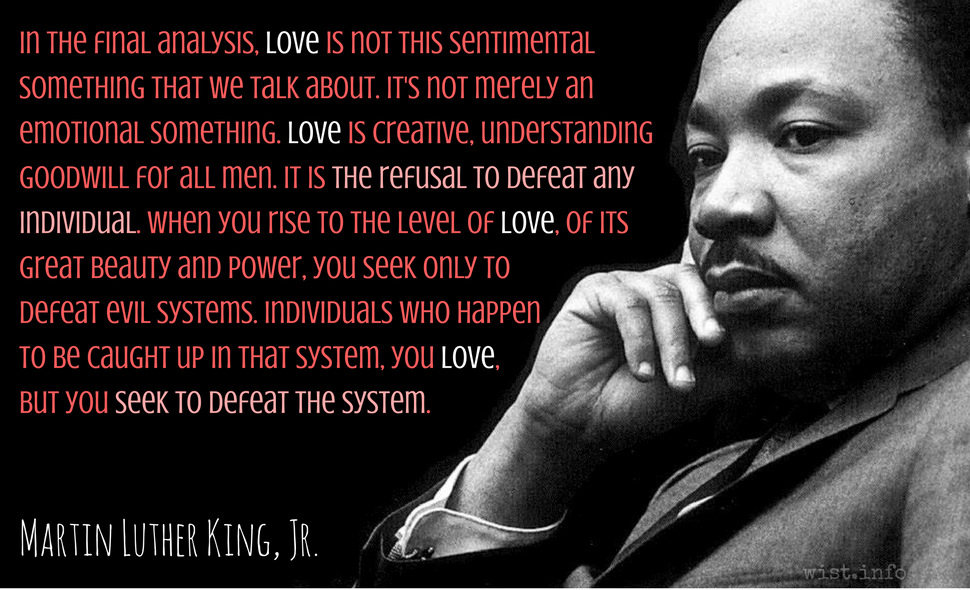
In the final analysis, love is not this sentimental something that we talk about. It’s not merely an emotional something. Love is creative, understanding goodwill for all men. It is the refusal to defeat any individual. When you rise to the level of love, of its great beauty and power, you seek only to defeat evil systems. Individuals who happen to be caught up in that system, you love, but you seek to defeat the system.
Martin Luther King, Jr. (1929–1968) American clergyman, civil rights leader, social activist, preacher
Sermon (1957-11-17), “Loving Your Enemies,” Dexter Avenue Baptist Church, Montgomery
(Source)
We must meet hate with love. We must meet physical force with soul force. There is still a voice crying out through the vista of time, saying: “Love your enemies , bless them that curse you, pray for them that despitefully use you.” Then, and only then, can you matriculate into the university of eternal life. That same voice cries out in terms lifted to cosmic proportions: “He who lives by the sword will perish by the sword.” And history is replete with the bleached bones of nations that failed to follow this command. We must follow nonviolence and love.
Martin Luther King, Jr. (1929–1968) American clergyman, civil rights leader, social activist, preacher
“Give Us the Ballot,” Speech, Prayer Pilgrimage for Freedom, Washington, DC (1957)
(Source)
For a man to love again where he is loved, it is the charity of publicans contracted by mutual profit and good offices; but to love a man’s enemies is one of the cunningest points of the law of Christ, and an imitation of the divine nature.
Francis Bacon (1561–1626) English philosopher, scientist, author, statesman
Sacred Meditations [Meditationes Sacræ], “Of the Exaltation of Charity” (1597)

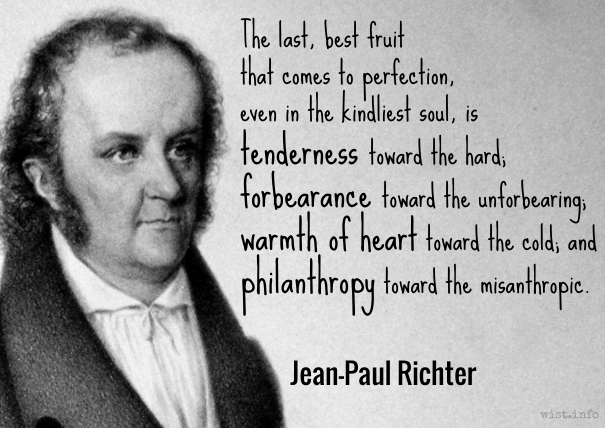
The last, best fruit that comes to perfection, even in the kindliest soul, is tenderness toward the hard; forbearance toward the unforbearing; warmth of heart toward the cold; and philanthropy toward the misanthropic.
Jean Paul Richter (1763–1825) German writer, art historian, philosopher, littérateur [Johann Paul Friedrich Richter; pseud. Jean Paul]
(Attributed)
Quoted in Josiah Hotchkiss Gilbert, Dictionary of Burning Words of Brilliant Writers (1895).

It is useless to try to adjudicate a long-standing animosity by asking who started it or who is the most wrong. The only sufficient answer is to give up the animosity and try forgiveness, to try to love our enemies and to talk to them and (if we pray) to pray for them. If we can’t do any of that, then we must begin again by trying to imagine our enemies’ children who, like our children, are in mortal danger because of enmity that they did not cause.
Wendell Berry (b. 1934) American farmer, educator, poet, conservationist
Essay (2003-02-09), “A Citizen’s Response,” sec. 4, Citizenship Papers (2003)
(Source)
The essay, including this passage, was also published in a longer form in Orion Magazine (2003-03/04), and collected in his Citizenship Papers (2003).

Beloved, never avenge yourselves, but leave room for the wrath of God, for it is written, “Vengeance is mine; I will repay, says the Lord.” Instead, “if your enemies are hungry, feed them; if they are thirsty, give them something to drink, for by doing this you will heap burning coals on their heads.” Do not be overcome by evil, but overcome evil with good.
[μὴ ἑαυτοὺς ἐκδικοῦντες, ἀγαπητοί, ἀλλὰ δότε τόπον τῇ ὀργῇ, γέγραπται γάρ, ” Ἐμοὶ ἐκδίκησις, ἐγὼ ἀνταποδώσω,” λέγει κύριος. ἀλλ᾽ ” ἐὰν πεινᾷ ὁ ἐχθρός σου, ψώμιζε αὐτόν· ἐὰν διψᾷ, πότιζε αὐτόν· τοῦτο γὰρ ποιῶν ἄνθρακας πυρὸς σωρεύσεις ἐπὶ τὴν κεφαλὴν αὐτοῦ.” μὴ νικῶ ὑπὸ τοῦ κακοῦ ἀλλὰ νίκα ἐν τῷ ἀγαθῷ τὸ κακόν.]
The Bible (The New Testament) (AD 1st - 2nd C) Christian sacred scripture
Book 6. Letter to the Romans 12:19ff (Rom 12:19–21) [NRSV (2021 ed.)]
(Source)
The two passages quoted are Deut. 32:35 and Proverbs 25:21-22.
(Source (Greek)). Other translations:Dearly beloved, avenge not yourselves, but rather give place unto wrath: for it is written, Vengeance is mine; I will repay, saith the Lord. Therefore if thine enemy hunger, feed him; if he thirst, give him drink: for in so doing thou shalt heap coals of fire on his head. Be not overcome of evil, but overcome evil with good.
[KJV (1611)]Never try to get revenge; leave that, my friends, to God's anger. As scripture says: vengeance is mine - I will pay them back, the Lord promises. But there is more: If your enemy is hungry, you should give him food, and if he is thirsty, let him drink. Thus you heap red-hot coals on his head. Resist evil and conquer it with good.
[JB (1966)]Never try to get revenge: leave that, my dear friends, to the Retribution. As scripture says: Vengeance is mine -- I will pay them back, the Lord promises. And more: If your enemy is hungry, give him something to eat; if thirsty, something to drink. By this, you will be heaping red-hot coals on his head. Do not be mastered by evil, but master evil with good.
[NJB (1985)]Never take revenge, my friends, but instead let God's anger do it. For the scripture says, “I will take revenge, I will pay back, says the Lord.” Instead, as the scripture says: “If your enemies are hungry, feed them; if they are thirsty, give them a drink; for by doing this you will make them burn with shame.” Do not let evil defeat you; instead, conquer evil with good.
[GNT (1992 ed.)]Don’t try to get revenge for yourselves, my dear friends, but leave room for God’s wrath. It is written, Revenge belongs to me; I will pay it back, says the Lord. Instead, If your enemy is hungry, feed him; if he is thirsty, give him a drink. By doing this, you will pile burning coals of fire upon his head. Don’t be defeated by evil, but defeat evil with good.
[CEB (2011)]