A good laugh is sunshine in a house.
William Makepeace Thackeray (1811–1863) English novelist
“On Love, Marriage, Men, and Women,” Sketches and Travels in London (1856)
(Source)
This particular line is widely attributed to Thackeray, but rarely cited. Part of the problem is that it is almost always given as "A good laugh is sunshine in the house," rather than "a house."
It is also sometimes cited to his famous novel Vanity Fair (1848), though the quotation cannot be found there.
Quotations about:
laugh
Note not all quotations have been tagged, so Search may find additional quotes on this topic.
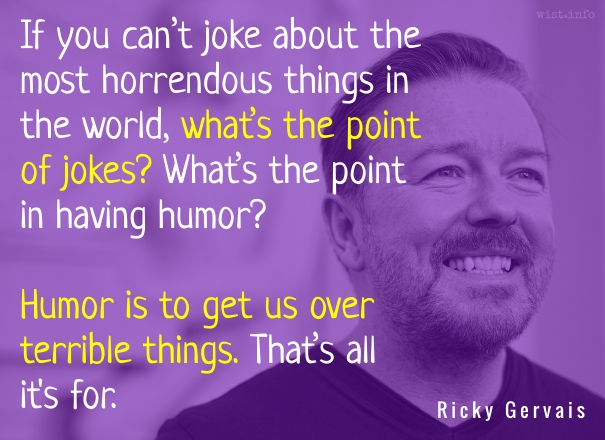
If you can’t joke about the most horrendous things in the world, what’s the point of jokes? What’s the point in having humor? Humor is to get us over terrible things. That’s all it’s for. That’s why you should laugh at funerals. Of course it’s the wrong thing to say. That’s why it’s funny.
Ricky Gervais (b. 1961) English comedian, actor, director, writer
Interview with Chris Heath, GQ (15 May 2013)
(Source)

He who laughs
Has not yet received
The terrible news.[Der Lachende
Hat die furchtbare Nachricht
Nur noch nicht empfangen.]Bertolt Brecht (1898–1956) German poet, playwright, director, dramaturgist
“To Those Born Later [An die Nachgeborenen],” (1938) [tr. Horton (2008)]
(Source)
Other translations: "He who laughs last has not yet heard the bad news," and "The man who laughs has simply not yet had the terrible news."
The title is also sometimes translated as "To Those Who Follow In Our Wake" and "To Those Born After."
Oddly enough, the German is sometimes given in paraphrase (or back-translated from the English): "Wer jetzt noch lacht, hat die neuesten Nachrichten noch nicht gehört." This German only appears to be found on quotation sites.

The most wasted of all days is that on which one has not laughed.
[La plus perdue de toutes les journées est celle où l’on n’a pas ri.]
Nicolas Chamfort (1741–1794) French writer, epigrammist (b. Nicolas-Sébastien Roch)
Products of Perfected Civilization [Produits de la Civilisation Perfectionée], Part 1 “Maxims and Thoughts [Maximes et Pensées],” ch. 1, ¶ 80 (1795) [tr. Morley (1887)]
(Source)
Often attributed to a more contemporary comedian (Groucho Marx, Charlie Chaplin) or writers such as Ben Burroughs, Grigori Alexandrov. It is arguably a clear enough sentiment that others might reinvent it.
(Source (French)). Other translations:The most lost of all days, is that in which we have not laughed.
[Source (1803)]The most completely lost of all days is that on which one has not laughed.
[Source (1891)]The worst wasted of all days is that during which one has not laughed.
[tr. Hutchinson (1902), "The Cynic's Breviary"]Of all days, the day on which one has not laughed is the one most surely wasted.
[tr. Mathers (1926)]That of all days is the most completely wasted in which one did not once laugh.
[tr. Merwin (1969)]The day that we have most lost is the one on which we have not laughed.
[Siniscalchi (1994)]
Other versions:More history of the quotation: A Day Without Laughter is a Day Wasted – Quote Investigator®.
- "A day without laughter is a day wasted." [attr. to Chaplin]
- "The most lost of all days is that in which one has not laughed."
- "The most wasted day of all is that in which we have not laughed."