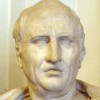
CALVIN: Isn’t it strange that evolution would give us a sense of humor? When you think about it, it’s weird that we have a physiological response to absurdity. We laugh at nonsense. We like it. We think it’s funny. Don’t you think it’s odd that we appreciate absurdity? Why would we develop that way? How does it benefit us?
HOBBES: I suppose if we couldn’t laugh at things that don’t make sense, we couldn’t react to a lot of life.
CALVIN: (after a pause) I can’t tell if that’s funny or really scary.
Quotations about:
absurdity
Note not all quotations have been tagged, so Search may find additional quotes on this topic.

A Flatterer never seems absurd:
The Flatter’d always take his Word.Benjamin Franklin (1706–1790) American statesman, scientist, philosopher, aphorist
Poor Richard (1740 ed.)
(Source)
Often an opinion, a custom, seems absurd when we are young, and advancing in life, we find the reason. Mustn’t we conclude that certain habits aren’t so ridiculous? One is lead to think sometimes that they were established by people who had read the entire book of life, and that they are judged by people who, despite their esprit, have only read a few pages.
[Souvent une opinion, une coutume commence à paraître absurde dans la première jeunesse, et en avançant dans la vie, on en trouve la raison; elle paraît moins absurde. En faudrait-il conclure que de certaines coutumes sont moins ridicules? On serait porté à penser quelquefois qu’elles ont été établies par des gens qui avaient lu le livre entier de la vie, et qu’elles sont jugées par des gens qui, malgré leur esprit, n’en ont lu que quelques pages.]
Nicolas Chamfort (1741–1794) French writer, epigrammist (b. Nicolas-Sébastien Roch)
Products of Perfected Civilization [Produits de la Civilisation Perfectionée], Part 1 “Maxims and Thoughts [Maximes et Pensées],” ch. 1, ¶ 21 (1795) [tr. Siniscalchi (1994)]
(Source)
Compare to also Chamfort.(Source (French)). Other translations:Often in early youth an opinion or custom seems absurd to us, which, with advancing years, we discover has some justification and so appears less absurd. Ought we to conclude from this that certain customs are not so ridiculous as others? One might sometimes be tempted to think that they were established by people who had read the book of life through, and that they are judged by those who, despite their intelligence, have only glanced at a few pages.
[tr. Hutchinson (1902)]Often an opinion or custom seems absurd to us in early youth; but as we advance in life we see the reason for it, and it appears less fatuous. Must we conclude from this that certain customs actually are less absurd? One is sometimes led to suppose that they have been established by folk who have read the whole of the book of life, and that they are criticized by those who, in spite of their intelligence, have only read a page or two at best.
[tr. Mathers (1926)]Often an opinion, a custom, seems absurd to begin with, when one is very young, and as one advances in life one learns the reason for it, and it seems less so. Must one conclude, then, that certain customs have become less ridiculous? At times one is drawn to the conclusion that they were established by persons who had read the book of life entire, and are judged by others who have read only a few pages.
[tr. Merwin (1969)]Often an opinion, or a custom, begins to seem absurd in one's early youth, and, as life advances, one finds the reason for it; it seems less absurd. Is one ot conclude that certain customs are less ridiculous? One would sometimes be inclined to think that they had been laid down by people who had read the entire book of life, and that they are judged by people who, in spite of their intellect, have only read a few pages of it.
[tr. Pearson (1973)]To the very young some opinions or customs seem absurd, but as you grow older you realize the reason behind them and they seem less absurd. Are we to conclude that certain customs aren't as ridiculous as they seem? There are times when you feel that they've been created by people who've read the book of life from cover to cover and that they're being judged by those who, however intelligent, have read only a few pages.
[tr. Parmée (2003), ¶ 20]

ROBIN: And those things do best please me
That befall prepost’rously.William Shakespeare (1564–1616) English dramatist and poet
Midsummer Night’s Dream, Act 3, sc. 2, ll. 122ff (3.2.122-123) (1605)
(Source)

It is customary to suppose that, if a belief is widespread, there must be something reasonable about it. I do not think this view can be held by anyone who has studied history. Practically all the beliefs of savages are absurd. In early civilizations there may be as much as one percent for which there is something to be said. In our own day …. But at this point I must be careful. We all know that there are absurd beliefs in Soviet Russia. If we are Protestants, we know that there are absurd beliefs among Catholics. If we are Catholics, we know that there are absurd beliefs among Protestants. If we are Conservatives, we are amazed by the superstitions to be found in the Labour Party. If we are Socialists, we are aghast at the credulity of Conservatives. I do not know, dear reader, what your beliefs may be, but whatever they may be, you must concede that nine-tenths of the beliefs of nine-tenths of mankind are totally irrational. The beliefs in question are, of course, those which you do not hold.
Bertrand Russell (1872–1970) English mathematician and philosopher
“Is There a God?” (1952)
(Source)
Essay commissioned by Illustrated magazine in 1952, but never published there. First publication in Russell, Last Philosophical Testament, 1943-68 (1997) [ed. Slater/Köllner].

Unless a thing is dignified, it cannot be undignified. Why is it funny that a man should sit down suddenly in the street? There is only one possible or intelligent reason: that man is the image of God. It is not funny that anything else should fall down; only that a man should fall down. No one sees anything funny in a tree falling down. No one sees a delicate absurdity in a stone falling down. No man stops in the road and roars with laughter at the sight of the snow coming down. The fall of thunderbolts is treated with some gravity. The fall of roofs and high buildings is taken seriously. It is only when a man tumbles down that we laugh. Why do we laugh? Because it is a grave religious matter: it is the Fall of Man. Only man can be absurd: for only man can be dignified.
Gilbert Keith Chesterton (1874–1936) English journalist and writer
“Spiritualism,” All Things Considered (1908)
(Source)
But in my college days I discovered that nothing can be imagined which is too strange or incredible to have been said by some philosopher.
[Mais ayant appris dès le collège qu’on ne sauroit rien imaginer de si étrange et si peu croyable, qu’il n’ait été dit par quelqu’un des philosophes.]
René Descartes (1596–1650) French philosopher, mathematician
Discourse on Method [Discours de la méthode], Part 2 (1637) [tr. Cottingham, Stoothoff (1985)]
(Source)
See Cicero. (Source (French)). Other translations:For having learnt from the very School, That one can imagin nothing so strange or incredible, which had not been said by some one of the Philosophers.
[tr. Newcombe ed. (1649)]But I had become aware, even so early as during my college life, that no opinion, however absurd and incredible, can be imagined, which has not been maintained by some on of the philosophers.
[tr. Veitch (1901)]But I had been taught, even in my College days, that there is nothing imaginable so strange or so little credible that it has not been maintained by one philosopher or another.
[tr. Haldane, Ross (1911)]One cannot conceive anything so strange and so implausible that it has not already been said by one philosopher or another.
Science is in far greater danger from the absence of challenge than from the coming of any number of even absurd challenges.
Isaac Asimov (1920–1992) Russian-American author, polymath, biochemist
“The Role of the Heretic,” Foreword to Donald W. Goldsmith (ed.), Scientists Confront Velikovsky (1977)
(Source)
I’m filled with a desire for clarity and meaning within a world and condition that offers neither.
Albert Camus (1913–1960) Algerian-French novelist, essayist, playwright
The Myth of Sisyphus” (1942)
Mass propaganda discovered that its audience was ready at all times to believe the worst, no matter how absurd, and did not particularly object to being deceived because it held every statement to be a lie anyhow. The totalitarian mass leaders based their propaganda on the correct psychological assumption that, under such conditions, one could make people believe the most fantastic statements one day, and trust if the next day they were given irrefutable proof of their falsehood, they would take refuge in cynicism; instead of deserting the leaders who had lied to them, they would protest that they had known all along the statement was a lie and would admire the leaders for their superior tactical cleverness.
Hannah Arendt (1906–1975) German-American philosopher, political theorist
Origins of Totalitarianism, Part 3, ch. 11 “The Totalitarian Movement,” sec. 2 (1951)
(Source)

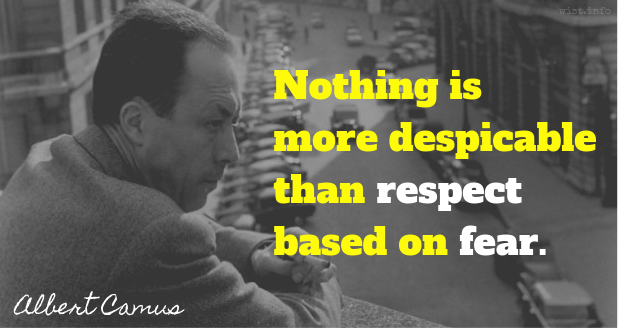
Always struck by the “comical” aspect of everything in Algeria connected with death. I find nothing more justified. Impossible to exaggerate the ridiculous quality of an event that is normally accompanied by sweat and gurgling. Similarly, it could not be too far demoted from the sacred status normally attributed to it. Nothing is more despicable than respect based on fear. And from this point of view, death is no more worthy of respect than Nero or the inspector at my local police station.
Albert Camus (1913–1960) Algerian-French novelist, essayist, playwright
Notebooks: 1935-1942, Notebook 3, Nov 1939 [tr. Thody (1963)]
(Source)
The most absurd customs and the most ridiculous ceremonies are everywhere excused by an appeal to the phrase, but that’s the tradition. This is exactly what the Hottentots say when Europeans ask them why they eat grasshoppers and devour their body lice. That’s the tradition, they explain.
[Les coutumes les plus absurdes, les étiquettes les plus ridicules, sont en France et ailleurs sous la protection de ce mot: c’est l’usage. C’est précisément ce même mot que répondent les Hottentots, quand les Européens leur demandent pourquoi ils mangent des sauterelles, pourquoi ils dévorent la vermine dont ils sont couverts. Ils disent aussi: c’est l’usage.]
Nicolas Chamfort (1741–1794) French writer, epigrammist (b. Nicolas-Sébastien Roch)
Products of Perfected Civilization [Produits de la Civilisation Perfectionée], Part 1 “Maxims and Thoughts [Maximes et Pensées],” ch. 3, ¶ 249 (1795) [tr. Mathers (1926)]
(Source)
(Source (French)). Other translations:The most absurd conventions, the most ridiculous formalities enjoy in France and elsewhere the protection of the phrase, "It's the custom.” It is the very phrase with which the Hottentots answer when the Europeans ask them why they eat grasshoppers, why they devour the vermin that crawl on them. They too say, “It’s the custom.”
[tr. Merwin (1969)]The most absurd habits, the most ridiculous matters of etiquette enjoy in France and elsewhere the protection afforded by this phrase: "It is the custom." It is precisely this phrase which Hottentots produce when Europeans ask them why they eat grasshoppers, and why they devour the vermin with which they are infested. They also say: "It is the custom."
[tr. Pearson (1973)]The most absurd customs, the most ridiculous etiquettes, are in France and elsewhere under the protection of this phrase: That's how things are. That is precisely the phrase that Hottentots say when Europeans ask them why they eat locusts; why they consume the vermin that they are covered in. They saÿ: "That's how things are."
[tr. Siniscalchi (1994)]In France and elsewhere, the most absurd customs and protocol are justified by the statement "It's always been done like that." That's exactly what Hottentots tell Europeans when asked why they feed on locusts or the vermin on their bodies: "It's what we've always done."
[tr. Parmée (2003), ¶161]
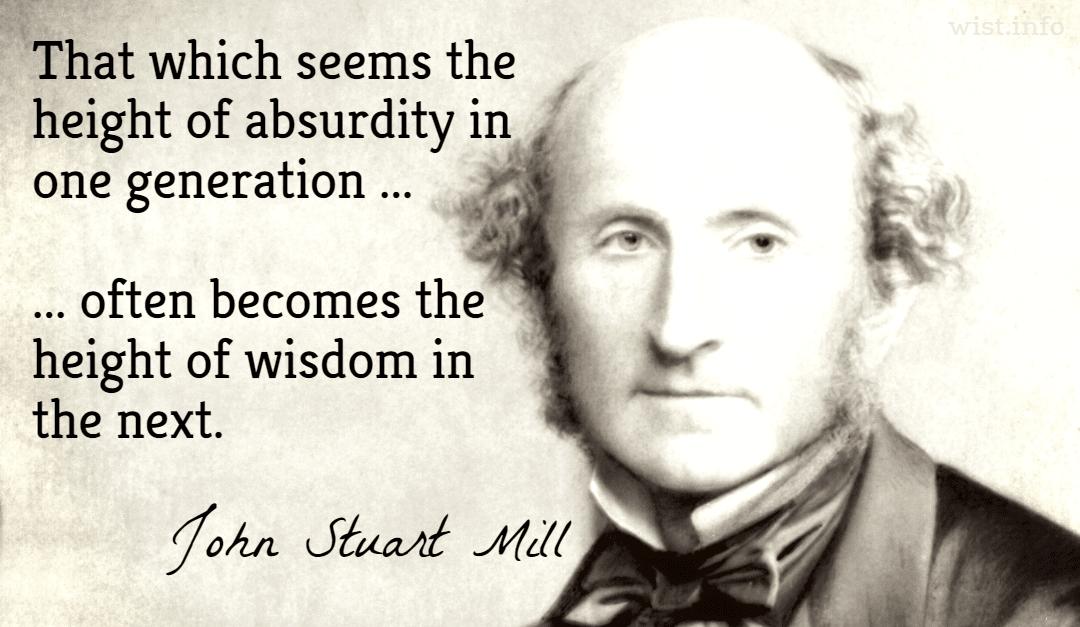
That which seems the height of absurdity in one generation often becomes the height of wisdom in the next.
John Stuart Mill (1806–1873) English philosopher and economist
(Attributed)
(Source)
Often cited from a quote in Adlai Stevenson, Call to Greatness (1954), but appears earlier in, e.g., National Magazine (Nov 1911). Unverified in Mills' writings.
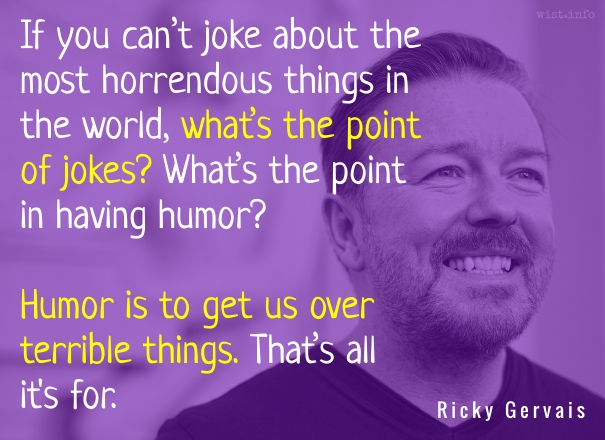
If you can’t joke about the most horrendous things in the world, what’s the point of jokes? What’s the point in having humor? Humor is to get us over terrible things. That’s all it’s for. That’s why you should laugh at funerals. Of course it’s the wrong thing to say. That’s why it’s funny.
Ricky Gervais (b. 1961) English comedian, actor, director, writer
Interview with Chris Heath, GQ (15 May 2013)
(Source)

Scientists have calculated that the chances of something so patently absurd actually existing are millions to one.
But magicians have calculated that million-to-one chances crop up nine times out of ten.

Every absurdity has now a champion to defend it: and as he is generally much in the wrong, so he has always much to say; for error is ever talkative.
Oliver Goldsmith (1730–1774) Irish poet, playwright, novelist
The Traveller: Or, A Prospect of Society (1764)
A sense of humor keen enough to show a man his own absurdities will keep him from the commission of all sins, or nearly all, save those that are worth committing.
Samuel Butler (1835–1902) English novelist, satirist, scholar
The Note-Books of Samuel Butler, ch. 1, “Life” (1912)
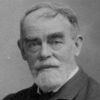
ABSURDITY, n. A statement or belief manifestly inconsistent with one’s own opinion.
Ambrose Bierce (1842–1914?) American writer and journalist
“Absurdity,” The Cynic’s Word Book (1906)
(Source)
Included in The Devil's Dictionary (1911).
Originally published in the "Cynic's Word Book" column in the New York American (1904-07-09) and the "Cynic's Dictionary" column in the San Francisco Examiner (1904-07-17.).
An earlier definition for this word appeared in the "Demon's Dictionary" column, San Francisco News Letter (1875-12-11).The argument of an opponent. A belief in which one has not had the misfortune to be instructed.
Not collected in later books.

The religion of one seems madnesse unto another.
Thomas Browne (1605–1682) English physician and author
Hydriotaphia, or Urne-Buriall, ch. 4 (1658)
(Source)
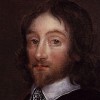
Almost all absurdity of conduct arises from the imitation of those whom we cannot resemble.
Samuel Johnson (1709–1784) English writer, lexicographer, critic
The Rambler, #135 (2 Jul 1751)
(Source)
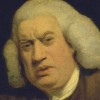
We have become blind to the alternatives to violence. This involves us in a sort of official madness, in which, while following what seems to be a perfect logic of self-defense and deterrence, we commit one absurdity after another: We seek to preserve peace by fighting a war, or to advance freedom by subsidizing dictatorships, or to “win the hearts and minds of the people” by poisoning their crops and burning their villages and confining them in concentration camps; we seek to uphold the “truth” of our cause with lies, or to answer conscientious dissent with threats and slurs and intimidations. […] All this is made frighteningly clear, in Vietnam, in our inability to control the swiftly widening discrepancy between what we are doing and what we say we are doing.
Wendell Berry (b. 1934) American farmer, educator, poet, conservationist
Speech (1968-02-10), “A Statement Against the War in Vietnam,” Kentucky Conference on the War and the Draft, University of Kentucky
(Source)
Collected in The Long-Legged House, Part 2 (1969).

Man, once surrendering his reason, has no remaining guard against absurdities the most monstrous, and like a ship without rudder is the sport of every wind. With such persons gullability which they call faith takes the helm from the hand of reason and the mind becomes a wreck.
Thomas Jefferson (1743–1826) American political philosopher, polymath, statesman, US President (1801–09)
Letter (1822-12-08) to James Smith
(Source)
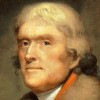
There is no absurdity, however palpable, which cannot be firmly implanted in the minds of all, if only one begins to inculcate it before the early age of six by constantly repeating it to them with an air of great solemnity.
[Es giebt keine Absurdität , die so handgreiflich wäre , daß man sie nicht allen Menden fest in den Kopf regen könnte, wenn man nur schon vor ihrem sechsten Jahre anfienge, sie ihnen einzuprägen, indem manunabläffig und mit feierlichstem Ernst sie ihnen vorsagte.]
Arthur Schopenhauer (1788–1860) German philosopher
Parerga and Paralipomena, Vol. 2, ch. 26 “Psychological Observations [Psychologische Bemerkungen],” § 344 (1851) [tr. Payne (1974)]
(Source)
(Source (German)). Other translations:There is no absurdity so palpable but that it may be firmly planted in the human head if you only begin to inculcate it before the age of five, by constantly repeating it with an air of great solemnity.
[tr. Saunders (1851)]There is no absurdity, however palpable it may be, which may not be fixed in the minds of all men, if it is inculcated before they are six years old by continual and earnest repetition.
[tr. Dircks(1897)]

I have complete faith in the continued absurdity of whatever’s going on.
Jon Stewart (b. 1962) American satirist, comedian, and television host. [b. Jonathan Stuart Leibowitz]
Interview, Philadelphia Inquirer (2007-04-22)
(Source)

Anyone who takes himself too seriously always runs the risk of looking ridiculous; anyone who can consistently laugh at himself does not.
Václav Havel (1936–2011) Czech playwright, essayist, dissident, politician
Disturbing the Peace, ch. 2 “Writing for the Stage” (1986) [tr. Wilson (1990)]
(Source)

Isn’t it the moment of most profound doubt that gives birth to new certainties? Perhaps hopelessness is the very soil that nourished human hope; perhaps one could never find sense in life without first experiencing its absurdity.
Václav Havel (1936–2011) Czech playwright, essayist, dissident, politician
Speech, Salzburg Festival (26 Jul 1990)
(Source)
For your race, in its poverty, has unquestionably one really effective weapon — laughter. Power, money, persuasion, supplication, persecution — these can lift at a colossal humbug — push it a little — weaken it a little, century by century; but only laughter can blow it to rags and atoms at a blast. Against the assault of laughter nothing can stand. You are always fussing and fighting with your other weapons. Do you ever use that one? No; you leave it lying rusting. As a race, do you ever use it at all? No; you lack sense and the courage.
Mark Twain (1835–1910) American writer [pseud. of Samuel Clemens]
Story (1916), The Mysterious Stranger, ch. 10
(Source)
Satan speaking. Often paraphrased: "The human race has one really effective weapon, and that is laughter."
The novella was published posthumously (and with significant alterations by Twain's executor).
The above is taken from the Paine-Duneka text. An earlier version (of this story and passage) appear in The Chronicle of Young Satan, ch. 10 (c. 1898-12):For your race, in its poverty, has unquestionably one really effective weapon -- laughter. Power, Money, Persuasion, Supplication, Persecution -- these can lift at a colossal humbug, -- push it a little -- crowd it a little -- weaken it a little, century by century: but only Laughter can blow it to rags and atoms at a blast. Against the assault of Laughter nothing can stand. You are always fussing and fighting with your other weapons: do you ever use that one? No, you leave it lying rusting. As a race, do you ever use it at all? No -- you lack sense and the courage.
Nonsense wakes up the brain cells. And it helps develop a sense of humor, which is awfully important in this day and age. Humor has a tremendous place in this sordid world. It’s more than just a matter of laughing. If you can see things out of whack, then you can see how things can be in whack.
Dr. Seuss (1904–1991) American author, illustrator [pseud. of Theodor Geisel]
“Author Isn’t Just a Cat in the Hat,” interview by Miles Corwin, Los Angeles Times (1983-11-27)
(Source)

Formerly there were those who said: You believe things that are incomprehensible, inconsistent, impossible because we have commanded you to believe them; go then and do what is unjust because we command it. Such people show admirable reasoning. Truly, whoever is able to make you absurd is able to make you unjust. If the God-given understanding of your mind does not resist a demand to believe what is impossible, then you will not resist a demand to do wrong to that God-given sense of justice in your heart. As soon as one faculty of your soul has been dominated, other faculties will follow as well. And from this derives all those crimes of religion which have overrun the world.
[Il y a eu des gens qui ont dit autrefois: Vous croyez des choses incompréhensibles, contradictoires, impossibles, parce que nous vous l’avons ordonné; faites donc des choses injustes parce que nous vous l’ordonnons. Ces gens-là raisonnaient à merveille. Certainement qui est en droit de vous rendre absurde est en droit de vous rendre injuste. Si vous n’opposez point aux ordres de croire l’impossible l’intelligence que Dieu a mise dans votre esprit, vous ne devez point opposer aux ordres de malfaire la justice que Dieu a mise dans votre coeur. Une faculté de votre âme étant une fois tyrannisée, toutes les autres facultés doivent l’être également. Et c’est là ce qui a produit tous les crimes religieux dont la terre a été inondée.]
Voltaire (1694–1778) French writer [pseud. of Francois-Marie Arouet]
Questions sur les miracles (1765)
(Source)
Commonly translated: "Those who can make you believe absurdities can make you commit atrocities."


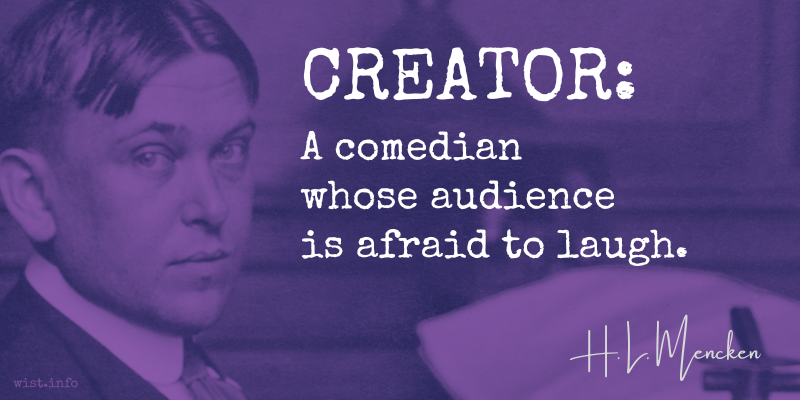
CREATOR. A comedian whose audience is afraid to laugh.
H. L. Mencken (1880–1956) American writer and journalist [Henry Lewis Mencken]
A Book of Burlesques, “The Jazz Webster” (1924)
(Source)
The A Little Book in C Major, ch. 4, § 18 (1916), has an alternate definition. This was expanded in Burlesques to include the above, which then became the sole definition in Chrestomathy, ch. 30 "Sententiae" (1949).
Sometimes misattributed to Voltaire.
Somehow or other no statement is too absurd for some philosophers to make.
[Sed nescio quo modo nihil tam absurde dici potest quod non dicatur ab aliquo philosophorum.]
Marcus Tullius Cicero (106–43 BC) Roman orator, statesman, philosopher
De Divinatione [On Divination], Book 2, ch. 58 (2.58) / sec. 119 (45 BC) [tr. Falconer (1923)]
(Source)