

CICERO: Indeed, it is a strange-disposèd time.
But men may construe things after their fashion,
Clean from the purpose of the things themselves.William Shakespeare (1564–1616) English dramatist and poet
Julius Caesar, Act 1, sc. 3, l. 33ff (1.3.33–35) (1599)
(Source)
Quotations about:
strangeness
Note not all quotations have been tagged, so Search may find additional quotes on this topic.

My dear fellow, life is infinitely stranger than anything which the mind of man could invent. We would not dare to conceive the things which are really mere commonplaces of existence. If we could fly out of that window hand in hand, hover over this great city, gently remove the roofs, and peep in at the queer things which are going on, the strange coincidences, the plannings, the cross-purposes, the wonderful chains of events, working through generations, and leading to the most outré results, it would make all fiction with its conventionalities and foreseen conclusions most stale and unprofitable.
Arthur Conan Doyle (1859–1930) British writer and physician
Story (1891-09), “A Case of Identity,” [Holmes], The Strand Magazine, Vol. 2, No. 3
(Source)
“You will remember that I remarked the other day, just before we went into the very simple problem presented by Miss Mary Sutherland, that for strange effects and extraordinary combinations we must go to life itself, which is always far more daring than any effort of the imagination.”
“A proposition which I took the liberty of doubting.”
“You did, Doctor, but none the less you must come round to my view, for otherwise I shall keep on piling fact upon fact on you until your reason breaks down under them and acknowledges me to be right.”Arthur Conan Doyle (1859–1930) British writer and physician
Story (1891-08), “The Red-Headed League,” The Strand Magazine, Vol. 2, No. 2
(Source)
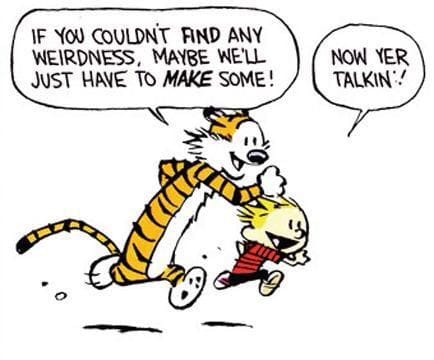
HOBBES: If you couldn’t find any weirdness, maybe we’ll just have to make some!

Will thou know what wonders strange be in the land that late was found?
Will thou learn thy life to lead, by divers ways that godly be?
Will thou of virtue and vice understand the very ground?
Will thou see this wretched world, how full it is of vanity?
[Vis nova monstra, novo dudum nunc orbe reperto?
Vivendi varia uis ratione modos?
Vis qui virtutum fontes, vis unde malorum
Principia? et quantum rebus inane latet?]Thomas More (1478–1535) English lawyer, social philosopher, statesman, humanist, Christian martyr
Utopia, “A Meter of Four Verses in the Utopian Tongue,” “Cornelius Graphey to the Reader” (1516 ed.) [tr. Open Utopia (Duncombe) (2012)]
(Source)
Included in an Appendix from the original (1516) edition, but not in the second (1518). As such, it only shows up in Robynson's translation (and in those who modernized it).
(Source (Latin)). Other translations:Wilt thou knowe what wonders straunge be in the lande that late was founde?
Wilte thou learne thy life to leade by divers ways that godly be?
Wilt thou of vertue and of vice understande the very grounde?
Wilt thou see this wretched world, how ful it is of vanitie?
[tr. Robynson (1551)]Wilt thou know what wonders strange be in the land that late was found?
Wilt thou learn thy life to lead by divers ways that godly be?
Wilt thou of virtue and of vice understand the very ground?
Wilt thou see this wretched world, how full it is of vanity?
[tr. Robynson/Lupton/Armes (1911)]

Strange roads have strange guides.
Ursula K. Le Guin (1929–2018) American writer
The Farthest Shore, “Lorbanery” [Sparrowhawk] (1972)
(Source)

“You,” said Sally Mills, “are very strange.”
“Only,” said Dirk, “as strange as I need to be.”Douglas Adams (1952–2001) English author, humorist, screenwriter
Dirk Gently No. 2, The Long Dark Tea-Time of the Soul, ch. 10 (1988)
(Source)

‘T is strange — but true; for truth is always strange;
Stranger than fiction; if it could be told,
How much would novels gain by the exchange!
How differently the world would men behold!George Gordon, Lord Byron (1788–1824) English poet
Don Juan, Canto 14, st. 101 (1823)
(Source)
Apparent origin of the phrase "Truth is stranger than fiction."
By day the bat is cousin to the mouse.
He likes the attic of an aging house.
His fingers make a hat about his head.
His pulse beat is so slow we think him dead.
He loops in crazy figures half the night
Among the trees that face the corner light.
But when he brushes up against a screen,
We are afraid of what our eyes have seen:
For something is amiss or out of place
When mice with wings can wear a human face.

Originality is a thing we constantly clamour for, and constantly quarrel with; as if, observes our author himself, any originality but our own could be expected to content us! In fact all strange thing are apt, without fault of theirs, to estrange us at first view, and unhappily scarcely anything is perfectly plain, but what is also perfectly common.
Thomas Carlyle (1795–1881) Scottish essayist and historian
“Jean Paul Friedrich Richter,” Edinburgh Review No. 91, Art. 7 (1827-06)
(Source)
A review of Heinrich Döring, Jean Paul Friedrich Richter's Life, with a Sketch of His Works (1826).
Beauty always has an element of strangeness. I do not mean a deliberate cold form of strangeness, for in that case it would be a monstrous thing that had jumped the rails of life. But I do mean that it always contains a certain degree of strangeness, of simple, unintended, unconscious strangeness, and that this form of strangeness is what gives it the right to be called beauty.
[Le Beau est toujours bizarre. Je ne veux pas dire qu’il soit volontairement, froidement bizarre, car dans ce cas il serait un monstre sorti des rails de la vie. Je dis qu’il contient toujours un peu de bizarrerie, de bizarrerie naive, non voulue, inconsciente, et que c’est cette bizarrerie qui le fait être particulièrement le Beau.]
Charles Baudelaire (1821–1867) French poet, essayist, art critic
“The Universal Exhibition of 1855 [Exposition Universelle de 1855],” sec. 1 (1855) [tr. Charvet (1972)]
(Source)
Frequently paraphrased as "Strangeness is a necessary ingredient in beauty." See also Bacon.
Collected in Curiosités Esthétiques, ch. 4 (1868). (Source (French)). Other translations:The Beautiful is always strange. I do not mean that it is coldly, deliberately strange, for in that case it would be a monstrosity that had jumped the rails of life. I mean that it always contains a touch of strangeness, of simple, unpremeditated and unconscious strangeness, and that it is in this touch of strangeness that gives it its particular quality as Beauty.
[tr. Mayne (1965)]Beauty is always bizarre. I do not mean to say that it is deliberately, coldly bizarre, for in that case it would be a monster that has escaped from the confines of existence. I mean that it always contains a certain amount of strangeness, naïve strangeness, unforced and even unconscious, and that it is this strangeness that stamps it as Beautiful.
[tr. Gregory (1961)]

But in my college days I discovered that nothing can be imagined which is too strange or incredible to have been said by some philosopher.
[Mais ayant appris dès le collège qu’on ne sauroit rien imaginer de si étrange et si peu croyable, qu’il n’ait été dit par quelqu’un des philosophes.]
René Descartes (1596–1650) French philosopher, mathematician
Discourse on Method [Discours de la méthode], Part 2 (1637) [tr. Cottingham, Stoothoff (1985)]
(Source)
See Cicero. (Source (French)). Other translations:For having learnt from the very School, That one can imagin nothing so strange or incredible, which had not been said by some one of the Philosophers.
[tr. Newcombe ed. (1649)]But I had become aware, even so early as during my college life, that no opinion, however absurd and incredible, can be imagined, which has not been maintained by some on of the philosophers.
[tr. Veitch (1901)]But I had been taught, even in my College days, that there is nothing imaginable so strange or so little credible that it has not been maintained by one philosopher or another.
[tr. Haldane, Ross (1911)]One cannot conceive anything so strange and so implausible that it has not already been said by one philosopher or another.
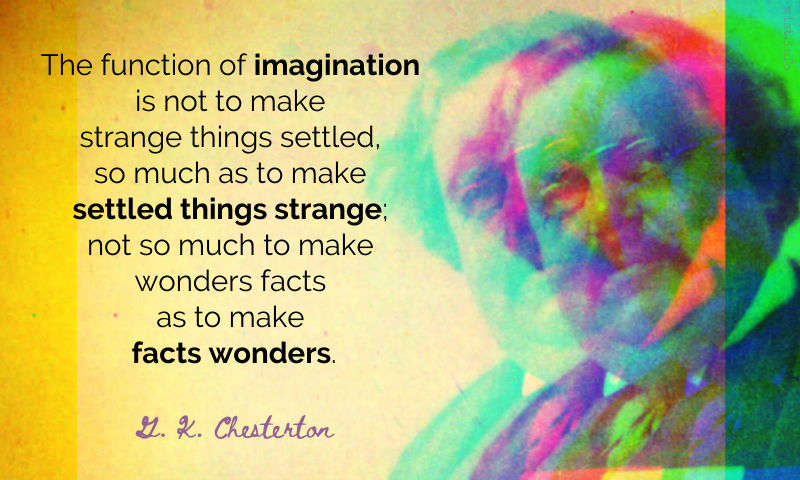
The function of imagination is not to make strange things settled, so much as to make settled things strange; not so much to make wonders facts as to make facts wonders.
Gilbert Keith Chesterton (1874–1936) English journalist and writer
The Defendant, ch. 7 “A Defence of China Shepherdesses” (1901)
(Source)

No, your seriously steeped-in-madness dabbler in the esoteric sciences usually finds themself taxed with a rag-tag collection of hangers-on, typically consisting of minions, constructs, adventurers, and those unique, unclassifiable, individuals whose raison d’être appears to be to remind us of what a strange world it is.
Phil Foglio (b. 1956) American writer, cartoonist
Agatha H. and the Siege of Mechanicsburg (2020) [with Kaja Foglio]

The most absurd customs and the most ridiculous ceremonies are everywhere excused by an appeal to the phrase, but that’s the tradition. This is exactly what the Hottentots say when Europeans ask them why they eat grasshoppers and devour their body lice. That’s the tradition, they explain.
[Les coutumes les plus absurdes, les étiquettes les plus ridicules, sont en France et ailleurs sous la protection de ce mot: c’est l’usage. C’est précisément ce même mot que répondent les Hottentots, quand les Européens leur demandent pourquoi ils mangent des sauterelles, pourquoi ils dévorent la vermine dont ils sont couverts. Ils disent aussi: c’est l’usage.]
Nicolas Chamfort (1741–1794) French writer, epigrammist (b. Nicolas-Sébastien Roch)
Products of Perfected Civilization [Produits de la Civilisation Perfectionée], Part 1 “Maxims and Thoughts [Maximes et Pensées],” ch. 3, ¶ 249 (1795) [tr. Mathers (1926)]
(Source)
(Source (French)). Other translations:The most absurd conventions, the most ridiculous formalities enjoy in France and elsewhere the protection of the phrase, "It's the custom.” It is the very phrase with which the Hottentots answer when the Europeans ask them why they eat grasshoppers, why they devour the vermin that crawl on them. They too say, “It’s the custom.”
[tr. Merwin (1969)]The most absurd habits, the most ridiculous matters of etiquette enjoy in France and elsewhere the protection afforded by this phrase: "It is the custom." It is precisely this phrase which Hottentots produce when Europeans ask them why they eat grasshoppers, and why they devour the vermin with which they are infested. They also say: "It is the custom."
[tr. Pearson (1973)]The most absurd customs, the most ridiculous etiquettes, are in France and elsewhere under the protection of this phrase: That's how things are. That is precisely the phrase that Hottentots say when Europeans ask them why they eat locusts; why they consume the vermin that they are covered in. They saÿ: "That's how things are."
[tr. Siniscalchi (1994)]In France and elsewhere, the most absurd customs and protocol are justified by the statement "It's always been done like that." That's exactly what Hottentots tell Europeans when asked why they feed on locusts or the vermin on their bodies: "It's what we've always done."
[tr. Parmée (2003), ¶161]

Dear sire, and offspring worthy of your fire!
We bards are dupes to what ourselves admire.
Would I be brief — I grow confused and coarse;
Who aims at smoothness, fails in fire and force;
In him who soars aloft, bombast is found;
Who fears to face the tempest, crawls aground.
Who courts variety and fain would ring
A thousand changes on the self-same string,
Will paint, as ’twere in fancy’s wildest mood
Boars in the wave and dolphins in the wood.
Thus even error, shun’d without address,
Breeds error, diff’rent in its kind, not less.[Maxima pars vatum, pater et iuvenes patre digni,
decipimur specie recti: brevis esse laboro,
obscurus fio; sectantem levia nervi
deficiunt animique; professus grandia turget;
serpit humi tutus nimium timidusque procellae:
qui variare cupit rem prodigialiter unam,
delphinum silvis adpingit, fluctibus aprum:
in vitium ducit culpae fuga, si caret arte.]Horace (65–8 BC) Roman poet, satirist, soldier, politician [Quintus Horatius Flaccus]
Epistles [Epistularum, Letters], Book 2, ep. 3 “Art of Poetry [Ars Poetica; To the Pisos],” l. 24ff (2.3.24-31) (19 BC) [tr. Howes (1845)]
(Source)
(Source (Latin)). Other translations:The more deale of us Poets, both the olde, and younge most parte,
Are ofte begylde by shewe of good, affectinge to muche arte.
I laboure to be verye breife, it makes me verye harde.
I followe flowinge easynes, my style is clearely marde
For lacke of pith and saverye sence, Write loftie, thou shalte swell:
He creepes by the grounde to lowe, afrayde with stormie vayne to mell.
He that in varyinge one pointe muche would bringe forth monstruouse store,
Would make the dolphin dwell in wooddes and in the flud the bore.
The shunning of a faulte is such that now and then it will
Procure a greater faulte, if it be not eschewde by skill.
[tr. Drant (1567)]The greater part, that boast the Muses fire
Father, and sons right worthy of your Sire,
Are with the likenesse of the truth beguil'd:
My selfe for shortnesse labour, and am stil'd
Obscure. Another striving smooth to runne,
Wants strength, and sinewes, as his spirits were done;
His Muse professing height, and greatnesse, swells;
Downe close by shore, this other creeping steales,
Being over-safe, and fearing of the flaw:
So he that varying still affects to draw
One thing prodigiously, paints in the woods
A Dolphin and a Boare amidst the floods:
The shunning vice, to greater vice doth lead,
If in th'escape an artlesse path we tread.
[tr. Jonson (1640), l. 33ff]Most Poets fall into the grossest faults,
Deluded by a seeming Excellence:
By striving to be short, they grow Obscure,
And when they would write smoothly they want strength,
Their Spirits sink; while others that affect,
A lofty Stile, swell to a Tympany;
Some timerous wretches start at every blast,
And fearing Tempests, dare not leave the Shore.
Others in love with wild variety,
Draw Boars in Waves, and Dolphins in a Wood;
Thus fear of Erring, joyn'd with want of Skill,
Is a most certain way of Erring still.
[tr. Roscommon (1680)]But oft, our greatest errors take their rise
From our best views. I strive to be concise;
I prove obscure. My strength, my fire decays,
When in pursuit of elegance and ease.
Aiming at greatness, some to fustian soar;
Some in cold safety creep along the shore,
Too much afraid of storms; while he, who tries
With ever-varying wonders to surprise,
In the broad forest bids his dolphins play,
And paints his boars disporting in the sea.
Thus, injudicious, while one fault we shun,
Into its opposite extreme we run.
[tr. Francis (1747)]Lov'd sire! lov'd sons, well worthy such a sire!
Most bards are dupes to beauties they admire.
Proud to be brief, for brevity must please,
I grow obscure; the follower of ease
Wants nerve and soul; the lover of sublime
Swells to bombast; while he who dreads that crime,
Too fearful of the whirlwind rising round,
A wretched reptile, creeps along the ground.
The bard, ambitious fancies who displays,
And tortures one poor thought a thousand ways,
Heaps prodigies on prodigies; in woods
Pictures the dolphin, and the boar in floods!
Thus ev'n the fear of faults to faults betrays,
Unless a master-hand conduct the lays.
[tr. Coleman (1783)]Most of us poets -- O father, and sons worthy of your father, -- are misled by our idea of what is correct. I try to be terse, and end by being obscure; another strives after smoothness, to the sacrifice of vigour and spirit; a third aims at grandeur, and drops into bombast; a fourth, through an excess of caution and fear of squalls, goes creeping along the ground. He who is bent on lending variety to a theme that is by nature uniform, so as to produce an unnatural effect, is like a man who paints a dolphin in a forest or a wild boar in the waves. If artistic feeling is not there, mere avoidance of a fault leads to some worse defect.
[tr. Blakeney (1828)]The great majority of us poets, father, and youths worthy such a father, are misled by the appearance of right. I labor to be concise, I become obscure: nerves and spirit fail him, that aims at the easy: one, that pretends to be sublime, proves bombastical: he who is too cautious and fearful of the storm, crawls along the ground: he who wants to vary his subject in a marvelous manner, paints the dolphin in the woods, the boar in the sea. The avoiding of an error leads to a fault, if it lack skill.
[tr. Smart/Buckley (1853)]Ye worthy trio! we poor sons of song
Oft find 'tis fancied right that leads us wrong.
I prove obscure in trying to be terse;
Attempts at ease emasculate my verse;
Who aims at grandeur into bombast falls;
Who fears to stretch his pinions creeps and crawls;
Who hopes by strange variety to please
Puts dolphins among forests, boars in seas.
Thus zeal to 'scape from error, if unchecked
By sense of art, creates a new defect.
[tr. Conington (1874)]We poets, most of us, by the pretence,
Dear friends, are duped of seeming excellence.
We grow obscure in striving to be terse;
Aiming at ease, we enervate our verse;
For grandeur soaring, into bombast fall,
And, dreading that, like merest reptiles crawl;
Whilst he, who seeks his readers to surprise
With common things shown in uncommon wise,
Will make his dolphins through the forests roam.
His wild boars ride upon the billows' foam.
So unskilled writers, in their haste to shun
One fault, are apt into a worse to run.
[tr. Martin (1881)]The greater part of us poets, O ye Father and Sons worthy of your parent, deceive ourselves under our illusion of what is right. I strive to write briefly, and so write obscurely. Compositions of a smooth nature argue a writer's deficiency both in force and spirit. An attempt at great subjects swells into bombast. A too cautious writer, and dreader of opposition, confines himself to common things. One who desires to amplify a single theme in an extravagant way, puts a dophin innto a wood, and a wild boar into the sea. The avoidance of one error, if unguarded by art, leads to another.
[tr. Elgood (1893)]Most of us poets are misled by insistence upon our idea of what is right. I try to be brief and I become obscure; aiming at smoothness, we lose in vigor and spirit; attempting the sublime, we become turgid. Timid of the storm, we crawl along the ground. Thus if one lacks art, the over careful avoidance of one fault leads to another.
[tr. Dana/Dana (1911)]Most of us poets, O father and ye sons worthy of the father, deceive ourselves by the semblance of truth. Striving to be brief, I become obscure. Aiming at smoothness, I fail in force and fire. One promising grandeur, is bombastic; another, overcautious and fearful of the gale, creeps along the ground. The man who tries to vary a single subject in monstrous fashion, is like a painter adding a dolphin to the woods, a boar to the waves. Shunning a fault may lead to error, if there be lack of art.
[tr. Fairclough (Loeb) (1926)]O father, and sons who deserve a father like yours,
We poets are too often tricked into trying to achieve
A particular kind of perfection: I studiously try
To be brief, and become obscure; I try to be smooth,
And my vigor and force disappear; another assures us
Of something big which turns out to be merely pompous.
Another one crawls on the ground because he's too safe,
Too much afraid of the storm. The poet who strives
To vary his single subject in wonderful ways
Paints dolphins in woods and foaming boars on the waves.
Avoiding mistakes, if awkwardly done, leads to an error.
[tr. Palmer Bovie (1959)]Most poets, father and young men deserving such a father,
go wrong in trying to be right: I struggle for concision,
I wind up being obscure; others try for smoothness
and lose strength, or for sublimit, and get gas.
One poet, too cautious, fears storms and craws along,
the other craves bizarre variety in a single subject
and paints a dolphin in a forest, a boar among the waves.
Fear of criticism leads to faults if we lack art.
[tr. Fuchs (1977)]Most poets, leaders and led,
Chase a will-o’-the-wisp of abstract Right.
Thus:
I aim
at concision,
I hit
on darkness.
I aim to be smooth, my lines go slack.
The eloquent idealist rants and raves,
The timid, the gutless, crawl like beetles,
Seekers after novelty hang dolphins in trees,
Float a boar in the sea:
O rare effects!
O marvelous.
Ugh.
[tr. Raffel (1983 ed.)]Father and worthy sons, we poets often
Know what we're aiming at, and often we miss.
I try my best to be terse, and I'm obscure;
I try for mellifluous smoothness, smooth as can be,
And the line comes out as spineless as a worm;
One poet, aiming for grandeur, booms and blusters;
Another one, scared, creeps his way under the storm;
And another, desiring to vary his single theme
In wonderful ways, produces not wonders but monsters --
Dolphins up in the trees, pigs in the ocean.
If you don't know what you're doing you can go wrong
Just out of trying to do your best to do right.
[tr. Ferry (2001)]Poets in the main (I’m speaking to a father and his excellent sons)
are baffled by the outer form of what’s right. I strive to be brief,
and become obscure; I try for smoothness, and instantly lose
muscle and spirit; to aim at grandeur invites inflation;
excessive caution or fear of the wind induces groveling.
The man who brings in marvels to vary a simple theme
is painting a dolphin among the trees, a boar in the billows.
Avoiding a fault will lead to error if art is missing.
[tr. Rudd (2005 ed.)]Most poets (dear sir, and you sons worthy of your sire),
Are beguiled by accepted form. I try to be brief
And become obscure: aiming at smoothness I fail
In strength and spirit: claiming grandeur he’s turgid:
Too cautious, fearing the blast, he crawls on the ground:
But the man who wants to distort something unnaturally
Paints a dolphin among the trees, a boar in the waves.
Avoiding faults leads to error, if art is lacking.
[tr. Kline (2015)]
There is no excellent beauty that hath not some strangeness in the proportion.
Francis Bacon (1561–1626) English philosopher, scientist, author, statesman
Essay (1612), “Of Beauty,” Essays, No. 43 (1625)
(Source)
See Baudelaire (1855).

TOUCHSTONE: We that are true lovers run into strange capers.
William Shakespeare (1564–1616) English dramatist and poet
As You Like It, Act 2, sc. 4, l. 53ff (2.4.53) (1599)
(Source)