

Not being able to control events, I control myself, and adapt myself to them if they do not adapt themselves to me.
[Ne pouvant regler les evenemens, je me regle moy-mesme : & m’applique à eux, s’ils ne s’appliquent à moy.]
Michel de Montaigne (1533–1592) French essayist
Essays, Book 2, ch. 17 (2.17), “Of Presumption [De la Presomption]” (1578) [tr. Cohen (1958)]
(Source)
This essay appeared in the 1st (1580) edition, and was expanded in succeeding editions. This passage was added in the 2nd (1588) edition.
(Source (French)). Other translations:Being unable to direct events, I governe my selfe; and if they apply not themselves to me, I apply my selfe to them.
[tr. Florio (1603)]Not being to govern events I govern myself, and apply myself to them, if they do not apply themselves to me.
[tr. Cotton (1686)]Not being able to govern events, I govern myself, and apply myself to them, if they will not apply themselves to me.
[tr. Cotton/Hazlitt (1877)]Being unable to regulate events, I regulate myself, and adapt myself to them if they do not adapt themselves to me.
[tr. Ives (1925)]Not being able to rule events, I rule myself, and adapt myself to them if they do not adapt themselves to me.
[tr. Frame (1943)]Not being able to control events I control myself: if they will not adapt to me then I adapt to them.
[tr. Screech (1987)]Since I cannot control events, I take control of myself and suit myself to them, if they do not suit me.
[tr. Atkinson/Sices (2012)]
Quotations about:
events
Note not all quotations have been tagged, so Search may find additional quotes on this topic.

Happy that nation, fortunate that age, whose history is not diverting.
Benjamin Franklin (1706–1790) American statesman, scientist, philosopher, aphorist
Poor Richard (1740 ed.)
(Source)
Cumulative errors depend largely on the big surprises, the big opportunities. Not only do economic, financial, and political predictors miss them, but they are quite ashamed to say anything outlandish to their clients — and yet events, it turns out, are almost always outlandish.
Nassim Nicholas Taleb (b. 1960) Lebanese-American essayist, statistician, risk analyst, aphorist
The Black Swan, Part 2, ch. 10 “The Scandal of Prediction” (2007)
(Source)

History is opaque. You see what comes out, not the script that produces events, the generator of history. There is a fundamental incompleteness in your grasp of such events, since you do not see what’s inside the box, how the mechanisms work. What I call the generator of historical events is different from the events themselves, much as the minds of the gods cannot be read just by witnessing their deeds. You are very likely to be fooled about their intentions.
Nassim Nicholas Taleb (b. 1960) Lebanese-American essayist, statistician, risk analyst, aphorist
The Black Swan, Part 1, ch. 1 “The Apprenticeship of an Empirical Skeptic” (2007)
(Source)
Let not these things thy least concern engage;
For though thou fret, they will not mind thy rage.
Him only good and happy we may call
Who rightly useth what doth him befall.
[τοῖς πράγμασιν γὰρ οὐχὶ θυμοῦσθαι χρεών:
μέλει γὰρ αὐτοῖς οὐδέν: ἀλλ᾽ οὑντυγχάνων
τὰ πράγματ᾽ ὀρθῶς ἂν τιθῇ, πράσσει καλῶς]Euripides (485?-406? BC) Greek tragic dramatist
Bellerophon [Βελλεροφῶν], frag. 287 (TGF) (c. 430 BC) [Morgan (1718)]
(Source)
Quoted in Plutarch, "De Tranquilitate Animi [On the Contentedness of the Mind]," sec. 4. (467a). Nauck frag. 287, Barnes frag. 132, Musgrave frag. 24.
(Source (Greek)). Other translations:Nor ought we to be angry at Events;
For they our anger heed not: but the man
Who best to each emergency adapts
His conduct, will assuredly act right.
[tr. Wodhull (1809)]Events will take their course, it is no good
Our being angry at them; he is happiest
Who wisely turns them to the best account.
[tr. Shilleto (1888), frag. 298]It does no good to rage at circumstance;
Events will take their course with no regard
For us. but he who makes the best of those
Events he lights upon will not fare ill.
[tr. Helmbold (1939)]There is no point in getting angry at circumstances. They are uncaring, utterly unconcerned.
But a man who responds to them in the right way, he fares well.
[tr. Stevens (2012)]One should not get angry with affairs, for they show no concern; but if a man handles affairs correctly as he encounters them, he fares well.
[tr. Collard, Hargreaves, Cropp (1995)]
Perhaps the hardest thing for humans to do is to imagine the world as it is imagined by others. We tend to confuse acting in accordance with the goals and values of the society in which we live with rationality; we tend to confuse intelligence with thinking in accordance with those goals and values. And, of course, we are always inclined to see events as predetermined — and we are almost always wrong.
Masha Gessen (b. 1967) Russian-American journalist, author, translator, activist
“The Fundamental Uncertainty of Mueller’s Russia Indictments,” The New Yorker (20 Feb 2018)
(Source)

Now and then it occurs to one to reflect upon what slender threads of accident depend the most important circumstances of his life; to look back and shudder, realizing how close to the edge of nothingness his being has come.
Upton Sinclair (1878–1968) American writer, journalist, activist, politician
100%: the Story of a Patriot, Sec. 1 (1920)
(Source)
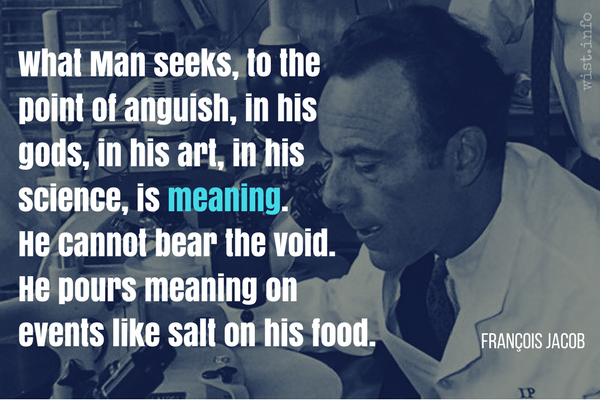
What Man seeks, to the point of anguish, in his gods, in his art, in his science, is meaning. He cannot bear the void. He pours meaning on events like salt on his food. He denies that life bounces along at random, at the mercy of events, in sound and in fury. He wants it always to be directed, aimed toward a goal, like an arrow.
François Jacob (1920–2013) French biologist, Nobel prize winner in Medicine
The Statue Within: An Autobiography (1987) [tr. Philip (1988)]
(Source)
A talent forms itself in solitude,
A character amid the stream of life.[Es bildet ein Talent sich in der Stille,
Sich ein Charakter in dem Strom der Welt.]Johann Wolfgang von Goethe (1749–1832) German poet, statesman, scientist
Torquato Tasso, Act 1, sc. 2, ll. 304-305 [Leonora] (1790) [tr. Ryder (1993)]
(Source)
(Source (German)). Other translations:
- "A talent doth in stillness form itself -- / A character on life's unquiet stream." [tr. Des Voeux (1827)]
- "Talents are nurtured best in solitude, -- / A character on life's tempestuous sea." [tr. Swanwick (1843)]
- "Man's talent ripens in tranquility, / His character in battling with the world." [tr. Cartwright (1861)]
- "A talent in tranquility is formed, / A character in the turbulence of affairs." [tr. Hamburger (20th C)]
- "Talent develops in quiet places, / Character in the full current of human life."
- Talents are best nurtured in solitude; / Character is best formed in the stormy billows of the world.
- "Genius is formed in quiet, / Character in the stream of human life."

I am weary of reading Newspapers. The Times are so full of Events, the whole Drama of the World is such a Tragedy that I am weary of the Spectacle.
John Adams (1735–1826) American lawyer, Founder, statesman; US President (1797–1801)
Letter (1793-02-27) to Abigail Adams
(Source)
The art of life isn’t controlling what happens, which is impossible; it’s using what happens.
Gloria Steinem (1934–2026) American feminist, journalist, activist
Moving Beyond Words, “Doing Sixty” (1994)

Life is one day at a time. And thank God! I couldn’t take much more.
Daniel Patrick Moynihan (1927–2003) American politician, diplomat, sociologist
Meet the Press (19 Jun 1994)
Life does not consist mainly — or even largely — of facts and happenings. It consists mainly of the storm of thoughts that is forever blowing through one’s head.
Mark Twain (1835–1910) American writer [pseud. of Samuel Clemens]
Autobiography, Part 1, sec. 28 “New York, January 10, 1906” (2003)
Full text.
Let us learn our lessons. Never, never, never believe any war will be smooth and easy, or that anyone who embarks on the strange voyage can measure the tides and hurricanes he will encounter. The statesman who yields to war fever must realise that once the signal is given, he is no longer the master of policy but the slave of unforeseeable and uncontrollable events. Antiquated War Offices, weak, incompetent, or arrogant Commanders, untrustworthy allies, hostile neutrals, malignant Fortune, ugly surprises, awful miscalculations — all take their seats at the Council Board on the morrow of a declaration of war. Always remember, however sure you are that you could easily win, that there would not be a war if the other man did not think he also had a chance.
TOUCHSTONE: We that are true lovers run into strange capers.
William Shakespeare (1564–1616) English dramatist and poet
As You Like It, Act 2, sc. 4, l. 53ff (2.4.53) (1599)
(Source)

It may help to understand human affairs to be clear that most of the great triumphs and tragedies of history are caused, not by people being fundamentally good or fundamentally bad, but by people being fundamentally people.
Terry Pratchett (1948–2015) English author
Good Omens, 2. “Eleven Years Ago” (1990) [with Neil Gaiman]
(Source)

Richard had noticed that events were cowards: they didn’t occur singly, but instead they would run in packs and leap out at him all at once.
Neil Gaiman (b. 1960) British author, screenwriter, fabulist
Neverwhere, ch. 1 (1996; 2015 ed.)
(Source)
I think I am pretty much of a fatalist. You have to accept whatever comes and the only important thing is that you meet it with courage and with the best that you have to give.
Eleanor Roosevelt (1884–1962) American politician, diplomat, activist; First Lady of the US (1933–45)
Essay (1951-12), “This I Believe: Growth that Starts from Thinking,” on Edward R. Murrow, This I Believe, CBS Radio
(Source)
(Source (Audio); start 3:51). The essay was read without a script.
Apparently this statement (or at least the "fatalist" part of it), coupled with her earlier in the broadcast saying she was unsure "whether I believe in a future life," caused something of a stir. The Archibishop of Los Angeles took it to mean that Roosevelt was an agnostic and publicly declared that she should not sit on the Commission of Civil Rights. Roosevelt clarified the statement in a "My Day" column (1951-12-18):Of one thing I am quite sure, and that is that I never said I did not believe in immortality. That would not be true. What I was trying to say was that I, like a great many other people, could not definitely state what form immortality would take and that I did not see why people worried about this particular question. There I am a fatalist, for I do not believe in worrying about something I can do nothing about. The important thing is to live your life to the best of your ability here and to have faith that whatever happens hereafter is the will of God.
Collected in Edward P. Morgan (ed.), This I Believe (1952).

I claim not to have controlled events, but confess plainly that events have controlled me.
Abraham Lincoln (1809–1865) American lawyer, politician, US President (1861–65)
Letter (1864-04-04) to Albert G. Hodges
(Source)
On how neither the war nor the slavery issue had played out how as he anticipated or aimed for.

Men are disturbed, not by things, but by the principles and notions which they form concerning things.
Epictetus (c. 55-c. 135 AD) Greek (Phrygian) Stoic philosopher [Ἐπίκτητος, Epíktētos]
The Enchiridion (c. 135)
Other translations: "We suffer not from the events in our lives, but from our judgment about them."
World events are the work of individuals whose motives are often frivolous, even casual.
Gore Vidal (1925–2012) American novelist, dramatist, critic
“The Twelve Caesars,” United States (1993)
The day will happen whether or not you get up.
John Ciardi (1916–1986) American poet, writer, critic
(Attributed)
Life is just one damn thing after another.
Elbert Hubbard (1856–1915) American writer, businessman, philosopher
The Philistine (1909-12)
(Source)
Elbert is likely not the first to express this, though he helped to popularize it. The phrase is presented in The Philistine in a list of aphorisms, uncredited and uncited. Hubbard was the editor of the magazine, and a presumed contributor. Soon collected in Hubbard's A Thousand & One Epigrams (1911).
The earliest documented forms of this phrase show up in 1909 in various periodicals (such as Hubbard's Philistine). Also in 1909, Lilian Bell published The Concentrations of Bee:“Bob has a motto on his wall which says ‘Life is just one damned thing after another!'” said Jimmie. But I refused to smile. I was too distinctly annoyed.
Note that the phrase is showing up (in the book) as second-hand, not necessarily as something Bell wrote.
The phrase is often attributed to Mark Twain. It is not found in Twain's works. The earliest attribution to him found is in H. L. Mencken, The American Language: A Preliminary Inquiry Into the Development of English in the United States, Sec. 9 (1919), where he says that the Twain is "commonly credited" with the phrase.
Variants:More information about this quotation: Life Is Just One Damn Thing After Another – Quote Investigator®
- "Life is just one damned thing after another."
- "Life is just one darn thing after another."
See Zelazny.
FIRST LORD: The web of our life is a mingled yarn,
good and ill together.William Shakespeare (1564–1616) English dramatist and poet
All’s Well That Ends Well, Act 4, sc. 3, l. 73ff (4.3.73-74) (1602?)
(Source)