You can not live at all if you do not learn to adapt yourself to your life as it happens to be.
Eleanor Roosevelt (1884–1962) American politician, diplomat, activist; First Lady of the US (1933–45)
Memoir (1949), This I Remember, ch. 20 “The Last Term: 1944–1945”
(Source)
This passage was not included in her compiled Autobiography (1961).
Quotations about:
face reality
Note not all quotations have been tagged, so Search may find additional quotes on this topic.

Not being able to control events, I control myself, and adapt myself to them if they do not adapt themselves to me.
[Ne pouvant regler les evenemens, je me regle moy-mesme : & m’applique à eux, s’ils ne s’appliquent à moy.]
Michel de Montaigne (1533–1592) French essayist
Essays, Book 2, ch. 17 (2.17), “Of Presumption [De la Presomption]” (1578) [tr. Cohen (1958)]
(Source)
This essay appeared in the 1st (1580) edition, and was expanded in succeeding editions. This passage was added in the 2nd (1588) edition.
(Source (French)). Other translations:Being unable to direct events, I governe my selfe; and if they apply not themselves to me, I apply my selfe to them.
[tr. Florio (1603)]Not being to govern events I govern myself, and apply myself to them, if they do not apply themselves to me.
[tr. Cotton (1686)]Not being able to govern events, I govern myself, and apply myself to them, if they will not apply themselves to me.
[tr. Cotton/Hazlitt (1877)]Being unable to regulate events, I regulate myself, and adapt myself to them if they do not adapt themselves to me.
[tr. Ives (1925)]Not being able to rule events, I rule myself, and adapt myself to them if they do not adapt themselves to me.
[tr. Frame (1943)]Not being able to control events I control myself: if they will not adapt to me then I adapt to them.
[tr. Screech (1987)]Since I cannot control events, I take control of myself and suit myself to them, if they do not suit me.
[tr. Atkinson/Sices (2012)]

For years I have hoped that we could stop war as an instrument for settling any national and international difficulties. I have worked for it and shall continue to work for it. However, one has to face the world as it is and, without discarding one’s ideals, meet the realities of the day and keep on working for what one hopes will be a better future.
Eleanor Roosevelt (1884–1962) American politician, diplomat, activist; First Lady of the US (1933–45)
Column (1940-05-17), “My Day”
(Source)
No satisfaction based upon self-deception is solid, and, however unpleasant the truth may be, it is better to face it once for all, to get used to it, and to proceed to build your life in accordance with it.
Bertrand Russell (1872–1970) English mathematician and philosopher
Conquest of Happiness, Part 1, ch. 8 “Persecution Mania” (1930)
(Source)
Our minds are better employed in bearing the misfortunes that do befall us than in foreseeing those that may.
[Il vaut mieux employer notre esprit à supporter les infortunes qui nous arrivent qu’à prévoir celles qui nous peuvent arriver.]
François VI, duc de La Rochefoucauld (1613–1680) French epigrammatist, memoirist, noble
Réflexions ou sentences et maximes morales [Reflections; or Sentences and Moral Maxims], ¶174 (1665-1678) [tr. Tancock (1959)]
(Source)
Appeared in the 1st edition as this variant:[Il vaut mieux employer notre son esprit à supporter les infortunes qui arrivent qu’à pénétrer celles qui peuvent arriver.]
(Source (French)). Other translations:A mans Wits are Employed to better purpose in bearing up under the misfortunes that lie upon him at present, than in foreseeing those that may come upon him hereafter.
[tr. Stanhope (1694), ¶175]It is a better employment of the understanding to bear the misfortunes that actually befal us, than to penetrate into those that may.
[pub. Donaldson (1783), ¶463; ed. Lepoittevin-Lacroix (1797), ¶167]The understanding is better employed in bearing actual misfortune, than in penetrating into that which possibly may befal us.
[ed. Carvill (1835), ¶393]It is better to employ; our minds in supporting the misfortunes which actually happen, than in anticipating those which may happen to us.
[ed. Gowens (1851), ¶177]It is far better to accustom our mind to bear the ills we have than to speculate on those which may befall us.
[tr. Bund/Friswell (1871), ¶174]We make better use of our abilities by endeavoring to bear our misfortunes, than in seeking to forestall possible catastrophes.
[tr. Heard (1917), ¶174]It is better to devote our minds to endurance of present misfortunes than to anticipation of those which the future may bring.
[tr. Stevens (1939), ¶174]Our wits are better employed in helping us endure present misfortunes than in anticipating those that may yet be to come.
[tr. FitzGibbon (1957), ¶174]It is better for our minds to help us bear existing misfortunes than prevent possible future ones.
[tr. Kronenberger (1959), ¶174]It is better to employ our mind in bearing misfortunes which actually happen to us, than in predicting those which could occur in future.
[tr. Whichello (2016) ¶174]


The world as it stands is no illusion, no phantasm, no evil dream of a night; we wake up to it again for ever and ever; we can neither forget it nor deny it nor dispense with it.
Henry James (1843–1916) American writer
Essay (1874-04), “Iwan Turgéniew,” sec. 3, North American Review, Vol. 98, Art. 4
(Source)
Reviewing Ivan Turgenev's Frühlingsfluthen and Ein König Lear des Dorfes (1873). Collected in French Poets and Novelists, "Ivan Turgénieff," sec. 3 (1878)

People will tell us that without the consolations of religion they would be intolerably unhappy. So far as this is true, it is a coward’s argument. Nobody but a coward would consciously choose to live in a fool’s paradise. When a man suspects his wife of infidelity, he is not thought the better of for shutting his eyes to the evidence. And I cannot see why ignoring evidence should be contemptible in one case and admirable in the other.
Bertrand Russell (1872–1970) English mathematician and philosopher
“Is There a God?” (1952)
(Source)
Essay commissioned by Illustrated magazine in 1952, but never published there. First publication in Russell, Last Philosophical Testament, 1943-68 (1997) [ed. Slater/Köllner].
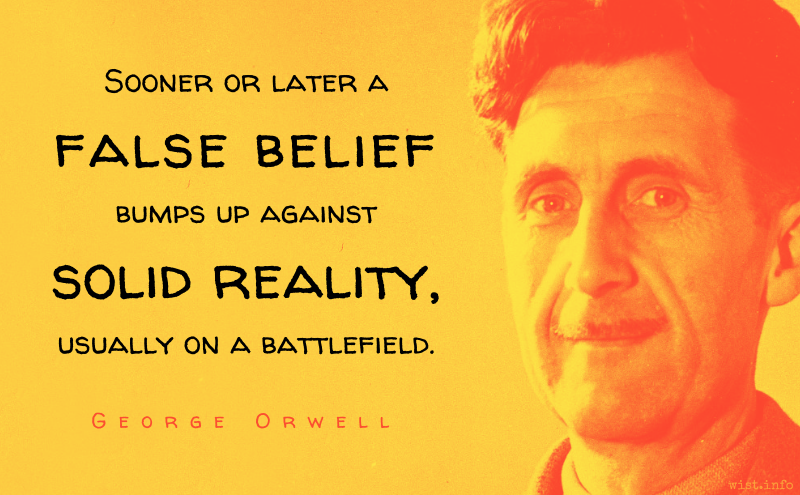
The point is that we are all capable of believing things which we know to be untrue, and then, when we are finally proved wrong, impudently twisting the facts so as to show that we were right. Intellectually, it is possible to carry on this process for an indefinite time: the only check on it is that sooner or later a false belief bumps up against solid reality, usually on a battlefield.
George Orwell (1903–1950) English journalist, essayist, writer [pseud. of Eric Arthur Blair]
Essay (1946-03-22), “In Front of Your Nose,” “As I Please” column, Tribune Newspaper
(Source)
A wise man weaves a philosophy out of each acceptance life forces upon him.


It’s no good trying to keep up old friendships. It’s painful for both sides. The fact is, one grows out of people, and the only thing is to face it.
W. Somerset Maugham (1874–1965) English novelist and playwright [William Somerset Maugham]
Cakes and Ale (1930)

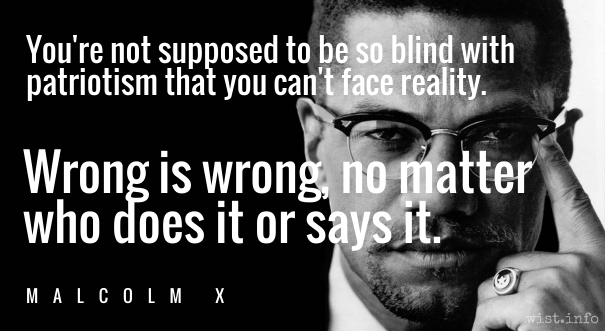
You’re not supposed to be so blind with patriotism that you can’t face reality. Wrong is wrong, no matter who does it or says it.
Malcolm X (1925–1965) American revolutionary, religious leader [b. Malcolm Little]
“Prospects for Freedom in 1965,” speech, New York (7 Jan 1965)
(Source)


For a successful technology, reality must take precedence over public relations, for nature cannot be fooled.
Richard Feynman (1918–1988) American physicist
Rogers Commission Report into the Challenger Crash, Appendix F “Personal Observations on Reliability of Shuttle,” sec. F5 (1986-06)
(Source)
Closing words of the section.
Facts are stubborn things; and whatever may be our wishes, our inclinations, or the dictates of our passions, they cannot alter the state of facts and evidence.
John Adams (1735–1826) American lawyer, Founder, statesman; US President (1797–1801)
Speech (1770-12-04), “Argument in Defence of the Soldiers in the Boston Massacre Trials”
(Source)

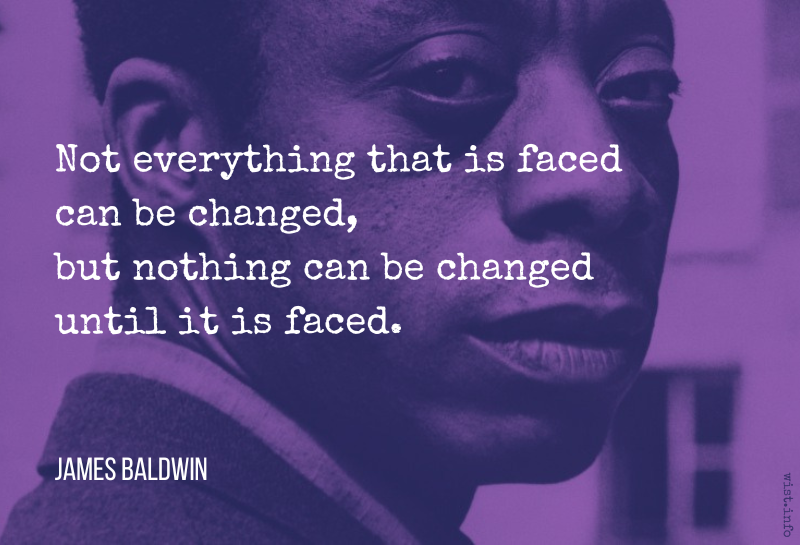
Not everything that is faced can be changed, but nothing can be changed until it is faced.
James Baldwin (1924–1987) American novelist, playwright, activist
Essay (1962-01-14), “As Much Truth as One Can Bear,” New York Times Book Review
(Source)