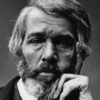
And always, in our highly regularised way of life, [the modern man] is obsessed by thoughts of the morrow. Of all the precepts in the Gospels the one that Christians have most neglected is the commandment to take no thought for the morrow. If a man is prudent, thought for the morrow will lead him to save; if he is imprudent, it will make him apprehensive of being unable to pay his debts. In either case the moment loses its savour. Everything is organised, nothing is spontaneous.
Bertrand Russell (1872–1970) English mathematician and philosopher
Lecture (1949-01-09), “The Role of Individuality,” Reith Lecture, “Authority and the Individual” No. 3, BBC Radio
(Source)
Quotations about:
here and now
Note not all quotations have been tagged, so Search may find additional quotes on this topic.
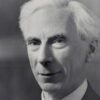
Often there is a seeming truce between the humanist and the religious believer, but in fact their attitudes cannot be reconciled: one must choose between this world and the next. And the enormous majority of human beings, if they understood the issue, would choose this world. They do make that choice when they continue working, breeding and dying instead of crippling their faculties in the hope of obtaining a new lease of existence elsewhere.
George Orwell (1903–1950) English journalist, essayist, writer [pseud. of Eric Arthur Blair]
Essay (1947-03), “Lear, Tolstoy and the Fool,” Polemic Magazine, No. 7
(Source)
Collected in Inside the Whale, and Other Essays (1962).
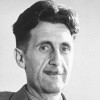
The world as it stands is no illusion, no phantasm, no evil dream of a night; we wake up to it again for ever and ever; we can neither forget it nor deny it nor dispense with it.
Henry James (1843–1916) American writer
Essay (1874-04), “Iwan Turgéniew,” sec. 3, North American Review, Vol. 98, Art. 4
(Source)
Reviewing Ivan Turgenev's Frühlingsfluthen and Ein König Lear des Dorfes (1873). Collected in French Poets and Novelists, "Ivan Turgénieff," sec. 3 (1878)
Most of us spend so much time thinking about where we have been or where we are supposed to be going that we have a hard time recognizing where we actually are.
Barbara Brown Taylor (b. 1951) American minister, academic, author
An Altar in the World, ch. 4 (2009)
(Source)

FUTURE, n. That period of time in which our affairs prosper, our friends are true, and our happiness is assured.
Ambrose Bierce (1842–1914?) American writer and journalist
“Future,” The Cynic’s Word Book (1906)
(Source)
Included in The Devil's Dictionary (1911). Originally published in the "Devil's Dictionary" column in the San Francisco Wasp (1885-02-21).
Remember that man lives only in the present, in this fleeting instant: all the rest of his life is either past and gone, or not yet revealed.
[καὶ ἔτι συμμνημόνευε, ὅτι μόνον ζῇ ἕκαστος τὸ παρὸν τοῦτο, τὸ ἀκαριαῖον: τὰ δὲ ἄλλα ἢ βεβίωται ἢ ἐν ἀδήλῳ.]
Marcus Aurelius (AD 121–180) Roman emperor (161–180), Stoic philosopher
Meditations [To Himself; Τὰ εἰς ἑαυτόν], Book 3, ch. 10 (3.10) (AD 161-180) [tr. Staniforth (1964)]
(Source)
Referencing what he has previously said in 2.14.
(Source (Greek)). Other translations:No man properly can be said to live more than that which is now present, which is but a moment of time. Whatsoever is besides either is already past, or uncertain.
[tr. Casaubon (1634)]Remembering withal, that every Mans Life lies all within the Present; For the Past is spent, and done with, and the Future is uncertain: Now the Present is strictly examin'd, is but a point of Time. Well then!
[tr. Collier (1701)]Remember also that each man lives only the present moment: The rest of time is either spent and gone, or is quite unknown.
[tr. Hutcheson/Moor (1742)]Recollect, moreover, what I have formerly remarked, "that every one lives that moment only which is now present." For the rest of his life is either already past, or is wrapt in uncertainty.
[tr. Graves (1792)]Bear in mind that every man lives only this present time, which is an indivisible point, and that all the rest of his life is either past or it is uncertain.
[tr. Long (1862)]Remembering withal, that every man's life lies all within the present, which is but a point of time; for the past is spent, and the future is uncertain.
[tr. Collier/Zimmern (1887)]And bear in mind withal that every man lives only in the present, this passing moment' all else is life outlived, or yet undisclosed.
[tr. Rendall (1898)]Remember also that every man lives only this present moment, which is a fleeting instant: the rest of time is either spent or quite unknown.
[tr. Hutcheson/Chrystal (1902)]Remember withal that it is only this present, a moment of time, that a man lives: all the rest either has been lived or may never be.
[tr. Haines (Loeb) (1916)]Each of us lives only in the present, this brief moment; the rest is either a life that is past, or is in an uncertain future.
[tr. Farquharson (1944)]Remember, furthermore, that each of us lives only in the present, this fleeting moment of time, and that the rest of one's days are either dead and gone or lie in an unknowable future.
[tr. Hard (1997 ed.)]Each of us lives only now, this brief instant. The rest has been lived already, or is impossible to see.
[tr. Hays (2003)]Remind yourself too that each of us lives only in the present moment, a mere fragment of time: the rest is life past or uncertain future.
[tr. Hammond (2006)]Also remember that each person lives in this very moment, and that the rest either has already happened or else is entirely uncertain.
[tr. Needleman/Piazza (2008)]Remember, furthermore, that each of us lives only in the present, this fleeting moment of time, and that the rest of one’s life has either already been lived or lies in an unknowable future.
[tr. Hard (2011 ed.)]Keep in mind that each of us only lives int he present, this brief moment of time; the rest of our life has been lived already or lies in the uncertain future.
[tr. Gill (2013)]
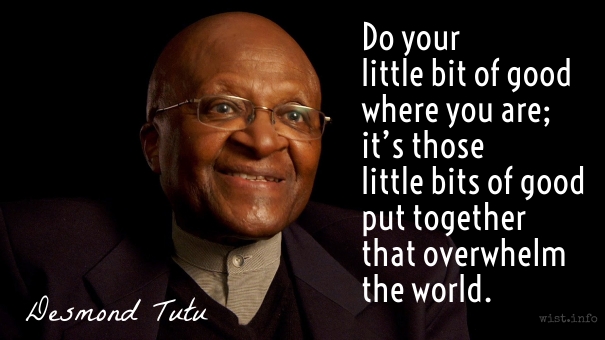
Do your little bit of good where you are; it’s those little bits of good put together that overwhelm the world.
Desmond Tutu (1931–2021) South African cleric, Anglican Archbishop of Cape Town, Nobel Laureate
(Attributed)
Widely attributed to Tutu, but I am unable to find a primary source or any sort of citation.
We cannot overstate our debt to the Past, but the moment has the supreme claim.
Ralph Waldo Emerson (1803–1882) American essayist, lecturer, poet
“Quotation and Originality,” Letters and Social Aims (1876)
What is called fashion is the tradition of the moment.
[Was man Mode heißt, ist augenblickliche Uberlieferung.]
Johann Wolfgang von Goethe (1749–1832) German poet, statesman, scientist
Sprüche in Prosa: Maximen und Reflexionen [Proverbs in Prose: Maxims and Reflections] (1833) [tr. Saunders (1893), “Life and Character,” sec. 7, #392]
(Source)
(Source (German)). Other translations:That which we call fashion is the tradition of the moment.
[tr. Rönnfeldt (1900)]What we call fashion is momentary transmission.
[tr. Stopp (1995), "Posthumous," #986]
Our grand business undoubtedly is, not to see what lies dimly at a distance, but to do what lies clearly at hand.
Thomas Carlyle (1795–1881) Scottish essayist and historian
Essay (1829-06), “Signs of the Times,” Edinburgh Review, Vol. 49, No. 98, Art. 7
(Source)
Review of three 1829 books: Anticipation; or, an Hundred Years Hence; The Rise, Progress, and Present State of Public Opinion in Great Britain; Edward Irvine, The Last Days; or, Discourses on These Our Times.