He who puts off the hour to begin living rightly
Is like the yokel who stands at the stream with a sigh:
“I can’t get across. I’ll wait here till it runs dry.”
Meanwhile, it flows, forever flows on and rolls by.[Qui recte vivendi prorogat horam,
rusticus exspectat dum defluat amnis; at ille
labitur et labitur in omne volubilis aevum.]Horace (65–8 BC) Roman poet, satirist, soldier, politician [Quintus Horatius Flaccus]
Epistles [Epistularum, Letters], Book 1, ep. 2 “To Lollius,” l. 41ff (1.2.41-42) (20 BC) [tr. Palmer Bovie (1959)]
(Source)
(Source (Latin)). Other translations:Who so dryves of good déedes, he playes the farmers part,
Who will not overslip the brooke whilste that the water falls,
The water runnes, and kepes his course, and ever kepe it shall.
[tr. Drant (1567)]He who defers this work from day to day,
Does on a river's bank expecting stay,
Till the whole stream which stopt him should be gone,
That runs, and as it runs, forever will run on.
[tr. Cowley (17th C)]He that to rule
And square his life, prolongs, is like the Fool
Who staid to have the River first pass by,
Which rowles and rowles to all Eternity.
[tr. Fanshawe; ed. Brome (1666)]So stayes the Clown till th' hasty Brook be dri'd,
But th' everlasting streams still still do glide.
[tr. "Dr. W."; ed. Brome (1666)]He that deferrs to live is like the Clown,
Who waits, expecting till the River's gone:
But that still rouls its Streams, and will roul on.
[tr. Creech (1684)]And sure the man, who has it in his power
To practise virtue, and protracts the hour,
Waits, like the rustic, till the river dried:
Still glides the river, and will ever glide.
[tr. Francis (1747)]He that defers life's task from day to day,
Is like the simple clown who thought to stay
Till the full stream that stopt him should be gone: --
Alas! the tide still rolls and ever will roll on!
[tr. Howes (1845)]He who postpones the hour of living well, like the hind [in the fable], waits till [all the water in] the river be run off: whereas it flows, and will flow, ever rolling on.
[tr. Smart/Buckley (1853)]He who puts off the time for mending, stands
A clodpoll by the stream with folded hands,
Waiting till all the water be gone past;
But it runs on, and will, while time shall last.
[tr. Conington (1874)]He that would mend his life, yet still delays
To set to work, is like the boor who stays
Till the broad stream that bars his way is gone.
But on still flows the stream, and ever will flow on.
[tr. Martin (1881)]Whoever puts off the course of a right life waits, like the rustic, until the stream shall stop. But it rolls on, and will continue to roll on to every age.
[tr. Elgood (1893)]He who puts off the hour of right living is like the bumpkin waiting for the river to run out: yet on it glides, and on it will glide, rolling its flood forever.
[tr. Fairclough (Loeb) (1926)]Any man delaying when he could be living right
is like the hayseed who waits for the river to stop:
it flows and flows -- in fact, it rushes -- forever.
[tr. Fuchs (1977)]The fool waits
For the river to run by, so he can cross, but it runs forever,
On and on, and always will. Now is the time.
[tr. Raffel (1983)]The man who puts off
The time to start living right is like the hayseed
Who wants to cross the river and so he sits there
Waiting for the river to run out of water,
And the river flows by, and it flows on by, forever.
[tr. Ferry (2001)]The man who postpones the hour of reform
is the yokel who waits for the river to pass; but it continues
and will continue gliding and rolling for ever and ever.
[tr. Rudd (2005 ed.)]He who postpones the time for right-living resembles
The rustic who’s waiting until the river’s passed by:
Yet it glides on, and will roll on, gliding forever.
[tr. Kline (2015)]He who postpones the hour of living rightly is like the rustic who waits for the river to run out before he crosses, yet on it glides, and will glide on forever.
[E.g.]He who postpones the hour of living rightly, is like the rustic who waits till the river shall have passed away; but that still flows, and will continue to flow to perpetuity.
[E.g.]
Quotations about:
now
Note not all quotations have been tagged, so Search may find additional quotes on this topic.
O the times! O the manners!
[O tempora, o mores!]
Marcus Tullius Cicero (106–43 BC) Roman orator, statesman, philosopher
Orationes in Catilinam [Catilinarian Orations], No. 1, § 1, cl. 2 (1.1.2) (63-11-08 BC) [tr. Mongan (1879)]
(Source)
(Source (Latin)). Other translations:Oh what times! what a world do we live in!
[tr. Wase (1671)]But O degenerate times!
[tr. Sydney (1795)]Shame on the age and on its principles!
[tr. Yonge (1856)]O the times! O the manners.
[tr. Underwood (1885)]O times! O manners!
[tr. Dewey (1916)]What a scandalous commentary on our age and its standards!
[tr. Grant (1960)]O what times (we live in)! O what customs (we pursue)!
[IB Notes]What times! What morals!
[Source]
It’s a terrible thing, I think, in life to wait until you’re ready. I have this feeling now that actually no one is ever ready to do anything. There is almost no such thing as ready. There is only now. And you may as well do it now.
Hugh Laurie (b. 1959) English actor, writer, musician, singer
Interview with Sophie Harris, Time Out: New York (1 Sep 2012)
(Source)

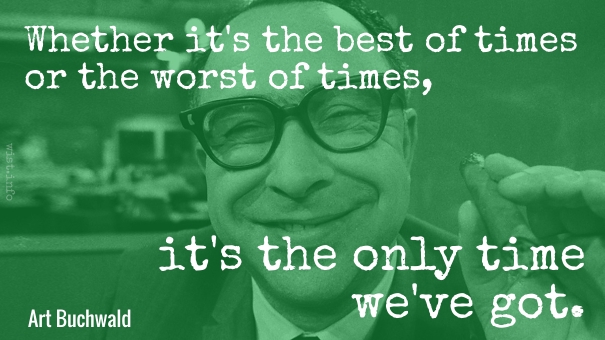
Whether it’s the best of times or the worst of times, it’s the only time we’ve got.
Art Buchwald (1925–2007) American humorist, columnist
(Attributed)

MARIAN: No, please, not tonight. Maybe tomorrow.
HAROLD: Oh, my dear little librarian. You pile up enough tomorrows, and you’ll find you are left with nothing but a lot of empty yesterdays.
Meredith Willson (1902–1984) American composer, songwriter, flutist, conductor, playwright
The Music Man (1957)
Mary, my sweet, carpe that old diem! — it’s the only game in town.
Robert A. Heinlein (1907–1988) American writer
Methuselah’s Children [Lazarus Long] (1958)
See Horace.
The secret of health for both mind and body is not to mourn for the past, worry about the future, or anticipate troubles, but to live in the present moment wisely and earnestly.
Buddha (c.563–483 BC) Indian mystic, philosopher [b. Siddharta Gautama]
In Bukkyõ Dendõ Kyõkai, The Teaching of Buddha (1966)
Likely a paraphrase of a variety of the Buddha's teachings.
ULYSSES: Those scraps are good deeds past, which are devoured
As fast as they are made, forgot as soon
As done. Perseverance, dear my lord,
Keeps honor bright. To have done is to hang
Quite out of fashion like a rusty mail
In monumental mock’ry.William Shakespeare (1564–1616) English dramatist and poet
Troilus and Cressida, Act 3, sc. 3, l. 153ff (3.3.153-158) (1602)
(Source)

We will have to repent in this generation not merely for the vitriolic words and actions of the bad people, but for the appalling silence of the good people. We must come to see that human progress never rolls in on wheels of inevitability. It comes through the tireless efforts and persistent work of men willing to be co-workers with God, and without this hard work time itself becomes an ally of the forces of social stagnation. We must use time creatively, and forever realize that the time is always ripe to do right.
Martin Luther King, Jr. (1929–1968) American clergyman, civil rights leader, social activist, preacher
Letter from Birmingham Jail (16 Apr 1963)
(Source)

He doubly benefits the needy who gives quickly.
[Inopi beneficium bis dat, qui dat celeriter.]
Publilius Syrus (d. 42 BC) Assyrian slave, writer, philosopher [less correctly Publius Syrus]
Sententiae [Moral Sayings], # 6
If there must be trouble, let it be in my day, that my child may have peace.
Thomas Paine (1737–1809) American political philosopher and writer
“The American Crisis” #1 (19 Dec 1776)
Source essay

Our grand business undoubtedly is, not to see what lies dimly at a distance, but to do what lies clearly at hand.
Thomas Carlyle (1795–1881) Scottish essayist and historian
Essay (1829-06), “Signs of the Times,” Edinburgh Review, Vol. 49, No. 98, Art. 7
(Source)
Review of three 1829 books: Anticipation; or, an Hundred Years Hence; The Rise, Progress, and Present State of Public Opinion in Great Britain; Edward Irvine, The Last Days; or, Discourses on These Our Times.