ORSINO: These most brisk and giddy-pacèd times.
William Shakespeare (1564–1616) English dramatist and poet
Twelfth Night, Act 2, sc. 4, l. 7 (2.4.7) (1601)
(Source)
Quotations about:
busyness
Note not all quotations have been tagged, so Search may find additional quotes on this topic.

Look at one of your industrious fellows for a moment, I beseech you. He sows hurry and reaps indigestion; he puts a vast deal of activity out to interest, and receives a large measure of nervous derangement in return. Either he absents himself entirely from all fellowship, and lives a recluse in a garret, with carpet slippers and a leaden inkpot; or he comes among people swiftly and bitterly, in a contraction of his whole nervous system, to discharge some temper before he returns to work. I do not care how much or how well he works, this fellow is an evil feature in other people’s lives. They would be happier if he were dead. They could easier do without his services in the Circumlocution Office, than they can tolerate his fractious spirits. He poisons life at the well-head. It is better to be beggared out of hand by a scapegrace nephew, than daily hag-ridden by a peevish uncle.
He who puts off the hour to begin living rightly
Is like the yokel who stands at the stream with a sigh:
“I can’t get across. I’ll wait here till it runs dry.”
Meanwhile, it flows, forever flows on and rolls by.[Qui recte vivendi prorogat horam,
rusticus exspectat dum defluat amnis; at ille
labitur et labitur in omne volubilis aevum.]Horace (65–8 BC) Roman poet, satirist, soldier, politician [Quintus Horatius Flaccus]
Epistles [Epistularum, Letters], Book 1, ep. 2 “To Lollius,” l. 41ff (1.2.41-42) (20 BC) [tr. Palmer Bovie (1959)]
(Source)
(Source (Latin)). Other translations:Who so dryves of good déedes, he playes the farmers part,
Who will not overslip the brooke whilste that the water falls,
The water runnes, and kepes his course, and ever kepe it shall.
[tr. Drant (1567)]He who defers this work from day to day,
Does on a river's bank expecting stay,
Till the whole stream which stopt him should be gone,
That runs, and as it runs, forever will run on.
[tr. Cowley (17th C)]He that to rule
And square his life, prolongs, is like the Fool
Who staid to have the River first pass by,
Which rowles and rowles to all Eternity.
[tr. Fanshawe; ed. Brome (1666)]So stayes the Clown till th' hasty Brook be dri'd,
But th' everlasting streams still still do glide.
[tr. "Dr. W."; ed. Brome (1666)]He that deferrs to live is like the Clown,
Who waits, expecting till the River's gone:
But that still rouls its Streams, and will roul on.
[tr. Creech (1684)]And sure the man, who has it in his power
To practise virtue, and protracts the hour,
Waits, like the rustic, till the river dried:
Still glides the river, and will ever glide.
[tr. Francis (1747)]He that defers life's task from day to day,
Is like the simple clown who thought to stay
Till the full stream that stopt him should be gone: --
Alas! the tide still rolls and ever will roll on!
[tr. Howes (1845)]He who postpones the hour of living well, like the hind [in the fable], waits till [all the water in] the river be run off: whereas it flows, and will flow, ever rolling on.
[tr. Smart/Buckley (1853)]He who puts off the time for mending, stands
A clodpoll by the stream with folded hands,
Waiting till all the water be gone past;
But it runs on, and will, while time shall last.
[tr. Conington (1874)]He that would mend his life, yet still delays
To set to work, is like the boor who stays
Till the broad stream that bars his way is gone.
But on still flows the stream, and ever will flow on.
[tr. Martin (1881)]Whoever puts off the course of a right life waits, like the rustic, until the stream shall stop. But it rolls on, and will continue to roll on to every age.
[tr. Elgood (1893)]He who puts off the hour of right living is like the bumpkin waiting for the river to run out: yet on it glides, and on it will glide, rolling its flood forever.
[tr. Fairclough (Loeb) (1926)]Any man delaying when he could be living right
is like the hayseed who waits for the river to stop:
it flows and flows -- in fact, it rushes -- forever.
[tr. Fuchs (1977)]The fool waits
For the river to run by, so he can cross, but it runs forever,
On and on, and always will. Now is the time.
[tr. Raffel (1983)]The man who puts off
The time to start living right is like the hayseed
Who wants to cross the river and so he sits there
Waiting for the river to run out of water,
And the river flows by, and it flows on by, forever.
[tr. Ferry (2001)]The man who postpones the hour of reform
is the yokel who waits for the river to pass; but it continues
and will continue gliding and rolling for ever and ever.
[tr. Rudd (2005 ed.)]He who postpones the time for right-living resembles
The rustic who’s waiting until the river’s passed by:
Yet it glides on, and will roll on, gliding forever.
[tr. Kline (2015)]He who postpones the hour of living rightly is like the rustic who waits for the river to run out before he crosses, yet on it glides, and will glide on forever.
[E.g.]He who postpones the hour of living rightly, is like the rustic who waits till the river shall have passed away; but that still flows, and will continue to flow to perpetuity.
[E.g.]
Some people see things that are and ask, Why? Some people dream of things that never were and ask, Why not? Some people have to go to work and don’t have time for all that shit.

My friend, there will come one day to you a Messenger, whom you cannot treat with contempt. He will say, “Come with me;” and all your pleas of business cares and earthly loves will be of no avail. When his cold hand touches yours, the key of the counting-room will drop forever, and he will lead you away from all your investments, your speculations, your bank-notes and real estate, and with him you will pass into eternity, up to the bar of God. You will not be too busy to die.
Abbott Eliot "A. E." Kittredge (1834–1912) American clergyman and Presbyterian leader
(Attributed)
(Source)
In Josiah Hotchkiss Gilbert (ed.), Burning Words of Brilliant Writers (1883). I could not find any primary source that Gilbert borrowed from.

I do not mean to make an idol of health, but it does seem to me that at least some of us have made an idol of exhaustion. The only time we have done enough is when we are running on empty and when the ones we love most are the ones we see the least.
Barbara Brown Taylor (b. 1951) American minister, academic, author
Essay (1999-11-03), “Divine Subtraction,” Christian Century
(Source)

THE DOCTOR: Listen, listen, gotta dash. Things happening. Well, four things. Well, four things and a lizard.
Doctor Who (2005-Present) British science fiction television series, revival (BBC)
03×10 “Blink” (2007-06-09) [w. Steven Moffat]
(Source)

Growing old is no more than a bad habit which a busy man has no time to form.
[Vieillir n’est qu’une mauvaise habitude; l’homme occupé n’a pas le temps de la prendre.]
André Maurois (1885–1967) French author [b. Émile Salomon Wilhelm Herzog]
The Art of Living [Un Art de Vivre], ch. 8 “The Art of Growing Old” (1939) [tr. Whitall (1940)]
(Source)
Parents are often so busy with the physical rearing of children that they miss the glory of parenthood, just as the grandeur of trees is lost when raking leaves.
Marcelene Cox (1900–1998) American writer, columnist, aphorist
“Ask Any Woman” column, Ladies’ Home Journal (1945-05)
(Source)

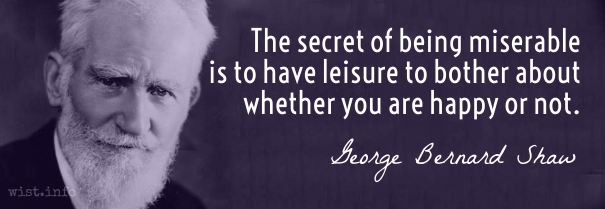
The secret of being miserable is to have leisure to bother about whether you are happy or not. The cure for it is occupation, because occupation means pre-occupation; and the pre-occupied person is neither happy nor unhappy, but simply alive and active, which is pleasanter than any happiness until you are tired of it.
George Bernard Shaw (1856–1950) Irish playwright and critic
Treatise on Parents and Children, “Children’s Happiness” (1914)
(Source)
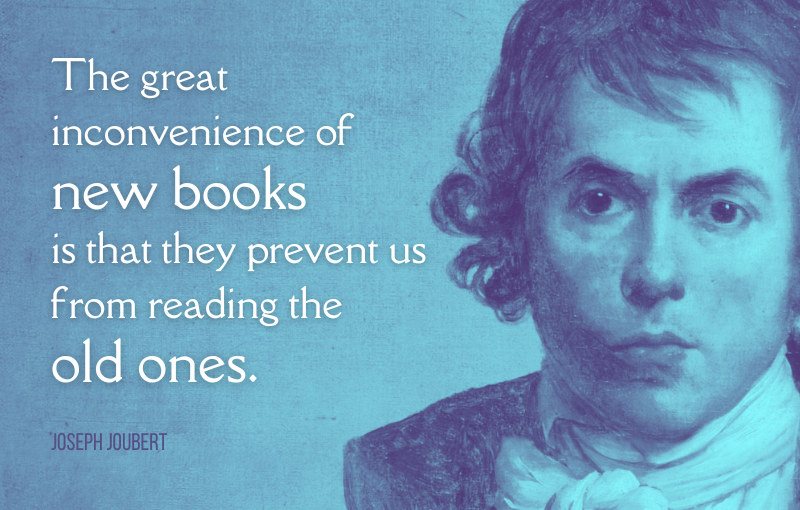
The great inconvenience of new books is that they prevent us from reading the old ones.
[C’est le grand inconvénient des livres nouveaux: ils nous empêchent de lire les anciens.]
Joseph Joubert (1754–1824) French moralist, philosopher, essayist, poet
Pensées [Thoughts], ch. 18 “Du Siècle [On the Age],” ¶ 57 (1850 ed.) [tr. Auster (1983), 1808]
(Source)
(Source (French)). Other translations:The great drawback in new books is that they prevent our reading older ones.
[tr. Attwell (1896), ¶ 250]That is the great drawback of new books: they keep us from reading the old.
[tr. Collins (1928), ch. 17]
HARRIS: Sitting there at that moment I thought of something else Shakespeare said. He said, “Hey … life is pretty stupid; with lots of hubbub to keep you busy, but really not amounting to much.” Of course I’m paraphrasing: “Life is a tale told by an idiot, full of sound and fury, signifying nothing.”
Steve Martin (b. 1945) American comedian, actor, writer, producer, musician
L. A. Story (1991)
(Source)

What with your exercises, some reading, and a great deal of company, your day is, I confess, extremely taken up; but the day, if well employed, is long enough for everything; and I am sure you will not slattern away one moment of it in inaction.
Lord Chesterfield (1694–1773) English statesman, wit [Philip Dormer Stanhope]
Letter to his son, #238 (8 Jan 1751)
(Source)
This world is a place of business. What an infinite bustle! I am awaked almost every night by the panting of the locomotive. It interrupts my dreams. There is no sabbath. It would be glorious to see mankind at leisure for once. It is nothing but work, work, work. I cannot easily buy a blank-book to write thoughts in; they are commonly ruled for dollars and cents. An Irishman, seeing me making a minute in the fields, took it for granted that I was calculating my wages. If a man was tossed out of a window when an infant, and so made a cripple for life, or scared out of his wits by the Indians, it is regretted chiefly because he was thus incapacitated for — business! I think that there is nothing, not even crime, more opposed to poetry, to philosophy, ay, to life itself, than this incessant business.
Henry David Thoreau (1817–1862) American philosopher and writer
Essay (1863-10), “Life without Principle,” Atlantic Monthly, No. 72
(Source)
Based his lecture (1854-12-06) "What Shall It Profit?" Railroad Hall, Providence, Rhode Island. He had edited it for publication before his death, and it was published posthumously.
There is no kind of idleness by which we are so easily seduced as that which dignifies itself by the appearance of business, and by making the loiterer imagine that he has something to do which must not be neglected, keeps in perpetual agitation and hurries him from place to place.
Samuel Johnson (1709–1784) English writer, lexicographer, critic
Essay (1759-03-17), The Idler, No. 48
(Source)