

Crikey. It’s been almost two years to the day since I last did one of these updates. It takes a fair amount of time to do one, so that’s one excuse. The other is that … well, I didn’t realize it had been that long. Better make a note on my to-do list for next summer …
One significant meta-change that’s happened since the last time is that I’ve retired. Thats’s theoretically given me a lot more time to do WIST stuff, though, honestly, it’s also proven to me the adage that work expands to fit all available time (Parkinson’s Law ), so I don’t always get to do everything I would like to provide new content. Nonetheless, I have about a dozen author/topic areas for each day of the work week, up quite a bit over the 5–6 I was doing, That also includes going back and updating a lot of my authors to clean up old entries, fixing bits from before I was so diligent about noting topics, including source links, or organizing citations so that they sort in a sensible and consistent fashion.
Net-net, I’m certainly pursuing this hobby more than I did when I was a working stiff, but not as much as I’d like to.
What’s happened over here since last time?
I’ve for a long while been reposting the source WIST.info blog stuff for a wider audience, and in acknowledgment that people browsing blogs on a regular basis is about a decade or two out of style. I used Diaspora* and Mastodon both for quite some time, but the instances I was using went kaput on me. After a lot of poking around, I ended up shifting to Friendica.world, which has been overall positive. Friendica as a platform offers a lot of advantages, including better formatting, longer message lengths, and one-stop federation with both the Fediverse and Diaspora* (where a lot of the people who follow me remain). To be honest, though, it’s not the best-optimized or -social media system out there; the folk at the .world instances continue to keep it running okay most of the time, though, so hopefully this setup will continue for some years.
I also shifted to a new model for post-by-email. While the normal Jetpack-based email subscription stuff still works, my recommendation is using one of the RSS feed system emailers. I’ve tested both Blogtrottr and Feedrabbit, and both of them work well. I have also set up a feed from my Friendica site, which has its own advantages and disadvantages. More on this here.
I’ve faced some significant performance issues since I last did one of these updates, and taken some major steps to fix them. The issues stem from a combination of (I believe) underpowered hardware under the host that bought the host I’d been using, and the general bot activity on the Internet buzzing around my system. To those ends, I’ve broken out WIST into its own DB on my host, implemented Lightspeed as a cache, and dived into using the QUIC.cloud content delivery network (CDN), to better protect and distribute WIST. This has made a significant improvement in performance and stability, though a few hiccups still remain.
Meanwhile, I’m all caught up to WordPress 7.0.4, and I’ve cleaned out the plugins I use quite a bit (to boost performance), so from a platform perspective, things here are good. Pingbacks and trackbacks are working here again, which has meant better cross-references between quotations and better feedback when other folk are linking back to quotes here (always interesting to see in context).
One change I’ve made in what I’m doing to better organize and sort entries is changing my date formats in titles. I’ve long used dd-MMM-yy type dates, from my old Oracle DBA days. Those show up automagically in the entry footers, but I was manually using them for citation information, too. Unfortunately, they don’t sort well. With my resolve to have entries-by-author show up in a better-sorted fashion, I’ve switched over my manual date entries to ISO format dates — yyyy-mm-dd. I’ve also, in most instances, changed to a citation/title format to sort and group by document type and date, e.g., Essay (2026-03-14), “On Sorting Stuff,” <i>Citations for Dummies</i>. It’s not perfect, nor perfectly consistent, but I’m a lot happier with the result.
And, in part to that end, I’ve used a nifty plugin called Search Regex to update some of the language and phrasing standards I use around the site. That includes using en-dashes / range-dashes for time periods, e.g., birth and death dates, to better distinguish “1812–1900” from “1812-03-14”.
Most of that stuff should be transparent to the reader, but I wanted to mention it for the record.
Doing the Numbers
Let’s look at the numbers:

The author count has flattened a bit as I focused more attention on cleaning up existing quotes (from, thus, existing authors). On the other hand, the quote count is arcing up a bit as I’m not just cleaning up quotes but adding new ones from those same sources, i.e., if I source in a book a quote by X, I’ll look around it on the page, or even maybe a few following pages, for other quotes of note — I’m particularly proud to “unearth” good quotes by folk that aren’t the standard fare in online quote databases.
Broken out into a graph (and normalizing the time frame):
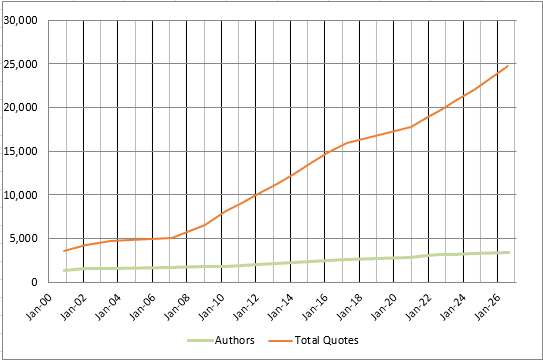
Note that, as always, all of these quotations are personally curated to some degree or another — digging out citations and online links when possible, finding author photos, etc. No mass uploads for me.
Beyond that count, I currently stand at 810 (up from 732) quotes flagged as meme/visual quotations. That number’s gone up slowly; I generate one of these every few weeks, though it’s always a kick to see one showing up in a web search.
Top Authors
Of the authors I have, who are the most quoted in WIST?
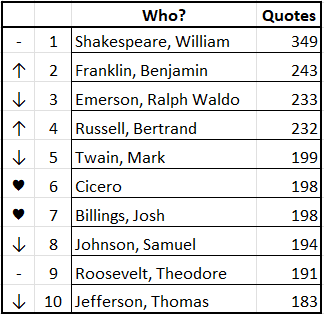
The arrows show how people have risen or falling in the Top Ten since last time (the hearts are new entries this year). These are almost all authors I have been working on for, well, the past couple of years, both cleaning up items and adding new ones. C. S. Lewis got pushed off the Top Ten list because I did very little with him; so did Terry Pratchett, where most of the work I’ve been was sourcing and cleaning up quotes I already had. Jefferson barely stuck around, with only one net new quote. Emerson fortunately already had a head start, because he actually net lost one quote (as I do these clean-ups, I spot a lot of duplicates that need to be deleted).
And, yes, that’s a bunch of old, dead, white guys. Sigh.
This table is more for curiosity’s sake than any real meaning, showing not just how prolific these folk are, but how interested I seem to be in recording things these individuals said.
Top Quotations
Here are the Top 10 Most Visited Quotations Ever (noting how they’ve changed since August 2024). I find these interesting, since it’s not driven anything I do, but by page hits by visitors.
- – (16,850; was 13,551) John Kenneth Galbraith, Speech (1963-12-13), “Wealth and Poverty,” National Policy Committee on Pockets of Poverty
- ↑ (12,814; was 8,117) Plato Republic, Book 1, 347c
- ↓ (10,379; was 8,551) Aeschylus, Agamemnon, ll. 175-183 [tr. Johnston (2007)]
- ↑ (8,046; was 6,340) Rainer Maria Rilke, Letter (1907-01-01) to Clara Rilke
- ↑ (7,563; was 5,531) Sa’adi “Bani Adam [The Children of Adam],” Gulistan [Rose Garden], ch. 1 “On the Conduct of Kings,” story 10 (1258)
- ↓ (7,170; was 6,399) Bertand Russell, “The Triumph of Stupidity” (1933-05-10)
- ↓ (6,997, was 6,393) Robert Frost, “The Lesson for Today,” A Witness Tree (1942)
- ♥ (6,575; new on the list) Charles MacKay, Poem (1884), “No Enemies”, Interludes and Undertones, Poem 121
- ♥ (6, 214; new on the list) Franz Kafka, Letter (1904-01-27) to Oskar Pollak [tr. Winston (1977)]
- ♥ (6,135; new on the list) Aristotle, (Attributed)
MacKay has not been on the list before. The Aristotle attribution and Kafka’s letter has been popular year-to-year, slowly building up to reach the Top Ten. Lost from the Top Ten were quotes from Fran Lebowitz, John Steinbeck, and Isaac Asimov.
Consider that list a tally of quotes you should take a look at if I had any recommendations of that sort.
It’s worth noting that page hits is increasingly bad of a measurement, as the numbers for those are both massively lower and less consistent than they were back when I started. I net-net get a fair number of hits to different pages on the site (see below). Once upon a time, a new quote might get a couple of dozen hits the first few days after posting; now it’s lucky if one gets any after a whole week. The mechanisms and reading processes of the Internet are simply different in 2026 than in 2000. That said, there is movement on this page (looking at the now-then numbers), so some entries must be scoring high in search engines to draw that additional traffic. It’s only new quotes that seem to struggle; of this list, Mackay’s is the newest, from 9/2025; after that, the next youngest (Rilke) is from 2015.
Looking at quotes that were most popular just over the last two years provides a somewhat different set. Since 8/2024, the Top 10 viewed quotes were, according to Google Analytics:
- ♥ 4,369 Charles MacKay, Poem (1884), “No Enemies”, Interludes and Undertones, Poem 121
- ↓ 2,823 Plato, Republic, Book 1, 347c
- – 1,433 John Kenneth Galbraith, Speech (1963-12-13), “Wealth and Poverty,” National Policy Committee on Pockets of Poverty
- ♥ 1,255 Dante Alighieri, The Divine Comedy [Divina Commedia], Book 1 “Inferno,” Canto 3, l. 1ff (3.1-9) (1309) [tr. Hollander/Hollander (2007)]
- ♥ 1,240 Virgil, The Aeneid [Ænē̆is], Book 6, l. 126ff (6.126-129) [The Sybil] (29-19 BC) [tr. Dryden (1697)]
- ♥ 1,163 Homer, The Odyssey [Ὀδύσσεια], Book 6, l. 180ff (6.180) [Odysseus to Nausicaa] (c. 700 BC) [tr. Rieu (1946)]
- ↓ 1,095 Emerson, Ralph Waldo, (Misattributed) — 1,095
- ♥ 1,018 Virgil, The Aeneid [Ænē̆is], Book 6, l. 851ff (6.851-53) [Anchises] (29-19 BC) [tr. Fagles (2006), l. 981ff]
- ♥ 975 Circassian proverb
- ↓ 956 Aristotle, Nicomachean Ethics [Ἠθικὰ Νικομάχεια] (c. 325 BC) (paraphrase)
Lots of new quotes showing up here, which is nice, even if they displaced ones from Rilke, Sa’adi, and Kafka (the ones still on the overall Top Ten list). Alas, still all Old, Dead, White Guys.
Note that the WIST front page, Authors list, and the collection pages for Cicero, Lyndon Johnson, Isaac Asimov, Dante, Hannah Arendt, Zora Neale Hurston, and Kafka all fell in the same hits range as these Top Ten.
Note also that these highest quote hit numbers for this two-year interval are comparable to the one-year interval last time I checked, which is a bit worrisome.
Who Are You People?
As Google Analytics gets more complex and commercially focused, figuring out old simplec stats becomes a bit more difficult. As far as I can tell, though compared to 8/2026, I am getting 237 visitors / day (vs 205) and 557 pages visited / day (vs 320). So a nice upward trend there. Producing content drives visitors, one would think.
I don’t have a way any more of tracking folk following by email on the RSS feeds (or following through a feed reader — yes, those still exist). I know I have 7 email subscribers through JetPack (waves).
Over in social media, as mentioned, I have a Friendica mirror site that talks with Mastodon and the rest of the Fediverse as well as Diaspora*. I’ve got 141 followers there, and a pretty decent level of engagement.
An interesting things about the Internet today: my home WIST.info blog gets a lot of hits, but it’s nearly all through search, rather than (as in olden days) people visiting through RSS or dropping in every few days to see what’s new.
Doing some further peering Google Analytics …
Demographics:
- There have been a few bizarre spikes of traffic from Singapore and China at different points over the last few years, so that’s distorting the active user data quite a bit. Leaving that be, for country of origin, the US claims 49% of the users, the UK 7%, and Canada 4%; Singapore shows at 8% of active users, which just seems wrong, with China accounting for another 4%.
- Language-wise, not surprisingly, 87% of active users registered as English; German and Spanish account for 2% each more, and Chinese and French 1% each.
Hardware and software:
- From a platform perspective, visits to WIST.info come mostly from desktop (62%) vs mobile (37%). Tablet is most of the remaining fringe, though there were 7 Smart TV users over that two year time frame. Those numbers are comparable to two years ago.
- Browser-wise, Chrome remains at around 61%, and Safari at 26%. Edge and Firefox both dropped a little to 6% and 4% respectively.
- That’s interesting to cross-reference with OS, where Windows is 34% of the users, iOS and Macintosh having 22% each, Android 17%, and with low single digits for ChromeOS and Linux. Not much difference from before.
The Year Ahead
Aside from cranking out quotations, what’s on the road map for the near future?
- Continue cleaning up stuff.
- Figure out a balance between New, Small, Interesting Quoters (maybe some of them neither dead nor white nor men), expanding on very quotable favorites, and cleaning up some of the crap-formatted, poorly-sourced authors I’ve had for a long time.
- I’d really like to do some topic (tag) cleanup (there are some that are redundant — plural vs singular — and others where I’ve inadvertently concatenated terms). There must be a way to do that more easily than what I’ve found so far.
- Maybe look into ways to get things auto-posted in things like Blue Sky and Threads. I don’t want to add any manual steps to my process, but each steps of these connections tends to mess up text to fit into the next box. So … we’ll see.
- Figure out how I will make a dent in my ever-increasing backlog before I get to find out about that “mortality” topic stuff. I can remember early days when I scrambled to dig up new quotations to post. These days, it could take a full lifetime to catch up with what I have in files, especially given the research (and cross-translations) I do.
When I retired, people warned me I’d get bored really quickly. I’m kinda anxious to find some boredom, to be perfectly honest. 😜
And that’s the end of the this newest update. See you next time I get an urge to do this (hopefully before another two years have passed)!