

In fact the whole antithesis between self and the rest of the world, which is implied in the doctrine of self-denial, disappears as soon as we have any genuine interest in persons or things outside ourselves. Through such interests a man comes to feel himself part of the stream of life, not a hard separate entity like a billiard-ball, which can have no relation with other such entities except that of collision.
Bertrand Russell (1872–1970) English mathematician and philosopher
Conquest of Happiness, Part 2, ch. 17 “The Happy Man” (1930)
(Source)
Quotations about:
worldliness
Note not all quotations have been tagged, so Search may find additional quotes on this topic.
This new understanding undermines the old admiration of worldly success as such. We are beginning to abandon our tolerance of the abuse of power by those who betray for profit the elementary decencies of life.
Franklin Delano Roosevelt (1882–1945) American lawyer, politician, statesman; US President (1933–45)
Speech (1937-01-20), Inaugural Address, Washington, D.C.
(Source)
Often there is a seeming truce between the humanist and the religious believer, but in fact their attitudes cannot be reconciled: one must choose between this world and the next. And the enormous majority of human beings, if they understood the issue, would choose this world. They do make that choice when they continue working, breeding and dying instead of crippling their faculties in the hope of obtaining a new lease of existence elsewhere.
George Orwell (1903–1950) English journalist, essayist, writer [pseud. of Eric Arthur Blair]
Essay (1947-03), “Lear, Tolstoy and the Fool,” Polemic Magazine, No. 7
(Source)
Collected in Inside the Whale, and Other Essays (1962).

But a normal human being does not want the Kingdom of Heaven: he wants life on earth to continue. This is not solely because he is “weak”, “sinful” and anxious for a “good time”. Most people get a fair amount of fun out of their lives, but on balance life is suffering, and only the very young or the very foolish imagine otherwise. Ultimately it is the Christian attitude which is self-interested and hedonistic, since the aim is always to get away from the painful struggle of earthly life and find eternal peace in some kind of Heaven or Nirvana. The humanist attitude is that the struggle must continue and that death is the price of life.
My friend, there will come one day to you a Messenger, whom you cannot treat with contempt. He will say, “Come with me;” and all your pleas of business cares and earthly loves will be of no avail. When his cold hand touches yours, the key of the counting-room will drop forever, and he will lead you away from all your investments, your speculations, your bank-notes and real estate, and with him you will pass into eternity, up to the bar of God. You will not be too busy to die.
Abbott Eliot "A. E." Kittredge (1834–1912) American clergyman and Presbyterian leader
(Attributed)
(Source)
In Josiah Hotchkiss Gilbert (ed.), Burning Words of Brilliant Writers (1883). I could not find any primary source that Gilbert borrowed from.

Go to! Cast dust on those deaf skies, who spurn
Thy orisons and bootless prayers, and learn
To quaff the cup, and hover round the fair;
Of all who go, did ever one return?
Omar Khayyám (1048–1123) Persian poet, mathematician, philosopher, astronomer [عمر خیام]
Rubáiyát [رباعیات], Bod. # 97 [tr. Whinfield (1883), # 267]
(Source)
Given as # 149 in Whinfield's 1882 edition. Calcutta manuscript # 271. Other translations:Behold the dawn arise, O fountain of delights. Drink your wine and touch your lute, for the life of those who sleep will be but brief; and of those who have gone hence, not one will e'er return.
[tr. McCarthy (1879), # 44]Go, on the earth and the heavens cast dust and all their care;
Drink wine and follow the trace of the pleasant-visaged fair.
Where is the good of obedience? Where is the profit of prayer?
Of all that have gone before us, there's none returneth e'er.
[tr. Payne (1898), # 463]Go! throw dust upon the face of the heavens,
drink wine, and consort with the fair of face;
what time is this for worship? and what time is this for supplication?
since, of all those that have departed, not one has returned?
[tr. Heron-Allen (1898), # 97]Go, thou, cast dust on the heaven above us,
Drink ye wine, and beauty seek today!
What use in adoration? What need for prayer?
For of all the gone no one comes again.
[tr. Cadell, after Nicholas (1879), # 228]Go then, cast dust on heaven's sapphire stair,
Drink wine, love beauty, in this world of men.
What place for pious deeds? What need for prayer?
Of the departed, none comes back again.
[tr. Cadell (1899), # 105]Go! On earth's face, in Heaven's face high in air
Flung dust, drink wine and woo the sweet-faced fair!
What time is there for worship? What for prayer?
For none of all those gone returneth e'er.
[tr. Thompson (1906), # 312]Fling dust at heaven, that every offering spurns;
Drink wine, and love while thy desire yet burns;
What time is this to worship or to pray?
Of all that have departed, none returns.
[tr. Talbot (1908), # 97]Go! throw dust upon the head of the heavens and the
world. Drink ever wine and hover about the fair-faced ones.
What place is there for worship? what place for prayer?
for of all those who are gone not one has come back.
[tr. Christensen (1927), # 56]Go, throw dust on the Sphere of this world,
Drink wine and court those whose face is resplendent like the moon.
What place is this for worship and for prayer?
Since from all who have left no news returns.
[tr. Rosen (1928), # 174]Ascend the skies, fling the dust on earth, 'tis base,
Yea seek His love, and linger on His face.
Thy rites and prayers will not profit there,
The path you once have plied you can't retrace.
[tr. Tirtha (1941), # 3.49]


And others are those sown among the thorns: these are the ones who hear the word, but the cares of the age and the lure of wealth and the desire for other things come in and choke the word, and it yields nothing.
[καὶ ἄλλοι εἰσὶν οἱ εἰς τὰς ἀκάνθας σπειρόμενοι· οὗτοί εἰσιν οἱ τὸν λόγον ἀκούσαντες, καὶ αἱ μέριμναι τοῦ αἰῶνος καὶ ἡ ἀπάτη τοῦ πλούτου καὶ αἱ περὶ τὰ λοιπὰ ἐπιθυμίαι εἰσπορευόμεναι συμπνίγουσιν τὸν λόγον καὶ ἄκαρπος γίνεται.]
The Bible (The New Testament) (AD 1st - 2nd C) Christian sacred scripture
Book 2. Gospel of Mark 4:18ff (Mark 4:18–19) (Jesus) [NRSV (2021 ed.)]
(Source)
Part of the Parable of the Sower. This passage is paralleled in Matthew 13:22 and Luke 8:14.
(Source (Greek)). Alternate translations:And these are they which are sown among thorns; such as hear the word, and the cares of this world, and the deceitfulness of riches, and the lusts of other things entering in, choke the word, and it becometh unfruitful.
[KJV (1611)]Then there are others who receive the seed in thorns. These have heard the word, but the worries of this world, the lure of riches and all the other passions come in to choke the word, and so it produces nothing.
[JB (1966)]Other people are like the seeds sown among the thorn bushes. These are the ones who hear the message, but the worries about this life, the love for riches, and all other kinds of desires crowd in and choke the message, and they don't bear fruit.
[GNT (1966)]Then there are others who are sown in thorns. These have heard the word, but the worries of the world, the lure of riches and all the other passions come in to choke the word, and so it produces nothing.
[NJB (1985)]Others are like the seed scattered among the thorny plants. These are the ones who have heard the word; but the worries of this life, the false appeal of wealth, and the desire for more things break in and choke the word, and it bears no fruit.
[CEB (2011)]

It is not the fact that a man has riches which keeps him from the Kingdom of Heaven, but the fact that riches have him.
John Caird (1820–1898) Scottish theologian, academic, preacher
(Attributed)
I am unable to find the source of this quotation amongst Caird's writings (including of his many sermons). While he preaches in places on money and riches (e.g., "Covetousness a Misdirected Worship"), these phrases or ones like them do not show up in his works that I can find.
Nevertheless, this quotation was popularly requoted in the late 19th and early 20th centuries, beginning during Caird's lifetime. The earliest references I find are from 1878 --
The Pacific, Vol. 27, No. 17/1366 (1878-04-25) and (in quotations marks rather than italics) The Calcutta Indian Mirror (1879-05-18):Dr. Caird says it is not the fact that a man has riches which keeps him from the kingdom of heaven, but the fact that riches have him.
Christian Pioneer Magazine, "Gems," Vol. 23 (1878) and The Raleigh Christian Advocate (1879-02-05):It is not the fact that a man has riches which keeps him from the kingdom of heaven, but the fact that riches have him.
-- Dr. Caird
Even this point, the references are not to a story about Caird preaching or writing it, but column filler, indicating the quote was already in wide circulation. The use of quotes / italics suggests it might also be an excerpt from a more complex formulation.
By the turn of the century, the quote is fixed as above, and gains popularity in various quotation collections, including Hotchkiss, ed., Dictionary of Burning Words of Brilliant Writers (1895).
Citations for this phrase begin with attribution to "John Caird," "J. Caird," and "Dr. Caird," referencing the prominent Scottish theologian and preacher. After a time, only his last name is used. Starting mid-20th century (and as memory of John Caird fades), the attribution is often to David Caird (e.g., 1, 2, 3).

Let the man of learning, the man of lettered leisure, beware of that queer and cheap temptation to pose to himself and to others as the cynic, as the man who has outgrown emotions and beliefs, the man to whom good and evil are as one. The poorest way to face life is to face it with a sneer.
Theodore Roosevelt (1858–1919) American politician, statesman, conservationist, writer; US President (1901–09)
Speech (1910-04-23), “Citizenship in a Republic [The Man in the Arena],” Sorbonne, Paris
(Source)
Indeed, it is easier for a camel to go through the eye of a needle than for someone who is rich to enter the kingdom of God.
[εὐκοπώτερον γάρ ἐστιν κάμηλον διὰ τρήματος βελόνης εἰσελθεῖν ἢ πλούσιον εἰς τὴν βασιλείαν τοῦ θεοῦ εἰσελθεῖν.]
The Bible (The New Testament) (AD 1st - 2nd C) Christian sacred scripture
Book 3. Gospel of Luke 18:25 (Luke 18:25) (Jesus) [NRSV (2021 ed.)]
(Source)
This passage is paralleled in Matthew 19:23 and Mark 10:23. Only Luke uses the camel/needle metaphor.
(Source (Greek)). Other translations:For it is easier for a camel to go through a needle’s eye, than for a rich man to enter into the kingdom of God.
[KJV (1611)]Yes, it is easier for a camel to pass through the eye of a needle than for a rich man to enter the kingdom of God.
[JB (1966)]It is much harder for a rich person to enter the Kingdom of God than for a camel to go through the eye of a needle.
[GNT (1976)]Yes, it is easier for a camel to pass through the eye of a needle than for someone rich to enter the kingdom of God.
[NJB (1985)]It’s easier for a camel to squeeze through the eye of a needle than for a rich person to enter God’s kingdom.
[CEB (2011)]
Divitiæ sæculi sunt laquei diaboli: so writes Bernard; worldly wealth is the devil’s bait: and as the Moon, when she is fuller of light, is still farthest from the Sun, the more wealth they have, the farther they are commonly from God.
Robert Burton (1577–1640) English scholar
Anatomy of Melancholy, Part 2, sec. 3, member 3 “Against Poverty and Want” (1621-1651)
(Source)
The Latin is as translated; it's elsewhere also given as: "The riches of the world are the snares of the devil."
This overall passage, in later editions (which did away with much of Burton's Latin, or just left it in translation), reads:Worldly wealth is the devil's bait: so writes Bernard; and as the Moon, when she is fuller of light, is still farthest from the Sun, the more wealth they have, the farther they are commonly from God.
Further edited and condensed editions in the 19th Century, shifts from wealth estranging people from God to wealth estranging people from happiness:Worldly wealth, indeed, is the devil's bait; and those whose minds feed upon riches recede, in general, from real happiness, in proportion as their stores increase; as the Moon when she is fullest is farthest from the Sun.
This last version, leaving out the "indeed," becomes commonly used in late 19th Century collections of quotations, and is most common (from that) in quotation collections today.

We must try to keep the mind in tranquility. For just as the eye which constantly shifts its gaze, now turning to the right or to the left, now incessantly peering up and down, cannot see distinctly what lies before it, but the sight must be fixed firmly on the object in view if one would make his vision of it clear, so too man’s mind when distracted by his countless worldly cares cannot focus itself distinctly on the truth.
Basil of Caesarea (AD 330–378) Christian bishop, theologian, monasticist, Doctor of the Church [Saint Basil the Great, Ἅγιος Βασίλειος ὁ Μέγας]
Letter to Gregory of Nazianzus (c. AD 358) [tr. Defarrari (1926)]
(Source)

Now Scripture enjoins nothing except charity, and condemns nothing except lust, and in that way fashions the lives of men.
[Non autem praecipit Scriptura nisi caritatem, nec culpat nisi cupiditatem, et eo modo informat mores hominum.]
Augustine of Hippo (354–430) Christian church father, philosopher, saint [b. Aurelius Augustinus]
On Christian Doctrine [De Doctrina Christiana], Book 3, ch. 10 / § 15 (3.10.15) (AD 397) [tr. Shaw (1858)]
(Source)
On how people treat Scripture as literal when it agrees with their and their culture's judgment, and figurative when not.
(Source (Latin)). Other translations:But Scripture teaches nothing but charity, nor condemns anything except cupidity, and in this way shapes the minds of men.
[tr. Robertson (1958)]Scripture enjoins nothing but love, and centures nothing but lust, and moulds men's minds accordingly.
[tr. Green (1995)]

The faithful labors of many Witnesses of Jesus Christ, extant to the world, abundantly proving, that the Church of the Jews under the Old Testament in the type, and the Church of the Christians under the New Testament in the Antitype, were both separate from the world; and that when they have opened a gap in the hedge or wall of Separation between the Garden of the Church and the Wilderness of the world, God hath ever broke down the wall itself, removed the Candlestick, etc., and made his Garden a Wilderness, as at this day.
Roger Williams (1603?-1683) American clergyman and reformer
Mr. Cotton’s Letter, Examined and Answered (1644)
(Source)
Writing of the blending of church and state, and resulting religious persecution, in Massachusetts. Likely origin of the "wall of separation between church and state" used by Jefferson.

If there is one thing which a comparative study of religions places in the clearest light, it is the inevitable decay to which every religion is exposed. It may seem almost like a truism, that no religion can continue to be what it was during the lifetime of its founder and its first apostles. Yet it is but seldom borne in mind that without constant reformation, i.e. without a constant return to its fountain-head, every religion, even the most perfect, nay the most perfect on account of its very perfection, more even than others, suffers from its contact with the world, as the purest air suffers from the mere fact of its being breathed.
Max Müller (1823–1900) German-British philologist, Orientalist, religious studies founder
Chips from a German Workshop, Preface (1866)
(Source)
Money is said to be power, which is, in some cases, true; and the same may be said of knowledge; but superior sobriety, industry and activity, are a still more certain source of power; for without these, knowledge is of little use; and, as to the power which money gives, it is that of brute force, it is the power of the bludgeon and the bayonet, and of the bribed press, tongue and pen.
William Cobbett (1763–1835) English politician, agriculturist, journalist, pamphleteer
Advice to Young Men, Letter 1, #40 (1829)
(Source)

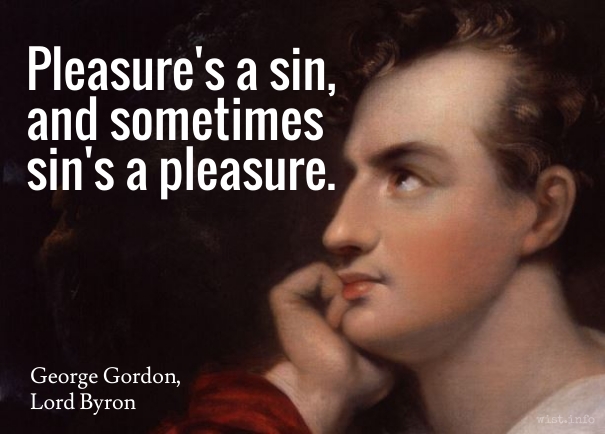
‘T is pity though, in this sublime world, that
Pleasure’s a sin, and sometimes sin’s a pleasure.
What human nature does is quite plain. It shows itself in immoral, filthy, and indecent actions; in worship of idols and witchcraft. People become enemies and they fight; they become jealous, angry, and ambitious. They separate into parties and groups; they are envious, get drunk, have orgies, and do other things like these. I warn you now as I have before: those who do these things will not possess the Kingdom of God.
[Φανερὰ δέ ἐστιν τὰ ἔργα τῆς σαρκός ἅτινά ἐστιν πορνεία ἀκαθαρσία ἀσέλγεια εἰδωλολατρία φαρμακεία ἔχθραι ἔρις ζῆλος θυμοί ἐριθεῖαι διχοστασίαι αἱρέσεις φθόνοι μέθαι κῶμοι καὶ τὰ ὅμοια τούτοις ἃ προλέγω ὑμῖν καθὼς προεῖπον ὅτι οἱ τὰ τοιαῦτα πράσσοντες βασιλείαν Θεοῦ οὐ κληρονομήσουσιν.]
The Bible (The New Testament) (AD 1st - 2nd C) Christian sacred scripture
Book 9. Letter to the Galatians 5:19ff (Gal 5:19–21) [GNT (1976)]
(Source)
(Source (Greek)). Other translations:Now the works of the flesh are manifest, which are these; Adultery, fornication, uncleanness, lasciviousness, idolatry, witchcraft, hatred, variance, emulations, wrath, strife, seditions, heresies, envyings, murders, drunkenness, revellings, and such like: of the which I tell you before, as I have also told you in time past, that they which do such things shall not inherit the kingdom of God.
[KJV (1611)]When self-indulgence is at work the results are obvious: fornication, gross indecency and sexual irresponsibility; idolatry and sorcery; feuds and wrangling, jealousy, bad temper and quarrels; disagreements, factions, envy; drunkenness, orgies and similar things. I warn you now, as I warned you before: those who behave like this will not inherit the kingdom of God.
[JB (1966)]When self-indulgence is at work the results are obvious: sexual vice, impurity, and sensuality, the worship of false gods and sorcery; antagonisms and rivalry, jealousy, bad temper and quarrels, disagreements, factions and malice, drunkenness, orgies and all such things. And about these, I tell you now as I have told you in the past, that people who behave in these ways will not inherit the kingdom of God.
[NJB (1985)]The actions that are produced by selfish motives are obvious, since they include sexual immorality, moral corruption, doing whatever feels good, idolatry, drug use and casting spells, hate, fighting, obsession, losing your temper, competitive opposition, conflict, selfishness, group rivalry, jealousy, drunkenness, partying, and other things like that. I warn you as I have already warned you, that those who do these kinds of things won’t inherit God’s kingdom.
[CEB (2011)]Now the works of the flesh are obvious: sexual immorality, impurity, debauchery, idolatry, sorcery, enmities, strife, jealousy, anger, quarrels, dissensions, factions, envy, drunkenness, carousing, and things like these. I am warning you, as I warned you before: those who do such things will not inherit the kingdom of God.
[NRSV (2021 ed.)]
Do not imagine that the knowledge, which I so much recommend to you, is confined to books, pleasing, useful, and necessary as that knowledge is: but I comprehend in it the great knowledge of the world, still more necessary than that of books. In truth, they assist one another reciprocally; and no man will have either perfectly, who has not both. The knowledge of the world is only to be acquired in the world and not in a closet. Books alone will never teach it you; but they will suggest many things to your observation, which might, otherwise escape you; and your own observations upon mankind, when compared with those which you will find in books, will help you to fix the true point.
Lord Chesterfield (1694–1773) English statesman, wit [Philip Dormer Stanhope]
Letter to his son, #112 (4 Oct 1746)
(Source)

What shall it profit a man, if he shall gain the whole world, and lose his own soul?
[τί γὰρ ὠφελεῖ ἄνθρωπον κερδῆσαι τὸν κόσμον ὅλον καὶ ζημιωθῆναι τὴν ψυχὴν αὐτοῦ]
The Bible (The New Testament) (AD 1st - 2nd C) Christian sacred scripture
Book 2. Gospel of Mark 8:36 (Mark 8:36) (Jesus) [KJV (1611)]
(Source)
This passage is paralleled in Matthew 16:26 and Luke 9:25.
(Source (Greek)). Other translations:What gain, then, is it for a man to win the whole world and ruin his life?
[JB (1966)]What gain, then, is it for anyone to win the whole world and forfeit his life?
[NJB (1985)]Do you gain anything if you win the whole world but lose your life? Of course not!
[GNT (1992 ed.)]Why would people gain the whole world but lose their lives?
[CEB (2011)]For what will it profit them to gain the whole world and forfeit their life?
[NRSV (2021 ed.)]
That observation which is called knowledge of the world will be found much more frequently to make men cunning than good.
Samuel Johnson (1709–1784) English writer, lexicographer, critic
Essay (1750-03-31), The Rambler, No. 4
(Source)

Prosperity has damn’d more Souls, than all the Devils together.
Thomas Fuller (1654–1734) English physician, preacher, aphorist, writer
Gnomologia: Adages and Proverbs (compiler), # 3963 (1732)
(Source)

OPHELIA:But, good my brother,
Do not, as some ungracious pastors do,
Show me the steep and thorny way to heaven,
Whiles, like a puffed and reckless libertine,
Himself the primrose path of dalliance treads
And recks not his own rede.William Shakespeare (1564–1616) English dramatist and poet
Hamlet, Act 1, sc. 3, l. 50ff (1.3.50-55) (c. 1600)
(Source)

FALSTAFF: Lord, Lord, how this world is given to lying!
William Shakespeare (1564–1616) English dramatist and poet
Henry IV, Part 1, Act 5, sc. 4, l. 148 (5.4.148) (1597)
(Source)