The attempt to combine wisdom and power has only rarely been successful, and then only for a short while.
[Dem Streben, Weisheit und Macht zu vereinigen, war nur selten und nur auf kurze Zeit Erfolg beschieden.]Albert Einstein (1879–1955) German-American physicist
Essay (1953-05-23), “Aphorisms for Leo Baeck [Neun Aphorismen], No. 2, Essays Presented to Leo Baeck on the Occasion of His Eightieth Birthday (1954) [Einstein Archives 28-962]
(Source)
Quotations about:
abuse of power
Note not all quotations have been tagged, so Search may find additional quotes on this topic.
The ascent of the privileged, not only in the Lager [prison camp] but in all human coexistence, is an anguishing but unfailing phenomenon: only in utopias is it absent. It is the duty of righteous men to make war on all undeserved privilege, but one must not forget that this is a war without end. Where there exists power exercised by the few or by only one against the many, privilege is born and proliferates, even against the will of the power itself; but on the other hand it is normal for power to tolerate and encourage it.
Primo Levi (1919–1987) Italian Jewish chemist and writer
The Drowned and the Saved, ch. 2 “The Grey Zone” (1986) [tr. Rosenthal (1888)]
(Source)
Writing of the grey zone, the protekcja [privilege], of those who existed between being prisoners and the military running the camps. It was granted to those who collaborated / compromised with the prison structure (such as the Kapos), and included marginally better treatment and chances of survival.

In the future world the misuse of power, as implied in the term “power politics,” must not be a controlling factor in international relations. That is the heart of the principles to which we have subscribed. We cannot deny that power is a factor in world politics any more than we can deny its existence as a factor in national politics. But in a democratic world, as in a democratic Nation, power must be linked with responsibility, and obliged to defend and justify itself within the framework of the general good.
Franklin Delano Roosevelt (1882–1945) American lawyer, politician, statesman; US President (1933–45)
Message (1945-01-06) to Congress, Annual Message (State of the Union)
(Source)
It has eternally been observed that any man who has power is led to abuse it; he continues until he finds limits.
[C’est une expérience éternelle, que tout homme qui a du pouvoir est porté à en abuser; il va jusqu’à ce qu’il trouve des limites.]
Charles-Lewis de Secondat, Baron de Montesquieu (1689–1755) French political philosopher
Spirit of Laws [The Spirit of the Laws; De l’esprit des lois], Book 11, ch. 4 (11.4) (1748) [tr. Cohler/Miller/Stone (1989)]
(Source)
See Acton (1887).
(Source (French)). Other translations:Constant experience shows us, that every man invested with power is apt to abuse it; he pushes on till he comes to the utmost limit.
[tr. Nugent (1750)]Timeless experience tells us that any man who holds power is inclined to abuse it : he continues until he encounters limits.
[tr. Stewart (2018)]
NURSE: Terrible is the temperament of royalty,
Who are rarely controlled, always imperious;
It is hard for them to give up their wrath.
To get used to living like everybody else
Is better.[ΤΡΟΦΌΣ: δεινὰ τυράννων λήματα καί πως
ὀλίγ᾽ ἀρχόμενοι, πολλὰ κρατοῦντες
χαλεπῶς ὀργὰς μεταβάλλουσιν.
τὸ γὰρ εἰθίσθαι ζῆν ἐπ᾽ ἴσοισιν
κρεῖσσον.]Euripides (485?-406? BC) Greek tragic dramatist
Medea [Μήδεια], l. 119ff (431 BC) [tr. Podlecki (1989)]
(Source)
(Source (Greek)). Other translations:For the souls
Of Kings are prone to cruelty, so seldom
Subdued, and over others wont to rule,
That it is difficult for such to change
Their angry purpose. Happier I esteem
The lot of those who still are wont to live
Among their equals.
[tr. Wodhull (1782)]Kings have a fiery quality of soul,
Accustom'd to command, if once they feel
control, though small, their anger blazes out
Not easily extinguish'd: hence I deem
An equal mediocrity of life
More to be wish'd.
[tr. Potter (1814)]Dread are the humours of princes: as wont
To be ruled in few things and in many to lord,
It is hard to them to turn from their wrath.
But to lead one's life in the level ways
Is best.
[tr. Webster (1868)]Strange are the tempers of princes, and maybe because they seldom have to obey, and mostly lord it over others, change they their moods with difficulty. 'Tis better then to have been trained to live on equal terms.
[tr. Coleridge (1891)]Dreadful are the dispositions of tyrants, and somehow in few things controlled, in most absolute, they with difficulty lay aside their passion. The being accustomed then to live in mediocrity of life is the better.
[tr. Buckley (1892)]Ah princes -- how fearful their moods are! --
Long ruling, unschooled to obey, --
Unforgiving, unsleeping their feuds are.
Better life's level way.
[tr. Way (Loeb) (1894)]Rude are the wills of princes: yea,
Prevailing alway, seldom crossed,
On fitful winds their moods are tossed:
'Tis best men tread the equal way.
[tr. Murray (1906)]Great people’s tempers are terrible, always
Having their own way, seldom checked,
Dangerous they shift from mood to mood.
How much better to have been accustomed
To live on equal terms with one’s neighbors.
[tr. Warner (1944)]Oh, it's a bad thing
To be born of high race, and brought up wilful and powerful in a great house, unruled
And ruling many: for then if misfortune comes it is unendurable, it drives you mad. I say that poor people
Are happier: the little commoners and humble people, the poor in spirit.
[tr. Jeffers (1946)]The mind of a queen
Is a thing to fear. A queen is used
To giving commands, not obeying them;
And her rage once roused is hard to appease.
To have learnt to live on the common level
Is better.
[tr. Vellacott (1963)]The minds of royalty are dangerous: since they often command and seldom obey, they are subject to violent changes of mood. For it is better to be accustomed to live on terms of equality.
[tr. Kovacs (1994)]They have frightening natures, those of royal blood; because, I imagine, they’re seldom overruled and generally have their way, they do not easily forget a grudge. Better to have formed the habit of living on equal terms with your neighbours.
[tr. Davie (1996)]How afraid I am of these royal rages! It’s so hard for such rages to subside.
Kings and queens have always been spoiled by power. They’re not used to taking orders. No, they’d much rather give them!
Kings and Queens only do what they want and forget about everyone else!
Oh, how much better it is to live a balanced life: to be an equal among equals.
[tr. Theodoridis (2004)]Tyrants’ tempers are insufferable:
they are seldom under control, their power is far-reaching.
It is hard for them to swallow their rages.
To get used to living on terms of equality
is better.
[tr. Luschnig (2007)]The pride of rulers is something to fear --
they often order men, but seldom listen,
and when their tempers change it’s hard to bear.
It’s better to get used to living life
as an equal common person.
[tr. Johnston (2008)]The temperaments of royalty are fearsome;
because they're almost unrestrained
and are so powerful, it is rare
for them to overcome their rage.
To be accustomed to live in equality
is best.
[tr. Ewans (2022)]Terrible / wonderful [deina] are the tempers of turannoi; maybe because they seldom have to obey, and mostly lord it over others, they change their moods with difficulty. It is better then to have been trained to live in equality.
[tr. Coleridge / Ceragioli / Nagy / Hour25]
SGANARELLE: But when a great lord is a wicked man, it is a terrible thing.
[Mais un grand seigneur méchant homme est une terrible chose.]
Molière (1622–1673) French playwright, actor [stage name for Jean-Baptiste Poquelin]
Don Juan [Dom Juan], Act 1, sc. 1 (1665) [tr. Waller (1904)]
(Source)
(Source (French)). Other translations:But a great Lord, a wicked Man, is a terrible thing.
[tr. Clitandre (1672)]If a great lord is a wicked man it is a terrible thing.
[tr. Van Laun (1876)]But if a great lord is also a wicked man, it is a terrible thing.
[tr. Wall (1879)]But a wicked nobleman is a terrible thing.
[tr. Page (1908)]But a great lord who is a wicked man is a terrible thing.
[tr. Frame (1967)]But a wicked nobleman is a frightening master.
[tr. Bermel (1987)]But a great lord who's a wicked man is a frightening thing.
[tr. Wilbur (2001)]
Sometimes rendered "What a terrible thing to be a great lord, yet a wicked man," though I could not find a good source for that phrasing, which is also attributed to Carlos Castañeda.
This new understanding undermines the old admiration of worldly success as such. We are beginning to abandon our tolerance of the abuse of power by those who betray for profit the elementary decencies of life.
Franklin Delano Roosevelt (1882–1945) American lawyer, politician, statesman; US President (1933–45)
Speech (1937-01-20), Inaugural Address, Washington, D.C.
(Source)
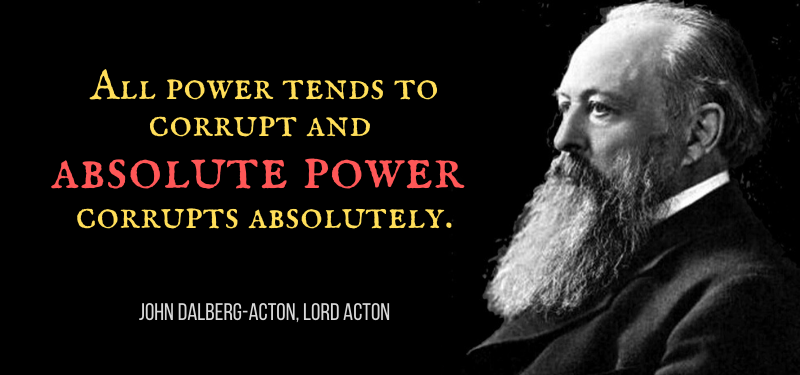
I cannot accept your canon that we are to judge Pope and King unlike other men, with a favourable presumption that they did no wrong. If there is any presumption it is the other way against holders of power, increasing as the power increases. Historic responsibility has to make up for the want of legal responsibility. All power tends to corrupt and absolute power corrupts absolutely. Great men are almost always bad men, even when they exercise influence and not authority: still more when you superadd the tendency or the certainty of corruption by authority. There is no worse heresy than that the office sanctifies the holder of it.
John Dalberg, Lord Acton (1834–1902) British historian, politician, writer
Letter (1887-04-05) to Mandell Creighton
(Source)
Often paraphrased, "Power corrupts, and absolute power corrupts absolutely."
There is an alternate, probably spurious version of this quote, for which I have been unable to find an actual citation (except where it is mis-cited to this letter to Bp. Creighton): "And remember, where you have a concentration of power in a few hands, all too frequently men with the mentality of gangsters get control. History has proven that. All power corrupts; absolute power corrupts absolutely." As the word "gangster" has only been traced back to 1886, and that in the US, its use by Acton (esp. in a modern sense) seems unlikely.