

We ought to beware of people who do not think it necessary to pretend that they are good and decent. Lack of hypocrisy in such things hints at a capacity for a most depraved ruthlessness.
Eric Hoffer (1902–1983) American writer, philosopher, longshoreman
Passionate State of Mind, Aphorism 200 (1955)
(Source)
Quotations about:
decency
Note not all quotations have been tagged, so Search may find additional quotes on this topic.

This new understanding undermines the old admiration of worldly success as such. We are beginning to abandon our tolerance of the abuse of power by those who betray for profit the elementary decencies of life.
Franklin Delano Roosevelt (1882–1945) American lawyer, politician, statesman; US President (1933–45)
Speech (1937-01-20), Inaugural Address, Washington, D.C.
(Source)

My first reaction was to be afraid
This ardor was a snare the Devil had laid;
And I avoided you as a temptation
That might stand in the way of my salvation.
But finally I knew, O gracious beauty,
That passion need not be at odds with duty,
That I can reconcile it with propriety;
And so I yield to it without anxiety.
[D’abord j’appréhendai que cette ardeur secrète
Ne fût du noir esprit une surprise adroite;
Et même à fuir vos yeux mon cœur se résolut,
Vous croyant un obstacle à faire mon salut.
Mais enfin je connus, ô beauté tout aimable!
Que cette passion peut n’être point coupable,
Que je puis l’ajuster avecque la pudeur;
Et c’est ce qui m’y fait abandonner mon cœur.]Molière (1622–1673) French playwright, actor [stage name for Jean-Baptiste Poquelin]
Tartuffe, or the Hypocrite [Le Tartuffe, ou L’Imposteur], Act 3, sc. 3 (1669) [tr. Frame (1967)]
(Source)
Tartuffe plays the "It can't be wrong if it feels so right" seduction card. "Modesty" is used here in many of the translations in its meaning of moderate behavior or avoidance of sexual explicitness.
(Source (French)). Alternate translations:At first I was under Apprehension lest this secret Flame might be a dexterous Surprize of the foul Fiend; and my Heart even resolv'd to avoid your Eyes, believing you an Obstacle to my future Happiness. But at length I perceiv'd, most lovely Beauty, that my passion could not be blameable, that I could reconcile it with Modesty, and this made me abandon my Heart to it.
[tr. Clitandre (1672)]At first I feared that this secret ardour might be nothing but a cunning snare of the foul fiend; and my heart even resolved to fly your presence, thinking that you might be an obstacle to my salvation. But at last I found, oh most lovely beauty, that my passion could not be blameable; that I could reconcile it with modesty; and this made me feely indulge it.
[tr. Van Laun (1876)]At first I feared that this secret tenderness might be a skilful assault of the evil one; I event hought I would avoid your presence, fearing you might prove a stumbling-block to my salvation. But I have learnt, O adorable beauty, that my passion need not be a guilty one; that i can reconcile it with modesty; and I have given up my whole soul to it.
[tr. Wall (1879)]At first I was afraid lest this secret flame might be a subtle surprise of the evil one; and my heart resolved to avoid your eyes as an obstacle to my future happiness; but at length I perceived, most lovely beauty, that: my passion could not be guilty; that I could reconcile it with the rules of modesty, and this made me yield my heart to it.
[tr. Mathew (1890)]At first I feared lest this secret tenderness might be but an artful assault of the evil one; and my heart even resolved to flee from your eyes, fearing you might be a stumbling-block in the way of my salvation. But at last I learnt, ah! most entrancing beauty, that this passion need not be a guilty one, that I cuold reconcile it with modesty, and so I have let my heart give way to it.
[tr. Waller (1903)]At first I trembled lest this secret love
Might be the Evil Spirit's artful snare;
I even schooled my heart to flee your beauty,
Thinking it was a bar to my salvation.
But soon, enlightened, O all lovely one,
I saw how this my passion may be blameless,
How I may make it fit with modesty,
And thus completely yield my heart to it.
[tr. Page (1909)]At first I trembled, lest my secret flame
Should be a stratagem of the Evil One;
Even, I was resolved to flee your presence,
A possible obstacle to my salvation.
But finally I realized, my fair one,
That there need be no guilt in such a passion.
That I can make it chime with modesty;
And so I let my heart follow its bent.
[tr. Bishop (1957)]At first, I trembled, lest that love should be
A subtle snare that Hell had laid for me;
I vowed to flee the sight of you, eschewing
A rapture that might prove my soul's undoing;
But soon, fair being, I became aware
That my deep passion could be made to square
With rectitude, and with my bounden duty.
I thereupon surrendered to your beauty.
[tr. Wilbur (1963)]At first I feared that this secret passion was a clever temptation of the Evil One, and I even tried to avoid you, thinking you might be an obstacle to my salvation. But at last, most adorable beauty, I recognized that such love need not be sinful, that I could reconcile it with decency, and I surrendered to it.
[tr. Steiner (2008)]

Although fear was turning you into a good citizen, fear is only in the short term a teacher of duty; and that unscrupulousness of yours, which never deserts you so long as you are not afraid, has turned you into a scoundrel.
[Quamquam bonum te timor faciebat, non diuturnus magister officii, improbum fecit ea, quae, dum timor abest, a te non discedit, audacia.]
Marcus Tullius Cicero (106–43 BC) Roman orator, statesman, philosopher
Philippics [Philippicae; Antonian Orations], No. 2, ch. 36 / sec. 90 (2.36/2.90) (44-10-24 BC) [tr. Berry (2006)]
(Source)
(Source (Latin)). Other translations:However, the cause of your loyalty was fear, no lasting monitor of duty, while your worthlessness springs from that audacity which is ever present with you while you are free from fear.
[tr. King (1877)]Fear is not a lasting teacher of duty.
[Timor non est diuturnus magister officii.]
[ed. Hoyt (1883)]However, it was fear -- no steadfast teacher of duty -- that made you good: what made you unprincipled was that which, in the absence of fear, never departs from you, audacity.
[tr. Ker (Loeb) (1926)]Although it was fear that was then making you a good citizen, which is never a lasting teacher of duty; your own audacity, which never departs from you as long as you are free from fear, has made you a worthless one.
[tr. Yonge (1903)]Although fear (not a long-lasting teacher of one’s duty) was making you a decent person then, your arrogance, which never leaves you as long as fear is absent, has made you shameless.
[tr. McElduff (2011)]
The worth of the ideal must be largely determined by the success with which it can in practice be realized. We should abhor the so-called “practical” men whose practicality assumes the shape of that peculiar baseness which finds its expression in disbelief in morality and decency, in disregard of high standards of living and conduct. Such a creature is the worst enemy of the body politic. But only less desirable as a citizen is his nominal opponent and real ally, the man of fantastic vision who makes the impossible better forever the enemy of the possible good.
Theodore Roosevelt (1858–1919) American politician, statesman, conservationist, writer; US President (1901–09)
Speech (1910-04-23), “Citizenship in a Republic [The Man in the Arena],” Sorbonne, Paris
(Source)

I told her that what made being alive almost worthwhile for me was all the saints I met almost anywhere, people who were behaving decently in an indecent society.
Kurt Vonnegut, Jr. (1922–2007) American novelist, journalist
Letter (1992-10-16) to Robert Maslansky
(Source)
Phrases used in a number of places by Vonnegut, often as his reply when a woman wrote him to ask if it were right to bring a child into a world as bad as this one; he then encouraged his readers or listeners to become a saint for that child. He also used the phrase to describe the underlying theme of his writing.
Other variants:I replied that what made being alive almost worthwhile for me was the saints I met, people behaving unselfishly and capably. They turned up in the most unexpected places.
[Timequake, ch. 62 (1997)]I replied that what made living almost worthwhile for me were the saints I met. They could be anywhere. They were people who behaved decently in an indecent society.
[Kevin Alexander Bacon, ed., At Millennium's End: New Essays on the Work of Kurt Vonnegut, Foreword (1998-11-11) (2001)]What makes life worth living are the saints I meet -- they can be long-time friends or someone I meet on a street. They find a way to behave decently in an indecent society.
["Vonnegut Unbound," Interview by Christopher R. Blazejewski, The Harvard Crimson (2000-05-12)]I replied that what made being alive almost worthwhile for me, besides music, was all the saints I met, who could be anywhere. By saints I meant people who behaved decently in a strikingly indecent society.
[Lecture (2003-09-22), University of Wisconsin, Madison; reprinted in "Knowing What's Nice," In These Times (2003-11-06)]What makes life worth living are the saints. You meet saints everywhere. They can be anywhere. They are people behaving decently in an indecent society.
[Frequently quoted version]

I was raised in an old-fashioned American tradition and there were certain homely things that were taught to me: To try to tell the truth, not to bear false witness, not to harm my neighbor, to be loyal to my country, and so on. In general, I respected these ideals of Christian honor and did as well with them as I knew how. It is my belief that you will agree with these simple rules of human decency and will not expect me to violate the good American tradition from which they spring.
Lillian Hellman (1905–1984) American playwright, screenwriter
Letter to Rep. John S. Wood, House Committee on Un-American Activities (19 May 1952)
(Source)
On declining to "name names" before HUAC (see here). National Archives copy. Reprinted in The Nation (31 May 1952).
As a result of the letter and her invoking the Fifth Amendment at the HUAC hearings, Hellman was put on the Hollywood Blacklist for the rest of the decade.

Between justice and respect there is this difference, that it is the part of justice not to injure; of respect, not to offend. In this the force of propriety is extremely clear.
[Est autem, quod differat in hominum ratione habenda inter iustitiam et verecundiam. Iustitiae partes sunt non violare homines, verecundiae non offendere; in quo maxime vis perspicitur decori.]
Marcus Tullius Cicero (106–43 BC) Roman orator, statesman, philosopher
De Officiis [On Duties; On Moral Duty; The Offices], Book 1, ch. 28 (1.28) / sec. 99 (44 BC) [tr. McCartney (1798)]
(Source)
Verecundia is usually translated as "modesty," but Cicero is using a more complex sense here, leading to a variety of translations. Peabody translates it as "courtesy" that is "part of or a consequence of modesty." Edmonds (at length) considers the term untranslatable here, "an inward abhorrence of moral turpitude, through which the conscience is awed, and may be said to blush."
(Source (Latin)). Other translations:But here we must observe, that there is a great deal of difference between that which justice, and that which this modesty, respect, or reverence demands, in relation to other people. It is the duty of justice, not to injure or wrong any man; of respect, or reverence, not to do anything that may offend or displease him; wherein more especially the nature of that decorum we are speaking of consists.
[tr. Cockman (1699)]But, in our estimate of human life, we are to make a difference between justice and moral susceptibility. The dictate of justice is to do no wrong; that of moral susceptibility is to give no offense to mankind, and in this the force of the graceful is most perceptible.
[tr. Edmonds (1865)]But in the treatment of men there is a difference between justice and courtesy. It is the part of justice not to injure men; of courtesy, not to give them offence, and it is in this last that the influence of becomingness is most clearly seen.
[tr. Peabody (1883)]In our social relations there is a difference between justice and sympathy. Not to wrong our fellow-men is the function of justice: that of sympathy is not to wound their feelings; herein the power of decorum is most conspicuous.
[tr. Gardiner (1899)]There is, too, a difference between justice and considerateness in one's relations to one's fellow-men. It is the function of justice not to do wrong to one's fellow-men; of considerateness, not to wound their feelings; and in this the essence of propriety is best seen.
[tr. Miller (1913)]Moreover, in maintaining distinctions among men there is a degree of difference between justice and decent respect. The duty of justice is not to do violence to men. The duty of decent respect is not to insult them; this latter especially reveals the essence of decorum.
[tr. Edinger (1974)]
I’d write a story once in a while, but I wouldn’t pester editors with it. I’d write of people and places like I knew, and I’d make my characters talk everyday English; and I’d let the sun rise and set in the usual quiet way without much fuss over the fact. If I had to have villains at all, I’d give them a chance, Anne — I’d give them a chance. There are some terrible bad men in the world, I suppose, but you’d have to go a long piece to find them — though Mrs. Lynde believes we’re all bad. But most of us have got a little decency somewhere in us.
Lucy Maud Montgomery (1874–1942) Canadian author
Anne of the Island, ch. 12 [Mr. Harrison] (1915)
(Source)

To jest at physical deformities is to prove Yourself Unfit to breathe the air of Decency.
Minna Antrim (1861–1950) American epigrammatist, writer
Don’ts for Bachelors and Old Maids (1908)
(Source)

It’s hard for decent people to stay angry at someone who has burst into tears, which is why it is often a good idea to burst into tears if a decent person is yelling at you.
Lemony Snicket (b. 1970) American author, screenwriter, musician (pseud. for Daniel Handler)
The Carnivorous Carnival (2002)

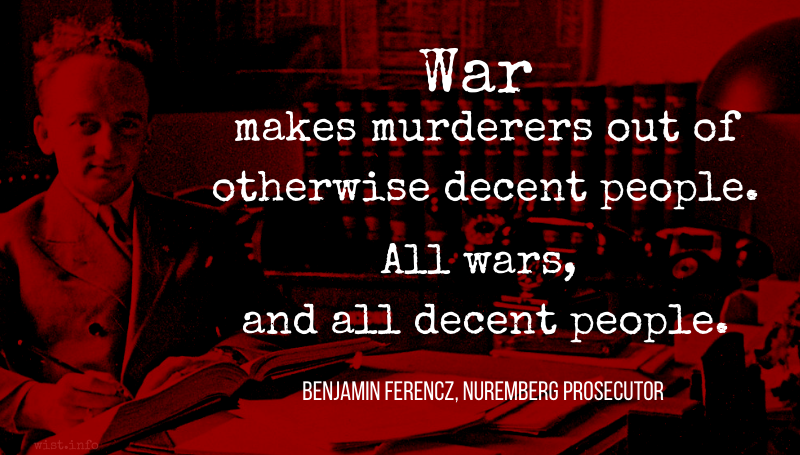
War makes murderers out of otherwise decent people. All wars, and all decent people.
Benjamin Ferencz (b. 1920) American lawyer, international legal scholar, activist
“What the last Nuremberg prosecutor alive wants the world to know,” interview with Leslie Stahl, 60 Minutes (7 May 2017)
(Source)
Ferencz served as chief prosecutor of twenty Einsatzgruppen officers during the Nuremberg war crimes trials. Longer excerpt:STAHL: Did you meet a lot of people who perpetrated war crimes who would otherwise in your opinion have been just a normal, upstanding citizen?
FERENCZ: Of course, is my answer. These men would never have been murderers had it not been for the war. These were people who could quote Goethe, who loved Wagner, who were polite --
STAHL: What turns a man into a savage beast like that?
FERENCZ: He's not a savage. He's an intelligent, patriotic human being.
STAHL: He's a savage when he does the murder though.
FERENCZ: No. He's a patriotic human being acting in the interest of his country, in his mind.
STAHL: You don't think they turn into savages even for the act?
FERENCZ: Do you think the man who dropped the nuclear bomb on Hiroshima was a savage? Now I will tell you something very profound, which I have learned after many years. War makes murderers out of otherwise decent people. All wars, and all decent people.

A real man of fashion and pleasures observes decency: at least, neither borrows nor affects vices; and, if he unfortunately has any, he gratifies them with choice, delicacy, and secrecy.
Lord Chesterfield (1694–1773) English statesman, wit [Philip Dormer Stanhope]
Letter to his son, #119 (27 Mar 1747)
(Source)

The best foreign policy is to live our daily lives in honesty, decency, and integrity; at home, making our own land a more fitting habitation for free men; and abroad, joining with those of like mind and heart, to make of the world a place where all men can dwell in peace.
Dwight David Eisenhower (1890–1969) American general, US President (1953–61)
Lecture (1950-03-23), Inaugural Gabriel Silver Lecture, Columbia University


Good judgment in our dealings with others consists not in seeing through deceptions and evil intentions but in being able to waken the decency dormant in every person.
Eric Hoffer (1902–1983) American writer, philosopher, longshoreman
Passionate State of Mind, Aphorism 141 (1955)
(Source)
Don’t join the book burners. Don’t think you are going to conceal thoughts by concealing evidence that they ever existed. Don’t be afraid to go in your library and read every book, as long as that document does not offend your own ideas of decency. That should be the only censorship.
Dwight David Eisenhower (1890–1969) American general, US President (1953–61)
Commencement Speech, Dartmouth College (14 Jun 1953)