Perhaps that’s what we all had to do — think out for ourselves what we could believe and how we could live by it. And so I came to the conclusion that you had to use this life to develop the very best that you could develop.
Eleanor Roosevelt (1884–1962) American politician, diplomat, activist; First Lady of the US (1933–45)
Essay (1951-12), “This I Believe: Growth that Starts from Thinking,” on Edward R. Murrow, This I Believe, CBS Radio
(Source)
(Source (Audio); start 1:54). The essay was read without a script. The official transcript gives "what we all must do," but the audio clearly says, "what we all had to do."
Collected in Edward P. Morgan (ed.), This I Believe (1952).
Quotations about:
good behavior
Note not all quotations have been tagged, so Search may find additional quotes on this topic.

Thou never wast so good as thou shouldest be; if thou does not strive to be better. And thou never wilt be better, if thou doest not fear to grow worse.
Thomas Fuller (1654–1734) English physician, preacher, aphorist, writer
Introductio ad Prudentiam, Vol. 2, # 2092 (1727)
(Source)
Your children are neither as bad nor as good as you imagine. But then, neither are you.
Mignon McLaughlin (1913–1983) American journalist and author
The Neurotic’s Notebook, ch. 2 (1963)
(Source)

I told her that what made being alive almost worthwhile for me was all the saints I met almost anywhere, people who were behaving decently in an indecent society.
Kurt Vonnegut, Jr. (1922–2007) American novelist, journalist
Letter (1992-10-16) to Robert Maslansky
(Source)
Phrases used in a number of places by Vonnegut, often as his reply when a woman wrote him to ask if it were right to bring a child into a world as bad as this one; he then encouraged his readers or listeners to become a saint for that child. He also used the phrase to describe the underlying theme of his writing.
Other variants:I replied that what made being alive almost worthwhile for me was the saints I met, people behaving unselfishly and capably. They turned up in the most unexpected places.
[Timequake, ch. 62 (1997)]I replied that what made living almost worthwhile for me were the saints I met. They could be anywhere. They were people who behaved decently in an indecent society.
[Kevin Alexander Bacon, ed., At Millennium's End: New Essays on the Work of Kurt Vonnegut, Foreword (1998-11-11) (2001)]What makes life worth living are the saints I meet -- they can be long-time friends or someone I meet on a street. They find a way to behave decently in an indecent society.
["Vonnegut Unbound," Interview by Christopher R. Blazejewski, The Harvard Crimson (2000-05-12)]I replied that what made being alive almost worthwhile for me, besides music, was all the saints I met, who could be anywhere. By saints I meant people who behaved decently in a strikingly indecent society.
[Lecture (2003-09-22), University of Wisconsin, Madison; reprinted in "Knowing What's Nice," In These Times (2003-11-06)]What makes life worth living are the saints. You meet saints everywhere. They can be anywhere. They are people behaving decently in an indecent society.
[Frequently quoted version]

Etiquette means behaving yourself a little better than is absolutely essential.
Will Cuppy (1884–1949) American humorist, satirist, literary critic
How to Be a Hermit, “A Few Hints on Etiquette” (1929)
(Source)

Those who so act and so live as to give proof of loyalty and uprightness, of fairness and generosity; who are free from all passion, caprice, and insolence, and have great strength of character — men like those just mentioned — such men let us consider good, as they were accounted good in life, and also entitled to be called by that term because, in as far as that is possible for man, they follow Nature, who is the best guide to good living.
[Qui ita se gerunt, ita vivunt, ut eorum probetur fides integritas aequitas1 liberalitas, nec sit in eis ulla cupiditas libido audacia, sintque magna constantia, ut ei fuerunt, modo quos nominavi, hos viros bonos, ut habiti sunt, sic etiam appellandos putemus, quia sequantur, quantum homines possunt, naturam optimam bene vivendi ducem.]
Marcus Tullius Cicero (106–43 BC) Roman orator, statesman, philosopher
Laelius De Amicitia [Laelius on Friendship], ch. 5, part 3 (5.3) / sec. 19 (44 BC) [tr. Falconer (1923)]
(Source)
Original Latin. Other translations:Those who so conduct themselves, and so live that their honor, their integrity, their justice, and liberality are approved; so that there is not in them any covetousness, or licentiousness, or boldness; and that they are of great consistency, as those men whom I have mentioned above; -- let us consider these worthy of the appellation of good men, as they have been accounted such because they follow (as far as men are able) nature, which is the best guide of a good life.
[tr. Edmonds (1871)]Those who so conduct themselves, so live, that their good faith, integrity, equity, and kindness win approval, who are entirely free from avarice, lust, and the infirmities of a hasty temper, and in whom there is perfect consistency of character; in fine, men like those whom I have named, while they are regarded as good, ought to be so called, because to the utmost of human capacity they follow Nature, who is the best guide in living well.
[tr. Peabody (1887)]We mean then by the "good" those whose actions and lives leave no question as to their honour, purity, equity, and liberality; who are free from greed, lust, and violence; and who have the courage of their convictions. The men I have just named may serve as examples. Such men as these being generally accounted “good,” let us agree to call them so, on the ground that to the best of human ability they follow nature as the most perfect guide to a good life.
[tr. Shuckburgh (1909)]Those who comport themselves in such a way, who live in such a way that their loyalty, integrity, fairness and generosity are proven, such that there is no desire, lust, and insolence in them, and such that they have great steadfastness of character (like those whom I named just before), we consider ought indeed to be called good men (as is customary), because they follow (as much as humans can) nature -- the best leader in proper living.
[Source]
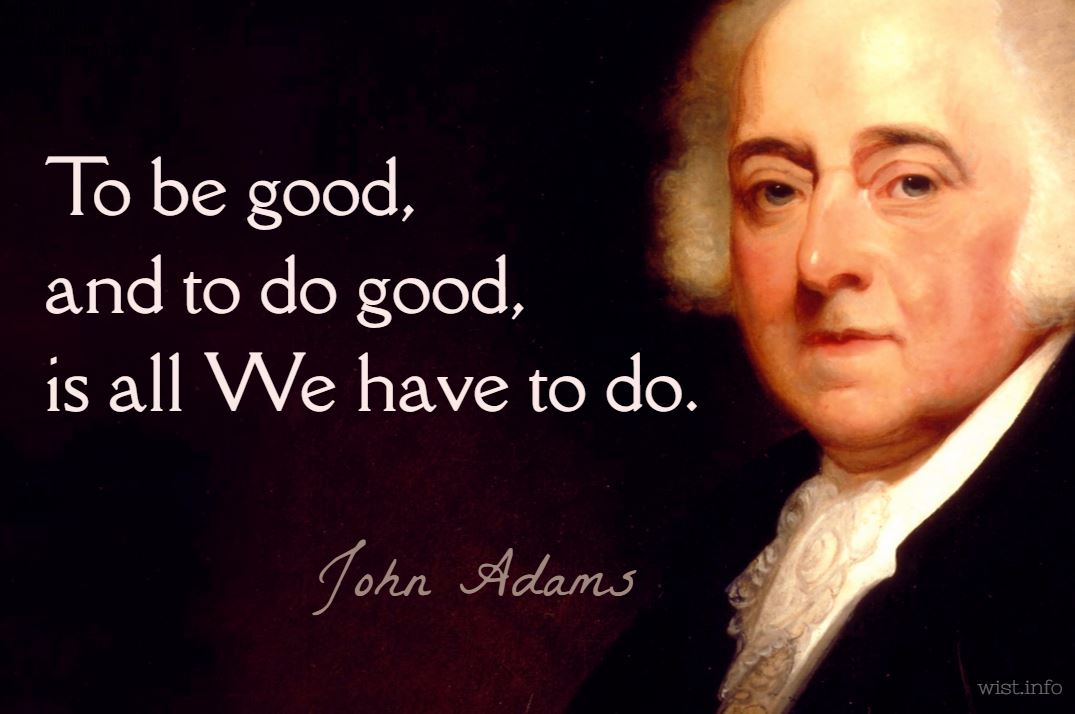
To be good, and to do good, is all We have to do.
John Adams (1735–1826) American lawyer, Founder, statesman; US President (1797–1801)
Letter (1777-03-17) to Nabby Adams (Abigail Adams 2d)
(Source)

Act uprightly, and despise Calumny; Dirt may stick to a Mud Wall, but not to polish’d Marble.
Benjamin Franklin (1706–1790) American statesman, scientist, philosopher, aphorist
Poor Richard’s Almanack (1757)
Your goodness must have some edge to it, — else it is none.
Ralph Waldo Emerson (1803–1882) American essayist, lecturer, poet
Essay (1841), “Self-Reliance,” Essays: First Series, No. 2
(Source)
This essay was inspired by his reading of Walter Savage Landor in 1833, with passages pulled from his lecture "Individualism," last in his course on "The Philosophy of History" (1836–1837), with other passages from the lectures "School," "Genius," and "Duty" in his course on "Human Life" (1838–1839).