The various codes which were presented to you at Crossgates — religious, moral, social, and intellectual — contradicted one another of you worked out their implications. The essential conflict was between the tradition of nineteenth-century asceticism and the actually existing luxury and snobbery of the pre-1914 age. On the one side were low-church Bible Christianity, sex puritanism, insistence on hard work, respect for academic distinction, disapproval of self-indulgence: on the other, contempt for “braininess” and worship of games, contempt for foreigners and the working class, an almost neurotic dread of poverty, and, above all, the assumption not only that money and privilege are the things that matter, but that it is better to inherit them than to have to work for them. Broadly, you were bidden to be at once a Christian and a social success, which is impossible.
George Orwell (1903–1950) English journalist, essayist, writer [pseud. of Eric Arthur Blair]
Essay (1948-06), “‘Such, Such Were the Joys …’,” sec. 5, Partisan Review (1952-09)
(Source)
Speaking of the school he attended. This autobiographical essay was drafted around 1939, revised around 1946, and then completed in May or June of 1948. Collected in Such, Such Were the Joys, essay 8 (1953), though the full, unredacted version was not published until 2000.
Quotations about:
moral code
Note not all quotations have been tagged, so Search may find additional quotes on this topic.

Do what you feel in your heart to be right — for you’ll be criticized, anyway. You’ll be “damned if you do, and damned if you don’t.”
Eleanor Roosevelt (1884–1962) American politician, diplomat, activist; First Lady of the US (1933–45)
Quoted in Dale Carnegie, How to Stop Worrying and Start Living, ch. 21 (1948)
(Source)
I cannot find this in any of Roosevelt's written works or other primary sources. Carnegie wrote that Roosevelt told him this personally, and framed it as an extension of advice she'd received from her paternal aunt Anna "Bamie" Roosevelt Cowles: "Never be bothered by what people say, as long as you know in your heart you are right." See also Roosevelt.
From this Roosevelt has sometimes been credited with originating the phrase "Damned if you do and damned if you don't," though she set it in quotation marks to indicate she was quoting it. The saying was actually first recorded written by evangelist Lorenzo Dow in 1836.

The laws of conscience, which we pretend to be derived from nature, proceed from custom; every one, having an inward veneration for the opinions and manners approved and received among his own people, cannot, without very great reluctance, depart from them, nor apply himself to them without applause.
[Les loix de la conscience, que nous disons naistre de nature, naissent de la coustume : chacun ayant en veneration interne les opinions & mœurs approuvees & receues autour de luy, ne s’en peut desprendre sans remors, ny s’y appliquer sans applaudissement.]
Michel de Montaigne (1533–1592) French essayist
Essays, Book 1, ch. 22 (1.22), “Of Custom and Not Easily Changing an Accepted Law [De la Coustume et de Ne Changer Aisément une Loy Receüe]” (1572) [tr. Cotton/Hazlitt (1877)]
(Source)
The essay was in the 1st (1580) edition, but this passage was written in or after 1588, showing up in the final (1588) edition.
Some translators use the 1588 sequence of chapters, not the 1595, and so identify this as ch. 23.
(Source (French)). Alternate translations:The lawes of conscience, which we say to proceede from nature, rise and proceede of custome: every man holding in speciall regard, and inward veneration the opinions approved, and customes received about him, can not without remorse leave them, nor without applause applie himselfe unto them.
[tr. Florio (1603)]The Laws of Conscience, which we pretend to be deriv’d from Nature, proceed from Custom; every one having an inward Veneration for the Opinions and Manners, approv’d and receiv’d amongst his own People, cannot without very great Reluctancy depart from them, nor apply himself to them without applause.
[tr. Cotton (1686)]The laws of conscience, which we say are engendered by nature, are born of custom; every man, holding in inward veneration the opinions and fashions approved and received around him, can not depart from them without [self] upbraiding, or conform to them without [self] commendation.
[tr. Ives (1925), 1.23]The laws of conscience, which we say are born of nature, are born of custom. Each man, holding in inward veneration the opinions and the behavior approved and accepted around him, cannot break loose from them without remorse, or apply himself to them without self-satisfaction.
[tr. Frame (1943), 1.23]The laws of conscience which we say are born of Nature are born of custom; since man inwardly venerates the opinions and the manners approved and received about him, he cannot without remorse free himself from them nor apply himself to them without self-approbation.
[tr. Screech (1987), 1.23]

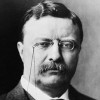
[… T]he individual virtues, and the necessity of character as the chief factor in any man’s success — a teaching in which I now believe as sincerely as ever, for all the laws that the wit of man can devise will never make a man a worthy citizen unless he has within himself the right stuff, unless he has self-reliance, energy, courage, the power of insisting on his own rights and the sympathy that makes him regardful of the rights of others.
Theodore Roosevelt (1858–1919) American politician, statesman, conservationist, writer; US President (1901–09)
Autobiography, ch. 1 “Boyhood and Youth” (1913)
(Source)
I am very wary of those individuals who are neither writers nor editors nor even, in some cases, readers, who feel that they have the right to apply their own moral criteria to the books in public and school libraries. I have enormous respect and admiration and love for the librarians who are rising up to protest this, because they are putting their very jobs on the line.
Madeleine L'Engle (1918–2007) American writer
Speech (1983-11-16), “Dare To Be Creative,” Lecture, Library of Congress, Washington, DC
(Source)

Perhaps that’s what we all had to do — think out for ourselves what we could believe and how we could live by it. And so I came to the conclusion that you had to use this life to develop the very best that you could develop.
Eleanor Roosevelt (1884–1962) American politician, diplomat, activist; First Lady of the US (1933–45)
Essay (1951-12), “This I Believe: Growth that Starts from Thinking,” on Edward R. Murrow, This I Believe, CBS Radio
(Source)
(Source (Audio); start 1:54). The essay was read without a script. The official transcript gives "what we all must do," but the audio clearly says, "what we all had to do."
Collected in Edward P. Morgan (ed.), This I Believe (1952).
The Constitution and the Declaration of Independence can live only as long as they are enshrined in our hearts and minds. If they are not so enshrined, they would be no better than mummies in their glass cases, and they could in time become idols whose worship would be a grim mockery of the true faith. Only as these documents are reflected in the thoughts and acts of Americans can they remain symbols of a power that can move the world.
Then the King established all the knights, and gave them riches and lands; and charged them never to do outrage nor murder, and always to flee treason, and to give mercy unto him that asketh mercy, upon pain of forfeiture of their worship and lordship of King Arthur for evermore; and always to do ladies, damosels, and gentlewomen and widows succour; strengthen them in their rights, and never to enforce them, upon pain of death. Also, that no man take no battles in a wrongful quarrel for no love, nor for no worldly goods. So unto this were all the knights sworn of the Table Round, both old and young. And every year so were they sworn at the high feast of Pentecost.
Thomas Malory (c. 1415–1471) English writer
Le Morte d’Arthur, Winchester Ed., Book 3, ch. 15 (1485)
(Source)
The Caxton version reads:Then the king stablished all his knights, and them that were of lands not rich he gave them lands, and charged them never to do outrageousity nor murder, and always to flee treason; also, by no means to be cruel, but to give mercy unto him that asketh mercy, upon pain of forfeiture of their worship and lordship of King Arthur for evermore; and always to do ladies, damosels, and gentlewomen succour, upon pain of death. Also that no man take no battles in a wrongful quarrel for no law, nor for no world's goods. Unto this were all the knights sword of the Table Round, both old and young. And every year were they sworn at the high feast of Pentecost.
A spurious, modern version of this oath is frequently found attributed to Malory:I will develop my life for the greater good. I will place character above riches, and concern for others above personal wealth, I will never boast, but cherish humility instead, I will speak the truth at all times, and forever keep my word, I will defend those who cannot defend themselves, I will honor and respect women, and refute sexism in all its guises, I will uphold justice by being fair to all, I will be faithful in love and loyal in friendship, I will abhor scandals and gossip -- neither partake nor delight in them, I will be generous to the poor and to those who need help, I will forgive when asked, that my own mistakes will be forgiven, I will live my life with courtesy and honor from this day forward.
Needless to say, Malory never wrote about refuting "sexism." This modern version may have originated with "The International Fellowship of Charity-Now," whose site quotes Malory above (as well as additional aspects of the oath that Tennyson included in Idylls of the King) and then lays out the modern oath broken out into twelve "trusts."

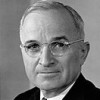
To ensure moral salvation, it is primarily necessary to depend on oneself, because in the moment of peril we are alone. And strength is not to be acquired instantaneously. He who knows that he will have to fight, prepares himself for boxing and dueling by strength and skill; he does not sit still with folded hands.
Maria Montessori (1870–1952) Italian educator, philosopher, educator, physician
The Advanced Montessori Method: Spontaneous Activity in Education, Vol. I (1917)
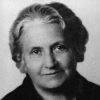
The most important thing about me is that I am a Catholic. It’s a superstructure within which you can work, like a sonnet. A good director tells the actors where to move exactly; then they’re free to act. I’m grateful for that discipline, and I’ve never had a crisis of conscience.
Jean Kerr (1922–2003) American author and playwright [b. Bridget Jean Collins]
Quoted in (1961-04-14) “Show Business: BROADWAY,” Time Magazine
(Source)
You always said people don’t do what they believe in,
they just do what’s most convenient, then they repent.Bob Dylan (b. 1941) American singer, songwriter
“Brownsville Girl,” Knocked Out Loaded (1986)

Do what thy manhood bids thee do, from none but self expect applause;
He noblest lives and noblest dies who makes and keeps his self-made laws.Richard Francis Burton (1821–1890) British explorer and orientalist
“The Kasidah of Haji Abdu El-Yezdi,” or “Lay of the Higher Law” (1880)
[S]he brought some of those apples. I was obliged to eat them, I was so hungry. It was against my principles, but I find that principles have no real force except when one is well-fed.
Mark Twain (1835–1910) American writer [pseud. of Samuel Clemens]
Story (1893), “Extracts from Adam’s Diary,” The Niagara Book
(Source)
This was first published as one of the stories and sketches from various authors in The Niagara Book: A Complete Souvenir of Niagara Falls (1893), mentioning the story as "The Earliest Authentic Mention of Niagara Falls" (so named by Eve on the first Tuesday).
The story was first collected in a Twain collection in 1903 (My Debut as a Literary Person with Other Essays and Stories), and published as an independent book with this title in 1904.
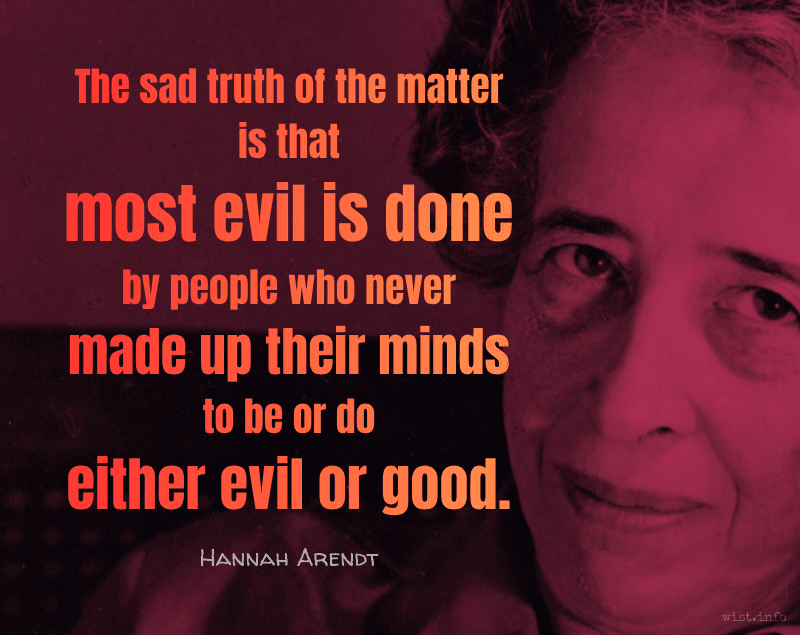
The sad truth of the matter is that most evil is done by people who never made up their minds to be or do either evil or good.
Hannah Arendt (1906–1975) German-American philosopher, political theorist
Life of the Mind, Vol. 1 “Thinking,” Part 3, ch. 18 “The two-in-one” (1977)
(Source)
Sometimes shortened as: "The sad truth is that most evil is done by people who never make up their minds to be good or evil."
Originally printed as an essay (1977-11-28), "Thinking -- III," The New Yorker (1977-12-05). That version is slightly longer:The sad truth of the matter is that most evil is done by people who never made up their minds to be either good or bad or to do either good or evil.
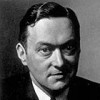
He has honor if he holds himself to an ideal of conduct though it is inconvenient, unprofitable, or dangerous to do so.
Walter Lippmann (1889–1974) American journalist and author
A Preface to Morals, 11.3 (1929)