If you wish a man to commit some abominable crime, from which he would naturally recoil in horror, you first teach him loyalty to a gang of arch-criminals, and then make his crime appear to him as exemplifying the virtue of loyalty. Of this process, patriotism is the most perfect instance.
Bertrand Russell (1872–1970) English mathematician and philosopher
Education and the Social Order [Education and the Modern World], ch. 1 “The Individual vs. the Citizen” (1932)
(Source)
Quotations about:
wrong-doing
Note not all quotations have been tagged, so Search may find additional quotes on this topic.

HECUBA: It the duty of a good man to do good everywhere and always to punish the evil men.
[ἙΚΆΒΗ: ἐσθλοῦ γὰρ ἀνδρὸς τῇ δίκῃ θ᾿ ὑπηρετεῖν
καὶ τοὺς κακοὺς δρᾶν πανταχοῦ κακῶς ἀεί.]Euripides (485?-406? BC) Greek tragic dramatist
Hecuba [Hekabe; Ἑκάβη], l. 844ff (c. 424 BC) [tr. Theodoridis (2007)]
(Source)
Requesting that Agamemnon help her avenge the murder of her son, Polydorus.
(Source (Greek)). Alternate translations:For the good man's duty
Is to obey the dread behests of justice,
And ever punish those who act amiss.
[tr. Wodhull (1809)]For it belongs to a good man to minister justice, and always and in every case to punish the bad.
[tr. Edwards (1826)]For 'tis the good man's part to champion right,
And everywhere and aye to smite the wrong.
[tr. Way (Loeb) (1894)]This, this is virtue: to do justice still,
Requiting evil every way with ill.
[tr. Sheppard (1924)]For it is always a good man's duty to help the right, and to punish evil-doers wherever found.
[tr. Coleridge (1938)]Do your duty as a man of honor:
see justice done. Punish this murder.
[tr. Arrowsmith (1958)]A good man is just, he'll punish the bad.
[tr. McGuinness (2004)]A good man commits himself to justice and combats the wicked in whatever place.
[tr. Harrison (2005)]Do your duty. Mete out justice.
Punish this heinous crime against gods and man.
[tr. Karden/Street (2011)]For it is right that a good man serve justice
And always do evil everywhere to evil men.
[tr. @sentantiq (2020)]
ALCESTE: His social polish can’t conceal his nature;
One sees at once that he’s a treacherous creature;
No one could possibly be taken in
By those soft speeches and that sugary grin.
The whole world knows the shady means by which
The low-brow’s grown so powerful and rich,
And risen to a rank so bright and high
That virtue can but blush, and merit sigh.
[Au travers de son masque on voit à plein le traître;
Partout il est connu pour tout ce qu’il peut être ;
Et ses roulements d’yeux, et son ton radouci
N’imposent qu’à des gens qui ne sont point d’ici.
On sait que ce pied plat, digne qu’on le confonde,
Par de sales emplois s’est poussé dans le monde,
Et que, par eux son sort de splendeur revêtu
Fait gronder le mérite et rougir la vertu.]Molière (1622–1673) French playwright, actor [stage name for Jean-Baptiste Poquelin]
Le Misanthrope, Act 1, sc. 1 (1666) [tr. Wilbur (1954)]
(Source)
(Source (French)). Other translations:You may plainly perceive the traitor through his mask; he is well known everywhere in his true colours; his rolling eyes and his honeyed tones impose only on those who do not know him. People are aware that this low-bred fellow, who deserves to be pilloried, has, by the dirtiest jobs, made his way in the world; and that the splendid position he has acquired makes merit repine and virtue blush.
[tr. Van Laun (1878)]The treacherous rascal is plainly seen through his mask, he is everywhere known for what he is; his rolling eyes and soft tones impose only upon strangers. People know that this wretched fellow, who ought to be hanged, has pushed his way in the world by dirty jobs, and that the splendid condition he finds himself in through them makes merit grumble and virtue blush.
[tr. Mathew (1890)]Behind his mask the knave is seen, wherever he is known, for what he is; the rolling of his eye, his bated voice, impose on none but those who do not live here. All others know that the sneaking fellow, fit only to be shunned, has by the foulest actions foisted himself upon society, where his career, by their connivance clothed in splendor, makes merit groan and virtue blush.
[tr. Wormeley (1894)]You can clearly see the traitor through his mask. He is known everywhere for what he is: his rolling eyes and his honeyed tones only impose on those people who do not know him. They know that this low-bred cur, who deserves to be exposed, has, by the dirtiest means, pushed himself on in the world; and the splendid position he has acquired by these means makes merit repine and virtue blush.
[tr. Waller (1903)]The traitor's face shows plainly through his mask,
And everywhere he's known for what he is;
His up-turned eyes, his honeyed canting voice,
Impose on none but strangers. All men know
That this confounded, low-bred, sneaking scamp
Has made his way by doing dirty jobs,
And that the splendid fortune these have brought him
Turns merit bitter and makes virtue blush.
[tr. Page (1913)]Behind his mask the scoundrel's visible.
Here everybody knows his character;
And his protesting eyes, his honeyed tongue,
Impose on no one but a casual stranger.
And that contemptible boor notoriously
Has made his way in the world by dirty means,
So that his present splendid situation
Makes merit grumble and makes virtue blush.
[tr. Bishop (1957)]Right through his mask men see the traitor's face,
And everywhere give him his proper place;
His wheedling eyes, his soft and cozening tone,
Fool only those to whom he is not known.
That this knave rose, where he deserved to fall,
By shameful methods, is well known to all,
And that his state, which thanks to these is lush,
Makes merit murmur and makes virtue blush.
[tr. Frame (1967)]
Many are saved from sin by being so inept at it.
Mignon McLaughlin (1913–1983) American journalist and author
The Neurotic’s Notebook, ch. 8 (1963)
(Source)

The trouble with Eichmann was precisely that so many were like him, and that the many were neither perverted nor sadistic, that they were, and still are, terribly and terrifyingly normal. From the viewpoint of our legal institutions and of our moral standards of judgment, this normality was much more terrifying than all the atrocities put together, for it implied — as had been said at Nuremberg over and over again by the defendants and their counsels — that this new type of criminal, who is in actual fact hostis generis humani, commits his crimes under circumstances that make it well-nigh impossible for him to know or to feel that he is doing wrong.
Hannah Arendt (1906–1975) German-American philosopher, political theorist
Eichmann in Jerusalem: A Report on the Banality of Evil, Epilogue (1963)
(Source)
Hostis humani generis (Latin for "enemy of humanity") was an admiralty legal term indicating that slavers, pirates, and terrorists were held beyond legal protection and were a legitimate target of any nation.

Nothing is so contagious as an example, and our every really good or bad action inspires a similar one.
[Rien n’est si contagieux que l’exemple, et nous ne faisons jamais de grands biens ni de grands maux qui n’en produisent de semblables.]
François VI, duc de La Rochefoucauld (1613–1680) French epigrammatist, memoirist, noble
Réflexions ou sentences et maximes morales [Reflections; or Sentences and Moral Maxims], ¶230 (1665-1678) [tr. Tancock (1959)]
(Source)
In the manuscript and 1665 ed., this concluded "... nor are there any great evils that do not inevitably produce their like [ni de grands maux qui ne produisent infailliblement leurs pareils]."
(Source (French)). Other translations:There is not any thing so contagious as Example, and whatever actions are done remarkable either for their Goodness or Mischief, they are Patterns to others to do the like.
[tr. Davies (1669), ¶48]Nothing is of so pestilent spreading a Nature, as Example; and no Man does any exceeding good, or very wicked thing; but it produces others of the same kind.
[tr. Stanhope (1694), ¶231]Nothing is so contagious as example: never is any considerable good or ill done that does not produce its like.
[pub. Donaldson (1783), ¶122; ed. Lepoittevin-Lacroix (1797), ¶219]Nothing is so contagious as example. Never was there any considerable good or ill action, that hath not produced its like.
[ed. Carvill (1835), ¶469]Nothing is so contagious as example; and we never do any great good or great evil which does not produce its like.
[ed. Gowens (1851), ¶241]Nothing is so infectious as example, and we never do great good or evil without producing the like.
[tr. Bund/Friswell (1871), ¶230]Nothing is as contagoius as example. Each of our very good or very bad acts reproduces itself.
[tr. Heard (1917), ¶237]Nothing is so contagious as example, and all our very good or bad deeds beget their like.
[tr. Stevens (1939), ¶230]Nothing is as contagious as example, and we never perform an outstandingly good or evil action without its producing others of its sort.
[tr. FitzGibbon (1957), ¶230]Nothing is so contagious as example, and we never commit good or evil acts without their propagating themselves.
[tr. Kronenberger (1959), ¶230]Nothing is so contagious as example, and we never do either great good nor great evil without producing the like.
[tr. Whichello (2016) ¶230]

No man is justified in doing evil on the ground of expediency. He is bound to do all the good possible. Yet he must consider the question of expediency, in order that he may do all the good possible, for otherwise he will do none.
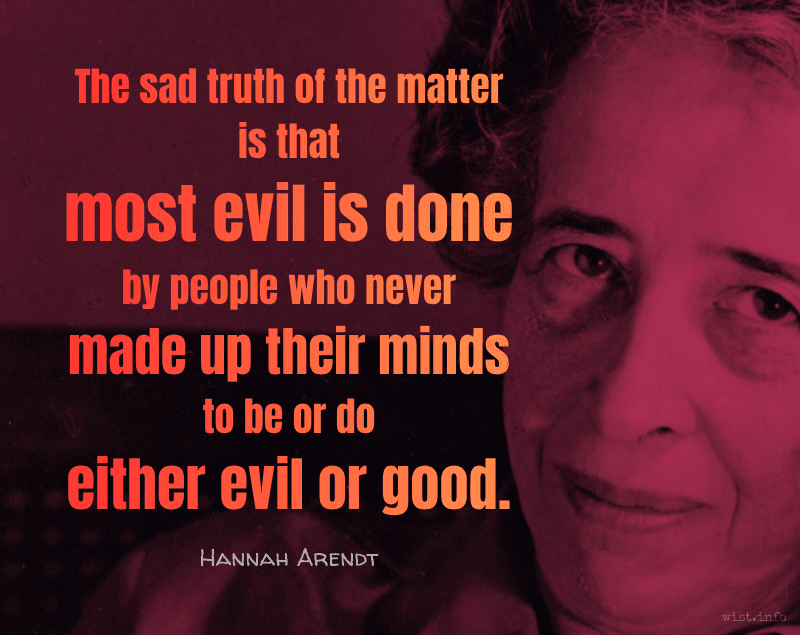
The sad truth of the matter is that most evil is done by people who never made up their minds to be or do either evil or good.
Hannah Arendt (1906–1975) German-American philosopher, political theorist
Life of the Mind, Vol. 1 “Thinking,” Part 3, ch. 18 “The two-in-one” (1977)
(Source)
Sometimes shortened as: "The sad truth is that most evil is done by people who never make up their minds to be good or evil."
Originally printed as an essay (1977-11-28), "Thinking -- III," The New Yorker (1977-12-05). That version is slightly longer:The sad truth of the matter is that most evil is done by people who never made up their minds to be either good or bad or to do either good or evil.