If you tell children that they ought to be affectionate, you run the risk of producing cant and humbug. But if you make them happy and free, if you surround them with kindness, you will find that they become spontaneously friendly with everybody, and that almost everybody responds by being friendly with them. A trustful affectionate disposition justifies itself, because it gives irresistible charm, and creates the response which it expects. This is one of the most important results to be expected from the right education of character.
Bertrand Russell (1872–1970) English mathematician and philosopher
Education and the Good Life, Part 2, ch. 11 “Affection and Sympathy” (1926)
(Source)
Quotations about:
set an example
Note not all quotations have been tagged, so Search may find additional quotes on this topic.

To bring up a child in the way he should go, travel that way yourself once in a while.
Josh Billings (1818–1885) American humorist, aphorist [pseud. of Henry Wheeler Shaw]
Josh Billings’ Farmer’s Allminax, 1871-03 “Housekeer’s Guide” (1871 ed.)
(Source)

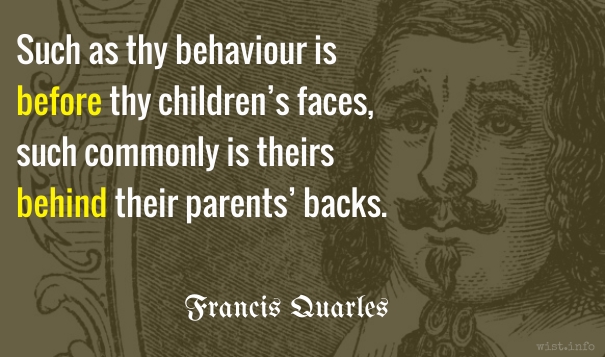
If thou desire to see thy child virtuous, let him not see his father’s vices: thou canst not rebuke that in them, that they behold practiced in thee; till reason be ripe, examples direct more than precepts: such as thy behaviour is before thy children’s faces, such commonly is theirs behind their parents’ backs.
To be good is noble; but to show others how to be good is nobler and no trouble.
Mark Twain (1835–1910) American writer [pseud. of Samuel Clemens]
Following the Equator, Preface (1897)
Nothing is so contagious as an example, and our every really good or bad action inspires a similar one.
[Rien n’est si contagieux que l’exemple, et nous ne faisons jamais de grands biens ni de grands maux qui n’en produisent de semblables.]
François VI, duc de La Rochefoucauld (1613–1680) French epigrammatist, memoirist, noble
Réflexions ou sentences et maximes morales [Reflections; or Sentences and Moral Maxims], ¶230 (1665-1678) [tr. Tancock (1959)]
(Source)
In the manuscript and 1665 ed., this concluded "... nor are there any great evils that do not inevitably produce their like [ni de grands maux qui ne produisent infailliblement leurs pareils]."
(Source (French)). Other translations:There is not any thing so contagious as Example, and whatever actions are done remarkable either for their Goodness or Mischief, they are Patterns to others to do the like.
[tr. Davies (1669), ¶48]Nothing is of so pestilent spreading a Nature, as Example; and no Man does any exceeding good, or very wicked thing; but it produces others of the same kind.
[tr. Stanhope (1694), ¶231]Nothing is so contagious as example: never is any considerable good or ill done that does not produce its like.
[pub. Donaldson (1783), ¶122; ed. Lepoittevin-Lacroix (1797), ¶219]Nothing is so contagious as example. Never was there any considerable good or ill action, that hath not produced its like.
[ed. Carvill (1835), ¶469]Nothing is so contagious as example; and we never do any great good or great evil which does not produce its like.
[ed. Gowens (1851), ¶241]Nothing is so infectious as example, and we never do great good or evil without producing the like.
[tr. Bund/Friswell (1871), ¶230]Nothing is as contagoius as example. Each of our very good or very bad acts reproduces itself.
[tr. Heard (1917), ¶237]Nothing is so contagious as example, and all our very good or bad deeds beget their like.
[tr. Stevens (1939), ¶230]Nothing is as contagious as example, and we never perform an outstandingly good or evil action without its producing others of its sort.
[tr. FitzGibbon (1957), ¶230]Nothing is so contagious as example, and we never commit good or evil acts without their propagating themselves.
[tr. Kronenberger (1959), ¶230]Nothing is so contagious as example, and we never do either great good nor great evil without producing the like.
[tr. Whichello (2016) ¶230]