The best teacher is the one who suggests rather than dogmatizes, and inspires his listener with the wish to teach himself.
Edward George Bulwer-Lytton (1803–1873) English novelist and politician
Kenelm Chillingly: His Adventures and Opinions, Book 3, ch. 12 [Kenelm] (1873)
(Source)
Sometimes given as “The best teacher is the one who suggests rather than dogmatizes and inspires rather than instructs.”
Quotations about:
suggestion
Note not all quotations have been tagged, so Search may find additional quotes on this topic.

It is easy to tell the toiler
How best he can carry his pack,
But no one can rate a burden’s weight
Until it has been on his back.Ella Wheeler Wilcox (1850–1919) American author, poet, temperance advocate, spiritualist
Poem (1896), “Preaching vs. Practice,” st. 4, Custer and Other Poems
(Source)

“It’s just Eeyore,” said Piglet. “I thought your Idea was a very good Idea.”
Pooh began to feel a little more comfortable, because when you are a Bear of Very Little Brain, and you Think of Things, you find sometimes that a Thing which seemed very Thingish inside you is quite different when it gets out into the open and has other people looking at it.A. A. Milne (1882–1956) English poet and playwright [Alan Alexander Milne]
House at Pooh Corner, ch. 6 “Eeyore Joins the Game” (1928)
(Source)
There was a moment’s silence while everybody thought.
“I’ve got a sort of idea,” said Pooh at last, “but I don’t suppose it’s a very good one.”
“I don’t suppose it is either,” said Eeyore.A. A. Milne (1882–1956) English poet and playwright [Alan Alexander Milne]
House at Pooh Corner, ch. 6 “Eeyore Joins the Game” (1928)
(Source)
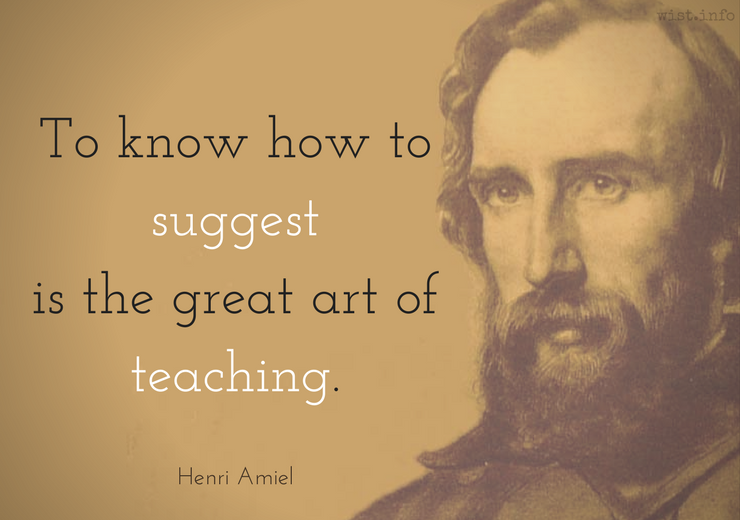
To know how to suggest is the great art of teaching.
Henri-Frédéric Amiel (1821–1881) Swiss philosopher, poet, critic
Journal (16 Nov 1864) [tr. Ward (1887)]
We are susceptible only to those suggestions with which we are already secretly in accord.
Carl Jung (1875–1961) Swiss psychologist
Modern Man in Search of a Soul, ch. 3 [tr. Dell & Baynes (1933)]
Nothing is so contagious as an example, and our every really good or bad action inspires a similar one.
[Rien n’est si contagieux que l’exemple, et nous ne faisons jamais de grands biens ni de grands maux qui n’en produisent de semblables.]
François VI, duc de La Rochefoucauld (1613–1680) French epigrammatist, memoirist, noble
Réflexions ou sentences et maximes morales [Reflections; or Sentences and Moral Maxims], ¶230 (1665-1678) [tr. Tancock (1959)]
(Source)
In the manuscript and 1665 ed., this concluded "... nor are there any great evils that do not inevitably produce their like [ni de grands maux qui ne produisent infailliblement leurs pareils]."
(Source (French)). Other translations:There is not any thing so contagious as Example, and whatever actions are done remarkable either for their Goodness or Mischief, they are Patterns to others to do the like.
[tr. Davies (1669), ¶48]Nothing is of so pestilent spreading a Nature, as Example; and no Man does any exceeding good, or very wicked thing; but it produces others of the same kind.
[tr. Stanhope (1694), ¶231]Nothing is so contagious as example: never is any considerable good or ill done that does not produce its like.
[pub. Donaldson (1783), ¶122; ed. Lepoittevin-Lacroix (1797), ¶219]Nothing is so contagious as example. Never was there any considerable good or ill action, that hath not produced its like.
[ed. Carvill (1835), ¶469]Nothing is so contagious as example; and we never do any great good or great evil which does not produce its like.
[ed. Gowens (1851), ¶241]Nothing is so infectious as example, and we never do great good or evil without producing the like.
[tr. Bund/Friswell (1871), ¶230]Nothing is as contagoius as example. Each of our very good or very bad acts reproduces itself.
[tr. Heard (1917), ¶237]Nothing is so contagious as example, and all our very good or bad deeds beget their like.
[tr. Stevens (1939), ¶230]Nothing is as contagious as example, and we never perform an outstandingly good or evil action without its producing others of its sort.
[tr. FitzGibbon (1957), ¶230]Nothing is so contagious as example, and we never commit good or evil acts without their propagating themselves.
[tr. Kronenberger (1959), ¶230]Nothing is so contagious as example, and we never do either great good nor great evil without producing the like.
[tr. Whichello (2016) ¶230]