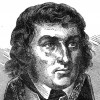
To bring up a child in the way he should go, travel that way yourself once in a while.
Josh Billings (1818–1885) American humorist, aphorist [pseud. of Henry Wheeler Shaw]
Josh Billings’ Farmer’s Allminax, 1871-03 “Housekeer’s Guide” (1871 ed.)
(Source)
Quotations about:
lead by example
Note not all quotations have been tagged, so Search may find additional quotes on this topic.
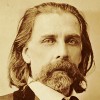
It is not the whole ov our duty tew foller the examples ov good men, but tew leave behind us sum decent tracks for others tew foller.
[It is not the whole of our duty to follow the examples of good men, but to leave behind us some decent tracks for others to follow.]
Josh Billings (1818–1885) American humorist, aphorist [pseud. of Henry Wheeler Shaw]
Everybody’s Friend, Or; Josh Billing’s Encyclopedia and Proverbial Philosophy of Wit and Humor, ch. 132 “Affurisms: Chips” (1874)
(Source)
His preaching much, but more his practice wrought;
(A living sermon of the truths he taught).John Dryden (1631–1700) English poet, dramatist, critic
“The Character of a Good Parson,” l. 77, Fables (1700)

We must show by our behavior that we believe in equality and justice and that our religion teaches faith and love and charity to our fellow men. Here is where each of us has a job to do that must be done at home, because we can lose the battle on the soil of the United States just as surely as we can lose it in any one of the countries of the world.
Eleanor Roosevelt (1884–1962) American politician, diplomat, activist; First Lady of the US (1933–45)
India and the Awakening East, Conclusion (1953)
(Source)

To be good is noble; but to show others how to be good is nobler and no trouble.
Mark Twain (1835–1910) American writer [pseud. of Samuel Clemens]
Following the Equator, Preface (1897)
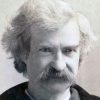
Nothing is so contagious as an example, and our every really good or bad action inspires a similar one.
[Rien n’est si contagieux que l’exemple, et nous ne faisons jamais de grands biens ni de grands maux qui n’en produisent de semblables.]
François VI, duc de La Rochefoucauld (1613–1680) French epigrammatist, memoirist, noble
Réflexions ou sentences et maximes morales [Reflections; or Sentences and Moral Maxims], ¶230 (1665-1678) [tr. Tancock (1959)]
(Source)
In the manuscript and 1665 ed., this concluded "... nor are there any great evils that do not inevitably produce their like [ni de grands maux qui ne produisent infailliblement leurs pareils]."
(Source (French)). Other translations:There is not any thing so contagious as Example, and whatever actions are done remarkable either for their Goodness or Mischief, they are Patterns to others to do the like.
[tr. Davies (1669), ¶48]Nothing is of so pestilent spreading a Nature, as Example; and no Man does any exceeding good, or very wicked thing; but it produces others of the same kind.
[tr. Stanhope (1694), ¶231]Nothing is so contagious as example: never is any considerable good or ill done that does not produce its like.
[pub. Donaldson (1783), ¶122; ed. Lepoittevin-Lacroix (1797), ¶219]Nothing is so contagious as example. Never was there any considerable good or ill action, that hath not produced its like.
[ed. Carvill (1835), ¶469]Nothing is so contagious as example; and we never do any great good or great evil which does not produce its like.
[ed. Gowens (1851), ¶241]Nothing is so infectious as example, and we never do great good or evil without producing the like.
[tr. Bund/Friswell (1871), ¶230]Nothing is as contagoius as example. Each of our very good or very bad acts reproduces itself.
[tr. Heard (1917), ¶237]Nothing is so contagious as example, and all our very good or bad deeds beget their like.
[tr. Stevens (1939), ¶230]Nothing is as contagious as example, and we never perform an outstandingly good or evil action without its producing others of its sort.
[tr. FitzGibbon (1957), ¶230]Nothing is so contagious as example, and we never commit good or evil acts without their propagating themselves.
[tr. Kronenberger (1959), ¶230]Nothing is so contagious as example, and we never do either great good nor great evil without producing the like.
[tr. Whichello (2016) ¶230]
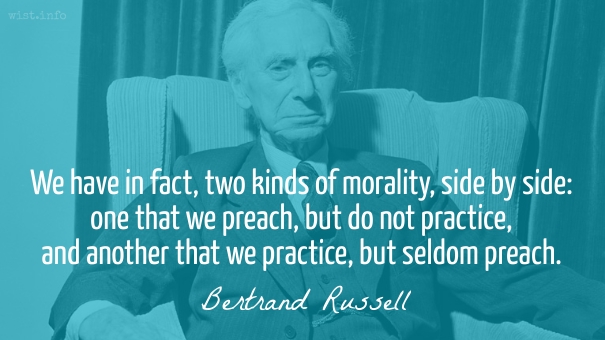
There are large parts of the Christian ethic which are universally admitted to be too good for this wicked world. We have in fact, two kinds of morality, side by side: one that we preach, but do not practice, and another that we practice, but seldom preach.
Bertrand Russell (1872–1970) English mathematician and philosopher
“Eastern and Western Ideals of Happiness,” Sceptical Essays (1928)
You can preach a better sermon with your life than with your lips.
Oliver Goldsmith (1730–1774) Irish poet, playwright, novelist
(Attributed)
Children have more need of models than of critics.
[Les enfants ont plus besoin de modèles que de critiques.]
Joseph Joubert (1754–1824) French moralist, philosopher, essayist, poet
Pensées [Thoughts], ch. 19 “De l’Éducation [On Education],” ¶ 3 (1850 ed.) [tr. Calvert (1866), ch. 14]
(Source)
Sometimes attributed to Carolyn Coats.
(Source (French)). Other translations:Children have more need of models than of critics.
[tr. Attwell (1896), ¶ 261]Children need models rather than critics.
[tr. Lyttelton (1899), ch. 18, ¶ 1]Children. Need models more than critics.
[tr. Auster (1983), 1800 entry]