ADAGE, n. A hoary-headed platitude that is kicked along the centuries until nothing is left of it but its clothes. A “saw” which has worn out its teeth on the human understanding.
Ambrose Bierce (1842–1914?) American writer and journalist
“Adage,” “Devil’s Dictionary” column, San Francisco Wasp (1881-03-05)
(Source)
Not collected in later books. Instead, in The Cynic's Word Book (1906), he changed it to "Boned wisdom for weak teeth."
Quotations about:
banality
Note not all quotations have been tagged, so Search may find additional quotes on this topic.

That familiarity produces neglect, has been long observed. The effect of all external objects, however great or splendid, ceases with their novelty; the courtier stands without emotion in the royal presence; the rustick tramples under his foot the beauties of the spring with little attention to their colours or their fragrance; and the inhabitant of the coast darts his eye upon the immense diffusion of waters, without awe, wonder, or terrour.
Samuel Johnson (1709–1784) English writer, lexicographer, critic
Essay (1753-06-26), The Adventurer, No. 67
(Source)

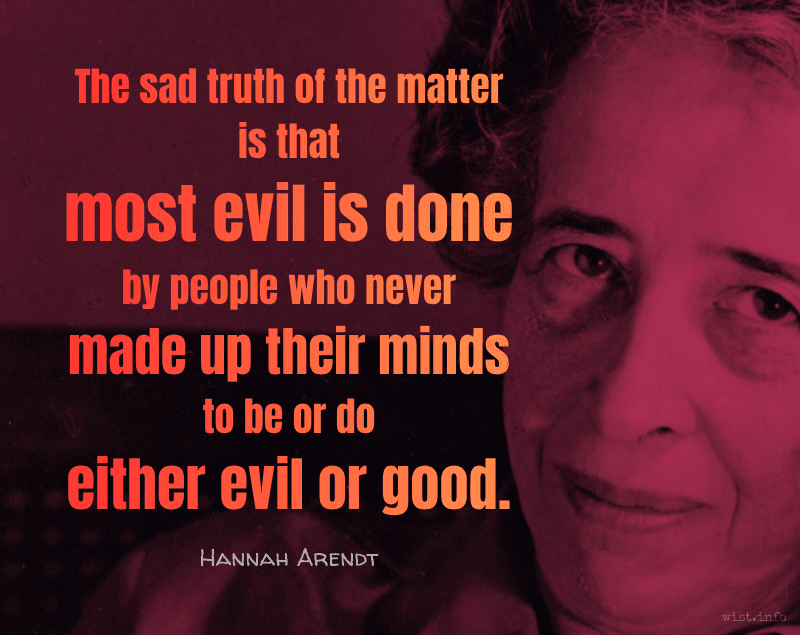
The sad truth of the matter is that most evil is done by people who never made up their minds to be or do either evil or good.
Hannah Arendt (1906–1975) German-American philosopher, political theorist
Life of the Mind, Vol. 1 “Thinking,” Part 3, ch. 18 “The two-in-one” (1977)
(Source)
Sometimes shortened as: "The sad truth is that most evil is done by people who never make up their minds to be good or evil."
Originally printed as an essay (1977-11-28), "Thinking -- III," The New Yorker (1977-12-05). That version is slightly longer:The sad truth of the matter is that most evil is done by people who never made up their minds to be either good or bad or to do either good or evil.

Making a film means, first of all, to tell a story. That story can be an improbable one, but it should never be banal. It must be dramatic and human. What is drama, after all, but life with the dull bits cut out.
Alfred Hitchcock (1899–1980) English film director
Interview (1962-08) by François Truffaut
(Source)
Why he avoids making "slice of life" films. Sometimes paraphrased as "Drama is life with the dull bits cut out."
From a series of interviews (with Helen Scott as the translator) of Hitchcock by Truffaut, edited and collected in the Truffaut book Hitchcock: A Definitive Study [Le Cinéma Selon Hitchcock], ch. 4 (1966) [tr. Truffaut (1967)].