Old wine, and old friend, and old gold are beloved in all places.
[Vin vieux, amy vieux, Y or vieux sont amez en touts lieux.]
James Howell (c. 1594–1666) Welsh historian, writer, aphorist
Paroimiographia [Παροιμιογραφία]: Proverbs, or, Old Sayed Sawes & Adages, “Proverbs in French” (1659) [compiler]
(Source)
Howell also gives a Spanish version (in the same source, "Proverbs in Spanish"):Old wine, and an old friend.
[Vino anejo, y amigo viejo.]
See Alfonso X, Bacon (1624), Herbert (1640).
Quotations about:
familiarity
Note not all quotations have been tagged, so Search may find additional quotes on this topic.

As for the duties of marital love that some people consider injured by absence, I do not believe it. On the contrary, it is a relationship that is readily cooled by too continual association, and harmed by assiduity. Every strange woman seems to us an attractive woman. And every man feels by experience that seeing one another continually cannot match the pleasure of parting and being together again at intervals.
[Quant aux devoirs de l’amitié maritale, qu’on pense estre interessez par cette absence: je ne le crois pas. Au rebours, c’est une intelligence, qui se refroidit volontiers par une trop continuelle assistance, & que l’assiduité blesse. Toute femme estrangere nous semble honneste femme: Et chacun sent par experience, que la continuation de se voir, ne peut representer le plaisir que lon sent à se desprendre, & reprendre à secousses.]
Michel de Montaigne (1533–1592) French essayist
Essays, Book 3, ch. 9 (3.9), “Of Vanity [De la vanité]” (1587) [tr. Frame (1943)]
(Source)
First appeared in the second (1588) edition. See also Propertius (c. 20 BC), La Rochefoucauld (1665), Ouida (1878).
(Source (French)). Alternate translations:Concerning dueties of wedlocke-friendship, which some happily imagine to be interressed or prejudiced by the husbands absence, I beleeve it not. Contrariwise, it is a kinde of intelligence, that easily growes colde by an over continuall assistance, and decayeth by assiduitie; for, to stand still at racke and manger breedeth a saciety. Every strange woman seemeth to us an honest woman: And all feele by experience, that a continuall seeing one another, can not possibly represent the pleasure, men take by parting and meeting againe.
[tr. Florio (1603)]As to the Duties of Conjugal Friendship, that some think to be violated by the absence, I am quite of another Opinion; it is on the contrary an Intelligence that easily cools by a too frequent and assiduous Practice. Every strange Woman appears graceful, and every one finds by Experience, that being continually together is not so pleasing, as to part for a time, and meet again.
[tr. Cotton (1686)]As to the duties of conjugal friendship, that some think to be impaired by these absences, I am quite of another opinion. It is, on the contrary, an intelligence that easily cools by a too frequent and assiduous companionship. Every strange woman appears charming, and we all find by experience that being continually together is not so pleasing as to part for a time and meet again.
[tr. Cotton/Hazlitt (1877)]As for the duties of conjugal friendship, which are thought to be wronged by such absences, I do not believe so; on the contrary, it is an intercourse which easily grows cool with too continuous companionship and which assiduity injures. Every woman who is a strange seems to us a worthy woman; and we all know by experience that continually being together cannot equal the pleasure that we feel in parting and meeting by turns.
[tr. Ives (1925)]As for the duties of conjugal love which are thought to be infringed by such absences, I do not believe that they are. On the contrary: such intercourse can easily be cooled by too continuous a presence and impaired by assiduity: every other woman seems charming then! Everyone knows that seeing each other all the time cannot provide the same pleasure as is given by alternately going away and coming together.
[tr. Screech (1987)]

That familiarity produces neglect, has been long observed. The effect of all external objects, however great or splendid, ceases with their novelty; the courtier stands without emotion in the royal presence; the rustick tramples under his foot the beauties of the spring with little attention to their colours or their fragrance; and the inhabitant of the coast darts his eye upon the immense diffusion of waters, without awe, wonder, or terrour.
Samuel Johnson (1709–1784) English writer, lexicographer, critic
Essay (1753-06-26), The Adventurer, No. 67
(Source)

Every man calls barbarous anything he is not accustomed to.
[Chacun appelle barbarie, ce qui n’est pas de son usage.]
Michel de Montaigne (1533–1592) French essayist
Essays, Book 1, ch. 30 (1.30), “Of Cannibals [Des Cannibales]” (1578) [tr. Screech (1987), 1.31]
(Source)
Some translators use the 1588 sequence of chapters, not the 1595, and so identify this as ch. 31.
(Source (French)). Alternate translations:Men call that barbarisme which is not common to them.
[tr. Florio (1603)]Every one gives the title of barbarism to everything that is not in use in his own country.
[tr. Cotton (1686)]Everyone gives the denomination of barbarism to what is not the custom of his country.
[tr. Friswell (1868)]Every one gives the title of barbarism to everything that is not in use in his own country.
[tr. Cotton/Hazlitt (1877)]Every one calls "barbarism" whatever he is not accustomed to.
[tr. Ives (1925), 1.31]Each man calls barbarism whatever is not his own practice.
[tr. Frame (1943)]Everyone calls barbarism what is not customary to him.
[ed. Rat (1958), 1.31]Everyone calls what he is not accustomed to barbarity.
[tr. Atkinson/Sices (2012)]
Mankind ain’t apt tew respekt verry mutch what they are familiar with, it iz what we don’t know, or kant see, that we hanker for.
[Mankind ain’t apt to respect very much what they are familiar with; it is what we don’t know, or can’t see, that we hanker for.]
Josh Billings (1818–1885) American humorist, aphorist [pseud. of Henry Wheeler Shaw]
Everybody’s Friend, Or; Josh Billing’s Encyclopedia and Proverbial Philosophy of Wit and Humor, ch. 156 “Affurisms: Embers on the Harth” (1874)
(Source)

Gratitude without familiarity, gratitude otherwise than as a nameless element in a friendship, is a thing so near to hatred that I do not care to split the difference. Until I find a man who is pleased to receive obligations, I shall continue to question the tact of those who are eager to confer them.
Robert Louis Stevenson (1850–1894) Scottish essayist, novelist, poet
Essay (1888-03), “Beggars,” sec. 4 Scribner’s Magazine, Vol. 3, No. 3
(Source)
Collected in Across the Plains, ch. 9 (1892).
The nearer we approach great men, the clearer we see that they are men. Barely do they appear great before their valets.
[Rarement ils sont grands vis-à-vis de leurs valets-de-chambre.]
Jean de La Bruyère (1645–1696) French essayist, moralist
(Spurious)
This passage, both English and French, is attributed to La Bruyere (and, more specifically, to his Characters [Les Caractères] (1688). It does not, however, appear in that work (in any translation or the native French) nor does it seem to appear in any other work of La Bruyere that I could find.
Both English and French show up in a passage in Samuel Arthur Bent, Short Sayings of Great Men (1882), about Mme. de Cornuel (d. 1694). Bent is discussing a quotation attributed to her, with parallels amongst Montaigne (1586) and Goethe (1805). (The passage is quoted at Bartleby.com, which may account for modern familiarity with it.) Bent cites the above from La Bruyere's Caractères.
Other versions, of each sentence, show up in quotations collections over the following decades, and today the French has a number of hits on Russian/Slavic websites, but nothing (not even on French search engines) that pins it to any source aside from the same pages in English language searches.

I will tell you my rule. Talk about those subjects you have had long in your mind, and listen to what others say about subjects you have studied but recently. Knowledge and timber shouldn’t be much used till they are seasoned.
Oliver Wendell Holmes, Sr. (1809–1894) American poet, essayist, scholar
Article (1858-04), “Autocrat of the Breakfast-Table,” Atlantic Monthly
(Source)
Collected in Autocrat of the Breakfast-Table, ch. 6 (1858).

Gradually we become tired of the old, of what we safely possess, and we stretch out our hands again. Even the most beautiful scenery is no longer assured of our love after we have lived in it for three months, and some more distant coast attracts our avarice: possessions are generally diminished by possession.
[Wir werden des Alten, sicher Besessenen allmählich überdrüssig und strecken die Hände wieder aus; selbst die schönste Landschaft, in der wir drei Monate leben, ist unserer Liebe nicht mehr gewiss, und irgend eine fernere Küste reizt unsere Habsucht an: der Besitz wird durch das Besitzen zumeist geringer.]Friedrich Nietzsche (1844–1900) German philosopher and poet
The Gay Science [Die fröhliche Wissenschaft], Book 1, § 14 (1882) [tr. Kaufmann (1974)]
(Source)
Also known as La Gaya Scienza, The Joyful Wisdom, or The Joyous Science.
(Source (German)). Alternate translations:We gradually become satiated with the old, the securely possessed, and again stretch out our hands; even the finest landscape in which we live for three months is no longer certain of our love, and any kind of more distant coast excites our covetousness: the possession for the most part becomes smaller through possessing.
[tr. Common (1911)]We slowly grow tired of the old, of what we safely possess, and we stretch our our hands again; even the most beautiful landscape is no longer sure of our love after we have lived in it for three months, and some more distant coast excites our greed: possession usually diminishes the possession.
[tr. Nauckhoff (2001)]We gradually grow weary of the old, familiar things we securely hold, and again stretch forth our hands; even the most beautiful landscape lived in for three months is no longer assured of our love, and some more distant shore excites our avarice: what is had loses much in the having.
[tr. Hill (2018)]
The need for a body of common knowledge and common reference does not disappear when a society is largely pluralistic, as ours has become. On the contrary, it grows more necessary, so that people of different origins and occupation may quickly find familiar ground and, as we say, speak a common language. It not only saves time and embarrassment, but it also ensures a kind of mutual confidence and good will. One is not addressing an alien, blank as a stone wall, but a responsive creature whose mind is filled with the same images, memories, and vocabulary as oneself.

False greatness is unsociable and inaccessible; as it is sensible of its weakness, it conceals itself, or at least does not show itself openly, and only allows just so much to be seen as will carry on the deceit, so as not to appear what it really is, namely, undoubtedly mean. True greatness, on the contrary, is free, gentle, familiar, and popular; it allows itself to be touched and handled, loses nothing by being seen closely, and is the more admired the better it is known.
[La fausse grandeur est farouche et inaccessible: comme elle sent son faible, elle se cache, ou du moins ne se montre pas de front, et ne se fait voir qu’autant qu’il faut pour imposer et ne paraître point ce qu’elle est, je veux dire une vraie petitesse. La véritable grandeur est libre, douce, familière, populaire; elle se laisse toucher et manier, elle ne perd rien à être vue de près; plus on la connaît, plus on l’admire.]Jean de La Bruyère (1645–1696) French essayist, moralist
The Characters [Les Caractères], ch. 2 “Of Personal Merit [Du Mérite Personnel],” § 42 (2.42) (1688) [tr. Van Laun (1885)]
(Source)
(Source (French)). Other translations:False Greatness is unsociable, inaccessible, as if 'twere sensible of its weakness, and strove to conceal it. 'Twill not be seen, except just so much, as may carry on the Deceit, but dares not shew its Face for fear of being discover'd: Discover'd how really little and mean it is. True Greatness, on the contrary, is free, complaisant, familiar, popular, suffers it self to be touch'd and handl'd, loses nothing by being view'd near at hand, is rather more known and admir'd for it.
[Bullord ed. (1696)]False greatness is unsociable and remote: conscious of its own frailty, it hides, or at least averts its face, and reveals itself only enough to create an illusion and not be recognized as the meanness that it really is. True greatness is free, kind, familiar and popular; it lets itself be touched and handled, it loses nothing by being seen at close quarters; the better one knows it, the more one admires it.
[tr. Stewart (1970)]

Childhood is the world of miracle and wonder; as if creation rose, bathed in light out of the darkness, utterly new and fresh and astonishing. The end of childhood is when things cease to astonish us. When the world seems familiar, when one has got used to existence, one has become adult. The brave new world, the wonderland has grown trite and commonplace.
[L’enfance c’est le monde du miracle ou du merveilleux: c’est comme si la creation surgissait, lumineuse, de la nuit, toute neuve et toute fraîche, et tout étonnante. Il n’y a plus d’enfance à partir du moment où les choses ne sont plus étonnantes. Lorsque le monde vous semble «déja vu», lorsqu’on s’est habitué à l’existence, on devient adulte. Le monde de la féerie, la merveille neuve se fait banalité, cliché.]Eugène Ionesco (1912–1994) Romanian-French dramatist
Fragments of a Journal [Journal en Miettes], “The Crisis of Language” (1967) [tr. Stewart (1968)]
(Source)

If a book read when young is a lover, that same book, reread later on, is a friend. […] This may sound like a demotion, but after all, it is old friends, not lovers, to whom you are most likely to turn when you need comfort. Fatigue, grief, and illness call for familiarity, not innovation.
Anne Fadiman (b. 1953) American essayist, journalist, literary critic, teacher
Rereadings: Seventeen Writers Revisit Books They Love, Foreword (2005)

And now I understand
something so frightening, and wonderful —
how the mind clings to the road it knows, rushing
through crossroads, sticking
like lint to the familiar.

It is the function of art to renew our perception. What we are familiar with we cease to see. The writer shakes up the familiar scene, and as if by magic, we see a new meaning in it.
Anaïs Nin (1903–1977) Catalan-Cuban-French author, diarist
The Novel of the Future, ch. 2 “Abstraction” (1968)
(Source)

And now I understand
something so frightening, and wonderful —
how the mind clings to the road it knows, rushing
through crossroads, sticking
like lint to the familiar.
JUBA: Beauty soon grows familiar to the lover,
Fades in his eye, and palls upon the sense.

What a comfort one familiar face is in a howling wilderness of strangers!

An old belief is like an old shoe. We so value its comfort that we fail to notice the hole in it.
Robert Brault (b. c. 1945) American aphorist, programmer
(Attributed)

The first impression is readily received. We are so constituted that we believe the most incredible things; and, once they are engraved upon the memory, woe to him who would endeavor to efface them.
[Der erste Eindruck findet uns willig, und der Mensch ist gemacht, daß man ihn das Abenteuerlichste überreden kann; das haftet aber auch gleich so fest, und wehe dem, der es wieder auskratzen und austilgen will!]
Johann Wolfgang von Goethe (1749–1832) German poet, statesman, scientist
The Sorrows of Young Werther, Book 1, “August 15” (1774) [tr. Boylan]
(Source)
Alt. trans.:
- "... woe to him who would endeavor to erase them!" [tr. Lange, Ryan]
- "The first impression finds us receptive, and man is so made that he can be persuaded by the most outlandish things; but it strikes root so immediately that woe to him who tries to scratch it out and eradicate it!" [tr. Pike (2004)]
- Original German.

Familiarity breeds contempt, while rarity wins admiration.
[Parit enim conversatio contemptum; raritas conciliat admirationem.]
Apuleius (AD c. 124 - c. 170) Numidian Roman writer, philosopher, rhetorician [Lucius Apuleius Madaurensis]
On the God of Socrates [De Deo Socratis]
(Source)
First recorded passage with this phrase. Discussing why the gods do not mingle with humanity. Other translations:The first part of the phrase is also used as the modern moral the English translation of Aesop's "The Fox and the Lion." Applying this proverb to Aesop seems to have first happened in 1820; in classic Greek sources, the moral was more along the line that "acquaintance overcomes fear."
- "Familiarity produces contempt, but infrequency conciliates admiration."
[tr. Taylor (1822)]- "Familiarity breeds contempt, but privacy gains admiration." [
Works of Apuleius (1853)]- "Familiarity breeds contempt, but concealment excites interest."
[National Review (1858-04)]

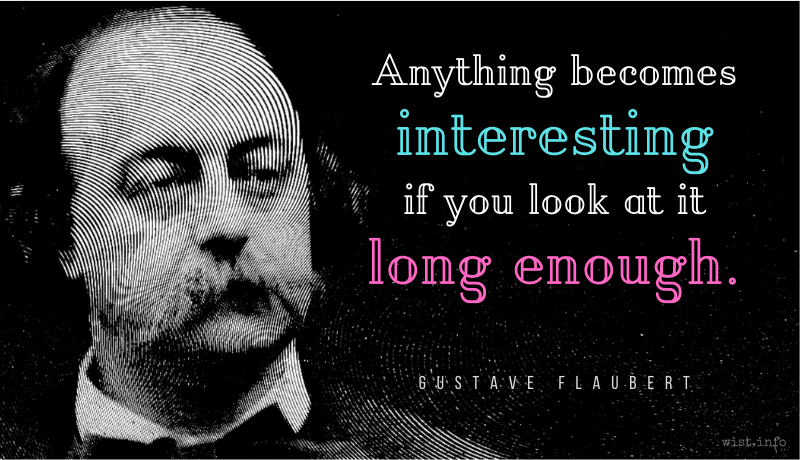
Anything becomes interesting if you look at it long enough.
[Pour qu’une chose soit intéressante, il suffit de la regarder longtemps.]
Gustave Flaubert (1821–1880) French writer, novelist
Letter to Alfred Le Poittevin (16 Sep 1845)
(Source)
Other translations: "To make something interesting, just look at it for a long time."
ENOBARBUS: Age cannot wither her, nor custom stale
Her infinite variety; other women cloy
The appetites they feed, but she makes hungry
Where most she satisfies.
William Shakespeare (1564–1616) English dramatist and poet
Antony and Cleopatra, Act 2, sc. 2, l. 276ff (2.2.276-279) (1607)
(Source)


Ever since I had dinner with Lou Reed I’ve tried to avoid meeting the people who would make me feel starstruck. It was a great dinner but by the end of it Lou Reed was no longer my hero, and I don’t have many heroes. I resolutely avoided meeting David Bowie, which became harder when I became friends with Duncan Jones, his son, and then got even harder when I moved to Woodstock and he lived around the corner. But I love the fact that the Bowie that I have is the Bowie in my head: a strange, evolving, absolutely fictional Bowie who became my hero when I was 11.
Neil Gaiman (b. 1960) British author, screenwriter, fabulist
“This Much I Know,” The Guardian (2017-08-05)
(Source)

Sit at the feet of the masters long enough, and they’ll start to smell.
(Other Authors and Sources)
Sauget’s Law of Education
(Source)
Attributed to John Sauget of Urbana, Ill., in Paul Dickson, The Official Rules, "Revised Proverbs" (1978).

The choicest garb, the sweetest grace,
Are oft to strangers shown;
The careless mien, the frowning face,
Are given to our own.
We flatter those we scarcely know,
We please the fleeting guest,
And deal full many a thoughtless blow
To those who love us best.Ella Wheeler Wilcox (1850–1919) American author, poet, temperance advocate, spiritualist
Poem (1896-10), “Life’s Scars,” st. 3, Frank Leslie’s Popular Monthly, Vol. 42, No. 4
(Source)
Originally published in Frank Leslie's Popular Monthly, Vol. 42, #4 (1896-10)


Men have seemed miraculous to the world, in whom their wives and valets have never seen anything even worth noticing. Few men have been admired by their own households.
[Tel a esté miraculeux au monde, auquel sa femme & son valet n’ont rien veu seulement de remerquable. Peu d’hommes ont esté admirez par leurs domestiques.]
Michel de Montaigne (1533–1592) French essayist
Essays, Book 3, ch. 2 (3.2), “Of Repentance [Du Repentir]” (1586) [tr. Frame (1943)]
(Source)
See Cornuel (1728) and Goethe (1805). For discussion on this and related quotes, see here.
(Source (French)). Other translations:Some have beene admirable to the world, in whom nor his wife, nor his servant ever noted any thing remarkeable. Few men have beene admired of their familiers.
[tr. Florio (1603)]Such a one has been a Miracle to the World, in whom neither his Wife nor Servant have ever seen any thing so much as remarkable. Few men have been admired by their own Domesticks.
[tr. Cotton (1686)]Such a one has been a miracle to the world, in whom neither his wife nor servant has ever seen anything so much as remarkable; few men have been admired by their own domestics.
[tr. Cotton/Hazlitt (1877)]A man may appear wonderful to the world, in whom his wife and his servant see nothing even remarkable; few men have been admired by their household.
[tr. Ives (1925)]Many a man has been a wonder to the world, whose wife and valet have seen nothing in him that was even remarkable. Few have been admired by their servants.
[tr. Cohen (1958)]A man may appear to the world as a marvel: yet his wife and his manservant see nothing remarkable about him. Few men have been wonders to their families.
[tr. Screech (1987)]
Admiration is a very short-lived passion, that immediately decays upon growing familiar with its object, unless it be still fed with fresh discoveries, and kept alive by a new perpetual succession of miracles rising up to its view.
Joseph Addison (1672–1719) English essayist, poet, statesman
Essay (1711-12-24), The Spectator, No. 256
(Source)
“Familiarity breeds kontempt.” This only applies tew men, not tew hot bukwheat slapkakes, well buttered and sugared.
[“Familiarity breeds contempt.” This only applies to men, not to hot buckwheat slapcakes, well buttered and sugared.]
All the works of Nature are Miracles, and nothing makes them appear otherwise but our Familiarity with them.
Samuel Butler (1835–1902) English novelist, satirist, scholar
Prose Observations. “Nature” [ed. de Quehen (1979)]
Choose the best life; for habit will make it pleasant.
Epictetus (c. 55-c. 135 AD) Greek (Phrygian) Stoic philosopher [Ἐπίκτητος, Epíktētos]
Fragment 144
Sometimes attributed to Francis Bacon.
Familiarity breeds acquiescence as well as contempt.


Burn old wood, read old books, drink old wines, have old friends.
[Quemad viejos leños, leed viejos libros, bebed viejos vinos, tened viejos amigos.]
Alfonso X (1221–1284) Spanish King of Castile and Leon
(Attributed)
Quoted in L. F. Betancourt, Aire puro para el amor y la amistad. See Bacon (1624), Herbert (1640), Howell (1659).

He who carves the Buddha never worships him.
Proverbs, Sayings, and Adages
Chinese proverb

HAL: If all the year were playing holidays,
To sport would be as tedious as to work,
But when they seldom come, they wished-for come,
And nothing pleaseth but rare accidents.William Shakespeare (1564–1616) English dramatist and poet
Henry IV, Part 1, Act 1, sc. 2, l. 211ff (1.2.211-212) (1597)
(Source)
Alonso of Aragon was wont to say in commendation of age, that age appears to be best in four things — old wood best to burn, old wine to drink, old friends to trust, and old authors to read.