The world is so full of a number of things,
I’m sure we should all be as happy as kings.Robert Louis Stevenson (1850–1894) Scottish essayist, novelist, poet
Poem (1885), “Happy Thought,” A Child’s Garden of Verses
(Source)
Quotations about:
variety
Note not all quotations have been tagged, so Search may find additional quotes on this topic.
Differences between nations, so long as they do not lead to hostility, are by no means to be deplored. Living for a time in a foreign country makes us aware of merits in which our own country is deficient, and this is true whichever country our own may be. The same thing holds of differences between different regions within one country, and of the differing types produced by different professions. Uniformity of character and uniformity of culture are to be regretted. Biological evolution has depended upon inborn differences between individuals or tribes, and cultural evolution depends upon acquired differences. When these disappear, there is no longer any material for selection. In the modern world, there is a real danger of too great similarity between one region and another in cultural respects. One of the best ways of minimising this evil is an increase in the autonomy of different groups.
Bertrand Russell (1872–1970) English mathematician and philosopher
Lecture (1949-01-23), “Control and Initiative: Their Respective Spheres,” Reith Lecture, “Authority and the Individual” No. 5, BBC Radio
(Source)

If man is to survive, he will learn to take a delight in the essential differences between cultures. To learn that differences in ideas and attitudes are a delight, part of life’s exciting variety, not something to fear.
Gene Roddenberry (1921–1991) American television screenwriter and producer
Quoted in Stephen E. Whitfield, The Making of Star Trek, Part 1, ch. 3, epigraph (1968)
(Source)

Beware the student of one teacher. A good idea spirals into dogma when it gets applied to everything and stretched beyond the areas where it is useful. Remain open and embrace a lot of teachers.

Since the invention of the mirror, everyone knows what he or she looks like and does not find it helpful or enjoyable to have oddities or deficiencies — according to someone else’s standards and tastes — pointed out. And every adult assumes the right of making his or her own decisions about eating, drinking, mating and reproducing, and finds being monitored and instructed — again according to someone else’s preferences — distasteful.
Judith Martin (b. 1938) American author, journalist, etiquette expert [a.k.a. Miss Manners]
“Miss Manners,” syndicated column (1986-01-19)
(Source)

All this variety is certainly interesting. If there were a standard and everyone met it, how on earth could people tell their ex-spouses from their new ones? If children did not show visible changes, what would encourage their parents to believe that they might ever pass out of the horrible stages they happen to be in?
Judith Martin (b. 1938) American author, journalist, etiquette expert [a.k.a. Miss Manners]
“Miss Manners,” syndicated column (1986-01-19)
(Source)
’T were a dull old world, methinks, my friend,
If we all just went one way;
Yet our paths will meet no doubt at the end,
Though they lead apart today.Ella Wheeler Wilcox (1850–1919) American author, poet, temperance advocate, spiritualist
Poem (1879), “Advice,” st. 4, Maurine and Other Poems (1882 ed.)
(Source)

I write poetry, prose, and everything I do, I do on the principle of Russian borscht. You can throw everything into it — beets, carrots, cabbage, onions, everything you want. What’s important is the result, the taste of the borscht.
Yevgeny Yevtushenko (1933–2017) Russian poet, writer, film director, academic [Евге́ний Евтуше́нко, Evgenij Evtušenko]
Interview (1986-02-02), “Yevtushenko: A Soviet Poet Turns to Movie Making,” by Serge Schmemann, New York Times
(Source)

It is useful to know something of the manners of different nations, that we may be enabled to form a more correct judgment regarding our own, and be prevented from thinking that everything contrary to our customs is ridiculous and irrational, — a conclusion usually come to by those whose experience has been limited to their own country.
[Il est bon de savoir quelque chose des moeurs de divers peuples, afin de juger des nôtres plus sainement, et que nous ne pensions pas que tout ce qui est contre nos modes soit ridicule et contre raison, ainsi qu’ont coutume de faire ceux qui n’ont rien vu.]
René Descartes (1596–1650) French philosopher, mathematician
Discourse on Method [Discours de la méthode], Part 1 (1637) [tr. Veitch (1850)]
(Source)
(Source (French)). Other translations:It's good to know something of the manners of severall Nations, that we may not think that all things against our Mode are ridiculous or unreasonable, as those are wont to do, who have seen Nothing.
[Newcombe ed. (1649)]It is good to know something of the customs of different peoples in order to judge more sanely of our own, and not to think that everything of a fashion not ours is absurd and contrary to reason, as do those who have seen nothing.
[tr. Haldane & Ross (1911)]It is good to know something of the customs of various peoples, so that we may judge our own more soundly and not think that everything contrary to our own ways is ridiculous and irrational, as those who have seen nothing of the world ordinarily do.
[tr. Cottingham, Stoothoff (1985)]It is well to know something of the manner of various peoples, in order more sanely to judge our own, and that we do not think that everything against our modes is ridiculous, and against reason, as those who have seen nothing are accustomed to think.
Despair says It’s all the same. Happiness knows there are even a thousand Despairs.
James Richardson (b. 1950) American poet
“Vectors: 56 Aphorisms and Ten-second Essays,” Michigan Quarterly Review, # 50 (Spring 1999)
(Source)

To cut out every negative root would simultaneously mean choking off positive elements that might arise from it further up the stem of the plant. We should not feel embarrassed by our difficulties, only by our failure to grow anything beautiful from them.
Alain de Botton (b. 1969) Swiss-British author
The Consolations of Philosophy, ch. 6 “Consolation for Difficulties” (2000)
(Source)
Discussing Nietzsche.

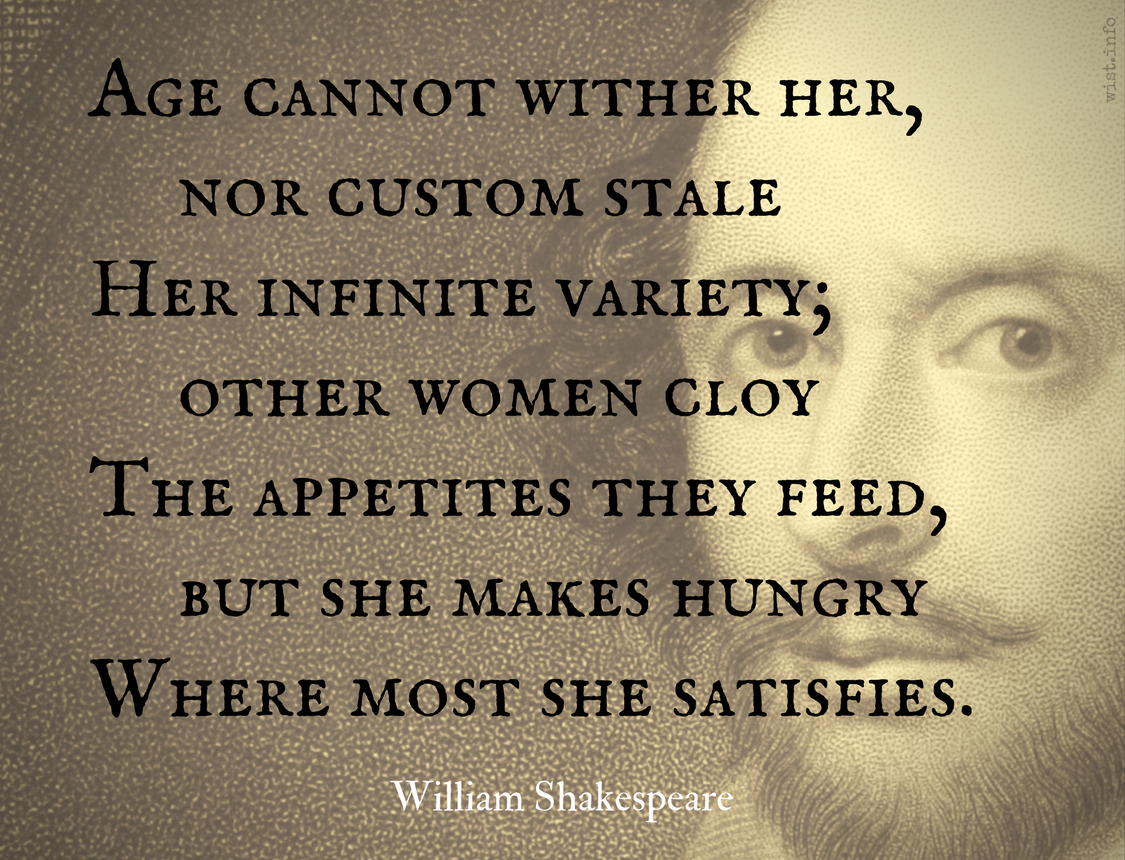
ENOBARBUS: Age cannot wither her, nor custom stale
Her infinite variety; other women cloy
The appetites they feed, but she makes hungry
Where most she satisfies.
William Shakespeare (1564–1616) English dramatist and poet
Antony and Cleopatra, Act 2, sc. 2, l. 276ff (2.2.276-279) (1607)
(Source)

People often say that a set of books looks ugly if all volumes are not in the same format, but I was impressed to hear the Abbot Koyu say, “It is typical of the unintelligent man to insist on assembling complete sets of everything. Imperfect sets are better.”
Yoshida Kenkō (1284–1350) Japanese author and Buddhist monk [吉田 兼好]
Essays in Idleness [Tsurezuregusa] (c. 1330)
How can anyone govern a nation that has two hundred and forty-six different kinds of cheese?
Charles de Gaulle (1890–1970) French statesman and soldier
(Attributed)
Quoted in Ernest Mignon, Les Mots du Général (1962).

“But do you really mean, sir,” said Peter, “that there could be other worlds — all over the place, just round the corner — like that?”
“Nothing is more probable,” said the Professor, taking off his spectacles and beginning to polish them, while he muttered to himself, “I wonder what they do teach them at these schools.”
C. S. Lewis (1898–1963) English writer, literary scholar, lay theologian [Clive Staples Lewis]
The Lion, the Witch, and the Wardrobe (1950)

Let us not torment each other because we are not all alike, but believe that God knew best what He was doing in making us so different. So will the best harmony come out of seeming discords, the best affection out of differences, the best life out of struggle, and the best work will be done when each does his own work, and lets every one else do and be what God made him for.
James Freeman Clarke (1810–1888) American theologian and author
(Attributed)
Quoted in Josiah Hotchkiss Gilbert, Dictionary of Burning Words of Brilliant Writers (1895).
Dear sire, and offspring worthy of your fire!
We bards are dupes to what ourselves admire.
Would I be brief — I grow confused and coarse;
Who aims at smoothness, fails in fire and force;
In him who soars aloft, bombast is found;
Who fears to face the tempest, crawls aground.
Who courts variety and fain would ring
A thousand changes on the self-same string,
Will paint, as ’twere in fancy’s wildest mood
Boars in the wave and dolphins in the wood.
Thus even error, shun’d without address,
Breeds error, diff’rent in its kind, not less.[Maxima pars vatum, pater et iuvenes patre digni,
decipimur specie recti: brevis esse laboro,
obscurus fio; sectantem levia nervi
deficiunt animique; professus grandia turget;
serpit humi tutus nimium timidusque procellae:
qui variare cupit rem prodigialiter unam,
delphinum silvis adpingit, fluctibus aprum:
in vitium ducit culpae fuga, si caret arte.]Horace (65–8 BC) Roman poet, satirist, soldier, politician [Quintus Horatius Flaccus]
Epistles [Epistularum, Letters], Book 2, ep. 3 “Art of Poetry [Ars Poetica; To the Pisos],” l. 24ff (2.3.24-31) (19 BC) [tr. Howes (1845)]
(Source)
(Source (Latin)). Other translations:The more deale of us Poets, both the olde, and younge most parte,
Are ofte begylde by shewe of good, affectinge to muche arte.
I laboure to be verye breife, it makes me verye harde.
I followe flowinge easynes, my style is clearely marde
For lacke of pith and saverye sence, Write loftie, thou shalte swell:
He creepes by the grounde to lowe, afrayde with stormie vayne to mell.
He that in varyinge one pointe muche would bringe forth monstruouse store,
Would make the dolphin dwell in wooddes and in the flud the bore.
The shunning of a faulte is such that now and then it will
Procure a greater faulte, if it be not eschewde by skill.
[tr. Drant (1567)]The greater part, that boast the Muses fire
Father, and sons right worthy of your Sire,
Are with the likenesse of the truth beguil'd:
My selfe for shortnesse labour, and am stil'd
Obscure. Another striving smooth to runne,
Wants strength, and sinewes, as his spirits were done;
His Muse professing height, and greatnesse, swells;
Downe close by shore, this other creeping steales,
Being over-safe, and fearing of the flaw:
So he that varying still affects to draw
One thing prodigiously, paints in the woods
A Dolphin and a Boare amidst the floods:
The shunning vice, to greater vice doth lead,
If in th'escape an artlesse path we tread.
[tr. Jonson (1640), l. 33ff]Most Poets fall into the grossest faults,
Deluded by a seeming Excellence:
By striving to be short, they grow Obscure,
And when they would write smoothly they want strength,
Their Spirits sink; while others that affect,
A lofty Stile, swell to a Tympany;
Some timerous wretches start at every blast,
And fearing Tempests, dare not leave the Shore.
Others in love with wild variety,
Draw Boars in Waves, and Dolphins in a Wood;
Thus fear of Erring, joyn'd with want of Skill,
Is a most certain way of Erring still.
[tr. Roscommon (1680)]But oft, our greatest errors take their rise
From our best views. I strive to be concise;
I prove obscure. My strength, my fire decays,
When in pursuit of elegance and ease.
Aiming at greatness, some to fustian soar;
Some in cold safety creep along the shore,
Too much afraid of storms; while he, who tries
With ever-varying wonders to surprise,
In the broad forest bids his dolphins play,
And paints his boars disporting in the sea.
Thus, injudicious, while one fault we shun,
Into its opposite extreme we run.
[tr. Francis (1747)]Lov'd sire! lov'd sons, well worthy such a sire!
Most bards are dupes to beauties they admire.
Proud to be brief, for brevity must please,
I grow obscure; the follower of ease
Wants nerve and soul; the lover of sublime
Swells to bombast; while he who dreads that crime,
Too fearful of the whirlwind rising round,
A wretched reptile, creeps along the ground.
The bard, ambitious fancies who displays,
And tortures one poor thought a thousand ways,
Heaps prodigies on prodigies; in woods
Pictures the dolphin, and the boar in floods!
Thus ev'n the fear of faults to faults betrays,
Unless a master-hand conduct the lays.
[tr. Coleman (1783)]Most of us poets -- O father, and sons worthy of your father, -- are misled by our idea of what is correct. I try to be terse, and end by being obscure; another strives after smoothness, to the sacrifice of vigour and spirit; a third aims at grandeur, and drops into bombast; a fourth, through an excess of caution and fear of squalls, goes creeping along the ground. He who is bent on lending variety to a theme that is by nature uniform, so as to produce an unnatural effect, is like a man who paints a dolphin in a forest or a wild boar in the waves. If artistic feeling is not there, mere avoidance of a fault leads to some worse defect.
[tr. Blakeney (1828)]The great majority of us poets, father, and youths worthy such a father, are misled by the appearance of right. I labor to be concise, I become obscure: nerves and spirit fail him, that aims at the easy: one, that pretends to be sublime, proves bombastical: he who is too cautious and fearful of the storm, crawls along the ground: he who wants to vary his subject in a marvelous manner, paints the dolphin in the woods, the boar in the sea. The avoiding of an error leads to a fault, if it lack skill.
[tr. Smart/Buckley (1853)]Ye worthy trio! we poor sons of song
Oft find 'tis fancied right that leads us wrong.
I prove obscure in trying to be terse;
Attempts at ease emasculate my verse;
Who aims at grandeur into bombast falls;
Who fears to stretch his pinions creeps and crawls;
Who hopes by strange variety to please
Puts dolphins among forests, boars in seas.
Thus zeal to 'scape from error, if unchecked
By sense of art, creates a new defect.
[tr. Conington (1874)]We poets, most of us, by the pretence,
Dear friends, are duped of seeming excellence.
We grow obscure in striving to be terse;
Aiming at ease, we enervate our verse;
For grandeur soaring, into bombast fall,
And, dreading that, like merest reptiles crawl;
Whilst he, who seeks his readers to surprise
With common things shown in uncommon wise,
Will make his dolphins through the forests roam.
His wild boars ride upon the billows' foam.
So unskilled writers, in their haste to shun
One fault, are apt into a worse to run.
[tr. Martin (1881)]The greater part of us poets, O ye Father and Sons worthy of your parent, deceive ourselves under our illusion of what is right. I strive to write briefly, and so write obscurely. Compositions of a smooth nature argue a writer's deficiency both in force and spirit. An attempt at great subjects swells into bombast. A too cautious writer, and dreader of opposition, confines himself to common things. One who desires to amplify a single theme in an extravagant way, puts a dophin innto a wood, and a wild boar into the sea. The avoidance of one error, if unguarded by art, leads to another.
[tr. Elgood (1893)]Most of us poets are misled by insistence upon our idea of what is right. I try to be brief and I become obscure; aiming at smoothness, we lose in vigor and spirit; attempting the sublime, we become turgid. Timid of the storm, we crawl along the ground. Thus if one lacks art, the over careful avoidance of one fault leads to another.
[tr. Dana/Dana (1911)]Most of us poets, O father and ye sons worthy of the father, deceive ourselves by the semblance of truth. Striving to be brief, I become obscure. Aiming at smoothness, I fail in force and fire. One promising grandeur, is bombastic; another, overcautious and fearful of the gale, creeps along the ground. The man who tries to vary a single subject in monstrous fashion, is like a painter adding a dolphin to the woods, a boar to the waves. Shunning a fault may lead to error, if there be lack of art.
[tr. Fairclough (Loeb) (1926)]O father, and sons who deserve a father like yours,
We poets are too often tricked into trying to achieve
A particular kind of perfection: I studiously try
To be brief, and become obscure; I try to be smooth,
And my vigor and force disappear; another assures us
Of something big which turns out to be merely pompous.
Another one crawls on the ground because he's too safe,
Too much afraid of the storm. The poet who strives
To vary his single subject in wonderful ways
Paints dolphins in woods and foaming boars on the waves.
Avoiding mistakes, if awkwardly done, leads to an error.
[tr. Palmer Bovie (1959)]Most poets, father and young men deserving such a father,
go wrong in trying to be right: I struggle for concision,
I wind up being obscure; others try for smoothness
and lose strength, or for sublimit, and get gas.
One poet, too cautious, fears storms and craws along,
the other craves bizarre variety in a single subject
and paints a dolphin in a forest, a boar among the waves.
Fear of criticism leads to faults if we lack art.
[tr. Fuchs (1977)]Most poets, leaders and led,
Chase a will-o’-the-wisp of abstract Right.
Thus:
I aim
at concision,
I hit
on darkness.
I aim to be smooth, my lines go slack.
The eloquent idealist rants and raves,
The timid, the gutless, crawl like beetles,
Seekers after novelty hang dolphins in trees,
Float a boar in the sea:
O rare effects!
O marvelous.
Ugh.
[tr. Raffel (1983 ed.)]Father and worthy sons, we poets often
Know what we're aiming at, and often we miss.
I try my best to be terse, and I'm obscure;
I try for mellifluous smoothness, smooth as can be,
And the line comes out as spineless as a worm;
One poet, aiming for grandeur, booms and blusters;
Another one, scared, creeps his way under the storm;
And another, desiring to vary his single theme
In wonderful ways, produces not wonders but monsters --
Dolphins up in the trees, pigs in the ocean.
If you don't know what you're doing you can go wrong
Just out of trying to do your best to do right.
[tr. Ferry (2001)]Poets in the main (I’m speaking to a father and his excellent sons)
are baffled by the outer form of what’s right. I strive to be brief,
and become obscure; I try for smoothness, and instantly lose
muscle and spirit; to aim at grandeur invites inflation;
excessive caution or fear of the wind induces groveling.
The man who brings in marvels to vary a simple theme
is painting a dolphin among the trees, a boar in the billows.
Avoiding a fault will lead to error if art is missing.
[tr. Rudd (2005 ed.)]Most poets (dear sir, and you sons worthy of your sire),
Are beguiled by accepted form. I try to be brief
And become obscure: aiming at smoothness I fail
In strength and spirit: claiming grandeur he’s turgid:
Too cautious, fearing the blast, he crawls on the ground:
But the man who wants to distort something unnaturally
Paints a dolphin among the trees, a boar in the waves.
Avoiding faults leads to error, if art is lacking.
[tr. Kline (2015)]
DON JUAN: I can’t, in short, deny my heart to anything that strikes me as lovable, and the sight of a beautiful face so masters me that, if I had a thousand hearts, I’d give them all. There is, besides, an inexpressible charm in the first stirrings of a new passion, and the whole pleasure of love lies in change.
[DOM JUAN: Quoi qu’il en soit, je ne puis refuser mon cœur à tout ce que je vois d’aimable; et, dès qu’un beau visage me le demande, si j’en avais dix mille, je les donnerais tous. Les inclinations naissantes, après tout, ont des charmes inexplicables, et tout le plaisir de l’amour est dans le changement.]
Molière (1622–1673) French playwright, actor [stage name for Jean-Baptiste Poquelin]
Don Juan [Dom Juan], Act 1, sc. 2 (1665) [tr. Wilbur (2001)]
(Source)
(Source (French)). Other translations:However it is, I can't refuse my Heart to any lovely Creature I see, and from the Moment a handsome Face demands it, had I thousand Hearts I'd give 'em all. The rising Inclinations, after all, have inexplicable Charmes in 'em, and all the Pleasure of Love consists in the Variety.
[tr. Clitandre (1672)]However it may be, I cannot refuse my heart to any lovely creature I behold; and as soon as a handsome face asks it of me, if I had ten thousand hearts, I would give them all. Budding inclinations, after all, have a charm which is indescribable, and all the pleasure of love is in variety.
[tr. Van Laun (1876)]Whatever may have taken place before, I cannot refuse my love to any of the lovely women I behold; and, as soon as a handsome face asks it of me, if I had ten thousand hearts I would give them all away. The first beginnings of love have, besides, indescribable charms, and the true pleasure of love consists in its variety.
[tr. Wall (1879)]However it may be, I cannot refuse my heart to any lovely creature I see; and, as soon as a pretty face asks me, had I ten thousand hearts I would give them all. First beginnings, besides, have indescribable charms, and ll the pleasure of love consists in variety.
[tr. Waller (1904)]I cannot refuse my heart to any lovely creature I behold, and as soon as a fair face asks it, had I ten thousand hearts I'd give them all. Love at its birth hath unexpressible charms, and all the pleasure of it lies in change.
[tr. Page (1908)]Whatever my situation, I cannot refuse my heart to anyone I see to be lovable; and as soon as a fair face asks me for it, if I had ten thousand hearts I'd give them all. After all, budding inclinations have unaccountable charms, and the whole pleasure of love lies in change.
[tr. Frame (1967)]I can't withhold my love from everything I find lovable. What happens later -- happens. A beautiful face has only to ask for my heart. If I had ten thousand hearts, I'd give them all. There is something indescribable and thrilling in a fresh affair. The entire pleasure of love lies in how it changes.
[tr. Bermel (1987)]

There is a variety of gifts but always the same Spirit; there are all sorts of service to be done, but always to the same Lord; working in all sorts of different ways in different people, it is the same God who is working in all of them.
[Διαιρέσεις δὲ χαρισμάτων εἰσίν τὸ δὲ αὐτὸ Πνεῦμα. καὶ διαιρέσεις διακονιῶν εἰσιν καὶ ὁ αὐτὸς Κύριος. καὶ διαιρέσεις ἐνεργημάτων εἰσίν (καὶ) ὁ δὲ αὐτὸς Θεός ὁ ἐνεργῶν τὰ πάντα ἐν πᾶσιν.]
The Bible (The New Testament) (AD 1st - 2nd C) Christian sacred scripture
Book 7. 1st Letter to the Corinthians 12: 4ff (1 Cor 12:4-6) [JB (1966)]
(Source)
(Source (Greek)). Other translations:Now there are diversities of gifts, but the same Spirit. And there are differences of administrations, but the same Lord. And there are diversities of operations, but it is the same God which worketh all in all.
[KJV (1611)]There are different kinds of spiritual gifts, but the same Spirit gives them. There are different ways of serving, but the same Lord is served. There are different abilities to perform service, but the same God gives ability to all for their particular service.
[GNT (1976)]There are many different gifts, but it is always the same Spirit; there are many different ways of serving, but it is always the same Lord. There are many different forms of activity, but in everybody it is the same God who is at work in them all.
[NJB (1985)]There are different kinds of gifts, but the same Spirit. There are different kinds of service, but the same Lord. There are different kinds of working, but the same God works all of them in all men.
[NIV (2011 ed.)]There are different spiritual gifts but the same Spirit; and there are different ministries and the same Lord; and there are different activities but the same God who produces all of them in everyone.
[CEB (2011)]Now there are varieties of gifts but the same Spirit, and there are varieties of services but the same Lord, and there are varieties of activities, but it is the same God who activates all of them in everyone.
[NRSV (2021 ed.)]