I have often thought if the minds of men were laid open, we should see but little difference between that of the wise man and that of the fool. There are infinite reveries, numberless extravagances, and a perpetual train of vanities which pass through both. The great difference is, that the first knows how to pick and cull his thoughts for conversation, by suppressing some, and communicating others; whereas the other lets them all indifferently fly out in words.
Joseph Addison (1672–1719) English essayist, poet, statesman
Essay (1711-11-17), The Spectator, No. 225
(Source)
Quotations about:
thoughts
Note not all quotations have been tagged, so Search may find additional quotes on this topic.

Strange enough how creatures of the human-kind shut their eyes to plainest facts; and by the mere inertia of Oblivion and Stupidity, live at ease in the midst of Wonders and Terrors. But indeed man is, and was always, a blockhead and dullard; much readier to feel and digest, than to think and consider.
Thomas Carlyle (1795–1881) Scottish essayist and historian
Sartor Resartus, Book 1, ch. 8 (1834)
(Source)
Quoting Herr Teufelsdröckh.
This chapter first appeared in Fraser's Magazine for Town and Country, Vol. 8, No. 48 (1833-12).
You need to get used to winnowing your thoughts, so that if someone says, “What are you thinking about?” you can respond at once (and truthfully) that you are thinking this or thinking that. And it would be obvious at once from your answer that your thoughts were straightforward and considerate ones — the thoughts of an unselfish person, one unconcerned with pleasure and with sensual indulgence generally, with squabbling, with slander and envy, or anything else you’d be ashamed to be caught thinking.
[ἐθιστέον ἑαυτὸν μόνα φαντάζεσθαι, περὶ ὧν εἴ τις ἄφνω ἐπανέροιτο: τί νῦν διανοῇ; μετὰ παρρησίας παραχρῆμα ἂν ἀποκρίναιο ὅτι τὸ καὶ τό: ὡς ἐξ αὐτῶν εὐθὺς δῆλα εἶναι, ὅτι πάντα ἁπλᾶ καὶ εὐμενῆ καὶ ζῴου κοινωνικοῦ καὶ ἀμελοῦντος ἡδονικῶν ἢ καθάπαξ ἀπολαυστικῶν φαντασμάτων ἢ φιλονεικίας τινὸς ἢ βασκανίας καὶ ὑποψίας ἢ ἄλλου τινός, ἐφ̓ ᾧ ἂν ἐρυθριάσειας ἐξηγούμενος, ὅτι ἐν νῷ αὐτὸ εἶχες.]
Marcus Aurelius (AD 121–180) Roman emperor (161–180), Stoic philosopher
Meditations [To Himself; Τὰ εἰς ἑαυτόν], Book 3, ch. 4 (3.4) (AD 161-180) [tr. Hays (2003)]
(Source)
(Source (Greek)). Other translations:Thou must use thyself to think only of such things, of which if a man upon a sudden should ask thee, what it is that thou art now thinking, thou mayest answer This, and That, freely and boldly, that so by thy thoughts it may presently appear that in all thee is sincere, and peaceable; as becometh one that is made for society, and regards not pleasures, nor gives way to any voluptuous imaginations at all: free from all contentiousness, envy, and suspicion, and from whatsoever else thou wouldst blush to confess thy thoughts were set upon.
[tr. Casaubon (1634)]Let it be your way to think upon nothing, but what you could freely Discover, if the Question was put to you : So that if your Soul was thus laid open, there would nothing appear, but what was Sincere, Good-natur'd, and publick Spirited; not so much as one Libertine, or Luxurious Fancy, nothing of Litigiousness, Envy, or unreasonable Suspicion, or any thing else, which would not bear the Light, without Blushing.
[tr. Collier (1701)]We ought, therefore, to [...] enure ourselves to think on such things, as, if we were of a sudden examined, what are we now musing upon, we could freely answer, such or such matters: so that all within might appear simple and goodnatured, such as becomes a social being, who despises pleasure, and all sensual enjoyment, and is free from emulation, envy, suspicion, or any other passion that we would blush to own we were now indulging in our minds.
[tr. Hutcheson/Moor (1742)]Indeed you should regulate your thoughts in such a manner, that if any one should ask you, on a sudden, what is the subject of them, you may answer him without embarrassment; so that they may evidently appear to be all simplicity and benevolence, and such as become a being born for society; free from every idea of sensuality or lasciviousness; from rancour, envy, or suspicion; or from any other sentiment, which, if you were to confess it, would occasion a blush.
[tr. Graves (1792)]A man should use himself to think of those things only about which if one should suddenly ask, What hast thou now in thy thoughts? with perfect openness thou mightest immediately answer, This or That; so that from thy words it should be plain that everything in thee is simple and benevolent, and such as befits a social animal, and one that cares not for thoughts about pleasure or sensual enjoyments at all, nor has any rivalry or envy and suspicion, or anything else for which thou wouldst blush if thou shouldst say that thou hadst it in thy mind.
[tr. Long (1862)][A man] ought, therefore, not to work his mind to no purpose, nor throw a superfluous link into the chain of thought; and more especially, to avoid curiosity and malice in his inquiry. Accustom yourself, therefore, tot hink up on nothing but what you could freely reveal, if the question were put to you; so that if your soul were thus laid open, there would nothing appear but what was sincere, good-natured, and public-spirited -- not so much as one voluptuous or luxurious fancy, nothing of hatred, envy, or unreasonable suspicion, nor aught else which you could not bring to the light without blushing.
[tr. Collier/Zimmern (1887)]Limit yourself habitually to such regards, that if suddenly asked 'What is in your thoughts now?,' you could tell at once the candid and unhesitating truth -- a direct plain proof, that all your thoughts were simple and in charity, such as befit a social being, who eschews voluptuous or even self-indulgent fancies, or jealousy of any kind, or malice and suspicion, or any other mood which you would blush to own.
[tr. Rendall (1898)]Accustom yourself so, and only so, to think, that, if any one were suddenly to ask you, “Of what are you thinking-now?” you could answer frankly and at once, “Of so and so.” Then it will plainly appear that you are all simplicity and kindliness, as befits a social being who takes little thought for enjoyment or any phantom pleasure; who spurns contentiousness, envy, or suspicion; or any passion the harbouring of which one would blush to own.
[tr. Hutcheson/Chrystal (1902)]A man should accustom himself to think only of those things about which, if one were to ask on a sudden, What now in thy thoughts? thou couldst quite frankly answer at once, This or that; so that thine answer should immediately make manifest that all that is in thee is simple and kindly and worthy of a living being that is social and has no thought for pleasures or for the entire range of sensual images, or for any rivalry, envy, suspicion, or anything else, whereat thou wouldst blush to admit that thou hadst it in thy mind.
[tr. Haines (Loeb) (1916)]You must habituate yourself only to thoughts about which if some one were suddenly to ask: 'What is in your mind now?', you would at once reply, quite frankly, this or that; and so from the answer it would immediately be plain that all was simplicity and kindness, the thoughts of a social being, who disregards pleasurable, or to speak more generally luxurious imaginings or rivalry of any kind, or envy and suspicion or anything else about which you would blush to put into words that you had it in your head.
[tr. Farquharson (1944)]A man should habituate himself to such a way of thinking that if suddenly asked, "What is in your mind at this minute?" he could respond frankly and without hesitation; thus proving that all his thoughts were simple and kindly, as becomes a social being with no taste for the pleasures of sensual imaginings, jealousies, envies, suspicions, or any other sentiments that he would blush to acknowledge in himself.
[tr. Staniforth (1964)]You must train yourself only to think such thoughts that if somebody were suddenly to ask you, "What are you thinking of?" you could reply in all honesty and without hesitation of this or that, and so make it clear at once from your reply that all within you is simple and kindly, and worthy of a social being who has no thought for pleasure, or luxury in general, or contentiousness of any kind, or envy, or suspicion, or anything else that you would blush to admit if you had it in your mind.
[tr. Hard (1997 ed.)]Train yourself to think only those thoughts such that in answer to the sudden question ‘What is in your mind now?’ you could say with immediate frankness whatever it is, this or that: and so your answer can give direct evidence that all your thoughts are straightforward and kindly, the thoughts of a social being who has no regard for the fancies of pleasure or wider indulgence, for rivalry, malice, suspicion, or anything else that one would blush to admit was in one’s mind.
[tr. Hammond (2006)]You should accustom yourself to think only of those things which, if someone were suddenly to ask "What are you thinking?" you could openly answer this or that, so as to reveal straightaway that everything within yourself is straightforward and well disposed, appropriate to a communal being, and without care for base pleasures or even a single one of the delights we take in our experiences, or for any rivalry, slander, suspicion, or anything else which you would blush to answer that you had in your mind.
[tr. Needleman/Piazza (2008)]You must train yourself only to think such thoughts that if somebody were suddenly to ask you, ‘What are you thinking of?’ you could reply in all honesty and without hesitation, of this thing or that, and so make it clear at once from your reply that all within you is simple and benevolent, and worthy of a social being who has no thought for pleasure, or luxury in general, or contentiousness of any kind, or envy, or suspicion, or anything else that you would blush to admit if you had it in your mind.
[tr. Hard (2011 ed.)]You must train yourself only to think the kind of thoughts about which, if someone suddenly asked you, "what are you thinking now?" you would at once answer frankly, "this" or "that." So, from your reply it would immediately be clear that all your thoughts are straightforward and kind and express the character of a social being who has no concern with images of pleasure, or self-indulgence in general, or any kind of rivalry, malice, or suspicion, or anything else you would blush to admit you were thinking about.
[tr. Gill (2013)]
KING: I am wrapp’d in dismal thinkings.
William Shakespeare (1564–1616) English dramatist and poet
All’s Well That Ends Well, Act 5, sc. 3, ll. 147ff (5.3.147) (1602?)
(Source)

You never can tell what your thoughts may do,
In bringing you hate or love,
For thoughts are things, and their airy wings
Are swifter than carrier doves.
They follow the law of the universe —
Each thing must create its kind,
And they speed o’er the track to bring you back
Whatever went out of your mind.Ella Wheeler Wilcox (1850–1919) American author, poet, temperance advocate, spiritualist
Poem (1896), “You Never Can Tell,” st. 3, Custer and Other Poems
(Source)
I don’t know whether you have ever seen a map of a person’s mind. Doctors sometimes draw maps of other parts of you, and your own map can become intensely interesting, but catch them trying to draw a map of a child’s mind, which is not only confused, but keeps going round all the time. There are zigzag lines on it, just like your temperature on a card, and these are probably roads in the island, for the Neverland is always more or less an island, with astonishing splashes of colour here and there, and coral reefs and rakish-looking craft in the offing, and savages and lonely lairs, and gnomes who are mostly tailors, and caves through which a river runs, and princes with six elder brothers, and a hut fast going to decay, and one very small old lady with a hooked nose. It would be an easy map if that were all, but there is also first day at school, religion, fathers, the round pond, needle-work, murders, hangings, verbs that take the dative, chocolate pudding day, getting into braces, say ninety-nine, threepence for pulling out your tooth yourself, and so on, and either these are part of the island or they are another map showing through, and it is all rather confusing, especially as nothing will stand still.
Of course the Neverlands vary a good deal. John’s, for instance, had a lagoon with flamingoes flying over it at which John was shooting, while Michael, who was very small, had a flamingo with lagoons flying over it. John lived in a boat turned upside down on the sands, Michael in a wigwam, Wendy in a house of leaves deftly sewn together. John had no friends, Michael had friends at night, Wendy had a pet wolf forsaken by its parents, but on the whole the Neverlands have a family resemblance, and if they stood still in a row you could say of them that they have each other’s nose, and so forth. On these magic shores children at play are for ever beaching their coracles. We too have been there; we can still hear the sound of the surf, though we shall land no more.J. M. Barrie (1860–1937) Scottish novelist and dramatist [James Matthew Barrie]
Peter and Wendy, ch. 1 “Peter Breaks Through” (1911)
(Source)
Not included in the play.
So too with our minds. If we do not keep them busy with some particular subject which can serve as a bridle to rein them in, they charge ungovernably about, ranging to and fro over the wastelands of our thoughts. Then, there is no madness, no raving lunacy, which such agitations do not bring forth.
[Ainsi est-il des esprits, si on ne les occupe à certain sujet, qui les bride & contraigne, ils se jettent desreglez, par-ci par là, dans le vague champ des imaginations. Et n’est follie ny réverie, qu’ils ne produisent en cette agitation.]
Michel de Montaigne (1533–1592) French essayist
Essays, Book 1, ch. 8 (1.8), “Of Idleness [De l’Oisiveté]” (1572) [tr. Screech (1987)]
(Source)
This essay was in the 1st ed. (1595); though the essay was revised for later editions, this text was not. The Essays themselves were begun to cure the melancholy and unrestrained thoughts caused by Montaigne's moving to his country estates, retiring from public life, and isolating himself in the château library for some time. This essay speaks to that experience.
(Source (French)). Alternate translations:So is it of minds, which except they be busied about some subject, that may bridle and keepe them under, they will here and there wildely scatter themselves through the vaste field of imaginations. And there is no follie, or extravagant raving, they produce not in that agitation.
[tr. Florio (1603)]So it is with Wits, which if not applyed to some certain Study that may fix and restrain them, run into a thousand Extravagancies, and are eternally roving here and there in the inextricable Labyrinth of restless Imagination. In which wild and irregular Agitation, there is no Folly, nor idle Fancy they do not light upon.
[tr. Cotton (1686)]So it is with our minds, which, if not applied to some particular subject to check and restrain them, rove about confusedly in the vague expanse of imagination. In which agitation there is no folly nor idle fancy which they do not create.
[tr. Friswell (1868)]So it is with minds, which if not applied to some certain study that may fix and restrain them, run into a thousand extravagances, eternally roving here and there in the vague expanse of the imagination -- in which wild agitation there is no folly, nor idle fancy they do not light upon.
[tr. Cotton/Hazlitt (1877)]So it is with our minds. If we do not apply them to some sort of study that will fix and restrain them, they will drift into a thousand extravagances, and will sternly run here and there in an inextricable labyrinth of restless imagination. In this wild and irregular agitation there is no folly nor idle fancy they do not touch upon.
[tr. Rector (1899)]So it is with our minds: if we do not keep them occupied with a distinct subject, which curbs and restrains them, they run aimlessly to and fro, in the undefined field of imagination. And there is no folly or fantasy to which they do not give birth in this agitation.
[tr. Ives (1925)]So it is with minds. Unless you keep them busy with some definite subject that will bridle and control them, they throw themselves in disorder hither and yon in the vague field of imagination. And there is no mad or idle fancy that they do not bring forth in this agitation.
[tr. Frame (1943)]So it is with our minds. If we do not occupy them with some definite subject which curbs and restrains them, they rush wildly to and fro in the ill-defined field of the imagination. And there is no folly or fantasy that they will not produce in this restless state.
[tr. Cohen (1958)]If [minds] have no object to busy themselves with, something to check and restrain them, they will run free and ramble through the open field of their imagination. And in this state of excitement, minds will come up with all kinds of foolishness and fantasies.
[tr. HyperEssays (2025)]

PETER: You just think lovely wonderful thoughts and they lift you up in the air.
J. M. Barrie (1860–1937) Scottish novelist and dramatist [James Matthew Barrie]
Peter Pan, Act 1 (1904, pub. 1928)
(Source)
In Barrie's novelization, Peter and Wendy, ch. 3 "Come Away, Come Away!" (1911), Peter uses the same words.
If one’s thoughts were written on one’s face, many would need masks.
Minna Antrim (1861–1950) American epigrammatist, writer
Naked Truth and Veiled Allusions (1902)
(Source)
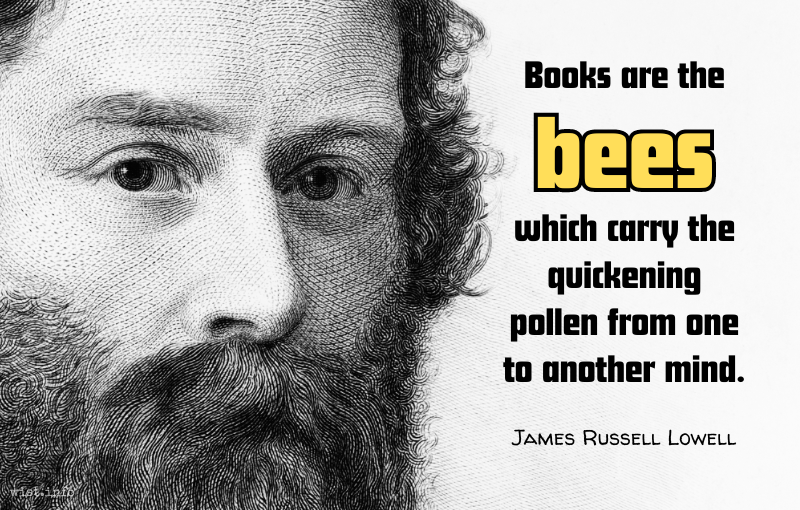
Books are the bees which carry the quickening pollen from one to another mind.
James Russell Lowell (1819–1891) American diplomat, essayist, poet
“Nationality in Literature,” North American Review, Article 10 (1849-07)
(Source)
Reviewing Henry Wadsworth Longfellow, Kavanagh (1849).
And now I understand
something so frightening, and wonderful —
how the mind clings to the road it knows, rushing
through crossroads, sticking
like lint to the familiar.

For always the man in whom thought springs up over thought sets his mark farther off, for the one thought saps the force of the other.
[Ché sempre l’omo in cui pensier rampolla
sovra pensier, da sé dilunga il segno,
perché la foga l’un de l’altro insolla]Dante Alighieri (1265–1321) Italian poet
The Divine Comedy [Divina Commedia], Book 2 “Purgatorio,” Canto 5, l. 16ff (5.16-18) (1314) [tr. Sinclair (1939)]
(Source)
Virgil telling Dante he's overthinking things, letting himself be distracted.
(Source (Italian)). Other translations:He, that permits his Fancy thus to stray.
With every lure, will rarely find his way
To that great end, to which his soul is bent:
For gath'ring fancies warp the steady light
Of Reason's beam, and leave her whelm'd in night,
For ever baffled of her first intent.
[tr. Boyd (1802), st. 3]He, in whose bosom thought on thought shoots out,
Still of his aim is wide, in that the one
Sicklies and wastes to nought the other’s strength.
[tr. Cary (1814)]He in whose bosom thought springs up to thought,
Destroys himself the figures of his loom --
The birth of one prepares the others's tomb.
[tr. Bannerman (1850)]For evermore the man in whom is springing
Thought upon thought, removes from him the mark,
Because the force of one the other weakens.
[tr. Longfellow (1867)]For ever the man, in whom thought wells up over thought, removes far from himself his mark, because the rush of the second slackens the first.
[tr. Butler (1885)]Always the man in whom new thought doth grow
On previous thought, from his true course doth roam,
Because the one doth flag the other's glow.
[tr. Minchin (1885)]For always the man in whom thought on thought wells up removes from himself his aim, for the force of one weakens the other.
[tr. Norton (1892)]For ever the man in whom thought wells up on thought, sets back his mark, because the one saps the force of the other.
[tr. Okey (1901)]For always he in whom thought overtakes
The former thought, his goal less clearly sees.
Because the one the other must relax.
[tr. Binyon (1943)]He aims beside the mark whose fancies bubble
One on another, driving back and drumming
Each other out, so that his eye sees double.
[tr. Sayers (1955)]For when a man lets his attention range
toward every wisp, he loses true direction,
sapping his mind's force with continual change.
[tr. Ciardi (1961)]For always the man in whom thought wells
up on thought sets back his mark,
for one thought weakens the force of the other.
[tr. Singleton (1973)]The man who lets his thoughts be turned aside
by one thing or another, will lose sight
of his true goal, his mind sapped of its strength.
[tr. Musa (1981)]Because the man in whom thoughts bubble up
One after the other, goes wide of the mark,
Because one thought weakens the force of another.
[tr. Sisson (1981)]The man in whom thought thrusts ahead of thought
allows the goal he’s set to move far off --
the force of one thought saps the other’s force.
[tr. Mandelbaum (1982)]For always the man in whom one care sprouts above the other makes his target more distant, because the impulse of the one weakens the other.
[tr. Durling (2003)]Since the man, in whom thought rises on thought, sets himself back, because the force of the one weakens the other.
[tr. Kline (2002)]When thought is bred too rampantly from thought,
then, of himself, a man will miss the mark.
Each mental thrust debilitates the first.
[tr. Kirkpatrick (2007)]For any man who lets one thought --
and then another -- take him over
will soon lose track of his first goal.
[tr. Hollander/Hollander (2007)]A man whose mind is distracted lets thought after thought
Keep him from getting where he wants to go:
They hammer each other down; nothing can grow.
[tr. Raffel (2010)]

Politeness, however, acts the lady’s-maid to our thoughts; and they are washed, dressed, curled, rouged, and perfumed, before they are presented to the public.
Letitia Elizabeth Landon (1802–1838) English poet and novelist [a/k/a L.E.L.]
Romance and Reality, Vol. 2, ch. 14 (1831)
(Source)

Experts in ancient Greek culture say that people back then didn’t see their thoughts as belonging to them. When ancient Greeks had a thought, it occurred to them as a god or goddess giving an order. Apollo was telling them to be brave. Athena was telling them to fall in love.
Now people hear a commercial for sour cream potato chips and rush out to buy them, but now they call this free will.
At least the ancient Greeks were being honest.

More gold has been mined from the brains of men than has ever been taken from the earth.
Napoleon Hill (1883–1970) American author, motivational writer
Think and Grow Rich (1937)
(Source)
In some editions this is given as: "More gold has been mined from the thoughts of men than has ever been taken from the earth."
We’re animals. We’re born like every other mammal and we live our whole lives around disguised animal thoughts.
Barbara Kingsolver (b. 1955) American novelist, essayist, poet
Animal Dreams (1990)

I collected my thoughts. Someday I hope to have them all.
Steven Brust (b. 1955) American writer, systems programmer
Orca [Vlad] (1996)

The more profound the thought, the more burdensome. What is in will out.
Ralph Waldo Emerson (1803–1882) American essayist, lecturer, poet
Journal (1836)
What a wee little part of a person’s life are his acts and his words! His real life is led in his head, and is known to none but himself. All day long, and every day, the mill of his brain is grinding, and his thoughts (which are but the mute articulation of his feelings,) not those other things, are his history. His acts and his words are merely the visible thin crust of his world, with its scarred snow summits and its vacant wastes of water — and they are so trifling a part of his bulk! a mere skin enveloping it. The mass of him is hidden — it and its volcanic fires that toss and boil, and never rest, night nor day. These are his life, and they are not written, and cannot be written. Every day would make a whole book of eighty thousand words — three hundred and sixty-five books a year. Biographies are but the clothes and buttons of the man — the biography of the man himself cannot be written.
Mark Twain (1835–1910) American writer [pseud. of Samuel Clemens]
The Autobiography of Mark Twain, Vol. 1 (2010)
(Source)
I wonder how anyone can have the face to condemn others when he reflects upon his own thoughts.
W. Somerset Maugham (1874–1965) English novelist and playwright [William Somerset Maugham]
The Summing Up, ch. 16 (1938)
(Source)
A man would do well to carry a pencil in his pocket and write down the thoughts of the moment. Those that come unsought are commonly the most valuable, and should be secured because they seldom return.
Francis Bacon (1561–1626) English philosopher, scientist, author, statesman
(Attributed)
Govern thy Life and Thoughts, as if the whole World were to see the one, and read the other.
Thomas Fuller (1654–1734) English physician, preacher, aphorist, writer
Introductio ad Prudentiam, Vol. 1, # 417 (1725)
(Source)

Life does not consist mainly — or even largely — of facts and happenings. It consists mainly of the storm of thoughts that is forever blowing through one’s head.
Mark Twain (1835–1910) American writer [pseud. of Samuel Clemens]
Autobiography, Part 1, sec. 28 “New York, January 10, 1906” (2003)
Full text.
I talk half the time to find out my own thoughts, as a school-boy turns his pockets inside out to see what is in them. One brings to light all sorts of personal property he had forgotten in his inventory.
Why can’t somebody give us a list of things that everybody thinks and nobody says, and another list of things that everybody says and nobody thinks?
The secret thoughts of a man run over all things holy, prophane, clean, obscene, grave, and light, without shame, or blame.
The thoughts they had were the parents of the actions they did; their feelings were the parents of their thoughts.
Thomas Carlyle (1795–1881) Scottish essayist and historian
Lecture (1840-05-05), “The Hero as Divinity,” Home House, Portman Square, London
(Source)
The lecture notes were collected by Carlyle into On Heroes, Hero-Worship, & the Heroic in History, Lecture 1 (1841).
Often an idea about it would occur to me which seemed to have force and make perfect answer to some of the things that were said and written about my actions. I never let one of those ideas escape me, but wrote it on a scrap of paper and put it in that drawer. In that way I saved my best thoughts on the subject, and, you know, such things often come in a kind of intuitive way more clearly than if one were to sit down and deliberately reason them out.
To save the results of such mental action is true intellectual economy. It not only saves time and labor, but also the very best material the mind can supply for unexpected emergencies.Abraham Lincoln (1809–1865) American lawyer, politician, US President (1861–65)
Remark (1863) to James F. Wilson (Attributed)
(Source)
Recounted in an essay (1896-12), "Some Memories of Lincoln," North American Review, Vol. 163, No. 481. Wilson references the remarks as having been made in late 1863, 33 years earlier.
Wilson was at the time a US Representative from Iowa (1861–1869); he went on to be US Senator (1883-1895). He had offered praise to a letter Lincoln had written (1862-06-13) to organizers of a public meeting which had criticized his suspension of the writ of habeas corpus and subsequent arrests. Lincoln described how the letter had come from a collection of ideas he had put aside in a drawer as he considered the question.
A variant of this was given in Henry Llewellyn Williams (ed.), Lincolnics: Familiar Sayings of Abraham Lincoln (1906), noted as "Lincoln to Senator Wilson, 1862."I never let any idea escape me, but write it on a scrap of paper, and put it in a drawer. In that way I save my best thoughts on a subject, and such things often come in a kind of intuitive way more clearly than if one were to sit down and deliberately reason them out. To save the results of such mental action is true intellectual economy. It not only saves time and labor, but also the very best material the mind can supply for unexpected emergencies.

Thoughts, like fleas, jump from man to man. But they don’t bite everybody.
Stanislaw Lec (1909–1966) Polish aphorist, poet, satirist
Unkempt Thoughts [Myśli nieuczesane] (1957) [tr. Gałązka (1962)]
(Source)

Don’t join the book burners. Don’t think you are going to conceal thoughts by concealing evidence that they ever existed. Don’t be afraid to go in your library and read every book, as long as that document does not offend your own ideas of decency. That should be the only censorship.
Dwight David Eisenhower (1890–1969) American general, US President (1953–61)
Commencement Speech, Dartmouth College (14 Jun 1953)