

It takes a lot of intellect to have faith, which is why so many people only have religiosity.
Madeleine L'Engle (1918–2007) American writer
“I Dare You,” Newsweek (interview) (7 May 2003)
Source article
Quotations by:
L’Engle, Madeleine
Q. What are you against?
A. Narrow-mindedness. I’m against people taking the Bible absolutely literally, rather than letting some of it be real fantasy, like Jonah. You know, the whole story of David is a novel … Faith is best expressed in story.
Q. If the Bible is not literally true, does that mean we don’t need to take it seriously?
A. Oh no, you do, because it’s truth, not fact, and you have to take truth seriously even when it expands beyond the facts.Madeleine L'Engle (1918–2007) American writer
“I Dare You,” Newsweek (interview) (7 May 2003)
Source article
If we commit ourselves to one person for life this is not, as many people think, a rejection of freedom; rather, it demands the courage to move into all the risks of freedom, and the risk of love which is permanent; into that love which is not possession but participation.
Madeleine L'Engle (1918–2007) American writer
“The Irrational Season” (1977)
No long-term marriage is made easily, and there have been times when I’ve been so angry or so hurt that I thought my love would never recover. And then, in the midst of near despair, something has happened beneath the surface. A bright little flashing fish of hope has flicked silver fins and the water is bright and suddenly I am returned to a state of love again — till next time. I’ve learned that there will always be a next time, and that I will submerge in darkness and misery, but that I won’t stay submerged. And each time something has been learned under the waters; something has been gained; and a new kind of love has grown. The best I can ask for is that this love, which has been built on countless failures, will continue to grow. I can say no more than that this is mystery, and gift, and that somehow or other, through grace, our failures can be redeemed and blessed.
Madeleine L'Engle (1918–2007) American writer
“The Irrational Season” (1977)
It’s a good thing to have all the props pulled out from under us occasionally. It gives us some sense of what is rock under our feet, and what is sand.
Madeleine L'Engle (1918–2007) American writer
“The Summer of the Great-Grandmother”
Inspiration usually comes during work, rather than before it.
Madeleine L'Engle (1918–2007) American writer
(Attributed)
Who Moved My Cheese? calendar
I have sometimes felt closest to God when I have been furious.
Madeleine L'Engle (1918–2007) American writer
(Attributed)
That’s something I’ve noticed about food: whenever there’s a crisis if you can get people to eating normally things get better.
Madeleine L'Engle (1918–2007) American writer
(Attributed)
The concentration of a small child at play is analogous to the concentration of the artist of any discipline. In real play, which is real concentration, the child is not only outside time, he is outside himself. He has thrown himself completely into whatever it is that he is doing. A child playing a game, building a sand castle, painting a picture, is completely in what he is doing. His self-consciousness is gone; his consciousness is wholly focused outside himself.
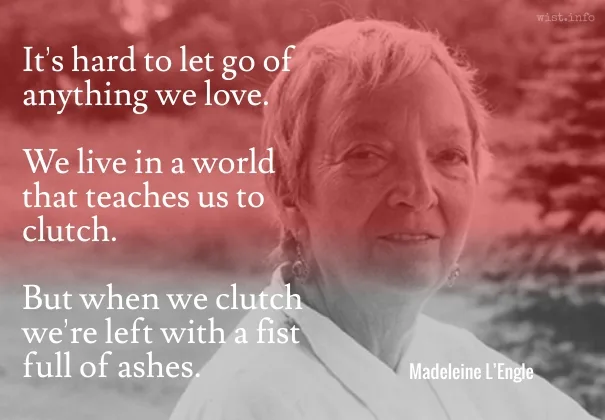
It’s hard to let go of anything we love. We live in a world that teaches us to clutch. But when we clutch we’re left with a fist full of ashes.
Madeleine L'Engle (1918–2007) American writer
A Ring of Endless Light, ch. 4 [Adam] (1980)
As the skipping rope hit the pavement, so did the ball. As the rope curved over the head of the jumping child, the child with the ball caught the ball. Down came the ropes. Down came the balls. Over and over again. Up. Down. All in rhythm. All identical. Like the houses. Like the paths. Like the flowers.
Madeleine L'Engle (1918–2007) American writer
A Wrinkle in Time (1962)
You’re given the form, but you have to write the sonnet yourself. What you say is completely up to you.
Madeleine L'Engle (1918–2007) American writer
A Wrinkle in Time (1962)
The Great God Science. It has failed us, because it was never meant to be a god, but only a few true scientists understand that.
Madeleine L'Engle (1918–2007) American writer
Dragons in the Waters (1976)
There’s more to life than just the things that can be explained by encyclopedias and facts. Facts alone are not adequate.
Madeleine L'Engle (1918–2007) American writer
Penguins and Golden Calves (2003)
That’s the way things come clear. All of a sudden. And then you realize how obvious they’ve been all along.
Madeleine L'Engle (1918–2007) American writer
The Arm of the Starfish (1965)
I cannot believe that God wants punishment to go on interminably any more than does a loving parent. The entire purpose of loving punishment is to teach, and it lasts only as long as is needed for the lesson. And the lesson is always love.
Madeleine L'Engle (1918–2007) American writer
The Irrational Season (1977)
I know a number of highly sensitive and intelligent people in my own communion who consider as a heresy my faith that God’s loving concern for his creation will outlast all our willfulness and pride. No matter how many eons it takes, he will not rest until all of creation, including Satan, is reconciled to him, until there is no creature who cannot return his look of love with a joyful response of love […] Some people feel it to be heresy because it appears to deny man his freedom to refuse to love God. But this, it seems to me, denies God his freedom to go on loving us beyond all our willfulness and pride. If the Word of God is the light of the world, and this light cannot be put out, ultimately it will brighten all the dark corners of our hearts and we will be able to see, and seeing, will be given the grace to respond with love — and of our own free will.
Madeleine L'Engle (1918–2007) American writer
The Irrational Season (1977)
We were not a latter-day Héloïse and Abelard, Pelléas and Mélisande when we married. For one thing the Héloïse and Abelards, Pelléases and Mélisandes, do not get married and stay married for forty years. A love which depends solely on the combustion of two attracting chemistries, tends to fizzle out. The famous lovers usually end up dead. A long-term marriage has to move beyond chemistry to compatibility, to friendship, to companionship. It is certainly not that passion disappears, but that it is conjoined with other ways of love.
Madeleine L'Engle (1918–2007) American writer
Two-Part Invention: The Story of a Marriage (1988)
(Source)
Readers usually grossly underestimate their own importance. If a reader cannot create a book along with the writer, the book will never come to life. Creative involvement: that’s the difference between reading a book and watching TV. In watching TV, we are passive — sponges; we do nothing. In reading, we must become creators, imagining the setting of the story, seeing the facial expressions, hearing the inflection of the voices. The author and the reader “know” each other; they meet on the bridge of words.
Madeleine L'Engle (1918–2007) American writer
Walking on Water: Reflections on Faith and Art (1982)
It is the ability to choose which makes us human.
Madeleine L'Engle (1918–2007) American writer
Walking on Water: Reflections on Faith and Art, ch. 2 (1980)
(Source)
If the artist works only when he feels like it, he’s not apt to build up much of a body of work. Inspiration far more often comes during the work than before it, because the largest part of the job of the artist is to listen to the work, and to go where it tells him to go.
Madeleine L'Engle (1918–2007) American writer
Walking on Water (1980)
We think because we have words, not the other way around, and the greater our vocabulary, the greater our ability to think conceptually. The first people a dictator puts in jail are the writers, the teachers, the librarians — because these people are dangerous. They have enough vocabulary to recognize injustice and to speak out loudly about it. Let us have the courage to go on being dangerous people.
Madeleine L'Engle (1918–2007) American writer
Speech (1983-11-16), “Dare To Be Creative,” Lecture, Library of Congress, Washington, DC
(Source)
The writer whose words are going to be read by children has a heavy responsibility. And yet, despite the undeniable fact that the children’s minds are tender, they are also far more tough than many people realize, and they have an openness and an ability to grapple with difficult concepts which many adults have lost. Writers of children’s literature are set apart by their willingness to confront difficult questions.
Madeleine L'Engle (1918–2007) American writer
Speech (1983-11-16), “Dare To Be Creative,” Lecture, Library of Congress, Washington, DC
(Source)
Many years ago, when A Wrinkle in Time was being rejected by publisher after publisher, I wrote in my journal, “I will rewrite for months or even years for an editor who sees what I am trying to do in this book and wants to make it better and stronger. But I will not, I cannot diminish and mutilate it for an editor who does not understand it and wants to weaken it.”
Now, the editors who did not understand the book and wanted the problem of evil soft peddled had every right to refuse to publish the book, as I had, sadly, the right and obligation to try to be true to it. If they refused it out of honest conviction, that was honorable. If they refused it for fear of trampling on someone else’s toes, that was, alas, the way of the world.Madeleine L'Engle (1918–2007) American writer
Speech (1983-11-16), “Dare To Be Creative,” Lecture, Library of Congress, Washington, DC
(Source)
We find what we are looking for. If we are looking for life and love and openness and growth, we are likely to find them. If we are looking for witchcraft and evil, we’ll likely find them, and we may get taken over by them.
Madeleine L'Engle (1918–2007) American writer
Speech (1983-11-16), “Dare To Be Creative,” Lecture, Library of Congress, Washington, DC
(Source)
We all practice some form of censorship. I practiced it simply by the books I had in the house when my children were little. If I am given a budget of $500 I will be practicing a form of censorship by the books I choose to buy with that limited amount of money, and the books I choose not to buy. But nobody said we were not allowed to have points of view. The exercise of personal taste is not the same thing as imposing personal opinion.
Madeleine L'Engle (1918–2007) American writer
Speech (1983-11-16), “Dare To Be Creative,” Lecture, Library of Congress, Washington, DC
(Source)
We need to dare disturb the universe by not being manipulated or frightened by judgmental groups who assume the right to insist that if we do not agree with them, not only do we not understand but we are wrong. How dull the world would be if we all had to feel the same way about everything, if we all had to like the same books, dislike the same books.
Madeleine L'Engle (1918–2007) American writer
Speech (1983-11-16), “Dare To Be Creative,” Lecture, Library of Congress, Washington, DC
(Source)
Writing fiction is definitely a universe disturber, and for the writer, first of all. My books push me and prod me and make me ask questions I might otherwise avoid. I start a book, having lived with the characters for several years, during the writing of other books, and I have a pretty good idea of where the story is going and what I hope it’s going to say. And then, once I get deep into the writing, unexpected things begin to happen, things which make me question, and which sometimes really shake my universe.
Madeleine L'Engle (1918–2007) American writer
Speech (1983-11-16), “Dare To Be Creative,” Lecture, Library of Congress, Washington, DC
(Source)
When I find myself hotly defending something, when I am, in fact, zealous, it is time for me to step back and examine whatever it is that has me so hot under the collar. Do I think it’s going to threaten my comfortable rut? Make me change and grow? — and growing always causes growing pains. Am I afraid to ask questions?
Madeleine L'Engle (1918–2007) American writer
Speech (1983-11-16), “Dare To Be Creative,” Lecture, Library of Congress, Washington, DC
(Source)
I am very wary of those individuals who are neither writers nor editors nor even, in some cases, readers, who feel that they have the right to apply their own moral criteria to the books in public and school libraries. I have enormous respect and admiration and love for the librarians who are rising up to protest this, because they are putting their very jobs on the line.
Madeleine L'Engle (1918–2007) American writer
Speech (1983-11-16), “Dare To Be Creative,” Lecture, Library of Congress, Washington, DC
(Source)
Someone sent me a clipping from a daily newspaper containing a list of ten books to be removed from library shelves because of their pornographic content. On the list was one of C. S. Lewis’s Narnia books. Also on the list was my book A Wind in the Door. I am totally baffled and frankly fascinated. This is the first time C. S. Lewis and I have been listed together as writers of pornography. I don’t know whether to laugh or cry.
Madeleine L'Engle (1918–2007) American writer
Speech (1983-11-16), “Dare To Be Creative,” Lecture, Library of Congress, Washington, DC
(Source)
Perhaps people who read and write and have enough vocabulary to think with are universe disturbers. But we need to disturb the universe if, as human beings on planet earth, we are to survive. We need to have the vocabulary to question ourselves, and enough courage to disturb creatively, rather than destructively, even if it is going to make us uncomfortable or even hurt.
Madeleine L'Engle (1918–2007) American writer
Speech (1983-11-16), “Dare To Be Creative,” Lecture, Library of Congress, Washington, DC
(Source)
How dreary to spend your time counting dirty words, but not reading the book. And how revealing of the person who is counting. We do find what we look for.
Madeleine L'Engle (1918–2007) American writer
Speech (1983-11-16), “Dare To Be Creative,” Lecture, Library of Congress, Washington, DC
(Source)
So let us look for beauty and grace, for love and friendship, for that which is creative and birth-giving and soul-stretching. Let us dare to laugh at ourselves, healthy, affirmative laughter. Only when we take ourselves lightly can we take ourselves seriously, so that we are given the courage to say, “Yes! I dare disturb the universe.”
Madeleine L'Engle (1918–2007) American writer
Speech (1983-11-16), “Dare To Be Creative,” Lecture, Library of Congress, Washington, DC
(Source)