And remember, we all stumble, every one of us. That’s why it’s a comfort to go hand in hand.
Emily Kimbrough (1899–1989) American author and journalist
The Innocents from Indiana, ch. 17 (1950)
(Source)
At the very end of the book, a note from the protagonist's mother, about the protagonist having failed the entrance examination to Bryn Mawr.
Quotations about:
companionship
Note not all quotations have been tagged, so Search may find additional quotes on this topic.
No pleasure has any taste for me when not shared with another: no happy thought occurs to me without my being irritated at bringing it forth alone with no one to offer it to.
[Nul plaisir n’a saveur pour moy sans communication. Il ne me vient pas seulement une gaillarde pensée en l’ame, qu’il ne me fasche de l’avoir produite seul, et n’ayant à qui l’offrir.]
Michel de Montaigne (1533–1592) French essayist
Essays, Book 3, ch. 9 (3.9), “Of Vanity [De la vanité]” (1587) [tr. Screech (1987)]
(Source)
First appeared in the 1588 edition.
(Source (French)). Other translations:With me no pleasure is fully delightsome without communication and no delight absolute except imparted. I doe not so much as apprehend one rare conceipt, or conceive one excellent good thought in my minde, but me thinks I am much grieved and grievously perplexed to have produced the same alone and that I have no sympathizing companion to impart it unto.
[tr. Florio (1603)]There can be no Pleasure to me without Communication. There is not so much as a spritely Thought comes into my Mind, that it does not grieve me to have produc'd alone, and that I have no one to communicate it unto.
[tr. Cotton (1686)]There can be no pleasure to me without communication: there is not so much as a sprightly thought comes into my mind, that it does not grieve me to have produced alone, and that I have no one to communicate it to.
[tr. Cotton/Hazlitt (1877)]No pleasure has any savour for me without imparting it; not even a lively thought comes into my mind that I am not vexed at expressing it when alone and at having no one to offer it to.
[tr. Ives (1925)]No pleasure has any savor for me without communication. Not even a merry thought comes to my mind without my being vexed at having produced it alone without anyone to offer it to.
[tr. Frame (1943)]

We were not a latter-day Héloïse and Abelard, Pelléas and Mélisande when we married. For one thing the Héloïse and Abelards, Pelléases and Mélisandes, do not get married and stay married for forty years. A love which depends solely on the combustion of two attracting chemistries, tends to fizzle out. The famous lovers usually end up dead. A long-term marriage has to move beyond chemistry to compatibility, to friendship, to companionship. It is certainly not that passion disappears, but that it is conjoined with other ways of love.
Madeleine L'Engle (1918–2007) American writer
Two-Part Invention: The Story of a Marriage (1988)
(Source)

One hardly dares to say that love is the core of the relationship, though love is sought for and created in relationship; love is rather the marvel when it is there, but it is not always there, and to know another and to be known by another — that is everything.
Florida Scott-Maxwell (1883–1979) American-British playwright, author, psychologist
Women and Sometimes Men (1957)
(Source)
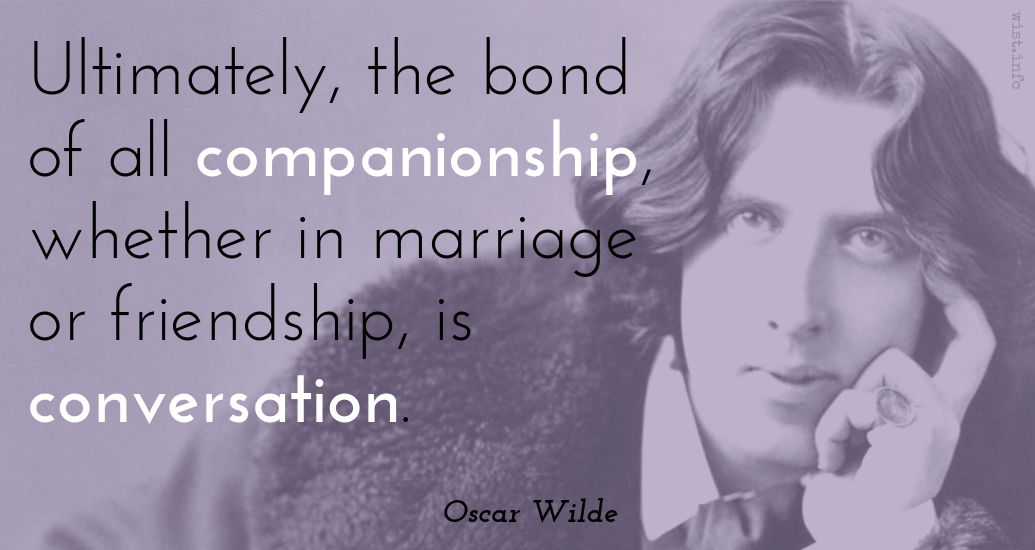
Ultimately, the bond of all companionship, whether in marriage or friendship, is conversation.
Oscar Wilde (1854–1900) Irish poet, wit, dramatist
Letter (1897-03) to Alfred Douglas, “Epistola: In Carcere et Vinculis”
(Source)
Wilde titled the letter, written while in prison in Reading, England, Epistola: In Carcere et Vinculis ("Letter: In Prison and in Chains"). Upon his release, the letter was entrusted to Robert Ross, who in 1905, after Wilde's death, published an edited version under the title De Profundis ("From the Depths," from Psalm 130), and later editions have retained that name.
This quotation was not in the 1905 edition, but in the eventually fully-restored version in Wilde's complete letters.
More information on the history of the letter here.

Consider what you have in the smallest chosen library. A company of the wisest and wittiest men that could be picked out of all civil countries, in a thousand years, have set in best order the results of their learning and wisdom. The men themselves were hid and inaccessible, solitary, impatient of interruption, fenced by etiquette; but the thought which they did not uncover to their bosom friend is here written out in transparent words to us, the strangers of another age.
Ralph Waldo Emerson (1803–1882) American essayist, lecturer, poet
“Books,” Society and Solitude (1870)

A bore is a man who deprives you of solitude without providing you with company.
Giovanni Vincenzo Gravina (1664–1718) Italian man of letters and jurist
(Attributed)
The actual provenance of this quotation is unknown. The earliest reference is in Reader's Digest (1949-03), where it is attributed by a contributor to Gravina, but identifying him as a contemporary author; the connection to the 18th Century Italian author and jurist is therefore tenuous.
Also attributed to Oscar Wilde (but not until long after his death), John C. MacDonald (who did use it, but attributed it to Gravina), and Roger Ebert (who did use it, but attributed it to John D. MacDonald).
A similar phrase can be found in Marcel Proust, The Captive [La Prisonnière], Part 1, ch. 1 (1923) [tr. Moncrieff (1929)] (Part 6 of his Remembrance of Things Past [A la Recherche du Temps Perdu]) [English, French]:Mamma would write to me: “Mme. Sazerat gave us one of those little luncheons of which she possesses the secret and which, as your poor grandmother would have said, quoting Mme. de Sévigné, deprive us of solitude without affording us company.”
[Maman m’écrivait : «Mme Sazerat nous a donné un de ces petits déjeuners dont elle a le secret et qui, comme eût dit ta pauvre grand’mère, en citant Mme de Sévigné, nous enlèvent à la solitude sans nous apporter la société.»]
More information and research into the quotation's origin can be found here: Quote Origin: A Bore Is a Person Who Deprives You of Solitude Without Providing You with Company – Quote Investigator®. QI says some very nice things about me and this site regarding the preliminary research I did on the question of authorship.

If it’s heaven for climate, it’s hell for company.
J. M. Barrie (1860–1937) Scottish novelist and dramatist [James Matthew Barrie]
The Little Minister, ch. 3 “The Night-Watchers” [Jo Cruickshanks] (1891)
(Source)
A similar quote is cited to Mark Twain at about the same time. More research into this quotation can be found here: Heaven for the Climate, and Hell for the Company – Quote Investigator®.