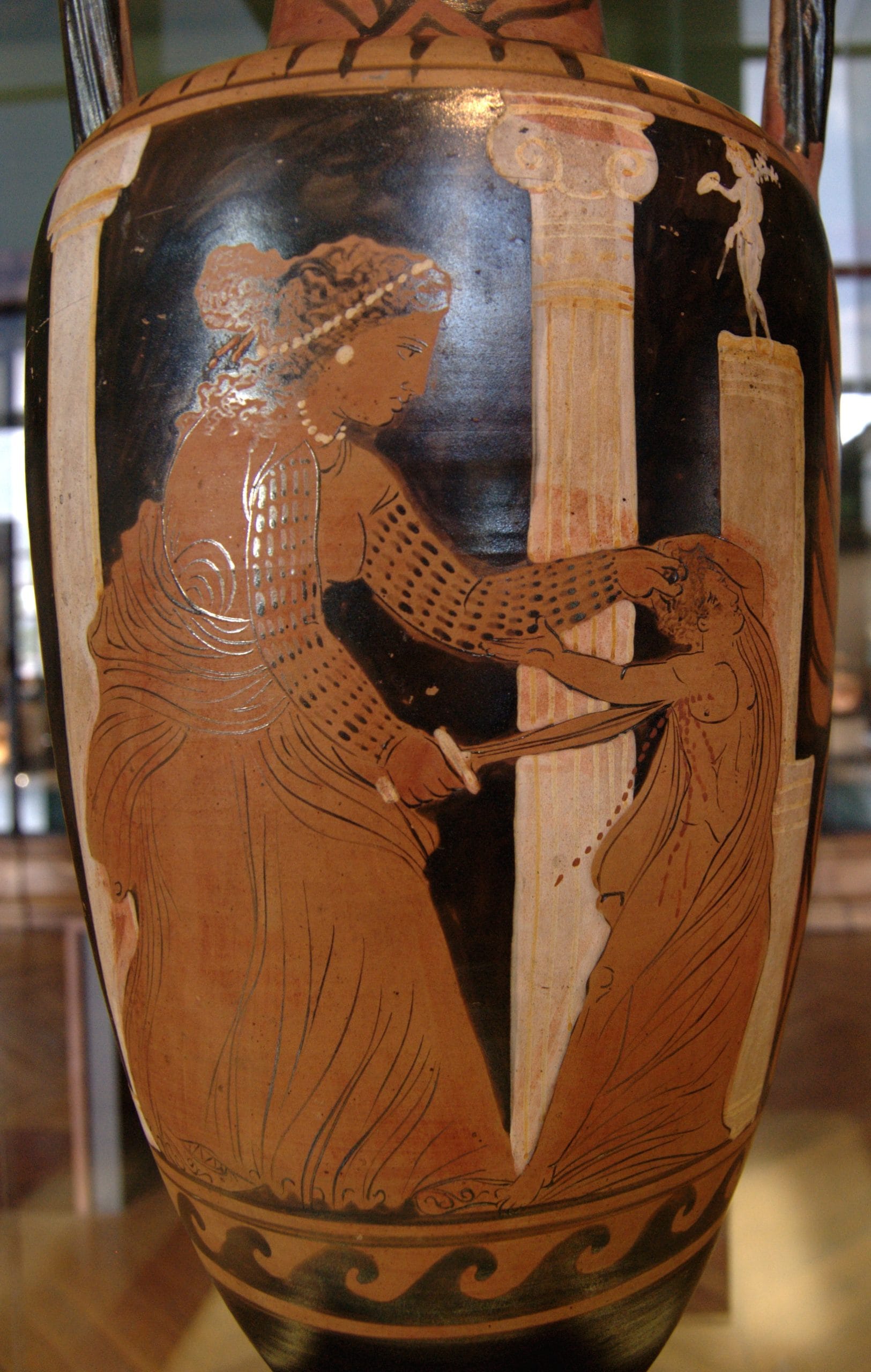
They were engaged in religion. You could tell by the knives (it’s not murder if you do it for a god).
Quotations about:
murder
Note not all quotations have been tagged, so Search may find additional quotes on this topic.

MEDEA: Women, my task is fixed: as quickly as I may
To kill my children, and start away from this land,
And not, by wasting time, to suffer my children
To be slain by another hand less kindly to them.
Force every way will have it they must die, and since
This must be so, then I, their mother, shall kill them.
Oh, arm yourself in steel, my heart! Do not hang back
From doing this fearful and necessary wrong.
Oh, come, my hand, poor wretched hand, and take the sword,
Take it, step forward to this bitter starting point,
And do not be a coward, do not think of them,
How sweet they are, and how you are their mother. Just for
This one short day be forgetful of your children,
Afterward weep; for even though you will kill them,
They were very dear — Oh, I am an unhappy woman!
(With a cry she rushes into the house.)[ΜΉΔΕΙΑ: φίλαι, δέδοκται τοὔργον ὡς τάχιστά μοι
παῖδας κτανούσῃ τῆσδ᾽ ἀφορμᾶσθαι χθονός,
καὶ μὴ σχολὴν ἄγουσαν ἐκδοῦναι τέκνα
ἄλλῃ φονεῦσαι δυσμενεστέρᾳ χερί.
πάντως σφ᾽ ἀνάγκη κατθανεῖν: ἐπεὶ δὲ χρή,
ἡμεῖς κτενοῦμεν οἵπερ ἐξεφύσαμεν.
ἀλλ᾽ εἶ᾽ ὁπλίζου, καρδία: τί μέλλομεν
τὰ δεινὰ κἀναγκαῖα μὴ πράσσειν κακά;
ἄγ᾽, ὦ τάλαινα χεὶρ ἐμή, λαβὲ ξίφος,
λάβ᾽, ἕρπε πρὸς βαλβῖδα λυπηρὰν βίου,
καὶ μὴ κακισθῇς μηδ᾽ ἀναμνησθῇς τέκνων,
ὡς φίλταθ᾽, ὡς ἔτικτες, ἀλλὰ τήνδε γε
λαθοῦ βραχεῖαν ἡμέραν παίδων σέθεν
κἄπειτα θρήνει: καὶ γὰρ εἰ κτενεῖς σφ᾽, ὅμως
φίλοι γ᾽ ἔφυσαν: δυστυχὴς δ᾽ ἐγὼ γυνή.]Euripides (485?-406? BC) Greek tragic dramatist
Medea [Μήδεια], l. 1236ff (431 BC) [tr. Warner (1944)]
(Source)
Medea, soliloquizing to the Chorus (of women) as she self-justifies killing her and Jason's sons. Though earlier she said she was doing so to revenge herself on him, here she seizes on the idea that they would otherwise be executed for her killing of Creon and Glauce through gifts that the boys carried to them. (There is a version of the Medea myth where that exact thing happens.)
(Source (Greek)). Other translations:My friends,
I am resolv'd, as soon as I have slain
My Children, from these regions to depart.
Nor thro' inglorious sloth will I abandon
My Sons to perish by detested hands;
They certainly must die: since then they must,
I bore and I will slay them. O my heart!
Be arm'd with tenfold firmness. What avails it
To loiter, when inevitable ills
Remain to be accomplish'd? take the sword.
And, O my band, on to the goal that ends
Their life, nor let one intervening thought
Of pity or maternal tenderness
Suspend thy purpose: for this one short day
Forget how fondly thou didst love thy Sons,
How bring them forth, and after that lament
Their cruel fate: altho' thou art resolv'd
To slay, yet hast thou ever held them dear.
But I am of all women the most wretched.
Exit Medea
[tr. Wodhull (1782)]This deed, my friends, is fix'd, to slay my sons
With quickest speed, then hasten from this land;
Nor fondly lingering leave them to be slain
By some more hostile hand: since they must die,
(For die they must) by me, who gave them life,
Death shall be given: and thou, my heart, be arm'd:
Yield not to weak reluctance, nor delay
A dreadful, but necessary deed.
Come, my unhappy hand, seize thou the sword,
Seize it, and wind thy progress to the goal
Of miserable life: faint not, nor thing
Of thy poor children, O how dear to me!
For this short day remember not thy sons,
Hereafter mourn at leisure: though I kill them,
Yet they were dear, and I -- a very wretch.
[tr. Potter (1814)]My friends, this purpose stand approved to me,
Slaying my boys to hurry from this realm;
Not, making weak delays, to give my sons
By other and more cruel hands to die.
Nay, steel thyself my heart. Why linger we
As not to do that horror which yet must be?
Come, oh my woeful hand, take take the sword:
On to my new life's mournful starting point,
And be no coward, nor think on thy boys,
How dear, how thou didst give them birth. Nay rather
For this short day forget they are thy sons:
Then weep them afterwards. For though thou slay'st them
Oh but they're dear, and I a desolate woman.
[tr. Webster (1868)]My friends, I am resolved upon the deed; at once will I slay my children and then leave this land, without delaying long enough to hand them over to some more savage hand to butcher. Needs must they die in any case; and since they must, I will slay them — I, the mother that bare them. O heart of mine, steel thyself! Why do I hesitate to do the awful deed that must be done? Come, take the sword, thou wretched hand of mine! Take it, and advance to the post whence starts thy life of sorrow! Away with cowardice! Give not one thought to thy babes, how dear they are or how thou art their mother. This one brief day forget thy children dear, and after that lament; for though thou wilt slay them yet they were thy darlings still, and I am a lady of sorrows.
[tr. Coleridge (1891)]The deed is determined on by me, my friends, to slay my children as soon as possible, and to hasten from this land; and not by delaying to give my sons for another hand more hostile to murder. But come, be armed, my heart; why do we delay to do dreadful but necessary deeds? Come, O wretched hand of mine, grasp the sword, grasp it, advance to the bitter goal of life, and be not cowardly, nor remember thy children how dear they are, how thou broughtest them into the world; but for this short day at least forget thy children; hereafter lament. For although thou slayest them, nevertheless they at least were dear, but I a wretched woman.
[tr. Buckley (1892)]Friends, my resolve is taken, with all speed
To slay my children, and to flee this land,
And not to linger and to yield my sons
To death by other hands more merciless.
They needs must die: and, since it needs must be,
Even I will give them death, who gave them life.
Up, gird thee for the fray, mine heart! Why loiter
To do the dread ill deeds that must be done?
Come, wretched hand of mine, grasp thou the sword;
Grasp it; — move toward life's bitter starting-post,
And turn not craven: think not on thy babes,
How dear they are, how thou didst bear them: nay,
For this short day do thou forget thy sons,
Thereafter mourn them. For, although thou slay,
Yet dear they are, and I a wretched woman.
[Exit Medea.
[tr. Way (Loeb) (1894)]Women, my mind is clear. I go to slay
My children with all speed, and then, away
From hence; not wait yet longer till they stand
Beneath another and an angrier hand
To die. Yea, howsoe'er I shield them, die
They must. And, seeing that they must, 'tis I
Shall slay them, I their mother, touched of none
Beside. Oh, up and get thine armour on,
My heart! Why longer tarry we to win
Our crown of dire inevitable sin?
Take up thy sword, O poor right hand of mine,
Thy sword: then onward to the thin-drawn line
Where life turns agony. Let there be naught
Of softness now: and keep thee from that thought,
'Born of thy flesh,' 'thine own belovèd.' Now,
For one brief day, forget thy children: thou
Shalt weep hereafter. Though thou slay them, yet
Sweet were they. . . . I am sore unfortunate.
[She goes into the house.
[tr. Murray (1906)]My friends, the deed’s resolved — that with all haste
I will kill my children and set forth from Corinth,
Not, hesitating here, yield up my sons
For other and less loving hands to murder.
Die they must, either way; and since they must,
Then I will slay them that did bring them forth.
Come steel thyself, my heart. What help to linger
Shrinking to do that dreadful thing thou must?
The sword, O miserable hand, the sword —
Take it and onward to that bitter race
Thy feet must run! No weakening now, no thought
Of thy sons, how dear they are, how thou didst once
Give life to them. For this one little day
Forget thy babes, and, after, weep for them.
For though thou slay them, yet dear-loved were they,
Thine own, — and I a miserable woman.
[tr. Lucas, ed. Higham (1938)]Friends, now my course is clear: as quickly as possible
To kill the children and then to fly from Corinth; not
Delay and so consign them to another hand
To murder with a better will. For they must die,
In any case; and since they must, then I who gave
Them birth will kill them. Arm yourself, my heart: the thing
That you must do is fearful, yet inevitable.
Why wait, then? My accursed hand, come, take the sword;
Take it, and forward to your frontier of despair.
No cowardice, no tender memories; forget
That once you loved them, that of your body they were born.
For one short day forget your children; afterwards
Weep: though you kill them, they were your beloved sons.
Life has been cruel to me.
Medea goes into the house.
[tr. Vellacott (1963)]My friends, I have decided to kill the children
Without delay and quickly depart from this country;
I shall not, by delaying, give my children over
To another, more unfriendly, hand to murder.
In any case, their death is inevitable, and since
It is, I who gave them birth shall kill them.
Up then! Arm yourself, my heart! Why wait
To do the dreadful evil that must be done?
Come, my wretched hand, take up the sword,
Take it and go to life’s goal of grief,
Do not be cowardly, do not remember the children,
How dear they are, how you bore them; for this short day
At least forget all about your children,
Then grieve. For even if you kill them, still,
You bore them, you loved them. I am an unlucky woman.
[tr. Podlecki (1989)]My friends, my resolve is fixed on the deed, to kill my children with all speed and to flee from this land: I must not, by lingering, deliver my children for murder to a less kindly hand. They must die at all events, and since they must, I who gave them birth shall kill them. Come, put on your armor, my heart. Why do I put off doing the terrible deed that must be done? Come, wretched hand, take the sword, take it and go to your life's miserable goal. Do not weaken, do not remember that you love the children, that you gave them life. Instead, for this brief day forget them — and mourn hereafter: for even if you kill them, they were dear to you. Oh, what an unhappy woman I am! Exit Medea into the house.
[tr. Kovacs (Perseus) (1994); tr. Kovacs / Zhang / Rogak]My friends, my resolve is fixed on the deed, to kill my children with all speed and to flee from this land: I must not, by lingering, deliver my children for murder to a less kindly hand. They must die at all events, and since they must, I who gave them birth shall kill them. Come, put on your armor, my heart. Why do I put off doing the terrible deed that must be done? Come, luckless hand, take the sword, take it and go to your life's miserable goal. Do not weaken, do not remember that you love the children, that you gave them life. Instead, for this brief day forget them — and mourn hereafter: for even if you kill them, they were dear to you. Oh, what an unhappy woman I am!
Exit Medea into the house.
[tr. Kovacs (Loeb) (1994)]My friends, I have decided to act and at once. I will kill the children and then quit this land. I will not delay and so deliver them to other hands to spill their blood more eagerly. They must be killed; there is no other way. And since they must, I will take their life, I who gave them life. Come, my heart, put on your armour! We must not hesitate to do this deed, this terrible yet necessary deed! Come, wretched hand of mine, grip the sword, grip it! On to the starting line! A painful race awaits you now! No time now for cowardice or thinking of your children, how much you love them, how you brought them into this world. No, for one day, one fleeting day, forget your children; there will be the rest of your life for weeping. For though you will put them to the sword, you loved them well. Oh, I am a woman born to sorrow!
[Medea turns and goes into the house.]
[tr. Davie (1996)]Enough, my friends!
My mind is made up. I’ve decided to kill my children and to leave this country. I haven’t a moment longer lest someone takes my children and they are slaughtered by some enemy’s hands. Die they must and so, better they die by me who gave birth to them.
Come, my heart, arm yourself. This is no time for equivocations. Need has forced this evil. So why wait? Come terrible hand, pick up the knife! Take it and take also the final, the most bitter step, the last step of life. Don’t be a coward now. Don’t think about the love you have for them, the life you gave them.
Today, forget that you have any children at all! Leave the crying for another day.
So what if you’re their murderer?
Their love will follow you for ever -- just as misery will.
Exit Medea
[tr. Theodoridis (2004)]My friends. I have determined to do the deed at once,
to kill my children and leave this land,
and not to falter or give my children
over to let a hand more hostile murder them.
They must die and since they must
I, who brought them into the world, will kill them.
But arm yourself, my heart. Why hesitate
to do these tragic, yet necessary, evils?
Come, unhappy hand of mine, take the sword
take it, move to the dismal turning point of life.
Do not be a coward. Do not think of your children —
how much you love them, how you gave them birth.
For this one short day forget your children,
and mourn tomorrow. For even if you kill them
still you loved them very much. I am an unhappy woman.
Exit Medea.
[tr. Luschnig (2007)]I’ve made up my mind, my friends.
I’ll do it — kill my children now, without delay,
and flee this land. I must not hesitate.
That would hand them over to someone else
to be slaughtered by a hand less loving.
No matter what, the children have to die.
Since that’s the case, then I, who gave them life,
will kill them. Arm yourself for this, my heart.
Why do I put off doing this dreadful act,
since it must be done? Come, pick up the sword,
wretched hand of mine. Pick up the sword,
move to where your life of misery begins.
Don’t play the coward. Don’t remember now
how much you love them, how you gave them life.
For this short day forget they are your children
and mourn them later. Although you kill them,
still you loved them. As a woman, I’m so sad.
[Exit MEDEA into the house.]
[tr. Johnston (2008)]Philai, I am resolved upon the deed: I shall slay my children at once, and then leave this land. I will not delay and so surrender them over to some hostile hand for butchering. They must die in any case, and since they must, I will slay them — I, the mother who bore them. But come, my heart, arm yourself! Why do I hesitate to do the terrible [deina] evils [kaka] that must be done? Come, take the sword, poor hand of mine! Take it, and advance to the starting-post, where your life of sorrow begins! Away with cowardice! Forget your children, forget how most phila they are, and how you bore them. For this brief day forget, and after that lament. Though you will slay them, yet they are your philoi still. And I am a woman of sorrows.
Medea enters the house.
[tr. Coleridge / Ceragioli / Nagy / Hour25]
One to destroy, is Murder by the Law,
And Gibbets keep the lifted Hand in Awe.
To murder Thousands, takes a specious Name,
War’s glorious Art, and gives immortal Fame.
O great Alliance! O divine Renown!
With Death and Pestilence to share the Crown!
When Men extol a wild Destroyer’s Name,
Earth’s Builder and Preserver they blaspheme.Benjamin Franklin (1706–1790) American statesman, scientist, philosopher, aphorist
Poor Richard (1747 ed.)
(Source)
This lengthy poem is not original to Franklin, but was penned by English poet Edward Young (1683-1765) in 1728, as the 7th Satire in his collection of poems, Love of Fame, the Universal Passion, l. 53ff, dedicated to Robert Walpole. Interestingly, Franklin reordered the passage; in Young's original the two quatrains are reversed. Franklin also changed the passage "dearth and pestilence" to "death and pestilence."
RICHARD: Shall I be plain? I wish the bastards dead;
And I would have it suddenly performed.William Shakespeare (1564–1616) English dramatist and poet
Richard III, Act 4, sc. 2, l. 20ff (4.2.20-21) (1592)
(Source)
Ordering Buckingham to kill the two Princes in the Tower.

MEDEA:What makes me cry with pain
Is the next thing I have to do. I will kill my sons.
No one shall take my children from me.[ΜΉΔΕΙΑ: ᾤμωξα δ᾿ οἷον ἔργον ἔστ᾿ ἐργαστέον
τοὐντεῦθεν ἡμῖν· τέκνα γὰρ κατακτενῶ
τἄμ᾿· οὔτις ἔστιν ὅστις ἐξαιρήσεται·]Euripides (485?-406? BC) Greek tragic dramatist
Medea [Μήδεια], l. 791ff (431 BC) [tr. Vellacott (1963)]
(Source)
This is the first time Medea directly announces her intent; scholars debate whether it's where she actually first thinks of it.
The most interesting divergence in translations here is whether Medea is asserting that nobody can save the children from her plan to kill them, or that nobody will take them from her because she will kill them first. The former seems to me more in keeping with the rest of the passage, but some translators disagree. Though her sons were to have been exiled with her, some scholars believe Medea was concerned that they might be killed (taken from her) once she murdered Glauce, Jason's new wife.
(Source (Greek)). Other translations:But I with anguish think upon a deed
Of more than common horror, which remains
By me to be accomplish'd: for my Sons
Am I resolved to slay, them from this arm
Shall no man rescue.
[tr. Wodhull (1782)]But what a deed,
Ay, there my heart is anguish'd, what a deed
Must next be done! My sons -- I'll kill them both,
And who shall save them from me?
[tr. Potter (1814)]But I am woe for what a deed
Needs must be done: for I shall slay my sons.
No one there is who may deliver them.
[tr. Webster (1868)]But I shudder at the deed I must do next; for I will slay the children I have borne; there is none shall take them from my toils.
[tr. Coleridge (1891)]But I bewail the deed such as must next be done by me; for I shall slay my children; there is no one who shall rescue them from me.
[tr. Buckley (1892)]And wail the deed that yet for me remains
To bring to pass; for I will slay my children,
Yea, mine: no man shall pluck them from mine hand.
[tr. Way (Loeb) (1894)]I gnash my teeth
Thinking on what a path my feet must tread
Thereafter. I shall lay those children dead --
Mine, whom no hand shall steal from me away!
[tr. Murray (1906)]Oh, my heart
Cries at the thought of what a deed I must
Do after that. For I must kill my children,
Mine own. There lives not who shall rescue them.
[tr. Lucas; ed. Higham (1938)]I weep to think of what a deed I have to do
Next after that; for I shall kill my own children.
My children, there is none who can give them safety.
[tr. Warner (1944)]I moan for the kind of task that I must proceed
To accomplish. For I shall put the children to death --
My children. No one will save them from me.
[tr. Podlecki (1989)]Ah me, I groan at what a deed I must do next! I shall kill my children: there is no one who can rescue them.
[tr. Kovacs (Loeb) (1994)]It makes me groan to think what deed I must do net. For I shall kill my own children; no one shall take them from me.
[tr. Davie (1996)]Ah! How I shudder with fear for the monstrous deed that I must do!
Immediately after the murder of the Princess I will have to murder my own children. No one can save them, now, no one!
[tr. Theodoridis (2004)]I grieve over the deed I must do
after this. For I shall kill my children.
There is no one who will rescue them.
[tr. Luschnig (2007)]But the next thing I’ll do fills me with pain --
I’m going to kill my children. There’s no one
can save them now.
[tr. Johnston (2008), l. 940ff]Now hear what follows: I weep for what I must do; for then I'll kill my children. No one will give relief.
[tr. Kovacs / Kitzinger (2016)]I have mourned the kind of thing that I need to do
After this: For I will kill my children.
There is no one who will save them.
[tr. @sentantiq (2020)]But then
I'm miserable about what I must do.
I have to kill my children; no one
will take them from my hands.
[tr. Ewans (2022)]I grieve at the deed I must do next; for I will slay my own children. No one will take them from me!
[tr. Coleridge / Ceragioli / Nagy / Hour25]Ah me, I groan at what a deed I must do next. I will kill my children: there is no one who can rescue them.
[tr. Kovacs / Zhang / Rogak]
MALCOLM: Be comforted.
Let’s make us med’cines of our great revenge,
To cure this deadly grief.MACDUFF: He has no children. All my pretty ones?
Did you say “all”? O hell-kite! All?
What, all my pretty chickens and their dam
At one fell swoop?MALCOLM: Dispute it like a man.
MACDUFF: I shall do so,
But I must also feel it as a man.William Shakespeare (1564–1616) English dramatist and poet
Macbeth, Act 4, sc. 3, l. 252ff (4.3.252-261) (1606)
(Source)
Macduff, learning his family and household have been killed on Macbeth's orders.
KING HENRY: Though I did wish him dead,
I hate the murderer, love him murderèd.William Shakespeare (1564–1616) English dramatist and poet
Richard II, Act 5, sc. 6, l. 39ff (5.6.39-40) (1595)
(Source)
If I solve my dispute with my neighbor by killing him, I have certainly solved the immediate dispute. If my neighbor was a scoundrel, then the world is no doubt better for his absence. But in killing my neighbor, though he may have been a terrible man who did not deserve to live, I have made myself a killer — and the life of my next neighbor is in greater peril than the life of the last.
Wendell Berry (b. 1934) American farmer, educator, poet, conservationist
Speech (1968-02-10), “A Statement Against the War in Vietnam,” Kentucky Conference on the War and the Draft, University of Kentucky
(Source)
Collected in The Long-Legged House, Part 2 (1969).

Gordon Way’s astonishment at being suddenly shot dead was nothing to his astonishment at what happened next.
Douglas Adams (1952–2001) English author, humorist, screenwriter
Dirk Gently No. 1, Dirk Gently’s Holistic Detective Agency, ch. 7 (1987)
(Source)

AGAMEMNON: Perhaps, for you, barbarians, it is easy to kill your guests but for us, Greeks, this is a thing of shame. How, then can I escape blame if I do not judge you guilty? I can’t do it. Since you could endure performing such a dishonourable deed, then you must also endure its awful consequences.
[ἈΓΑΜΈΜΝΩΝ: τάχ᾽ οὖν παρ᾽ ὑμῖν ῥᾴδιον ξενοκτονεῖν:
ἡμῖν δέ γ᾽ αἰσχρὸν τοῖσιν Ἕλλησιν τόδε.
πῶς οὖν σε κρίνας μὴ ἀδικεῖν φύγω ψόγον;
οὐκ ἂν δυναίμην. ἀλλ᾽ ἐπεὶ τὰ μὴ καλὰ
πράσσειν ἐτόλμας, τλῆθι καὶ τὰ μὴ φίλα.]Euripides (485?-406? BC) Greek tragic dramatist
Hecuba [Hekabe; Ἑκάβη], l. 1247ff (c. 424 BC) [tr. Theodoridis (2007)]
(Source)
Passing judgment on Polymestor for the death of Hecuba's son and theft of the Trojan treasure entrusted to him.
(Source (Greek)). Other translations:Perhaps the murder of your guests seems light,
We Greeks esteem it base. If I acquit thee
How shall I scape reproach? Indeed, I cannot:
since thou hast dar'd to perpetrate the crime,
Endure the consequences.
[tr. Wodhull (1809)]Perhaps with you it is a slight thing to kill your guests; but with us Grecians this thing is abhorred. How then, in giving my decision that thou hast not injured, can I escape blame? I can not; but as thou hast dared to do things dishonorable, endure now things unpleasant.
[tr. Edwards (1826)]Haply with you guest-murder is as nought,
But to us which be Greeks foul shame is this.
How can I uncondemned adjudge thee guiltless?
I cannot. Forasmuch as thou hast dared
To do foul deeds, even drain thy bitter cup.
[tr. Way (Loeb) (1894)]Perhaps among you it is a light thing to murder guests, but with us in Hellas it is a disgrace. How can I escape reproach if I judge you not guilty? I could not. No, since you endured your horrid crime, endure as well its painful consequence.
[tr. Coleridge (1938)]Perhaps you think it is a trifling matter
to kill a guest.
We Greeks call it murder.
How, therefore, could I acquit you now
without losing face among men?
I could not do it.
You committed a brutal crime; therefore accept
the consequences of your act.
[tr. Arrowsmith (1958)]Perhaps for lesser breeds it's no great thing to kill a guest, but to us Greeks it is. If I say you did no wrong I can't escape the censure and the blame that I'll incur. Since you were tough enough to do such deeds be tough enough to suffer the results.
[tr. Harrison (2005)]Maybe you think
killing a guest -- in this case a child who’d been
put in your care -- is a small matter in the larger
scheme of things. But we Greeks think of it
as heinous murder. How could I rule you innocent
and maintain a shred of credibility? I can’t.
You committed a brutal crime; be prepared,
therefore, for a justly brutal punishment.
[tr. Karden/Street (2011)]
That, Senators, is what a favour from gangsters amounts to. They refrain from murdering someone; then they boast that they have spared him!
[Quod est aliud, patres conscripti, beneficium latronum, nisi ut commemorare possint iis se dedisse vitam, quibus non ademerint?]
Marcus Tullius Cicero (106–43 BC) Roman orator, statesman, philosopher
Philippics [Philippicae; Antonian Orations], No. 2, ch. 3 / sec. 5 (3.3/3.5) (44-10-24 BC) [tr. Grant (1960)]
(Source)
(Source (Latin)). Other translations:What other services, my lords, can robbers render, save that they can claim to have given life to those whose lives they spare?
[tr. King (1877)]How; are brigands "benefactors," except in being able to assert that they have granted life to those from whom they have not taken it?
[tr. Ker (Loeb) (1926)]Us not this, O conscript fathers, such a kindness as is done by banditti, who are contented with being able to boast that they have granted their lives to all those men whose lives they have not taken?
[tr. Yonge (1903)]How else can brigands confer a favour, conscript fathers, except by asserting that they have granted life to those from whom they have not taken it away?
[tr. Berry (2006)]What is the kindness of outlaws, members of the Senate, other than their ability to remind us that they gave life to people from whom they did not steal it?
[tr. McElduff (2011)]
No one is happy who lives such a life that his murder would be no crime, but would rather redound to the credit of his murderer.
[Beatus est nemo qui ea lege vivit, ut non mode impune, sed etiam cum summa interfectoris gloria interfici potest.]
Marcus Tullius Cicero (106–43 BC) Roman orator, statesman, philosopher
Philippics [Philippicae; Antonian Orations, No. 1, ch. 14 / sec. 35 (1.14/1.35) (44-09-02 BC) [ed. Harbottle (1906)]
(Source)
See Achebe.
(Source (Latin)). Other translations:No one is happy who lives upon such terms that his death not only goes unpunished, but even brings the highest glory to his murderers.
[tr. King (1877)]No one is happy who holds his life on such terms that he may be slain, not only with impunity, but even to the greatest glory of his slayer.
[tr. Ker (Loeb) (1926)]No one is happy who lives on such terms that he may be put to death not merely with impunity, but even to the great glory of his slayer.
[tr. Yonge (1903)]No one is happy whose life is lived by this law: not only can someone kill him with impunity, but the killer gains enormous fame from the deed.
[tr. McElduff (2011)]
ORESTES: What should we do? Should we kill our mother?
[ὈΡΈΣΤΗΣ: τί δῆτα δρῶμεν; μητέρ᾿ ἦ φονεύσομεν.]
Euripides (485?-406? BC) Greek tragic dramatist
Electra [Ἠλέκτρα], l. 966ff (c. 420 BC) [tr. @sentantiq (2020)]
(Source)
The answer from Electra, of course, is yes -- Clytemnestra is to be killed for her role in the murder of her late husband (and Electra and Oresthes' father), Agamemnon. They have already killed the other responsible party, her next husband, Aegisthus.
(Source (Greek)). Alternate translations:What now remains
For us to do, shall we with ruthless steel
Pierce the maternal breast?
[tr. Wodhull (1809)]What are we going to do? Shall we kill our mother?
[tr. Coleridge (1891)]What then shall we do? shall we murder our mother?
[tr. Buckley (1892)]What shall we do? -- our mother shall we slay?
[tr. Way (1896)]What would we with our mother? Didst thou say
Kill her?
[tr. Murray (1905)]What must we do to our mother? Slay her?
[tr. Coleridge (1938 ed.)]What shall we do then? Slaughter our mother?
[tr. Theodoridis (2006)]What are we going to do?
Kill our mother?
[tr. Johnston (2009)]What shall we do? Can we really kill our mother?
[tr. Wilson (2016)]
Have no fear of robbers or murderers. They are external dangers, petty dangers. We should fear ourselves. Prejudices are the real robbers; vices the real murderers. The great dangers are within us. Why worry about what threatens our heads or our purses? Let us think instead of what threatens our souls.
[Ne craignons jamais les voleurs ni les meurtriers. Ce sont là les dangers du dehors, les petits dangers. Craignons-nous nous-mêmes. Les préjugés, voilà les voleurs; les vices, voilà les meurtriers. Les grands dangers sont au dedans de nous. Qu’importe ce qui menace notre tête ou notre bourse! Ne songeons qu’à ce qui menace notre âme.]
Victor Hugo (1802–1885) French writer, journalist, human rights activist, politician
Les Misérables, Part 1 “Fantine,” Book 1 “An Upright Man,” ch. 7 (1.1.7) [Bp. Myriel] (1862) [tr. Wilbour/Fahnestock/MacAfee (1987)]
(Source)
(Source (French)). Other translations:Have no fear of robbers or murderers. Such dangers are without, and are but petty. We should fear ourselves. Prejudices are teh real robbers; vices the real murderers. The great dangers are within us. What mater it what threatens our heads or our purses? Let us think only of what threatens our souls.
[tr. Wilbour (1862)]Never let us fear robbers or murderers. These are external and small dangers; let us fear ourselves; prejudices are the real robbers, vices the true murderers. The great dangers are within ourselves. Let us not trouble about what threatens our head or purse, and only think of what threatens our soul.
[tr. Wraxall (1862)]Let us never fear robbers nor murderers. Those are dangers from without, petty dangers. Let us fear ourselves. Prejudices are the real robbers; vices are the real murderers. The great dangers lie within ourselves. What matters it what threatens our head or our purse! Let us think only of that which threatens our soul.
[tr. Hapgood (1887)]We must never fear robbers or murderers. They are dangers from outside, small dangers. It is ourselves we have to fear. Prejudice is the real robber, and vice the real murderer. Why should we be troubled by a threat to our person or our pocket? What we have to beware of is the threat to our souls.
[tr. Denny (1976)]Never fear robbers or murderers. Thiose are dangers that come from without. Small dangers. Let us fear ourselves. Prejudices are the real robbers. Vices are the real murderers. The great dangers are within us. Never mind what endangers our life or our purse! Let's be mindful only of what endangers our soul.
[tr. Donougher (2013)]

LADY MACBETH:Come, you spirits
That tend on mortal thoughts, unsex me here,
And fill me from the crown to the toe top-full
Of direst cruelty. Make thick my blood.
Stop up th’ access and passage to remorse,
That no compunctious visitings of nature
Shake my fell purpose, nor keep peace between
Th’ effect and it. Come to my woman’s breasts
And take my milk for gall, you murd’ring ministers,
Wherever in your sightless substances
You wait on nature’s mischief. Come, thick night,
And pall thee in the dunnest smoke of hell,
That my keen knife see not the wound it makes,
Nor heaven peep through the blanket of the dark
To cry “Hold, hold!”William Shakespeare (1564–1616) English dramatist and poet
Macbeth, Act 1, sc. 5, l. 47ff (1.5.47-61) (1606)
(Source)
Maybe the purpose of this sorry and tragic error committed in my native Mississippi by two white adults on an afflicted Negro child is to prove to us whether or not we deserve to survive. Because if we in America have reached that point in our desperate culture when we must murder children, no matter for what reason or what color, we don’t deserve to survive, and probably won’t.
William Faulkner (1897–1962) American novelist
“The Art of Fiction,” Interview by Jean Stein, Paris Review #12 (Spring 1956)
(Source)
Regarding the Emmett Till murder.
Assassination is the extreme form of censorship.
George Bernard Shaw (1856–1950) Irish playwright and critic
The Shewing-up of Blanco Posnet, “The Rejected Statement, Part 1,” “The Limits to Toleration” (1909)
(Source)

LADY MACBETH: Out, damned spot, out, I say! One. Two. Why then, ’tis time to do ’t. Hell is murky. Fie, my lord, fie, a soldier and afeard? What need we fear who knows it, when none can call our power to account? Yet who would have thought the old man to have had so much blood in him?
William Shakespeare (1564–1616) English dramatist and poet
Macbeth, Act 5, sc. 1, l. 37ff (5.1.37-42) (1606)
(Source)
We are told by some of the Jewish Rabbins, that the first Murder was occasioned by a religious Controversy; and if we had the whole History of Zeal from the Days of Cain to our own Times, we should see it filled with so many Scenes of Slaughter and Bloodshed, as would make a wise Man very careful how he suffers himself to be actuated by such a Principle, when it only regards Matters of Opinion and Speculation.
Joseph Addison (1672–1719) English essayist, poet, statesman
Essay (1711-10-02), The Spectator, No. 185
(Source)

Fabius buries all his wives:
Chrestilla ends her husbands’ lives.
The torch which from the marriage-bed
They brandish soon attends the dead.
O Venus, link this conquering pair!
Their match will meet with issue fair,
Whereby for such a dangerous two
A single funeral will do![Effert uxores Fabius, Chrestilla maritos,
funereamque toris quassat uterque facem.
Victores committe, Venus: quos iste manebit
exitus, una duos ut Libitina ferat.]Martial (AD c.39-c.103) Spanish Roman poet, satirist, epigrammatist [Marcus Valerius Martialis]
Epigrams [Epigrammata], Book 8, epigram 43 (8.43) (AD 94) [tr. Duff (1929)]
(Source)
Original Latin. Other translations:Five wives hath he dispatch'd, she husbands five:
By both alike the undertakers thrive.
Venus assist! let them join hands in troth!
One common funeral, then, would serve them both.
[tr. Hay (1755)]While Tom and Dolly many mates
Do carry off ('tis said)
Each shakes by turns (so will the Fates)
The Fun'ral torch in bed.
Oh fie, ma'am, Venus, end this rout,
Commit them to the Fleet,
And grant they may be carried out,
Both buried in one sheet.
[tr. Scott (1773)]Both Fabby and Chrestil know well how to bury
A consort, and with sable torch to make merry.
Yoke, Venus, the victors; and, mutually loath,
Let one Libitana lay hold of them both.
[tr. Elphinston (1782), Book 6, Part 2, ep. 47]Fabius buries his wives, Chrestilla her husbands; each shakes a funeral torch over the nuptial couch. Unite these conquerers, Venus, and the result will then be that Libitina will carry them both off together.
[tr. Bohn's Classical (1860)]Fabius has buried all his wives;
Short are Chrestilla's husbands' lives.
And 'tis a funeral torch this pair
Do, at their nuptials, wave in air.
These conquerors, Venus, sure 'twere fit
Against each other now to pit:
So shall such end await the two,
That for them both one bier may do.
[tr. Webb (1879)]Chrestilla has buried her husbands,
While Fabius has buried his wives;
Since they're both sure to make
Every marriage a wake,
Pray, Venus, unite their two lives.
[tr. Nixon (1911)]Fabius buried his wives, Chrestilla her husbands, and each of them waves the funeral torch over a marriage-bed. Match the victors, Venus; this is the end that will await them -- one funeral to convey the pair.
[tr. Ker (1920)]He poisons wives, she husbands by the dozen,
With Pluto's torch the marriage-bed they cozen.
Unite them, Venus, in the marriage tether,
So death shall carry off the two together.
[tr. Pott & Wright (1921)]Chrestilla lays her lords to rest, his ladies
Fabius, and ushers them with pomp to Hades.
Kind Venus, match the winners. Then, I trust,
One funeral pyre will turn the pair to dust.
[tr. Francis & Tatum (1924) #420]Chrestilla digs her husbands' graves,
Fabius buries his wives. Each waves,
As bride or groom, the torch of doom
Over the marriage bed. Now pair
These finalists, Venus: let them share
Victory in a single tomb.
[tr. Michie (1972)]Fabius buries his wives, Chrestilla her husbands; each of them brandishes a funeral torch over the marriage bed. Venus, match the winners; the end awaiting them will be one bier to carry the pair.
[tr. Shackleton Bailey (1993)]They each took separate spouses to their bed,
Then swiftly to the graveyard each they led.
Conjoining both their marriage feats,
They'll serve each other funeral meats.
[tr. Wills (2007)]Fabius buries his wives; Christella, her husbands.
Each waves the funeral torch over the marriage bed.
Dear Venus, arrange that this pair be engaged.
One coffin will be enough to contain the dead.
[tr. Kennelly (2008), "Partners"]Chrestilla buries husbands; Fabius wives.
Each waves the funeral torch at the marriage bed.
Pair up the winners, Venus. The result
will be that both will share a bier instead.
[tr. McLean (2014)]

And so I say that for brutality and infamy there is no one to equal a woman who can contemplate such deeds. Who else could conceive so hideous a crime as her deliberate butchery of her husband and her lord?
[ὣς οὐκ αἰνότερον καὶ κύντερον ἄλλο γυναικός,
ἥ τις δὴ τοιαῦτα μετὰ φρεσὶν ἔργα βάληται:
οἷον δὴ καὶ κείνη ἐμήσατο ἔργον ἀεικές,
κουριδίῳ τεύξασα πόσει φόνον.]Homer (fl. 7th-8th C. BC) Greek author
The Odyssey [Ὀδύσσεια], Book 11, l. 427ff (11.427) [Agamemnon] (c. 700 BC) [tr. Rieu (1946)]
(Source)
Agamemnon, in the Underworld, telling Odysseus of his betrayal by Clytemnestra. Original Greek. Other translations:Nothing so heap’d is with impieties,
As such a woman that would kill her spouse
That married her a maid.
[tr. Chapman (1616)]Nothing so cruel as a woman yet
Did nature e’er produce; a thought so ill
In any other breast did never sit,
As her own loving husband’s blood to spill.
[tr. Hobbes (1675), l. 409ff]O woman, woman, when to ill thy mind
Is bent, all hell contains no fouler fiend:
And such was mine! who basely plunged her sword
Through the fond bosom where she reign'd adored!
[tr. Pope (1725)]So that the thing breathes not, ruthless and fell
As woman once resolv’d on such a deed
Detestable, as my base wife contrived,
The murther of the husband of her youth.
[tr. Cowper (1792), l. 519ff]Since nought exists more horrible and bold
Than evil in the breast of womankind,
When she to her own lust herself hath sold,
Even as this fell monster in her mind
Against the husband of her youth designed
Black murder.
[tr. Worsley (1861), st. 60]Thus there is nought more horrible and shameless,
Than woman, who such deeds as these could think on!
Like as she compassed this unseemly deed --
Blood -- murder 'gainst the husband of her youth!
[tr. Bigge-Wither (1869)]Nought can more fearful be --
Nought more revolting in all shamelessness
Than Woman of this stamp, who to her heart
Such schemes could lay: For what a loathsome act
Was that which she design'd by bloody death
The husband to destroy, whom in her youth
She had in lawful wedlock made her vow!
[tr. Musgrave (1869), l. 659ff]So surely is there nought more terrible and shameless than a woman who imagines such evil in her heart, even as she too planned a foul deed, fashioning death for her wedded lord.
[tr. Butcher/Lang (1879)]Nought more shameless or more fearful than a woman may ye find
When she at last conceiveth such deeds within her mind.
E'en such a deed so unseemly as she imagined for me,
To murder her wedded husband!
[tr. Morris (1887), l. 427ff]Ah, what can be more horrible and brutish than a woman when she admits into her thoughts such deeds as these! And what a shameless deed she plotted to bring about the murder of the husband of her youth!
[tr. Palmer (1891)]For there is nothing in this world so cruel and so shameless as a woman when she has fallen into such guilt as hers was. Fancy murdering her own husband!
[tr. Butler (1898)]So true is it that there is nothing more dread or more shameless than a woman who puts into her heart such deeds, even as she too devised a monstrous thing, contriving death for her wedded husband.
[tr. Murray (1919)]I tell you, there is nought more awful and inhuman than a woman who can fondle in her heart crimes so foul as this conception of my wife's to murder the husband of her youth.
[tr. Lawrence (1932)]So there is nothing more deadly or more vile than a woman
who stores her mind with acts that are of such sort, as this one
did when she thought of this act of dishonor, and plotted
the murder of her lawful husband.
[tr. Lattimore (1965)]So,
there’s nothing more deadly, bestial than a woman
set on works like these -- what a monstrous thing
she plotted, slaughtered her own lawful husband!
[tr. Fagles (1996)]Nothing
Is more grim or more shameless than a woman
Who sets her mind on such an unspeakable act
As killing her own husband.
[tr. Lombardo (2000), l. 443ff]So there is nothing at all more dreadful or vile than a woman who in the thought of her heart meditates this kind of misdoing like that woman who craftily plotted a deed so indecent causing the death of the husband she wedded.
[tr. Merrill (2002)]There is nothing more terrible, nor anything more shameless, than a woman who can plan deeds like this in her heart, deeds like this ugly crime that Clytemnestra plotted: the murder of her lawfully wedded husband.
[tr. Verity (2016)]There's nothing more frightful or shameless than a woman who conceives the idea of such misdeeds in her heart, like the horrifying act that this woman planned, contriving her own wedded husband's murder.
[tr. Green (2018)]The truth is, there’s nothing more disgusting,
more disgraceful, than a woman whose heart
is set on deeds like this -- the way she planned
the shameless act, to arrange the murder
of the man she married.
[tr. Johnston (2019), l. 539ff]

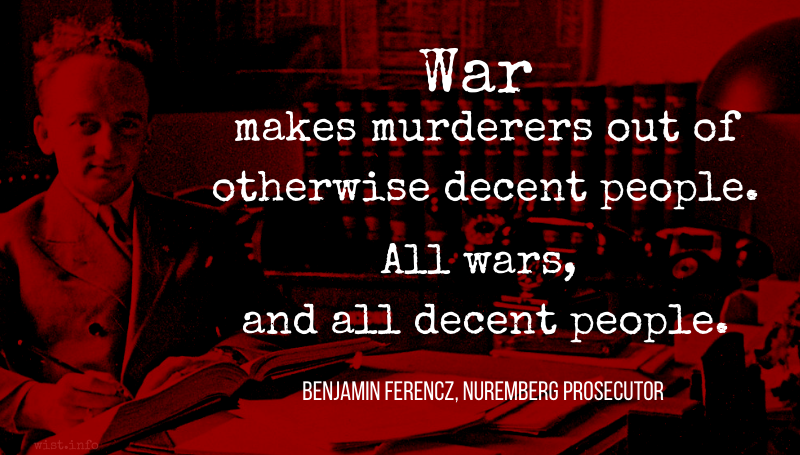
War makes murderers out of otherwise decent people. All wars, and all decent people.
Benjamin Ferencz (b. 1920) American lawyer, international legal scholar, activist
“What the last Nuremberg prosecutor alive wants the world to know,” interview with Leslie Stahl, 60 Minutes (7 May 2017)
(Source)
Ferencz served as chief prosecutor of twenty Einsatzgruppen officers during the Nuremberg war crimes trials. Longer excerpt:STAHL: Did you meet a lot of people who perpetrated war crimes who would otherwise in your opinion have been just a normal, upstanding citizen?
FERENCZ: Of course, is my answer. These men would never have been murderers had it not been for the war. These were people who could quote Goethe, who loved Wagner, who were polite --
STAHL: What turns a man into a savage beast like that?
FERENCZ: He's not a savage. He's an intelligent, patriotic human being.
STAHL: He's a savage when he does the murder though.
FERENCZ: No. He's a patriotic human being acting in the interest of his country, in his mind.
STAHL: You don't think they turn into savages even for the act?
FERENCZ: Do you think the man who dropped the nuclear bomb on Hiroshima was a savage? Now I will tell you something very profound, which I have learned after many years. War makes murderers out of otherwise decent people. All wars, and all decent people.
For laws are silent when arms are raised.
[Silent enim leges inter arma.]
Marcus Tullius Cicero (106–43 BC) Roman orator, statesman, philosopher
Pro Milone, ch. 4, sec. 11 [tr. Yonge (1891)]
(Source)
In context, Cicero is asserting that self-defense is a valid defense for killing, even though that principle was not written into Roman law. It has been extended in legal terms to times of war being exempt from normal laws regarding killing.
Other translations:Original Latin.
- "For laws are silent among arms."
- "In a time of war, the law falls silent."
- "Laws are silent in time of war."
- "The laws are silent in warfare."
- "For among arms, the laws fall mute."
- "The power of law is suspended during war."
And just as the law in civilized countries assumes that the voice of conscience tells everybody, “Thou shalt not kill,” even though man’s natural desires and inclinations may at times be murderous, so the law of Hitler’s land demanded that the voice of conscience tell everybody: “Thou shalt kill,” although the organizers of the massacres knew full well that murder is against the normal desires and inclinations of most people. Evil in the Third Reich had lost the quality by which most people recognize it — the quality of temptation.
Hannah Arendt (1906–1975) German-American philosopher, political theorist
Eichmann in Jerusalem: A Report on the Banality of Evil, ch. 8 (1963)
(Source)
Satchelmouth was by no means averse to the finger-foxtrot and the skull fandango, but he’d never murdered anyone, at least on purpose. Satchelmouth had been made aware that he had a soul and, though it had a few holes in it and was a little ragged around the edges, he cherished the hope that some day the god Reg would find him a place in a celestial combo. You didn’t get the best gigs if you were a murderer. You probably had to play the viola.
Terry Pratchett (1948–2015) English author
Discworld No. 16, Soul Music (1994)
Don’t flang him off the bluff, boys. Tain’t christian.
I may look calm, but in my head I’ve killed you five times.
Sig Lines
~

“Now, Preshea,” reprimanded Dimity, “it’s no good choosing your first husband from a school for evil geniuses. Much too difficult to kill.”
Gail Carriger (b. 1976) American archaeologist, author [pen name of Tofa Borregaard]
Etiquette & Espionage (2013)

In such a regime, I say, you died a good death if your life had inspired someone to come forward and shoot your murderer in the chest — without asking to be paid.
Chinua Achebe (1930–2013) Nigerian novelist, poet, professor, critic [Albert Chinualumogu Achebe]
A Man of the People, ch. 13 (1966)
(Source)
Final words of the novel.
To execute a murderer is simply to adopt his point of view.
Sydney J. Harris (1917–1986) Anglo-American columnist, journalist, author
Pieces of Eight (1982)
Murder investigations start with the victim because usually in the first instance that’s all you’ve got. The study of the victim is called victimology because everything sounds better with an ology tacked on the end. To make sure that you make a proper fist of this, the police have developed the world’s most useless mnemonic: 5 x WH & H. Otherwise known as Who? What? Where? When? Why? & How? Next time you watch a real murder investigation on the TV and you see a group of serious-looking detectives standing around talking, remember that what they’re actually doing is trying to work out what sodding order the mnemonic is supposed to go in. Once they’ve sorted that out the exhausted officers will retire to the nearest watering hole for a drink and a bit of a breather.
Ben Aaronovitch (b. 1964) British author
Moon Over Soho (2011)

I do not kill everyone with whom I have a difference of opinion and I would not want anyone reading this memoir to think that I do.
Robert A. Heinlein (1907–1988) American writer
Friday [Friday Jones] (1982)
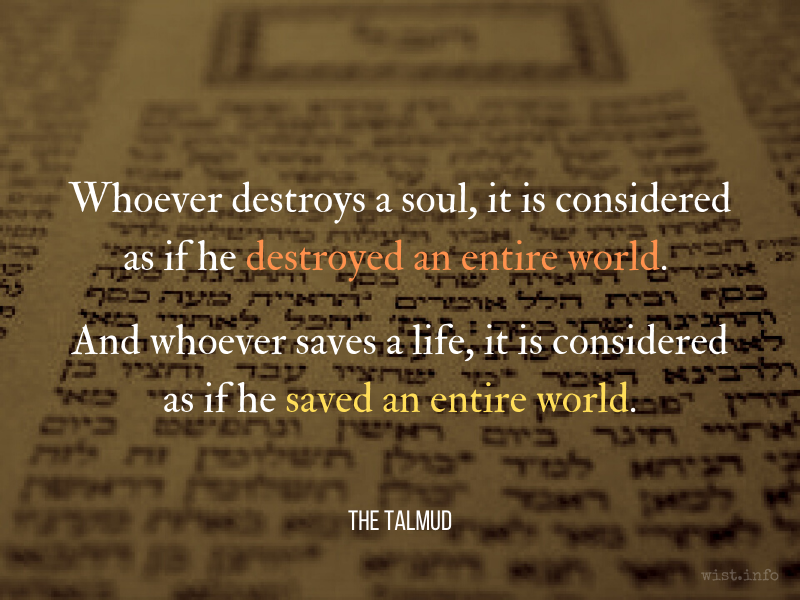
Whoever destroys a soul, it is considered as if he destroyed an entire world. And whoever saves a life, it is considered as if he saved an entire world.
The Talmud (AD 200–500) Collection of Jewish rabbinical writings
Mishnah Sanhedrin 4:9; Yerushalmi Talmud, Tractate Sanhedrin 37a
(Source)
Other translations: "Whoever destroys a single life is as guilty as though he had destroyed the entire world; and whoever rescues a single life earns as much merit as though he had rescued the entire world."

ZOE: Preacher, don’t the Bible have some pretty specific things to say about killin’?
BOOK: Quite specific. It is, however, somewhat fuzzier on the subject of kneecaps.
Cheryl Cain (contemp.) American television screenwriter
Firefly, 1×10 “War Stories” (6 Dec 2002)

SIMON: I’m trying to put this as delicately as I can. How do I know you won’t kill me in my sleep?
MAL: You don’t know me, son, so let me explain this to you once: If I ever kill you, you’ll be awake, you’ll be facing me, and you’ll be armed.
SIMON: Are you always this sentimental?
MAL: I had a good day.Joss Whedon (b. 1964) American screenwriter, author, producer [Joseph Hill Whedon]
Firefly, 1×01 “Serenity” (pilot) (20 Dec 2002)

Capital punishment is the most premeditated of murders, to which no criminal’s deed, however calculated, can be compared. For there to be an equivalency, the death penalty would have to punish a criminal who had warned his victim of the date on which he would inflict a horrible death on him and who, from that moment onward, had confined him at his mercy for months. Such a monster is not to be encountered in private life.
Albert Camus (1913–1960) Algerian-French novelist, essayist, playwright
“Reflections on the Guillotine” (1957)
“So?” Bob said. “Hat up, go kill her. Problem solved.”
“Bob,” I said. “You can’t just go around killing people.”
“I know. That’s why you should do it.”
“No, no. I can’t go around killing people, either.”Jim Butcher (b. 1971) American author
Grave Peril (2001)

Nothing is simpler than to kill a man; the difficulties arise in attempting to avoid the consequences.
Rex Stout (1886–1975) American writer
Too Many Cooks, ch. 3 [Wolfe] (1938)

What stuck in the minds of these men who had become murderers was simply the notion of being involved in something historic, grandiose, unique (“a great task that occurs once in two thousand years”), which must therefore be difficult to bear. This was important, because the murderers were not sadists or killers by nature; on the contrary, a systematic effort was made to weed out all those who derived physical pleasure from what they did. The troops of the Einsatzgruppen had been drafted from the Armed S.S., a military unit with hardly more crimes in its record than any ordinary unit of the German Army, and their commanders had been chosen by Heydrich from the S.S. élite with academic degrees. Hence the problem was how to overcome not so much their conscience as the animal pity by which all normal men are affected in the presence of physical suffering. The trick used by Himmler — who apparently was rather strongly afflicted by these instinctive reactions himself — was very simple and probably very effective; it consisted in turning these instincts around, as it were, in directing them toward the self. So that instead of saying: What horrible things I did to people!, the murderers would be able to say: What horrible things I had to watch in the pursuance of my duties, how heavily the task weighed upon my shoulders!
Hannah Arendt (1906–1975) German-American philosopher, political theorist
Eichmann in Jerusalem: A Report on the Banality of Evil, ch. 6 (1963)
(Source)
DILBERT: Lately, the only think keeping me from being a serial killer is my distaste for manual labor.
Scott Adams (b. 1957) American cartoonist
Dilbert (11 Jan. 2001)

MERLIN: When a man lies, he murders some part of the world.
John Boorman (b. 1933) English film director, writer
Excalibur (1981) [with Rospo Pallenburg]
I thoroughly disapprove of duels. I consider them unwise, and I know they are dangerous. Also, sinful. If a man should challenge me now, I would got to that man and take him kindly and forgivingly by the hand and lead him to a quiet, retired spot, and kill him.
Mark Twain (1835–1910) American writer [pseud. of Samuel Clemens]
The Autobiography of Mark Twain, Vol. 1, 1864 (2010)
(Source)
Seen paraphrased: "I thoroughly disapprove of duels. If a man should challenge me, I would take him kindly and forgivingly by the hand and lead him to a quiet place and kill him."
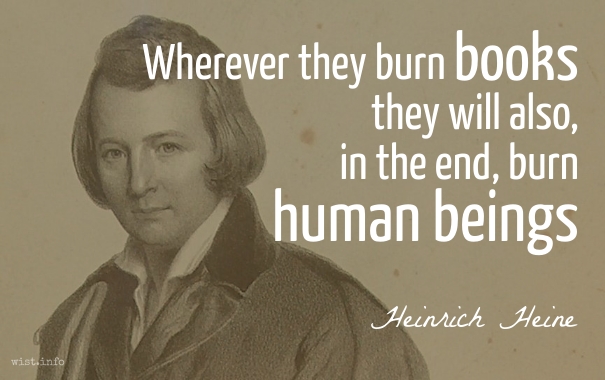
Wherever they burn books they will also, in the end, burn human beings.
[Dort, wo man Bücher verbrennt, verbrennt man auch am Ende Menschen.]
Heinrich Heine (1797–1856) German poet and critic
Almansor: A Tragedy, l. 245 (1823)
Alt trans:
- "Where they burn books, at the end they also burn people."
- "Where they burn books, they will also burn people."
- "It is there, where they burn books, that eventually they burn people."
- "Where they burn books, so too will they in the end burn human beings."
- "Where they burn books, they also burn people."
- "Them that begin by burning books, end by burning men."
- "Wherever books are burned, sooner or later men are also burned."