You may safely go to school with hope; but ere you marry, should have learned the mingled lesson of the world: that dolls are stuffed with sawdust, and yet are excellent play-things; that hope and love address themselves to a perfection never realised, and yet, firmly held, become the salt and staff of life; that you yourself are compacted of infirmities, perfect, you might say, in imperfection, and yet you have a something in you lovable and worth preserving; and that, while the mass of mankind lies under this scurvy condemnation, you will scarce find one but, by some generous reading, will become to you a lesson, a model, and a noble spouse through life. So thinking, you will constantly support your own unworthiness, and easily forgive the failings of your friend.
Robert Louis Stevenson (1850–1894) Scottish essayist, novelist, poet
Essay (1881), “Virginibus Puerisque, Part 2”
(Source)
First published in Virginibus Puerisque and Other Papers, ch. 1, part 2 (1881).
Quotations about:
husband
Note not all quotations have been tagged, so Search may find additional quotes on this topic.
NURSE:Surely this doth bind,
Through all ill days, the hurts of humankind,
When man and woman in one music move.[ΤΡΟΦΌΣ: ἥπερ μεγίστη γίγνεται σωτηρία,
ὅταν γυνὴ πρὸς ἄνδρα μὴ διχοστατῇ.]Euripides (485?-406? BC) Greek tragic dramatist
Medea [Μήδεια], l. 14ff (431 BC) [tr. Murray (1906)]
(Source)
(Source (Greek)). Other translations:Hence bliss supreme arises, when the bond
Of concord joins them.
[tr. Wodhull (1782)]This is the state of firmest happiness,
When from the husband no discordant will
The wife estranges.
[tr. Potter (1814)]In which the better part of safety lies
That the woman should not differ from the man.
[tr. Webster (1868)]The greatest safeguard this when wife and husband do agree.
[tr. Coleridge (1891)]Which is the surest support of conjugal happiness, when the wife is not estranged from the husband.
[tr. Buckley (1892)]Which is the chief salvation of the home,
When wife stands not at variance with her lord.
[tr. Way (Loeb) (1894)]This is indeed the greatest salvation of all --
For the wife not to stand apart from the husband.
[tr. Warner (1944)]Happy is the house
Where the man and the woman love and are faithful.
[tr. Jeffers (1946)]And in a marriage that's the saving thing,
When a wife obediently accepts her husband's will.
[tr. Vellacott (1963)]This, to my mind, is a woman’s greatest safety:
Not to take the opposite side from her husband.
[tr. Podlecki (1989)]This it is that most rescues life from trouble, when a woman is not at variance with her husband.
[tr. Kovacs (1994)]This is what keeps a marraige intact more than anything, when a husband can count on complete support from his wife.
[tr. Davie (1996)]That, you see, is how a woman earns her security: never argue with your husband!
[tr. Theodoridis (2004)]This is what brings the greatest stability at home:
when a woman does not challenge her husband.
[tr. Luschnig (2007)]That’s when life is most secure and safe,
when woman and her husband stand as one.
[tr. Johnston (2008)]This provides the greatest security,
when a wife doesn't oppose her husband.
[tr. Kovacs / Kitzinger (2016)]That is the best security,
when the wife does not quarrel with her husband.
[tr. Ewans (2022)]This is the greatest safety [sōtēriā], when wife does not stand apart from husband.
[tr. Coleridge / Ceragioli / Nagy / Hour25]
One good Husband is worth two good Wives; for the scarcer things are the more they’re valued.
Benjamin Franklin (1706–1790) American statesman, scientist, philosopher, aphorist
Poor Richard (1742 ed.)
(Source)

Sam Vimes could parallel process. Most husbands can. They learn to follow their own line of thought while at the same time listening to what their wives say. And the listening is important, because at any time they could be challenged and must be ready to quote the last sentence in full. A vital additional skill is being able to scan the dialogue for telltale phrases such as “and they can deliver it tomorrow” or “so I’ve invited them for dinner” or “they can do it in blue, really quite cheaply.”
Terry Pratchett (1948–2015) English author
Discworld Series No. 24, The Fifth Elephant (1999)
(Source)

MEDEA: Of all creatures that live and understand,
we women suffer most.
In the first place we must, for a vast sum,
buy a husband; what’s worse,
with him our bodies get a master.
And here’s what’s most at stake:
Did we get a man who’s good or bad?ΜΉΔΕΙΑ: πάντων δ᾽ ὅσ᾽ ἔστ᾽ ἔμψυχα καὶ γνώμην ἔχει
γυναῖκές ἐσμεν ἀθλιώτατον φυτόν:
ἃς πρῶτα μὲν δεῖ χρημάτων ὑπερβολῇ
πόσιν πρίασθαι, δεσπότην τε σώματος
[λαβεῖν: κακοῦ γὰρ τοῦτ᾽ ἔτ᾽ ἄλγιον κακόν].
κἀν τῷδ᾽ ἀγὼν μέγιστος, ἢ κακὸν λαβεῖν
ἢ χρηστόν.Euripides (485?-406? BC) Greek tragic dramatist
Medea [Μήδεια], l. 230ff (431 BC) [tr. Kovacs / Kitzinger (2016)]
(Source)
Speaking to the women of Corinth (the Chorus).
(Source (Greek)). Other translations:But sure among all those
Who have with breath and reason been endued.
We women are the most unhappy race,
First with abundant gold are we constrain'd
To buy a husband, and in him receive
A haughty master. Still doth there remain
One mischief than this mischief yet more grievous.
The hazard whether we. procure a mate
Worthless or virtuous.
[tr. Wodhull (1782)]Thus is it, of all beings, that have life
And sense, we women are most wretched; first
With all our dearest treasures we must buy
A husband, and in him receive a lord:
And hardship this: a greater hardship yet
Awaits us; here's the question, if this lord
Prove gentle, or a tyrant.
[tr. Potter (1814)]Aye, of all living and of reasoning things
Are woman the most miserable race:
Who first needs buy a husband at great price,
To take him then for owner of our lives:
For this ill is more keen than common ills.
And of essays most perilous is this,
Whether one good or evil do we take.
[tr. Webster (1868)]Of all things that have life and sense we women are the most hapless creatures; first must we buy a husband at an exorbitant price, and o'er ourselves a tyrant set which is an evil worse than the first; and herein lies the most important issue, whether our choice be good or bad.
[tr. Coleridge (1891)]But of all things as many as have life and intellect, we women are the most wretched race. Who indeed first must purchase a husband with excess of money, and receive him a lord of our persons; for this is a still greater ill than the former. And in this is the greatest risk, whether we receive a bad one or a good one.
[tr. Buckley (1892)]Surely, of creatures that have life and wit,
We women are of all things wretchedest,
Who, first, must needs, as buys the highest bidder,
Thus buy a husband, and our body's master
So win—for deeper depth of ill is this.
Nay, risk is dire herein, -- or shall we gain
An evil lord or good?
[tr. Way (Loeb) (1894)]Oh,
Of all things upon earth that bleed and grow,
A herb most bruised is woman. We must pay
Our store of gold, hoarded for that one day,
To buy us some man's love; and lo, they bring
A master of our flesh! There comes the sting
Of the whole shame. And then the jeopardy,
For good or ill, what shall that master be.
[tr. Murray (1906)]We women are the most unfortunate creatures.
Firstly, with an excess of wealth it is required
For us to buy a husband and take for our bodies
A master; for not to take one is even worse.
And now the question is serious whether we take
A good or bad one.
[tr. Warner (1944)]Surely, of all creatures that have life and will, we women
Are the most wretched. When, for an extravagant sum,
We have bought a husband, we must then accept him as
Possessor of our body. This is to aggravate
Wrong with worse wrong. Then the great question: will the man
We get be bad or good?
[tr. Vellacott (1963)]Of all creatures that live and have understanding
We women are the wretchedest breed alive;
First, we must use excessive amounts of cash
To buy our husbands, and what we get are masters
Of our bodies. This is the worst pain of all.
In fact, this is no small struggle, whether he’ll be
A good or bad one.
[tr. Podlecki (1989)]Of all creatures that have breath and sensation, we women are the most unfortunate. First at an exorbitant price we must buy a husband and master of our bodies. [This misfortune is more painful than misfortune.] And the outcome of our life's striving hangs on this, whether we take a bad or a good husband.
[tr. Kovacs (1994)]Of all creatures that have life and reason we women are the most miserable of specimens! In the first place, at great expense we must buy a husband, taking a master to play tyrant with our bodies (this is an injustice that crowns the other one). And here lies the crucial issue for us, whether we get a good man or a bad.
[tr. Davie (1996)]Of all the living things, of all those things that have a soul and a sense, we, yes we, the women, are the most pathetic!
Imagine!
We need to spend a fortune to buy us a man who -- what will he do? He will become the master of our bodies! And, it’s obvious, that this dangerous thing we do, becomes even more dangerous when we don’t find the right husband. Is he a good husband? Or is he a bad one? By the time you find that out it’s already too late.
[tr. Theodoridis (2004)]Of all creatures that have life and reason
we women are the sorriest lot:
first we must at a great expenditure of money
buy a husband and even take on a master
over our body: this evil is more galling than the first.
Here is the most challenging contest, whether we will get a bad man
or a good one.
[tr. Luschnig (2007)]Of all things with life and understanding,
we women are the most unfortunate.
First, we need a husband, someone we get
for an excessive price. He then becomes
the ruler of our bodies. And this misfortune
adds still more troubles to the grief we have.
Then comes the crucial struggle: this husband
we have selected, is he good or bad?
[tr. Johnston (2008)]Of every creature that’s alive and capable of thought
We women are most wretched.
First we must buy a husband with a massive dowry,
then subject our bodies to his mastery --
and that's the worse of the two evils.
In this the stakes are very high -- whether we get
a bad man or a good one.
[tr. Ewans (2022)]Of all things that have psūkhē and intelligence, we women are the most wretched creatures: first we must buy a husband at too high a price, and then acquire a master of our bodies—an evil thing [kakon] yet more evil [kakon].But in this lies the most important ordeal [agōn], whether our choice is good or bad [kakon].
[tr. Coleridge / Ceragioli / Nagy / Hour25]Of all things that have life and sense, we women are most wretched. For we are compelled to buy with gold a husband who is also -- worst of all -- the master of our person. And on his character, good or bad, our whole fate rests.
[Source]
Wives who are chummy with their husbands are apt to live contented lives.

When I learn that husband and wife never quarrel, I know that indifference has set in, and after that — the deluge.
Minna Antrim (1861–1950) American epigrammatist, writer
Naked Truth and Veiled Allusions (1902)
(Source)
King Louis XV of France is attributed with saying, "Après moi, le déluge [After me, the flood]" to Madame Pompadour in 1757.
Husbands are like fires. They go out when unattended.
Zsa Zsa Gabor (1917–2016) Hungarian-American actress, socialite [b. Sári Gábor]
Quoted in Newsweek (1960-03-28)
(Source)

You lead such matching, equal lives —
the worst of husband, worst of wives —
that it’s a mystery to me
why you aren’t suited perfectly.[Cum sitis similes paresque vita,
Uxor pessima, pessimus maritus,
Miror, non bene convenire vobis.]Martial (AD c.39-c.103) Spanish Roman poet, satirist, epigrammatist [Marcus Valerius Martialis]
Epigrams [Epigrammata], Book 8, epigram 35 (8.35) (AD 94) [tr. McLean (2014)]
(Source)
(Source (Latin)). Other translations:When as you are so like in life,
A wicked husband, wicked wife,
I wonder you should live in strife.
[16th C Manuscript]Sith that you both are like in life,
(a naughty man, an wicked wife:)
I muse ye live not voyd of strife.
[tr. Kendall (1577), "To a Married Couple, that could not Agree"]Why doe your wife and you so ill agree,
Since you in manners so well matched be?
Thou brazen-fac'd, she impudently bould,
Thou still dost brawle, she evermoure doth scould.
Thou seldome sober art, she often drunk,
Thou a whore hunting knave, she a knowne Punck.
Both of you filch, both seare, and damme, and lie,
And both take pawnes, and Iewish usurie.
Not manners like make man and wife agree,
Their manners must both like and vertuous bee.
[tr. Davison (1602)]Both man and wife as bad as bad can be:
I wonder they no better should agree.
[tr. Hay (1755)]O peerless pair, so like in life,
O vilest husband, vilest wife!
No wonder ye agree -- in strife.
[tr. Elphinston (1782), "To a Married Pair," Book 6, Part 2, ep. 46]Alike in temper and in life,
A drunken husband, sottish wife,
She a scold, a bully he, --
The devil's in 't they don't agree.
[tr. Hoadley (fl. 18th C), §243]Since you are so well matched, and so much alike in your lives, a very bad wife, and a very bad husband, I wonder that you do not agree.
[tr. Bohn's Classical (1859), "To a Bad Couple"]You are so like, so equal, in your life,
A husband of the worst, a worthless wife,
I really wonder why you don't agree.
[ed. Harbottle (1897)]Seeing that you are like one another, and a pair in your habits, vilest of wives, vilest of husbands, I wonder you don't agree!
[tr. Ker (1919)]It is very strange, as it seems to me,
That you and your wife should not agree,
Since each is as vile as vile can be.
[tr. Pott & Wright (1921), "Depth to Depth"]Bad wife, bad husband, like as pea to pea,
I really wonder that you can't agree.
[tr. Francis & Tatum (1924), ep. 412]Since you're alike and lead a matching life,
Horrible husband and ill-natured wife,
Why all the discord and domestic strife?
[tr. Michie (1972)]Since the two of you are alike and equal in your way of life, a rotten wife and a rotten husband, I am surprised you don't suit one another.
[tr. Shackleton Bailey (1993)]You're an awful couple,
but birds of a feather --
It's weird you don't
Get along together.
[tr. Ericsson (1995)]How can your squabbling be so curst?
Of natural pairings yours is first --
Worst husband with a wife that's worst.
[tr. Wills (2007)]Since you two are similar and equal in your way of life, being an awful wife and an awful husband, I’m surprised you don’t get along well with each other.
[tr. aleator classicus (2012)]Since you both share the same approach to life
(a lousy husband and a lousy wife),
I am bewildered it
is not a better fit.
[tr. Juster (2016)]

Man’s best possession is a sympathetic wife.
[ἄριστον ἀνδρὶ κτῆμα συμπαθὴς γυνή]
Euripides (485?-406? BC) Greek tragic dramatist
Antigone [Ἀντιγόνη], frag. 164 (TGF) (c. 420-406 BC)
(Source)
And so I say that for brutality and infamy there is no one to equal a woman who can contemplate such deeds. Who else could conceive so hideous a crime as her deliberate butchery of her husband and her lord?
[ὣς οὐκ αἰνότερον καὶ κύντερον ἄλλο γυναικός,
ἥ τις δὴ τοιαῦτα μετὰ φρεσὶν ἔργα βάληται:
οἷον δὴ καὶ κείνη ἐμήσατο ἔργον ἀεικές,
κουριδίῳ τεύξασα πόσει φόνον.]Homer (fl. 7th-8th C. BC) Greek author
The Odyssey [Ὀδύσσεια], Book 11, l. 427ff (11.427) [Agamemnon] (c. 700 BC) [tr. Rieu (1946)]
(Source)
Agamemnon, in the Underworld, telling Odysseus of his betrayal by Clytemnestra. Original Greek. Other translations:Nothing so heap’d is with impieties,
As such a woman that would kill her spouse
That married her a maid.
[tr. Chapman (1616)]Nothing so cruel as a woman yet
Did nature e’er produce; a thought so ill
In any other breast did never sit,
As her own loving husband’s blood to spill.
[tr. Hobbes (1675), l. 409ff]O woman, woman, when to ill thy mind
Is bent, all hell contains no fouler fiend:
And such was mine! who basely plunged her sword
Through the fond bosom where she reign'd adored!
[tr. Pope (1725)]So that the thing breathes not, ruthless and fell
As woman once resolv’d on such a deed
Detestable, as my base wife contrived,
The murther of the husband of her youth.
[tr. Cowper (1792), l. 519ff]Since nought exists more horrible and bold
Than evil in the breast of womankind,
When she to her own lust herself hath sold,
Even as this fell monster in her mind
Against the husband of her youth designed
Black murder.
[tr. Worsley (1861), st. 60]Thus there is nought more horrible and shameless,
Than woman, who such deeds as these could think on!
Like as she compassed this unseemly deed --
Blood -- murder 'gainst the husband of her youth!
[tr. Bigge-Wither (1869)]Nought can more fearful be --
Nought more revolting in all shamelessness
Than Woman of this stamp, who to her heart
Such schemes could lay: For what a loathsome act
Was that which she design'd by bloody death
The husband to destroy, whom in her youth
She had in lawful wedlock made her vow!
[tr. Musgrave (1869), l. 659ff]So surely is there nought more terrible and shameless than a woman who imagines such evil in her heart, even as she too planned a foul deed, fashioning death for her wedded lord.
[tr. Butcher/Lang (1879)]Nought more shameless or more fearful than a woman may ye find
When she at last conceiveth such deeds within her mind.
E'en such a deed so unseemly as she imagined for me,
To murder her wedded husband!
[tr. Morris (1887), l. 427ff]Ah, what can be more horrible and brutish than a woman when she admits into her thoughts such deeds as these! And what a shameless deed she plotted to bring about the murder of the husband of her youth!
[tr. Palmer (1891)]For there is nothing in this world so cruel and so shameless as a woman when she has fallen into such guilt as hers was. Fancy murdering her own husband!
[tr. Butler (1898)]So true is it that there is nothing more dread or more shameless than a woman who puts into her heart such deeds, even as she too devised a monstrous thing, contriving death for her wedded husband.
[tr. Murray (1919)]I tell you, there is nought more awful and inhuman than a woman who can fondle in her heart crimes so foul as this conception of my wife's to murder the husband of her youth.
[tr. Lawrence (1932)]So there is nothing more deadly or more vile than a woman
who stores her mind with acts that are of such sort, as this one
did when she thought of this act of dishonor, and plotted
the murder of her lawful husband.
[tr. Lattimore (1965)]So,
there’s nothing more deadly, bestial than a woman
set on works like these -- what a monstrous thing
she plotted, slaughtered her own lawful husband!
[tr. Fagles (1996)]Nothing
Is more grim or more shameless than a woman
Who sets her mind on such an unspeakable act
As killing her own husband.
[tr. Lombardo (2000), l. 443ff]So there is nothing at all more dreadful or vile than a woman who in the thought of her heart meditates this kind of misdoing like that woman who craftily plotted a deed so indecent causing the death of the husband she wedded.
[tr. Merrill (2002)]There is nothing more terrible, nor anything more shameless, than a woman who can plan deeds like this in her heart, deeds like this ugly crime that Clytemnestra plotted: the murder of her lawfully wedded husband.
[tr. Verity (2016)]There's nothing more frightful or shameless than a woman who conceives the idea of such misdeeds in her heart, like the horrifying act that this woman planned, contriving her own wedded husband's murder.
[tr. Green (2018)]The truth is, there’s nothing more disgusting,
more disgraceful, than a woman whose heart
is set on deeds like this -- the way she planned
the shameless act, to arrange the murder
of the man she married.
[tr. Johnston (2019), l. 539ff]

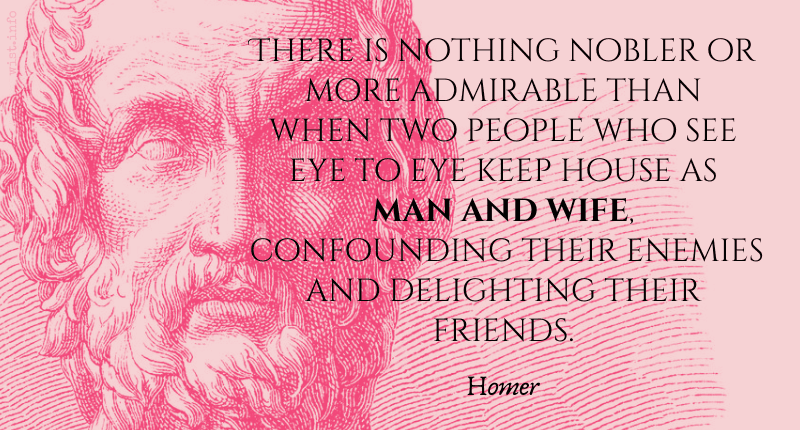
And in return may the gods grant you your heart’s desire; may they give you a husband and a home, and the harmony that is so much to be desired, since there is nothing nobler or more admirable than when two people who see eye to eye keep house as man and wife, confounding their enemies and delighting their friends, as they themselves know better than anyone.
[Σοὶ δὲ θεοὶ τόσα δοῖεν, ὅσα φρεσὶ σῇσι μενοινᾷς,
ἄνδρα τε καὶ οἶκον, καὶ ὁμοφροσύνην ὀπάσειαν
ἐσθλήν· οὐ μὲν γὰρ τοῦ γε κρεῖσσον καὶ ἄρειον,
ἢ ὅθ’ ὁμοφρονέοντε νοήμασιν οἶκον ἔχητον
ἀνὴρ ἠδὲ γυνή· πόλλ’ ἄλγεα δυσμενέεσσι,
χάρματα δ’ εὐμενέτῃσι· μάλιστα δέ τ’ ἔκλυον αὐτοί.]
Homer (fl. 7th-8th C. BC) Greek author
The Odyssey [Ὀδύσσεια], Book 6, l. 180ff (6.180) [Odysseus to Nausicaa] (c. 700 BC) [tr. Rieu (1946)]
(Source)
Original Greek. The passage uses variations on the Greek term ὁμοφροσύνην (homophrosynê, likemindedness). Other translations:God give you, in requital, all th’ amends
Your heart can wish, a husband, family,
And good agreement. Nought beneath the sky
More sweet, more worthy is, than firm consent
Of man and wife in household government.
It joys their wishers-well, their enemies wounds,
But to themselves the special good redounds.
[tr. Chapman (1616)]And may Jove you with all you wish for bless,
A husband and a house, and concord good;
For man and wife to live in unity
Is the great’st blessing can be understood:
It joys your friend, and grieves your enemy.
[tr. Hobbes (1675), l. 172ff]So may the gods, who heaven and earth control,
Crown the chaste wishes of thy virtuous soul,
On thy soft hours their choicest blessings shed;
Blest with a husband be thy bridal bed;
Blest be thy husband with a blooming race,
And lasting union crown your blissful days.
The gods, when they supremely bless, bestow
Firm union on their favourites below;
Then envy grieves, with inly-pining hate;
The good exult, and heaven is in our state.
[tr. Pope (1725)]And may the Gods thy largest wishes grant,
House, husband, concord! for of all the gifts
Of heav’n, more precious none I deem, than peace
’Twixt wedded pair, and union undissolved;
Envy torments their enemies, but joy
Fills ev’ry virtuous breast, and most their own.
[tr. Cowper (1792), l. 226ff]And unto thee the heavenly gods make flow
Whate'er of happiness thy mind forecast,
Husband and home and spirit-union fast!
Since nought is lovelier on the earth than this,
When in the house one-minded to the last
Dwell man and wife -- a pain to foes, I wis,
And joy ot friends -- but most themselves know their own bliss.
[tr. Worsley (1861), st. 24]But, to thyself may the immortal gods
The largest wishes of thy heart fulfil!
A consort, home, and perfect peace therein
May they bestow! For nought in nobleness,
Nought in all virtue can the good surpass
Of perfect concord in the married pair
Whose blended counsels rightly rule their home:
Their foes with pain behold it! but, to all
Who wish them well, it is a joyful sight!
Joy, which themselves, 'bove all, can well discern!" [tr. Musgrave (1869), ll. 277ff]To thee the gods give all thy heart's desire!
A husband and home and loving hearts beside --
That best of gifts: for nought is better and braver
Than this, when man and wife unanimous
Hold their own home -- a sorrow they to foes --
A joy to friends -- and chiefest to themselves!
[tr. Bigge-Wither (1869)]And may the gods grant thee all thy heart’s desire: a husband and a home, and a mind at one with his may they give -- a good gift, for there is nothing mightier and nobler than when man and wife are of one heart and mind in a house, a grief to their foes, and to their friends great joy, but their own hearts know it best.
[tr. Butcher/Lang (1879)]And so may the high Gods give thee whatso thine heart holds dear,
A husband and a homestead, and concord whole and sound.
For nothing sure more goodly or better may be found
Than man and woman holding one house with one goodwill.
Thuis many a grief are they giving to those that wish them ill,
But great joy to their well-willers; and they wot it best of all.
[tr. Morris (1887)]And may the gods grant all that in your thoughts you long for: husband and home and true accord may they bestow; for a better and higher gift than this there cannot be, when with accordant aims man and wife have a home. Great grief is it to foes and joy to friends; but they themselves best know its meaning.
[tr. Palmer (1891)]May heaven grant you in all things your heart's desire -- husband, house, and a happy, peaceful home; for there is nothing better in this world than that man and wife should be of one mind in a house. It discomfits their enemies, makes the hearts of their friends glad, and they themselves know more about it than any one.
[tr. Butler (1898)]And for thyself, may the gods grant thee all that thy heart desires; a husband and a home may they grant thee, and oneness of heart -- a goodly gift. For nothing is greater or better than this, when man and wife dwell in a home in one accord, a great grief to their foes and a joy to their friends; but they know it best themselves.
[tr. Murray (1919)]And to you may the Gods requite all your heart's desire; husband, house, and especially ingenious accord within that house: for there is nothing so good and lovely as when man and wife in their home dwell together in unity of mind and disposition. A great vexation it is to their enemies and a feast of gladness to their friends: surest of all do they, within themselves, feel all the good it means.
[tr. Lawrence (1932)]And may the gods accomplish your desire:
a home, a husband, and harmonious
converse with him -- the best thing in the world
being a strong house held in serenity
where man and wife agree. Woe to their enemies,
joy to their friends! But all this they know best.
[tr. Fitzgerald (1961)]And then may the gods give you everything that your heart longs for;
may they grant you a husband and a house and sweet agreement
in all things, for nothing is better than this, more steadfast
than when two people, a man and his wife, keep a harmonious
household; a thing that brings much distress to the people who hate them
and pleasure to their well-wishers, and for them the best reputation.
[tr. Lattimore (1965)]And may the gods grant you what your heart wants most,
a husband and a home, and may there be
accord between you both: there is no gift
more solid and precious than such trust:
a man and woman who conduct their house
with minds in deep accord, to enemies
bring grief, but to their friends bring gladness, and --
above all -- gaine a good name for themselves.
[tr. Mendelbaum (1990)]And may the good gods give you all your heart desires:
husband, and house, and lasting harmony too.
No finer, greater gift in the world than that ...
when man and woman possess their home, two minds,
two hearts that work as one. Despair to their enemies,
joy to all their friends. Their own best claim to glory.
[tr. Fagles (1996)]And for yourself, may the gods grant you
Your heart's desire, a husband and a home,
And the blessing of a harmonious life.
For nothing is greater or finer than this,
When a man and woman live together
With one heart and mind, bringing joy
To their friends and grief to their foes.
[tr. Lombardo (2000), l. 183ff]Then may the gods grant you what you in your spirit are wishing; may they endow you with blessings, a husband and house, and a noble concord of mind: for than this there is no gift better or greater, when both husband and wife in concord of mind and of counsel peacefully dwell in a house -- to their enemies greatest affliction, joy to benevolent friends, but especially known to their own hearts.
[tr. Merrill (2002)]And may the gods grant you your heart's desire; may they give you a husband and a home, and the blessing of harmony so much to be desired, since there is nothing better or finer than when two people of one heart and mind keep house as man and wife, a grief to their enemies and a joy to their friends, and their reputation spreads far and wide.
[tr. DCH Rieu (2002)]And may the gods grant you all your heart’s desire, a husband and a home, and mutual harmony, in all its beauty. Since nothing is finer or better than when a man and a woman of one heart and mind stay together, a joy to their friends, a sorrow to their enemies: their own reputation of the very highest.
[tr. Kline (2004)]Then may the gods grant you all that you desire in your heart, and may they bestow on you a husband, a house, and a good harmony of minds; there is nothing better or more powerful than this, when a man and his wife keep house in sympathy of mind -- a great grief to their enemies, but a joy to those who wish them well; and they themselves are highly esteemed.
[tr. Verity (2016)]So may the gods grant all your heart's desires, a home and husband, somebody like-minded. For nothing could be better than when two live in their minds in harmony, husband and wife. Their enemies are jealous, their friends delighted, and they have great honor.
[tr. Wilson (2018)]May the gods grant as much as you desire in your thoughts,
A husband and home, and may they give you fine likemindness,
For nothing is better and stronger than this
When two people who are likeminded in their thoughts share a home,
A man and a wife — this brings many pains for their enemies
And joys to their friends. And the gods listen to them especially.
[tr. @sentantiq (2018)]And may the gods grant you all that your heart desires, husband, home, and like-mindedness -- a precious gift, for there's nothing greater or better, ever, than when two like-minded people are keeping house together, a man and his wife: much frustration for their ill-wishers, much joy for their friends, but they two know it the best.
[tr. Green (2018)]As for you, may gods grant
everything your heart desires -- may they give
a husband, home, and mutual harmony,
a noble gift -- for there is nothing better
or a stronger bond than when man and wife
live in a home sharing each other’s thoughts.
That brings such pain upon their enemies
and such delight to those who wish them well.
They know that too, more so than anyone.
[tr. Johnston (2019)]
ANN ANDERSON: Here’s something else you must remember: husbands like to be alone once in awhile.
JENNIE ANDERSON: Why?
ANN ANDERSON: You never know why, but I can always tell when James wants to be alone. A mood comes over him. I can always see it in his eyes before it gets there. I don’t know where the mood comes from or why, but that’s when I leave him alone. It seems sometimes things get so fickle in a man that he comes to feel that everything is closing in on him — and that’s when he wants to be left alone. You understand, don’t you?
JENNIE ANDERSON: No!

She’s adorn’d
Amply that in her husband’s eye looks lovely —
The truest mirror that an honest wife
Can see her beauty in!

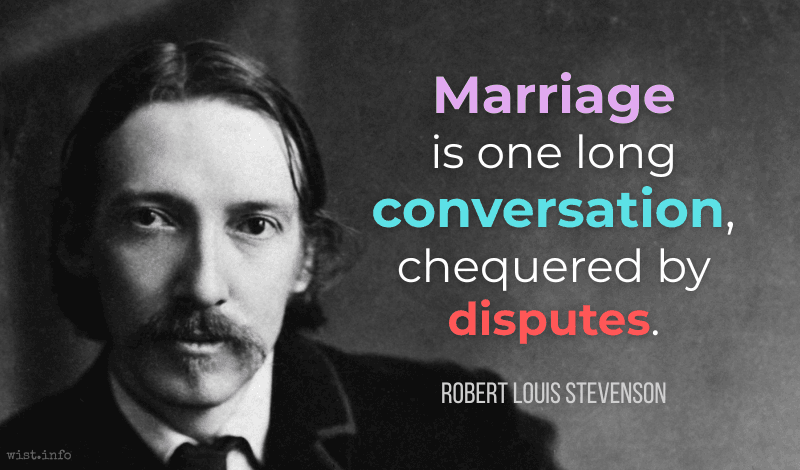
Marriage is one long conversation, chequered by disputes.
Marriage is not a noun, it’s a verb. It’s not something you have, like a house or a car. It is not a piece of paper that proves you are husband and wife. Marriage is a behavior. It is a choice you make over and over again, reflected in the way you treat your partner every day.
Barbara De Angelis (b. 1951) American relationship consultant, lecturer, author
Ask Barbara: The 100 Most-Asked Questions About Love, Sex, and Relationships (1997)
(Source)

A man must have something to grumble about; and if he can’t complain that his wife harries him to death with her perversity and ill-humour, he must complain that she wears him out with her kindness and gentleness.
Anne Brontë (1820–1849) British novelist, poet [pseud. Acton Bell]
The Tenant of Wildfell Hall, ch. 32 [Ralph to Milicent] (1848)
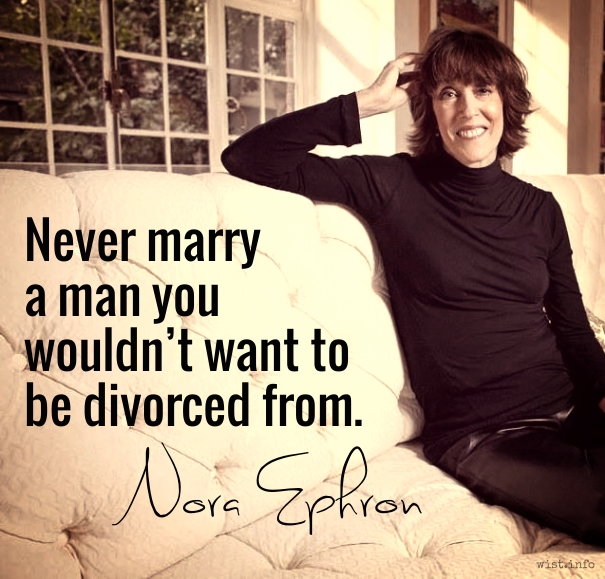
Never marry a man you wouldn’t want to be divorced from.
Nora Ephron (1941–2012) American screenwriter, author, journalist, director
Essay (2006), “What I Wish I’d Known,” I Feel Bad About My Neck (2007)
(Source)

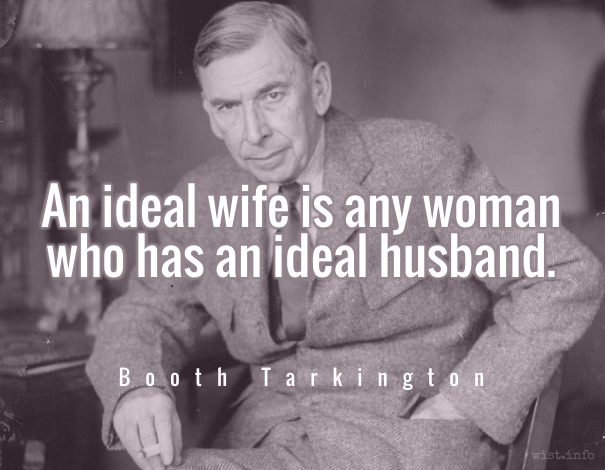
An ideal wife is any woman who has an ideal husband.
Booth Tarkington (1869–1946) American novelist and dramatist
“The Hopeful Pessimist,” Looking Forward and Others (1926)
Only the very bad or the very good are polygamists.
Abdal Hakim Murad (b. 1960) British Muslim shaykh, researcher, writer, academic [b. Timothy John Winter]
“Contentions 2,” #84
(Source)

MAGGIE: Every man who is high up loves to think that he has done it all himself; and the wife smiles, and lets it go at that.
J. M. Barrie (1860–1937) Scottish novelist and dramatist [James Matthew Barrie]
What Every Woman Knows, Act 4 (1918)
(Source)
HARKEN: [In an interrogation room] You fought with Captain Reynolds in the war?
ZOE: Fought with a lot of people in the war.
HARKEN: And your husband?
ZOE: Fight with him sometimes, too.
HARKEN: Is there any particular reason you don’t wish to discuss your marriage?
ZOE: Don’t see that it’s any of your business, is all. We’re very private people.
WASH: [In a different interrogation room] The legs! [Laughs] Oh yeah, definitely have to say it was her legs. You can put that down. Her legs, and right where her legs — meet her back. That — actually, that whole area. That, and — and above it. […] Have you seen what she wears? Forget about it. Have you ever been with a warrior woman?Tim Minear (b. 1963) American screenwriter and director
Firefly, 1X03 “Bushwhacked” (27 Sep 2002)

In the end is it not futile to try and follow the course of a quarrel between husband and wife? Such a conversation is sure to meander more than any other. It draws in tributary arguments and grievances from years before — all quite incomprehensible to any but the two people they concern most nearly. Neither party is ever proved right or wrong in such a case, or, if they are, what does it signify?
Susanna Clarke (b. 1949) British author
Jonathan Strange and Mr. Norrell (2004)

Art is a jealous mistress, and, if a man have a genius for painting, poetry, music, architecture, or philosophy, he makes a bad husband and an ill provider.
Ralph Waldo Emerson (1803–1882) American essayist, lecturer, poet
Essay (1860), “Wealth,” The Conduct of Life, ch. 3
(Source)
Based on a course of lectures, "The Conduct of Life," delivered in Pittsburg (1851-03).

To keep your marriage brimming,
With love in the loving cup,
Whenever you’re wrong, admit it;
Whenever you’re right, shut up.Ogden Nash (1902–1971) American poet
“A Word to Husbands,” Marriage Lines: Notes of a Student Husband (1964)
(Source)

Marriage is the best state for man in general; and every man is a worse man, in proportion as he is unfit for the married state.
Samuel Johnson (1709–1784) English writer, lexicographer, critic
Comment (22 Mar 1776)
In James Boswell, The Life of Samuel Johnson (1791)
A Man without a Wife is but half a Man.
Benjamin Franklin (1706–1790) American statesman, scientist, philosopher, aphorist
Poor Richard’s Almanack (Jan 1755)
Behind every great man is a woman rolling her eyes.
Jim Carrey (b. 1962) Canadian American actor, comedian, producer.
(Attributed)
It has often been a solid Grief to me, when I have reflected on this glorious Nation, which is the Scene of publick Happiness and Liberty, that there are still Crowds of private Tyrants, against whom there neither is any Law now in Being, nor can there be invented any by the Wit of Man. These cruel Men are ill-natured husbands.
Richard Steele (1672–1729) Anglo-Irish writer, journalist, playwright, politician
Essay (1710-03-22), The Tatler, No. 149
(Source)