I have seen wicked men and fools, a great many of both; and I believe they both get paid in the end; but the fools first.
Robert Louis Stevenson (1850–1894) Scottish essayist, novelist, poet
Novel (1886), Kidnapped, ch. 14 “The Islet”
(Source)
This chapter was originally published in Young Folks Paper, Vol. 28, No. 810 (1886-06-05)
Quotations about:
bad people
Note not all quotations have been tagged, so Search may find additional quotes on this topic.
However, I do belong in the fullest sense of the word to a large group that is having a vast and ever-increasing effect on the world. It is known as the human race. I am aware that as a member of that group I am in the worst possible company: communists, fascists and totalitarians of all sorts, militarists and tyrants, exploiters, vandals, gluttons, ignoramuses, murderers, thieves, and liars, men for whose birth the creation is worse off and for whose lives other men will still be suffering a hundred years from now. The price of admission to this group is great, and until death not fully known. The cost of getting out is extreme. I find, therefore, no reasonable alternative to membership. But since I am a member on such exacting terms, I will not allow my involvement with this group to remain accidental, but will give my whole allegiance to it and work for its betterment.
Wendell Berry (b. 1934) American farmer, educator, poet, conservationist
Speech (1968-02-10), “A Statement Against the War in Vietnam,” Kentucky Conference on the War and the Draft, University of Kentucky
(Source)
Collected in The Long-Legged House, Part 2 (1969).

Better be alone, than in bad Company.
Thomas Fuller (1654–1734) English physician, preacher, aphorist, writer
Introductio ad Prudentiam, Vol. 1, # 81 (1725)
(Source)

Weak men are the light troops in the army of the wicked. They do more harm than the main force; they overrun and and ravage the country.
[Les gens faibles sont les troupes légères de l’armée des méchans. Ils font plus de mal que l’armée même; ils infestent et ils ravagent.]
Nicolas Chamfort (1741–1794) French writer, epigrammist (b. Nicolas-Sébastien Roch)
Products of Perfected Civilization [Produits de la Civilisation Perfectionée], Part 1 “Maxims and Thoughts [Maximes et Pensées],” ch. 2, ¶ 133 (1795) [tr. Mathers (1926)]
(Source)
(Source (French)). Other translations:The weak are the light infantry of the army of the ill-intentioned. They do more harm than the army itself; they harry and they lay waste.
[tr. Merwin (1969)]Weaklings are the light foot of the army of the wicked. They do more harm than the army itself, they pillage and lay waste.
[tr. Pearson (1973)]Weak people are the light troops of the wicked. They cause more harm than the army itself, they infest and ravage.
[tr. Siniscalchi (1994)]Weak people are the light infantry of the army of the wicked. They cause more harm than the army itself; they spread infection, they wreak havoc.
[tr. Parmée (2003), ¶108]

Say to yourself first thing in the morning: I shall meet with people who are meddling, ungrateful, violent, treacherous, envious, and unsociable. They are subject to these faults because of their ignorance of what is good and bad.
[ἕωθεν προλέγειν ἑαυτῷ· συντεύξομαι περιέργῳ, ἀχαρίστῳ, ὑβριστῇ, δολερῷ, βασκάνῳ, ἀκοινωνήτῳ· πάντα ταῦτα συμβέβηκεν ἐκείνοις παρὰ τὴν ἄγνοιαν τῶν ἀγαθῶν καὶ κακῶν.]
Marcus Aurelius (AD 121–180) Roman emperor (161–180), Stoic philosopher
Meditations [To Himself; Τὰ εἰς ἑαυτόν], Book 2, ch. 1 (2.1) [tr. Gill (2013)]
(Source)
(Source (Greek)). Alternate translations:Betimes in the morning say to thyself, This day I shalt have to do with an idle curious man, with an unthankful man, a railer, a crafty, false, or an envious man; an unsociable uncharitable man. All these ill qualities have happened unto them, through ignorance of that which is truly good and truly bad.
[tr. Casaubon (1634), 1.15]Remember to put yourself in mind every Morning, That before Night 'twill be your Luck to meet with some Inquisitive Impertinent, with some ungrateful, and abusive Fellow; with some Knavish, Envious, or unsociable Churl or other. Now all this perverseness in them proceeds from their Ignorance of Good and Evil
[tr. Collier (1701)]Say thus to thyself every morning: to day I may have to do with some intermeddler in other mens affairs, with an ungrateful man; an insolent, or a crafty, or an envious, or an unsociable selfish man. These bad qualities have befallen them through their ignorance of what things are truly good or evil.
[tr. Hutcheson/Moor (1742)]Consider with yourself, before you go out in the morning, that in the course of the day you will probably meet with some impertinent, disagreeable, or abusive fellow, with some deceitful, envious, or selfish wretch: now all this perverseness in them proceeds from their ignorance of what is really good or evil.
[tr. Graves (1792)]Begin the morning by saying to thyself, I shall meet with the busybody, the ungrateful, arrogant, deceitful, envious, unsocial. All these things happen to them by reason of their ignorance of what is good and evil.
[tr. Long (1862)]Remember to put yourself in mind every morning, that before night it will be your luck to meet with some busy-body, with some ungrateful, abusive fellow, with some knavish, envious, or unsociable churl or other. Now all this perverseness in them proceeds from their ignorance of good and evil.
[tr. Collier/Zimmern (1887)]When you wake, say to yourself -- To-day I shall encounter meddling, ingratitude, violence, cunning, malice, self-seeking; all of them the results of men not know what is good and what is evil."
[tr. Rendall (1898)]Say this to yourself in the morning: Today I shall have to do with meddlers, with the ungrateful, with the insolent, with the crafty, with the envious and the selfish. All these vices have beset them, because they know not what is good and what is evil.
[tr. Hutcheson/Chrystal (1902)]Say to thyself at daybreak: I shall come across the busy-body, the thankless, the bully, the treacherous, the envious, the unneighbourly. All this has befallen them because they know not good from evil.
[tr. Haines (Loeb) (1916)]Say to yourself in the early morning: I shall meet to-day inquisitive, ungrateful, violent, treacherous, envious, uncharitable men. All these things have come upon them through ignorance of real good and ill.
[tr. Farquharson (1944)]Begin each day by telling yourself: Today I shall be meeting with interference, ingratitude, insolence, disloyalty, ill will, and selfishness -- all of them due to the offenders’ ignorance of what is good or evil.
[tr. Staniforth (1964)]Say to yourself at break of day, I shall meet with meddling, ungrateful, violent, treacherous, envious, and ungrateful men. All these vices have fallen to them because they have no knowledge of good and bad.
[tr. Hard (1997 ed.)]When you wake up in the morning, tell yourself: The people I deal with today will be meddling, ungrateful, arrogant, dishonest, jealous, and surly. They are like this because they can’t tell good from evil.
[tr. Hays (2003)]Say to yourself first thing in the morning: today I shall meet people who are meddling, ungrateful, aggressive, treacherous, malicious, unsocial. All this has afflicted them through their ignorance of true good and evil.
[tr. Hammond (2006)]Begin each day by saying to yourself: Today I am going to encounter people who are ungrateful, arrogant, deceitful, envious, and hostile. People have these characteristics because they do not understand what is good and what is bad.
[tr. Needleman/Piazza (2008)]Say to yourself at the start of the day, I shall meet with meddling, ungrateful, violent, treacherous, envious, and unsociable people. They are subject to all these defects because they have no knowledge of good and bad.
[tr. Hard (2011 ed.)]First thing in the morning say to yourself: "I’m going to meet a busybody, an ingrate, a bighead, a fraudster, a slanderer, and an anti-social person; they’ve become all these things because of their ignorance of good and evil."
[tr. @aleatorclassicus (2013)]Begin the morning by saying to yourself: Today I will meet people who are busy-bodies, ungrateful, arrogant, deceitful, envious, and unkind. This will happen because these people are ignorant of what is good and bad.
[tr. McNeill (2019)]
ALCESTE: Some men I hate for being rogues; the others
I hate because they treat the rogues like brothers,
And, lacking a virtuous scorn for what is vile,
Receive the villain with a complaisant smile.
[Je hais tous les hommes:
Les uns, parce qu’ils sont méchants et malfaisants,
Et les autres, pour être aux méchants complaisants,
Et n’avoir pas pour eux ces haines vigoureuses
Que doit donner le vice aux âmes vertueuses.]Molière (1622–1673) French playwright, actor [stage name for Jean-Baptiste Poquelin]
Le Misanthrope, Act 1, sc. 1 (1666) [tr. Wilbur (1954)]
(Source)
(Source (French)). Other translations:I hate all men: some, because they are wicked and mischievous; others because they lend themselves to the wicked, and have not that healthy contempt with which vice ought to inspire all virtuous minds.
[tr. Van Laun (1878)]I hate all men -- some because they are wicked and mischievous, and others for being complaisant to -- the wicked, and not having that vigorous hatred for them which vice ought to excite in all virtuous minds.
[tr. Mathew (1890)]I hate all men: some because they are wicked and evil-doers; others because they fawn upon the wicked, and dare not show that vigorous hatred which virtuous souls should feel to vice.
[tr. Wormeley (1894)]I hate all men: some, because they are wicked and mischievous; others, because they are lenient towards the wicked, and have not that healthy contempt for them with which vice ought to inspire all honest souls.
[tr. Waller (1903)]I hate all men:
A part, because they’re wicked and do evil;
The rest, because they fawn upon the wicked,
And fail to feel for them that healthy hatred
Which vice should always rouse in virtuous hearts.
[tr. Page (1913)]I detest all men;
Some because they are wicked and do evil,
Others because they tolerate the wicked,
Refusing them the active, vigorous scorn
Which vice should stimulate in virtuous minds.
[tr. Bishop (1957)]I hate all men:
For some are wholly bad in thought and deed;
The others, seeing this, pay little heed;
For they are too indulgent and too nice
To share the hate that virtue has for vice.
[tr. Frame (1967)]
He whom the good praize and wicked hate ought tew be satisfied with hiz reputashun.
[He whom the good praise and the wicked hate ought to be satisfied with his reputation.]Josh Billings (1818–1885) American humorist, aphorist [pseud. of Henry Wheeler Shaw]
Everybody’s Friend, Or; Josh Billing’s Encyclopedia and Proverbial Philosophy of Wit and Humor, ch. 150 “Affurisms: Parboils” (1874)
(Source)

Keep not ill men company, lest you increase the number.
George Herbert (1593–1633) Welsh priest, orator, poet.
Jacula Prudentum, or Outlandish Proverbs, Sentences, &c. (compiler), # 314 (1640 ed.)
(Source)
It is not worth living,
when we see bad men unjustly honored.
[ου γαρ άξιον λεύσσειν φάος κακούς ορώντας εκδίκως τιμωμένους.]Euripides (485?-406? BC) Greek tragic dramatist
Bellerophon [Βελλεροφῶν], frag. 293 (c. 430 BC) [tr. Collard (1997)]
(Source)
Nauck (TGF) frag. 293, Barnes frag. 129, Musgrave frag. 23. (Source (Greek)). Other translations:For life's not worth retaining when we see
The wicked crown'd with undeserv'd applause.
[tr. Wodhull (1809)]It is not worth living, if people see bad men unjustly honored.
[tr. Collard, Hargreaves, Cropp (1995)]Life has no value when the bad are seen to thrive unjustly.
[tr. Stevens (2012)]
You lead such matching, equal lives —
the worst of husband, worst of wives —
that it’s a mystery to me
why you aren’t suited perfectly.[Cum sitis similes paresque vita,
Uxor pessima, pessimus maritus,
Miror, non bene convenire vobis.]Martial (AD c.39-c.103) Spanish Roman poet, satirist, epigrammatist [Marcus Valerius Martialis]
Epigrams [Epigrammata], Book 8, epigram 35 (8.35) (AD 94) [tr. McLean (2014)]
(Source)
(Source (Latin)). Other translations:When as you are so like in life,
A wicked husband, wicked wife,
I wonder you should live in strife.
[16th C Manuscript]Sith that you both are like in life,
(a naughty man, an wicked wife:)
I muse ye live not voyd of strife.
[tr. Kendall (1577), "To a Married Couple, that could not Agree"]Why doe your wife and you so ill agree,
Since you in manners so well matched be?
Thou brazen-fac'd, she impudently bould,
Thou still dost brawle, she evermoure doth scould.
Thou seldome sober art, she often drunk,
Thou a whore hunting knave, she a knowne Punck.
Both of you filch, both seare, and damme, and lie,
And both take pawnes, and Iewish usurie.
Not manners like make man and wife agree,
Their manners must both like and vertuous bee.
[tr. Davison (1602)]Both man and wife as bad as bad can be:
I wonder they no better should agree.
[tr. Hay (1755)]O peerless pair, so like in life,
O vilest husband, vilest wife!
No wonder ye agree -- in strife.
[tr. Elphinston (1782), "To a Married Pair," Book 6, Part 2, ep. 46]Alike in temper and in life,
A drunken husband, sottish wife,
She a scold, a bully he, --
The devil's in 't they don't agree.
[tr. Hoadley (fl. 18th C), §243]Since you are so well matched, and so much alike in your lives, a very bad wife, and a very bad husband, I wonder that you do not agree.
[tr. Bohn's Classical (1859), "To a Bad Couple"]You are so like, so equal, in your life,
A husband of the worst, a worthless wife,
I really wonder why you don't agree.
[ed. Harbottle (1897)]Seeing that you are like one another, and a pair in your habits, vilest of wives, vilest of husbands, I wonder you don't agree!
[tr. Ker (1919)]It is very strange, as it seems to me,
That you and your wife should not agree,
Since each is as vile as vile can be.
[tr. Pott & Wright (1921), "Depth to Depth"]Bad wife, bad husband, like as pea to pea,
I really wonder that you can't agree.
[tr. Francis & Tatum (1924), ep. 412]Since you're alike and lead a matching life,
Horrible husband and ill-natured wife,
Why all the discord and domestic strife?
[tr. Michie (1972)]Since the two of you are alike and equal in your way of life, a rotten wife and a rotten husband, I am surprised you don't suit one another.
[tr. Shackleton Bailey (1993)]You're an awful couple,
but birds of a feather --
It's weird you don't
Get along together.
[tr. Ericsson (1995)]How can your squabbling be so curst?
Of natural pairings yours is first --
Worst husband with a wife that's worst.
[tr. Wills (2007)]Since you two are similar and equal in your way of life, being an awful wife and an awful husband, I’m surprised you don’t get along well with each other.
[tr. aleator classicus (2012)]Since you both share the same approach to life
(a lousy husband and a lousy wife),
I am bewildered it
is not a better fit.
[tr. Juster (2016)]
An optimist isn’t necessarily a blithe, slightly sappy whistler in the dark of our time. To be hopeful in bad times is not just foolishly romantic. It is based on the fact that human history is a history not only of cruelty, but also of compassion, sacrifice, courage, kindness. What we choose to emphasize in this complex history will determine our lives. If we see only the worst, it destroys our capacity to do something. If we remember those times and places — and there are so many — where people have behaved magnificently, this gives us the energy to act, and at least the possibility of sending this spinning top of a world in a different direction.
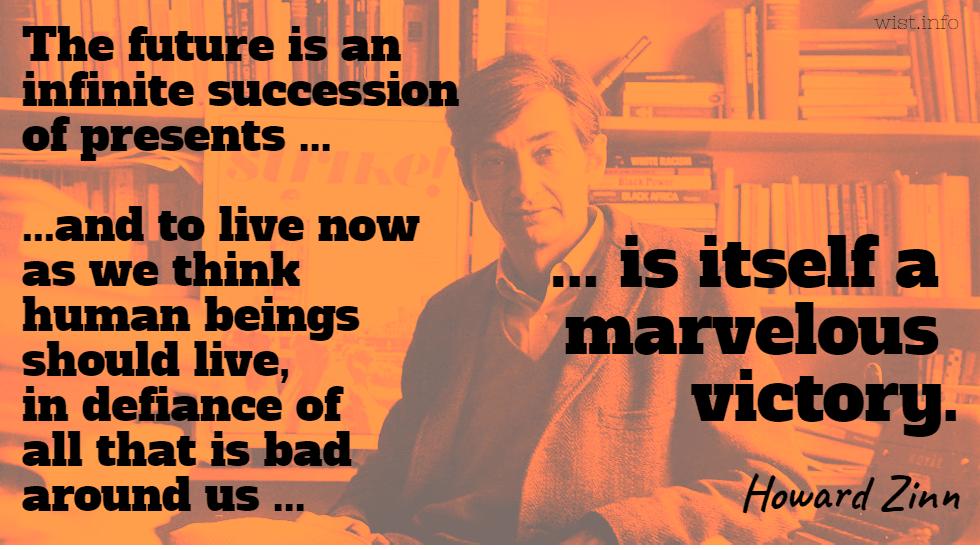
And if we do act, in however small a way, we don’t have to wait for some grand utopian future. The future is an infinite succession of presents, and to live now as we think human beings should live, in defiance of all that is bad around us, is itself a marvelous victory.
Howard Zinn (1922–2010) American historian, academic, author, social activist
Essay (2004-09-02), “The Optimism of Uncertainty,” The Nation
(Source)
Adopted from Zinn's essay of the same name in Paul Loeb (ed.), The Impossible Will Take a Little While (2004). See also Zinn, "A Marvelous Victory" (2004-02-23).

Treat bad men exactly as if they were insane. They are in-sane, out of health, morally. Reason, which is food to sound minds, is not tolerated, still less assimilated, unless administered with the greatest caution; perhaps, not at all. Avoid collision with them, so far as you honorably can; keep your temper, if you can, — for one angry man is as good as another; restrain them from violence, promptly, completely, and with the least possible injury, just as in the case of maniacs, — and when you have got rid of them, or got them tied hand and foot so that they can do no mischief, sit down and contemplate them charitably, remembering that nine tenths of their perversity comes from outside influences, drunken ancestors, abuse in childhood, bad company, from which you have happily been preserved, and for some of which you, as a member of society, may be fractionally responsible.
Oliver Wendell Holmes, Sr. (1809–1894) American poet, essayist, scholar
Article (1860-08), “The Professor’s Story [Elsie Venner],” ch. 16 [The Professor], Atlantic Monthly, Vol. 6, No. 34
(Source)
Originally serialized as “The Professor’s Story,” but collected as the novel Elsie Venner, ch. 16 (1861).
It is absurd to divide people into good and bad. People are either charming or tedious.
Oscar Wilde (1854–1900) Irish poet, wit, dramatist
Lady Windemere’s Fan, Act 1 [Lord Darlington] (1892)
(Source)