Much has been said in this country about not wanting to participate in foreign wars and people who have said it, must now face the fact that foreign wars come very close to our own shores. We will always have not only the religious groups, but many groups who feel that war is wrong. I cannot imagine how anyone could feel otherwise with the picture before them today. But when force not only rules in certain countries, but is as menacing to all the world, as it is today, one cannot live in a Utopia which prays for different conditions and ignores those which exist.
Eleanor Roosevelt (1884–1962) American politician, diplomat, activist; First Lady of the US (1933–45)
Column (1940-05-17), “My Day”
(Source)
Quotations about:
utopia
Note not all quotations have been tagged, so Search may find additional quotes on this topic.

The Utopia of a modern dreamer must needs differ in one fundamental aspect from the Nowheres and Utopias men planned before Darwin quickened the thought of the world. Those were all perfect and static States, a balance of happiness won for ever against the forces of unrest and disorder that inhere in things. […] But the Modern Utopia must be not static but kinetic, must shape not as a permanent state but as a hopeful stage, leading to a long ascent of stages. Nowadays we do not resist and overcome the great stream of things, but rather float upon it. We build now not citadels, but ships of state.
H. G. Wells (1866–1946) British writer [Herbert George Wells]
A Modern Utopia, ch. 1, § 1 (1905)
(Source)
All historical changes finally boil down to the replacement of one ruling class by another. All talk about democracy, liberty, equality, fraternity, all revolutionary movements, all visions of Utopia, or ‘the classless society’, or ‘the Kingdom of Heaven on earth’, are humbug (not necessarily conscious humbug) covering the ambitions of some new class which is elbowing its way into power.
George Orwell (1903–1950) English journalist, essayist, writer [pseud. of Eric Arthur Blair]
Essay (1946-05), “Second Thoughts on James Burnham,” Polemic Magazine
(Source)
Summarizing Burnham's view of history as given in The Machiavellians (1942). Orwell does not agree with Burnham's thesis.
Published separately as a pamphlet, James Burnham and the Managerial Revolution (1946).
I suggest that the real objective of Socialism is not happiness. Happiness hitherto has been a by-product, and for all we know it may always remain so. The real objective of Socialism is human brotherhood. This is widely felt to be the case, though it is not usually said, or not said loudly enough. Men use up their lives in heart-breaking political struggles, or get themselves killed in civil wars, or tortured in the secret prisons of the Gestapo, not in order to establish some central-heated, air-conditioned, strip-lighted Paradise, but because they want a world in which human beings love one another instead of swindling and murdering one another. And they want that world as a first step. Where they go from there is not so certain, and the attempt to foresee it in detail merely confuses the issue.
George Orwell (1903–1950) English journalist, essayist, writer [pseud. of Eric Arthur Blair]
Essay (1943-12-20), “Can Socialists Be Happy?” Tribune Newspaper [as John Freeman]
(Source)
The date given for this article varies: the issue of Tribune it was published in was 1943-12-24, but Orwell apparently received a check for the work on 1943-12-20. Note this was not the regular "As I Please" column Blair (Orwell) did for Tribune, which he also wrote for that issue, but a special article written under a different alias for unconfirmed reasons.
The title is sometimes given as "Why Socialists Don't Believe in Fun."
Nearly all creators of Utopia have resembled the man who has toothache, and therefore thinks happiness consists in not having toothache. They wanted to produce a perfect society by an endless continuation of something that had only been valuable because it was temporary. The wider course would be to say that there are certain lines along which humanity must move, the grand strategy is mapped out, but detailed prophecy is not our business. Whoever tries to imagine perfection simply reveals his own emptiness.
George Orwell (1903–1950) English journalist, essayist, writer [pseud. of Eric Arthur Blair]
Essay (1943-12-20), “Can Socialists Be Happy?” Tribune Newspaper [as John Freeman]
(Source)
The date given for this article varies: the issue of Tribune it was published in was 1943-12-24, but Orwell apparently received a check for the work on 1943-12-20. Note this was not the regular "As I Please" column Blair (Orwell) did for Tribune, which he also wrote for that issue, but a special article written under a different alias for unconfirmed reasons.
The title is sometimes given as "Why Socialists Don't Believe in Fun."
The greatest bloodshed? The most murders? I would say two things: sincere love and a sincere devotion to liberty. … If you kill out of love or for the perfect utopia, you never stop killing because human nature is always imperfect.
Peter Viereck (1916–2006) American poet, historian, academic
“Clio is No Cleo: The Messiness of History,” lecture, Mt. Holyoke College (1997)
(Source)
Reprinted in Society (Mar 2004) and collected in Strict Wildness (2008).

In short, there’s simply not
A more congenial spot
For happily-ever-aftering than here
In Camelot.Alan Jay Lerner (1918–1986) American dramatist, lyricist, composer
“Camelot” [Arthur], Camelot(1960; 1967)
(Source)
Based on T.H. White, The Once and Future King (1958).

If you said to a bunch of average people two hundred years ago “Would you be happy in a world where medical care is widely available, houses are clean, the world’s music and sights and foods can be brought into your home at small cost, travelling even 100 miles is easy, childbirth is generally not fatal to mother or child, you don’t have to die of dental abcesses and you don’t have to do what the squire tells you” they’d think you were talking about the New Jerusalem and say ‘yes’.
Terry Pratchett (1948–2015) English author
(Attributed)
Usually cited to alt.fan.pratchett, but not found in the repository.

The people I respect most behave as if they were immortal and as if society was eternal. Both assumptions are false: both of them must be accepted as true if we are to go on eating and working and loving, and are to keep open a few breathing-holes for the human spirit. No millennium seems likely to descend upon humanity; no better and stronger League of Nations will be instituted; no form of Christianity and no alternative to Christianity will bring peace to the world or integrity to the individual; no “change of heart” will occur. And yet we need not despair, indeed, we cannot despair; the evidence of history shows us that men have always insisted on behaving creatively under the shadow of the sword; that they have done their artistic and scientific and domestic stuff for the sake of doing it, and that we had better follow their example under the shadow of the aeroplanes.
E. M. Forster (1879–1970) English novelist, essayist, critic, librettist [Edward Morgan Forster]
“What I Believe,” The Nation (16 Jul 1938)
(Source)
It had been boldly predicted by some of the early Christians that the conversion of the world would lead to the establishment of perpetual peace. In looking back, with our present experience, we are driven to the melancholy conclusion that, instead of diminishing the number of wars, ecclesiastical influence as actually and very seriously increased it.
William Lecky (1838–1903) Irish historian
History of European Morals, Vol. 2, ch. 4 (1869)
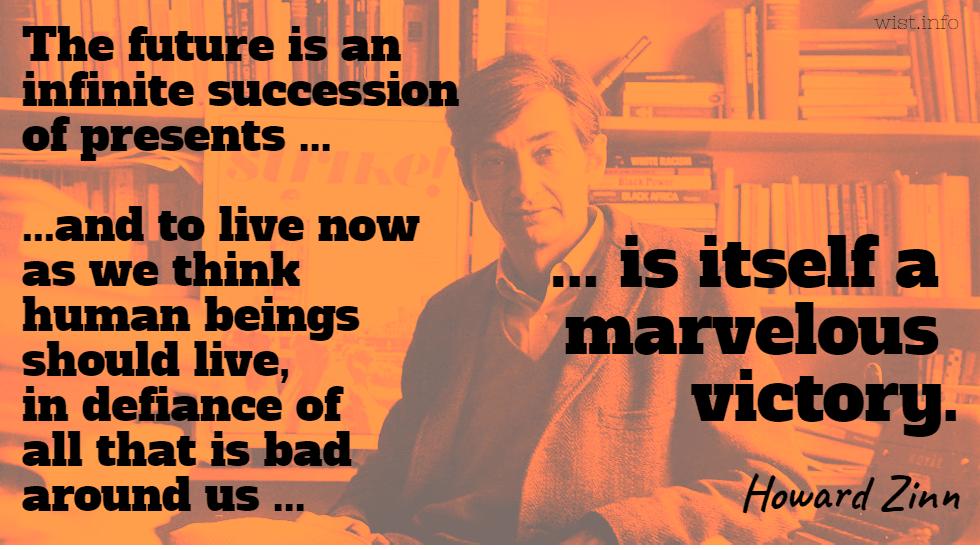
An optimist isn’t necessarily a blithe, slightly sappy whistler in the dark of our time. To be hopeful in bad times is not just foolishly romantic. It is based on the fact that human history is a history not only of cruelty, but also of compassion, sacrifice, courage, kindness. What we choose to emphasize in this complex history will determine our lives. If we see only the worst, it destroys our capacity to do something. If we remember those times and places — and there are so many — where people have behaved magnificently, this gives us the energy to act, and at least the possibility of sending this spinning top of a world in a different direction.
And if we do act, in however small a way, we don’t have to wait for some grand utopian future. The future is an infinite succession of presents, and to live now as we think human beings should live, in defiance of all that is bad around us, is itself a marvelous victory.
Howard Zinn (1922–2010) American historian, academic, author, social activist
Essay (2004-09-02), “The Optimism of Uncertainty,” The Nation
(Source)
Adopted from Zinn's essay of the same name in Paul Loeb (ed.), The Impossible Will Take a Little While (2004). See also Zinn, "A Marvelous Victory" (2004-02-23).

I think perhaps we want a more conscious life. We’re tired of drudging and sleeping and dying. We’re tired of seeing just a few people able to be individualists. We’re tired of always deferring hope till the next generation. We’re tired of hearing politicians and priests and cautious reformers (and the husbands!) coax us, “Be calm! Be patient! Wait! We have the plans for a Utopia already made; just wiser than you.” For ten thousand years they’ve said that. We want our Utopia now — and we’re going to try our hands at it.
Sinclair Lewis (1885–1951) American novelist, playwright
Main Street, ch. 16 [Carol] (1920)
(Source)
I wouldn’t want to live in Tomorrowland, where the social patterns and infrastructure are all so spiff and modern and rational and well-designed that any remaining problems must needs be insoluble, and so a cause for despair.

Listen, here’s the thing about politics: It’s not an expression of your moral purity and your ethics and your probity and your fond dreams of some utopian future. Progressive people constantly fail to get this.
Tony Kushner (b. 1956) American playwright and screenwriter
Interview with Ben Greenman, “Tony Kushner, Radical Pragmatist,” Mother Jones (Nov/Dec 2003)
(Source)

I profoundly believe that there is on this horizon, as yet only dimly perceived, a new dawn of conscience. In that purer light, people will come to see themselves in each other, which is to say they will make themselves known to one another by their similarities rather than by their differences. Man’s knowledge of things will begin to be matched by man’s knowledge of self. The significance of a smaller world will be measured not in terms of military advantage, but in terms of advantage for the human community. It will be the triumph of the heartbeat over the drumbeat.
Adlai Stevenson II (1900–1965) American politician, diplomat, statesman
Speech (1952-10-24), “The United Nations: Our Hope and Commitment,” United Nations Day Radio Broadcast, Springfield, Illinois
(Source)
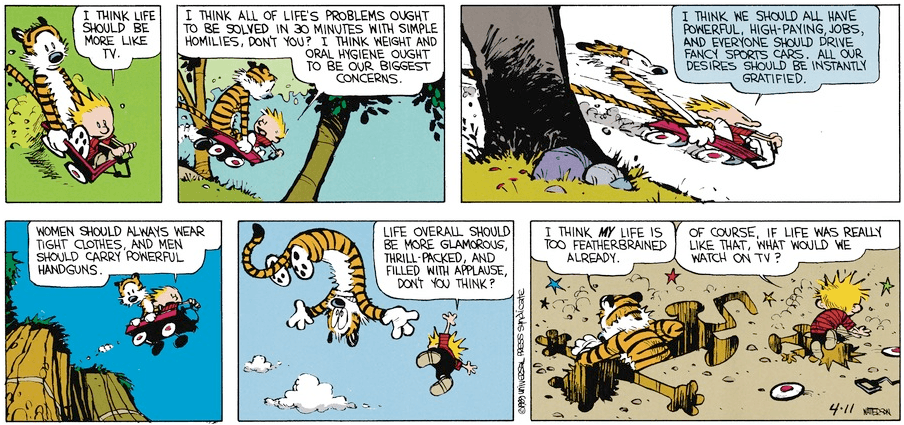
CALVIN (as he and Hobbes ride a wagon downhill): I think life should be more like TV.
CALVIN: I think all of life’s problems ought to be solved in thirty minutes with simple homilies, don’t you? I think weight and oral hygiene ought to be our biggest concerns.
CALVIN: I think we should all have powerful, high-paying jobs, and everyone should drive fancy sports cars. All our desires should be instantly gratified.
CALVIN (as the wagon flies off a cliff): Women should always wear tight clothes, and men should carry powerful handguns.
CALVIN (as he and Hobbes tumble in mid-air): Life overall should be more glamorous, thrill-packed, and filled with applause, don’t you think?
HOBBES (as they pick themselves up from the ground): I think my life is too featherbrained already.
CALVIN: Of course, if life was really like that, what would we watch on TV?