A hasty quarrel sparks a fire,
and hasty conflict sheds blood.
If you blow on a spark, it will flame up,
and if you spit on it, it will go out;
nonetheless, both come out
of your mouth.[ἔρις κατασπευδομένη ἐκκαίει πῦρ,
καὶ μάχη κατασπεύδουσα ἐκχέει αἷμα.
ἐὰν φυσήσῃς εἰς σπινθῆρα, ἐκκαήσεται,
καὶ ἐὰν πτύσῃς ἐπ᾽ αὐτόν, σβεσθήσεται·
καὶ ἀμφότερα ἐκ τοῦ στόματός σου ἐκπορεύεται.]The Bible (The Old Testament) (14th - 2nd C BC) Judeo-Christian sacred scripture [Tanakh, Hebrew Bible], incl. the Apocrypha (Deuterocanonicals)
Book 22b. Sirach (Ecclesiasticus) 28:11ff (Sir 28:11–12) [tr. CEB (2011)]
(Source)
More on the history and acceptance of this Apocryphal book here and here.
(Source (Greek)). Alternate translations:An hasty contention kindleth a fire: and an hasty fighting sheddeth blood.
If thou blow the spark, it shall burn: if thou spit upon it, it shall be quenched: and both these come out of thy mouth.
[tr. KJV (1611)]A hasty contention kindleth a fire: and a hasty quarrel sheddeth blood: and a tongue that beareth witness bringeth death.
If thou blow the spark, it shall burn as a fire: and if thou spit upon it, it shall be quenched: both come out of the mouth.
[tr. DRA (1899), 28:13–14]A sudden quarrel kindles fire,
a hasty dispute leads to bloodshed.
Blow on a spark and up it flares,
spit on it and out it goes;
both are the effects of your mouth.
[tr. JB (1966); NJB (1985)]An argument that blazes out suddenly can lead to violence. You can blow on a spark to make it glow, or you can spit on it to put it out. Either way, you do it with your mouth.
[tr. GNT (1992 ed.)]A hasty quarrel kindles a fire,
and a hasty dispute sheds blood.
If you blow on a spark, it will glow;
if you spit on it, it will be put out,
yet both come out of your mouth.
[tr. NRSV (2021 ed.)]
Quotations about:
quarrel
Note not all quotations have been tagged, so Search may find additional quotes on this topic.

CHORUS: The fiercest anger of all, the most incurable
is that which rages in the place of dearest love.[ΚΥΚΛΩΨ: Δεινή τις ὀργὴ καὶ δυσίατος πέλει,
ὅταν φίλοι φίλοισι συμβάλωσ᾽ ἔριν.]Euripides (485?-406? BC) Greek tragic dramatist
Medea [Μήδεια], l. 520ff (431 BC) [tr. Vellacott (1963)]
(Source)
Of the estrangement Jason and Medea. Some translations say this line is given by the chorus leader, not the chorus as a whole.
(Source (Greek)). Other translations:How sharp their wrath, how hard to be appeas'd
When friends with friends begin the cruel strife.
[tr. Wodhull (1782)]When friends with friends at variance kindle strife,
Fierce is their anger and immedicable.
[tr. Potter (1814)]Terrible is that anger, and to assuage
Most difficult, when friends with friends join battle.
[tr. Webster (1868)]There is a something terrible and past all cure, when quarrels arise 'twixt those who are near and dear.
[tr. Coleridge (1891)]Dreadful is that anger and irremediable, when friends with friends kindle strife.
[tr. Buckley (1892)]Awful is wrath, and past all balm of healing,
When they that once loved clash in feud of hate.
[tr. Way (Loeb) (1894)]Dire and beyond all healing is the hate
When hearts that loved are turned to enmity.
[tr. Murray (1906)]It is a strange form of anger, difficult to cure, when two friends turn upon each other in hatred.
[tr. Warner (1944)]A terrible thing is temper and knows no cure
When dear ones wrangle and fall to fighting each other.
[tr. Podlecki (1989)]Terrible and hard to heal is the wrath that comes when kin join in conflict with kin.
[tr. Kovacs (Loeb) (1994)]Terrible is the anger and almost beyond cure, when strife severs those whom love once joined.
[tr. Davie (1996)]Friend against friend! An anger most implacable!
[tr. Theodoridis (2004)]Anger is frightening and hard to remedy
when loved ones join in strife with loved ones.
[tr. Luschnig (2007)]When members of a family fight like this,
rage pushes them beyond all compromise.
[tr. Johnston (2008)]It is a deinē anger and past all cure, whenever philoi fall to strife [eris] with philoi.
[tr. Coleridge / Ceragioli / Nagy / Hour25]

During a quarrel, to have said too little may be mended; to have said too much, not always.

When I learn that husband and wife never quarrel, I know that indifference has set in, and after that — the deluge.
Minna Antrim (1861–1950) American epigrammatist, writer
Naked Truth and Veiled Allusions (1902)
(Source)
King Louis XV of France is attributed with saying, "Après moi, le déluge [After me, the flood]" to Madame Pompadour in 1757.
They will teach us to quarrel about God, as Catholics and Protestants do on the Nez Percé Reservation [in Idaho] and at other places. We do not want to do that. We may quarrel with men sometimes about things on earth, but we never quarrel about the Great Spirit. We do not want to learn that.
Chief Joseph (1840–1904) Leader of the Wallowa band of the Nez Percé [Hin-mah-too-yah-lat-kekt, Hinmatóowyalahtq̓it]
Statement (1873-03-27) to T. B. Odeneal
(Source)
When asked by US government commissioners about allowing schools and Christian churches on a proposed Wallowa Valley Nez Percé reservation.
A slightly shorter version of this quotation is prominently displayed at the visitors center of the Crazy Horse Monument, South Dakota.

The rich know anger helps the cost of living:
Hating’s more economical than giving.[Genus, Aucte, lucri divites habent iram:
Odisse, quam donare, vilius constat.]Martial (AD c.39-c.103) Spanish Roman poet, satirist, epigrammatist [Marcus Valerius Martialis]
Epigrams [Epigrammata], Book 12, epigram 13 (12.13) (AD 101) [tr. Michie (1972)]
(Source)
"To Auctus." Closely parallel to 3.37, to the point where some translations are cross-applied in error. The general interpretation, from Ker, is that "picking quarrels with clients saves you giving them presents."
(Source (Latin)). Other translations:Anger's a kind of gain that rich men know:
It costs them less to hate than to bestow.
[tr. Fletcher (1656)]Rich men, my friend, by anger know to thrive.
'Tis cheaper much to quarrel, than to give.
[tr. Hay (1755)]From ire can gainmongers elicit ore.
Fell hate is frugal: love might lavish more.
[tr. Elphinston (1782), 12.68]Ask you, last night, why Gripus ill behaved?
A well-timed quarrel is a dinner saved.
[tr. Halhead (1793)]The rich, Auctus, make a species of gain out of anger.
It is cheaper to get into a passion than to give.
[tr. Bohn's Classical (1859)]Rich men, Auctus, regard anger as a kind of profit;
to hate is cheaper than to give!
[tr. Ker (1919)]The rich feign wrath -- a profitable plan;
'Tis cheaper far to hate than help a man.
[tr. Pott & Wright (1921)]Rich men, Auctus, think of anger as a sort of moneymaking:
hating comes cheaper than giving.
[tr. Shackleton Bailey (1993)]The rich pick fights and cause unpleasance:
Hate is cheaper than giving presents.
[tr. Ericsson (1995)]The rich believe it pays to get irate --
to give is costlier, Auctus, than to hate.
[tr. McLean (2014)]

Each party abuses the other; the profane and the infidel believe both sides, and enjoy the fray; the reputation of religion in general suffers, and its enemies are ready to say, not what was said in the primitive times, Behold how these Christians love one another, — but, Mark how these Christians HATE one another! Indeed, when religious people quarrel about religion, or hungry people about their victuals, it looks as if they had not much of either among them.
Benjamin Franklin (1706–1790) American statesman, scientist, philosopher, aphorist
Letter to Jane Mecom (23 Feb 1769)
(Source)
On the vociferous denominational debate in America over whether a new bishop should be sent from the Church of England to the Colonies.
Aravis also had many quarrels (and, I’m afraid even fights) with Cor, but they always made it up again: so that years later, when they were grown up they were so used to quarreling and making it up again that they got married so as to go on doing it more conveniently.
C. S. Lewis (1898–1963) English writer, literary scholar, lay theologian [Clive Staples Lewis]
The Horse and His Boy (1954)
The test of a man or woman’s breeding is how they behave in a quarrel.
George Bernard Shaw (1856–1950) Irish playwright and critic
The Philanderer, Act 4 (1893)

An association of men who will not quarrel with one another is a thing which never yet existed, from the greatest confederacy of nations down to a town meeting or a vestry.
Thomas Jefferson (1743–1826) American political philosopher, polymath, statesman, US President (1801–09)
Letter (1798-06-04) to John Taylor
(Source)

In the end is it not futile to try and follow the course of a quarrel between husband and wife? Such a conversation is sure to meander more than any other. It draws in tributary arguments and grievances from years before — all quite incomprehensible to any but the two people they concern most nearly. Neither party is ever proved right or wrong in such a case, or, if they are, what does it signify?
Susanna Clarke (b. 1949) British author
Jonathan Strange and Mr. Norrell (2004)

The advice of a father to his son “Beware of entrance to a quarrel, but being in, bear it that the opposed may beware of thee,” is good, and yet not the best. Quarrel not at all. No man resolved to make the most of himself can spare time for personal contention. Still less can he afford to take all the consequences, including the vitiating of his temper and loss of self control. Yield larger things to which you can show no more than equal right; and yield lesser ones, though clearly your own. Better give your path to a dog than be bitten by him in contesting for the right. Even killing the dog would not cure the bite.

Goe not for every griefe to the Physitian, nor for every quarrell to the Lawyer, nor for every thirst to the pot.
George Herbert (1593–1633) Welsh priest, orator, poet.
Jacula Prudentum, or Outlandish Proverbs, Sentences, &c. (compiler), # 290 (1640 ed.)
(Source)

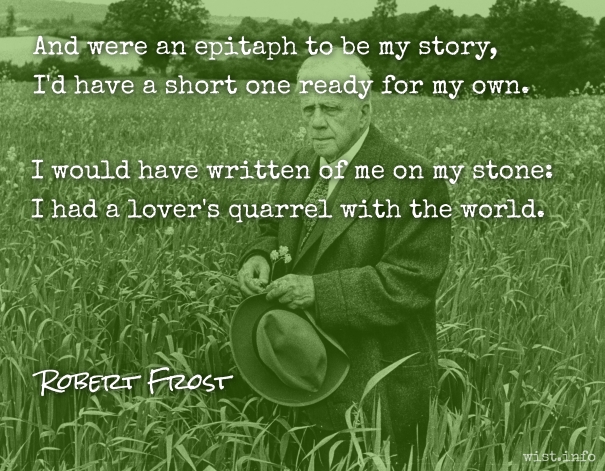
And were an epitaph to be my story,
I’d have a short one ready for my own.
I would have written of me on my stone:
I had a lover’s quarrel with the world.
Robert Frost (1874–1963) American poet
“The Lesson for Today,” A Witness Tree (1942)
Initially read before the Phi Beta Kappa Society, Harvard (20 Jun 1941)

But it must be remembered that, in spite of the proverb, it takes in reality only one to make a quarrel. It is useless for the sheep to pass resolutions in favour of vegetarianism, while the wolf remains of a different opinion.
William Ralph Inge (1860–1954) English prelate [Dean Inge]
“Patriotism,” Outspoken Essays: First Series (1915)
Sometimes quoted as "while wolves remain of a different opinion."
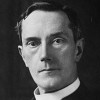
In quarreling, the truth is always lost.
Publilius Syrus (d. 42 BC) Assyrian slave, writer, philosopher [less correctly Publius Syrus]
Sententiae [Moral Sayings]
Other translations: "In excessive altercation, truth is lost."