Mizery luvs company but iz allwuss jealous, — there never waz a man yet but what thought hiz lame back was a good deal lamer than hiz nabors.
[Misery loves company but is always jealous — there never was a man yet but what thought his lame back was a good deal more lame than his neighbor’s.]
Josh Billings (1818–1885) American humorist, aphorist [pseud. of Henry Wheeler Shaw]
Josh Billings’ Farmer’s Allminax, 1877-07 “Dregs” (1877 ed.)
(Source)
Quotations about:
injury
Note not all quotations have been tagged, so Search may find additional quotes on this topic.

JASON: O children, what a wicked mother she was to you!
MEDEA: They died from a disease they caught from their father.
JASON: I tell you it was not my hand that destroyed them.
MEDEA: But it was your insolence, and your virgin wedding.
JASON: And just for the sake of that you chose to kill them.
MEDEA: Is love so small a pain, do you think, for a woman?[ἸΆΣΩΝ: ὦ τέκνα, μητρὸς ὡς κακῆς ἐκύρσατε.
ΜΉΔΕΙΑ: ὦ παῖδες, ὡς ὤλεσθε πατρῴᾳ νόσῳ.
ἸΆΣΩΝ: οὔτοι νιν ἡμὴ δεξιά γ᾽ ἀπώλεσεν.
ΜΉΔΕΙΑ: ἀλλ᾽ ὕβρις οἵ τε σοὶ νεοδμῆτες γάμοι.
ἸΆΣΩΝ: λέχους σφε κἠξίωσας οὕνεκα κτανεῖν;
ΜΉΔΕΙΑ: σμικρὸν γυναικὶ πῆμα τοῦτ᾽ εἶναι δοκεῖς;]Euripides (485?-406? BC) Greek tragic dramatist
Medea [Μήδεια], l. 1363ff (431 BC) [tr. Warner (1944)]
(Source)
Medea and Jason arguing over her murder of their sons. Here Medea blames Jason for deserting her (which he did) in favor of Princess Glauce (whom she has also killed).
(Source (Greek)). Other translations:JASON: How vile a Mother, O my sons, was yours!
MEDEA: How did ye perish thro' your Father's lust!
JASON: But my right hand was guiltless of their death.
MEDEA: Not so thy cruel taunts, and that new marriage.
JASON: Was my new marriage a sufficient cause
For thee to murder them?
MEDEA:Canst thou suppose
Such wrongs sit light upon the female breast?
[tr. Wodhull (1782)]JASON: My children, a bad mother have you found.
MEDEA: My sons, you perish'd through your father's folly.
JASON: Yet my right hand plung'd not the muurderous sword.
MEDEA: But thy foul wrongs, and thy new nuptials plung'd it.
JASON: And for these nupturals hast thou kill'd thy sons?
MEDEA: This to a woman deem'st thou a slight pain?
[tr. Potter (1814)]JASON: Oh sons, how foul a mother have ye had!
MEDEA: Oh boys, how died ye by your father's guilt!
JASON: Not this right hand of mine slew them, indeed.
MEDEA: No, but thine outrage and new wedding ties.
JASON: So for a bed lost thou thoughtst fit to slay them?
MEDEA: Dost thou count that a light wrong to a woman?
[tr. Webster (1868)]JASON: O my children, how vile a mother ye have found!
MEDEA: My sons, your father's feeble lust has been your ruin!
JASON: 'Twas not my hand, at any rate, that slew them.
MEDEA: No, but thy foul treatment of me, and thy new marriage.
JASON: Didst think that marriage cause enough to murder them?
MEDEA: Dost think a woman counts this a trifling injury?
[tr. Coleridge (1891)]JASON: My children, what a wicked mother have ye found!
MEDEA: My sons, how did ye perish by your father's fault!
JASON: Nevertheless my hand slew them not.
MEDEA: But injury, and thy new nuptials.
JASON: And on account of thy bed didst thou think fit to slay them?
MEDEA: Dost thou deem this a slight evil to a woman?
[tr. Buckley (1892)]JASON: O children mine, what miscreant mother had ye!
MEDEA: O sons, destroyed by your own father's lust!
JASON: Sooth, 'twas no hand of mine that murdered them.
MEDEA: Nay, but thine insolence and thy new-forged bonds.
JASON: How, claim the right for wedlock's sake to slay them!
MEDEA: A light affliction count'st thou this to woman?
[tr. Way (Loeb) (1894)]JASON: Oh, what a womb of sin my children bore!
MEDEA: Sons, did ye perish for your father's shame?
JASON: How? It was not my hand that murdered them.
MEDEA: 'Twas thy false wooings, 'twas thy trampling pride.
JASON: Thou hast said it! For thy lust of love they died.
MEDEA: And love to women a slight thing should be?
[tr. Murray (1906)]JASON: O children, what a wicked mother Fate gave you!
MEDEA: O sons, your father’s treachery cost you your lives.
JASON: It was not my hand that killed my sons.
MEDEA:No, not your hand;
But your insult to me, and your new-wedded wife.
JASON: You thought that reason enough to murder them, that I
No longer slept with you?
MEDEA:And is that injury
A slight one, do you imagine, to a woman?
[tr. Vellacott (1963)]JASON: O children, what an evil mother you encountered!
MEDEA: O children, how your father’s illness killed you!
JASON: At least it wasn’t my right hand that killed them.
MEDEA: No, your insults and your recent marriage.
JASON: Was it really for sex that you decided to kill them?
MEDEA: Do you think that this is small suffering for a woman?
[tr. Podlecki (1989)]JASON: Children, what an evil mother you got.
MEDEA: Children, how you have perished by your father's fault.
JASON: It was not my hand, you know, that killed them.
MEDEA: No: it was the outrage of your new marriage.
JASON: Did you really think it right to kill them because of a marriage?
MEDEA: Do you imagine that loss of love is a trivial grief for a woman?
[tr. Kovacs (Perseus)]JASON: Children, what an evil mother you got!
MEDEA: Children, how you have perished by your father's fault!
JASON: It was not my hand, you know, that killed them.
MEDEA: No: it was the outrage of your new marriage.
JASON: Did you really think it right to kill them because of a marriage?
MEDEA: Do you imagine that loss of this is a trivial grief for a woman?
[tr. Kovacs (Loeb) (1994)]JASON: O children, what a wicked mother you had!
MEDEA: O my sons, how your father's weakness caused your deaths!
JASON: Yet it was no right hand of mine that dealt them ruin!
MEDEA: No, it was your lustful heart and that new marriage of yours.
JASON: What? You decided to kill them because I loved another?
MEDEA: Do you think this is a minor annoyance to a woman?
[tr. Davie (1996)]JASON: My darling children! What a despicable woman gave birth to you!
MEDEA: My darling children! What a despicable man gave you such a destruction!
JASON: They were not murdered by my hand!
MEDEA: No, what killed them was the shame and your new marriage.
JASON: Was an empty bed a good enough reason for your murders?
MEDEA: Do you think an empty bed is such a small thing for a woman?
[tr. Theodoridis (2004)]JASON: Oh children, what a terrible mother you had.
MEDEA: Oh children, how you were destroyed by your father’s disease.
JASON: My right hand did not strike them.
MEDEA: But your abuse and your new marriage.
JASON: You thought the marriage bed was worth your children’s lives?
MEDEA: Do you think this a trivial wrong for a woman?
[tr. Luschnig (2007)]JASON:O my children,
you had such an evil mother!
MEDEA:O my children,
victims of your father’s evil actions!
JASON: At least it was not my hand that killed them.
MEDEA: No. It was an insult — your new marriage.
JASON: Was it right to murder them for that?
MEDEA: Do you think an insult to a woman
is something insignificant?
[tr. Johnston (2008)]JASON: My children, how kakē is the mother you have found!
MEDEA: My sons, your father’s lust has been your ruin.
JASON: It was not my right hand that slew them.
MEDEA: No, your hubris and your new marriage-bed.
JASON: Did you think that that was reason enough to murder them?
MEDEA: Do you think a woman finds that a tiny pain?
[tr. Coleridge / Ceragioli / Nagy / Hour25]JASON: Oh, children, what a wicked mother you had!
MEDEA: Oh, sons, you were ruined by your father's disease.
JASON: It wasn't my right hand that murdered them.
MEDEA: No, it was your insolence, your new-forged marriage.
JASON: You judged it right to kill them for your bed?
MEDEA: You think that pain's a small thing for a woman?
[tr. Kovacs / Kitzinger (2016)]
Kindness is invincible, if it be sincere and not hypocritical or a mere facade. For what can the most insulting of people do to you if you are consistently kind to him, and, when the occasion allows, gently advise him and quietly put him on the proper course at the very time when he is attempting to do you a mischief. “No, my son, we were born for something other than this; it is not I who am harmed, it is you, my son, who are causing harm to yourself.”
[τὸ εὐμενὲς ἀνίκητον, ἐὰν γνήσιον ᾖ καὶ μὴ σεσηρὸς μηδὲ ὑπόκρισις. τί γάρ σοι ποιήσει ὁ ὑβριστικώτατος, ἐὰν διατελῇς εὐμενὴς αὐτῷ καί, εἰ οὕτως ἔτυχε, πρᾴως παραινῇς καὶ μεταδιδάσκῃς εὐσχολῶν παῤ αὐτὸν ἐκεῖνον τὸν καιρὸν ὅτε κακοποιεῖν σε ἐπιχειρεῖ: ῾μή, τέκνον: πρὸς ἄλλο πεφύκαμεν. ἐγὼ μὲν οὐ μὴ βλαβῶ, σὺ δὲ βλάπτῃ, τέκνον.᾿]
Marcus Aurelius (AD 121–180) Roman emperor (161–180), Stoic philosopher
Meditations [To Himself; Τὰ εἰς ἑαυτόν], Book 11, ch. 18 (11.18) (AD 161-180) [tr. Hard (1997 ed.)]
(Source)
Marcus' 9th point to remember when aggravated by another's actions. Graves comments, "The good Emperor, I am afraid, had too good an opinion of human nature in general."
Hard uses the same translation in their 2011 edition.
(Source (Greek)). Alternate translations:Meekness is a thing unconquerable, if it be true and natural, and not affected or hypocritical. For how shall even the most fierce and malicious that thou shalt conceive, be able to hold on against thee, if thou shalt still continue meek and loving unto him; and that even at that time, when he is about to do thee wrong, thou shalt be well disposed, and in good temper, with all meekness to teach him, and to instruct him better? As for example; My son, we were not born for this, to hurt and annoy one another; it will be thy hurt not mine, my son.
[tr. Casaubon (1634)]Gentleness and Good Humour are invincible, provided they are of the right Stamp, without any thing of Hypocrisy, or Grimace. This is the way to Disarm the most Barbarous, and Savage: A constancy in Obliging Behaviour, will make the most Outragious Person asham'd of his Malice : The worst Body imaginable can't find in his heart to do you any Mischief, if you continue kind and unmov'd under ill Usage, if you strike in with the right opportunity for Advice; If when he is going to do you an ill Turn, you endeavour to recover his Understanding, and retrieve his Temper in such gentle Language as this. Prethee Child be quiet, Men were never made to worry one another; In earnest if you go on, my dear Friend, you'l have the worst on't; As for my part, I'm proof against every Thing, but my own Folly.
[tr. Collier (1701)]Meekness is invincible, where it is genuine, and sincere without hypocrisy. For, what can the most insolent do to you, if you steadfastly persist in kindness to him, and, upon occasion, mildly admonish and instruct him thus, at the very time he is attempting to do you an injury? “Don’t do so, my son! Nature formed us for a quite different conduct. You cannot hurt me; you hurt yourself, my son!”
[tr. Hutcheson/Moor (1742)]Consider that benevolence is invincible, if it be genuine, without affectation or hypocrisy. For what can the most brutishly injurious person do to you, if you persevere in your kindness to them, and when an opportunity offers, tenderly admonish him, and at the very time when he is going to do you an injury, thus calmly instruct him: "Forbear, my son, we were formed by nature for quite a different purpose; you cannot injure me, but you hurt yourself my son."
[tr. Graves (1792)]Consider that a good disposition is invincible if it be genuine, and not an affected smile and acting a part. For what will the most violent man do to thee, if thou continuest to be of a kind disposition towards him, and if, as opportunity offers, thou gently admonishest him and calmly correctest his errors at the very time when he is trying to do thee harm, saying, Not so, my child: we are constituted by nature for something else: I shall certainly not be injured, but thou art injuring thyself, my child.
[tr. Long (1862)]Gentleness is invincible, provided it is of the right stamp, without anything of hypocrisy or malice. This is the way to disarm the most insolent, if you continue kind and unmoved under ill usage, if you strike in with the right opportunity for advice. If when he is going to do you an ill turn you endeavour to recover his undertsanding, and retrieve his temper by such language as this: I pray you, child, be quiet, men were never made to worry one another. I shall not be injured, but you are injuring yourself, child.
[tr. Collier/Zimmern (1887)]Kindness is invincible if only it is honest, not fawning or insincere. What can the most aggressive do, if you keep persistently kind, and as ocasion offers gently remonstrate, and seize the moment when he is bent on mischief, for trying quietly to convert him to a better frame of mind. "Not so, my son, we are made for other ends; you cannot hurt me, you hurt yourself, my son."
[tr. Rendall (1898)]Meekness is invincible if it be genuine, without simper or hypocrisy. For what can the most insolent of men do to you, if you persist in civility towards him; and, if occasion offers, admonish him gently and deliberately, shew him the better way at the very moment that he is endeavouring to harm you? “Nay, my son; we were born for something better. No hurt can come to me; it is yourself you hurt, my son.”
[tr. Hutcheson/Chrystal (1902)]Kindness is irresistible, be it but sincere and no mock smile or a mask assumed. For what can the most unconscionable of men do to thee, if thou persist in being kindly to him, and when a chance is given exhort him mildly and, at the very time when he is trying to do thee harm, quietly teach him a better way thus: Nay, my child, we have been made for other things. I shall be in no wise harmed, but thou art harming thyself, my child.
[tr. Haines (Loeb) (1916)]Gentleness is invincible, if it be genuine and not sneering or hypocritical. For what can the most insolent do to you, if you continue gentle to him, and, if opportunity allows, mildly admonish him and quietly show him a better way at the very moment when he attempts to do you injury: "No, my child; we came into the world for other ends. It is not I that am harmed, but you are harmed, my child."
[tr. Farquharson (1944)]Kindness is irresistible, so long as it be genuine and without false smiles or duplicity. The most consummate impudence can do nothing, if you remain persistently kind to the offender, give him a gentle word of admonition when opportunity offers, and at the moment when he is about to vent his malice upon you bring him round quietly with "No, my son; it was not for this that we were made. I shall not be hurt; it is yourself you are hurting."
[tr. Staniforth (1964)]Kindness is invincible, provided it’s sincere -- not ironic or an act. What can even the most vicious person do if you keep treating him with kindness and gently set him straight -- if you get the chance -- correcting him cheerfully at the exact moment that he’s trying to do you harm. "No, no, my friend. That isn’t what we’re here for. It isn’t me who’s harmed by that. It’s you."
[tr. Hays (2003)]Kindness is invincible — if it is sincere, not fawning or pretense. What can the most aggressive man do to you if you continue to be kind to him? If, as opportunity arises, you gently admonish him and take your time to re-educate him at the very moment when he is trying to do you harm? "No, son, we were born for other purposes than this. There is no way that I can be harmed, but you are harming yourself, son."
[tr. Hammond (2006)]Kindness is unconquerable, so long as it is without flattery or hypocrisy. For what can the most insolent man do to you, if you continue to be kind to him and, if you have the chance, gently advise and calmly show him what is right at the very moment he is trying to harm you, saying: "No, my son. We were born for something else. I am certainly not harmed, but you bring harm to yourself?"
[tr. Needleman/Piazza (2008)]

The sinner sins against himself. The wrong-doer wrongs himself by making himself evil.
[Ὁ ἁμαρτάνων ἑαυτῷ ἁμαρτάνει: ὁ ἀδικῶν ἑαυτὸν ἀδικεῖ, ἑαυτὸν, ἑαυτὸν κακὸν ποιῶν.]
Marcus Aurelius (AD 121–180) Roman emperor (161–180), Stoic philosopher
Meditations [To Himself; Τὰ εἰς ἑαυτόν], Book 9, ch. 4 (9.4) (AD 161-180) [tr. Hutcheson/Chrystal (1902)]
(Source)
(Source (Greek)). Alternate translations:He that sinneth, sinneth unto himself. He that is unjust, hurts himself, in that he makes himself worse than he was before.
[tr. Casaubon (1634)]He that commits a Fault Abroad , is a Trespasser at Home; And he that injures his Neighbour, hurts himself , for to make himself an ill Man is a shrew'd Michief.
[tr. Collier (1701)]He who does wrong, does a wrong to himself. He who is injurious, does evil to himself, by making himself evil.
[tr. Hutcheson/Moor (1742)]He that commits a crime, is guilty of an offence against his own interest, and he that acts unjustly, injures himself: for to make himself a bad man, is an essential injury.
[tr. Graves (1792)]He who does wrong does wrong against himself. He who acts unjustly acts unjustly to himself, because he makes himself bad.
[tr. Long (1862)]He that commits a fault abroad is a trespasser at home; and he that injures his neighbour, hurts himself, for to make himself an evil man is a great mischief.
[tr. Collier/Zimmern (1887)]He who sins, sins against himself; he who does wrong, wrongs himself, making himself evil.
[tr. Rendall (1898)]He that does wrong, does wrong to himself. The unjust man is unjust to himself, for he makes himself bad.
[tr. Haines (Loeb) (1916)]Whosoever does wrong, wrongs himself; whosoever does injustice, does it to himself, making himself evil.
[tr. Farquharson (1944)]The sinner sins against himself; the wrongdoer wrongs himself, becoming the worse by his own action.
[tr. Staniforth (1964)]Whoever does wrong, wrongs himself; whosever acts unjustly, acts unjustly toward himself, because he makes himself bad.
[tr. Hard (1997 ed., 2011 ed.)]To do harm is to do yourself harm. To do an injustice is to do yourself an injustice -- it degrades you.
[tr. Hays (2003)]The sinner sins against himself: the wrongdoer wrongs himself, by making himself morally bad.
[tr. Hammond (2006)]He who acts wrongly harms himself. If a person commits an injustice, he acts badly toward himself, thus making himself bad.
[tr. Needleman/Piazza (2008)]
Injure a businessman and he’ll try to make you sorry; injure an artist and he’ll try to make you immortal.
Mignon McLaughlin (1913–1983) American journalist and author
The Neurotic’s Notebook, ch. 7 (1963)
(Source)

It is often said that the Church is a crutch. Of course it’s a crutch. What makes you think you don’t limp?
William Sloane Coffin, Jr. (1924–2006) American minister, social activist
Credo, “The Church” (2004)
(Source)

Sticks and stones may break my bones, but words will always hurt me. Bones mend and become actually stronger in the very place they were broken and where they have knitted up; mental wounds can grind and ooze for decades and be re-opened by the quietest whisper.

Write Injuries in Dust, Benefits in Marble.
Benjamin Franklin (1706–1790) American statesman, scientist, philosopher, aphorist
Poor Richard (1747 ed.)
(Source)
As with so much else of Franklin's, this phrase is not without earlier forms, e.g.: Thomas More, History of King Richard III (1513):For men use, if they have an evil turn, to write it in marble; and whosoever does us a good turn, we write it in dust.
Or see Shakespeare, Henry VIII 4.2.45-46 (1613):Men's evil manners live in brass, their virtues
We write in water.
Variants include "but kindnesses in marble" or "but kindness in marble."
This also shows up as a French saying in various forms:
- "Ecrivez les injures sur le sable, mais les bienfaits sur le marbre."
- "Écrivez les injures sur le sable, gravez les bienfaits sur le marbre."

He wishes that he, too, had a wound, a red badge of courage.

I once met a man who had forgiven an injury. I hope some day to meet the man who has forgiven an insult.
Charles Buxton (1823–1871) English brewer, philanthropist, writer, politician
Notes of Thought, #458 (1873)
(Source)
Shrapnel wounds and mangled, bullet ridden bodies are not the only casualties of war. There are casualties of the mind. Every war produces a backwash, a residue of pain and grief.
Rod Serling (1924–1975) American screenwriter, playwright, television producer, narrator
Comment, Antioch College (c. 1965)
(Source)
As quoted in Anne Serling, As I Knew Him: My Dad, Rod Serling (2013).

We injure ourselves more than our enemies, by indulging hatred towards them.
Marguerite Gardiner, Countess of Blessington (1789–1849) Irish novelist [Lady Blessington, b. Margaret Power]
Desultory Thoughts and Reflections (1839)
(Source)

There are two kinds of injustice — the one, on the part of those who inflict wrong, the other on the part of those who, when they can, do not shield from wrong those upon whom it is being inflicted. For he who, under the influence of anger or some other passion, wrongfully assaults another seems, as it were, to be laying violent hands upon a comrade; but he who does not prevent or oppose wrong, if he can, is just as guilty of wrong as if he deserted his parents or his friends or his country.
[Sed iniustitiae genera duo sunt, unum eorum, qui inferunt, alterum eorum, qui ab iis, quibus infertur, si possunt, non propulsant iniuriam. Nam qui iniuste impetum in quempiam facit aut ira aut aliqua perturbatione incitatus, is quasi manus afferre videtur socio; qui autem non defendit nec obsistit, si potest, iniuriae, tam est in vitio, quam si parentes aut amicos aut patriam deserat.]
Marcus Tullius Cicero (106–43 BC) Roman orator, statesman, philosopher
De Officiis [On Duties; On Moral Duty; The Offices], Book 1, ch. 7 (1.7) / sec. 23 (44 BC) [tr. Miller (1913)]
(Source)
Original Latin. Other translations:The vice that is opposite to justice is injustice, of which there are two sorts: the first consists in the actual doing an injury to another; the second, in tamely looking on while he is injured, and not helping and defending him though we are able: for he that injuriously falls on another, whether prompted by rage or other violent passion, does as it were leap at the throat of his companion; and he that refuses to help him when injured, and to ward off the wrong if it lies in his power, is as plainly guilty of baseness and and injustice as though he had deserted his father, his friends, or his native country.
[tr. Cockman (1699)]There are two kinds of injustice: Of the one, they are guilty who do an injury; of the other, they who, if they are able, do not defend those from injury to whom it is offered. For he who urged on by anger, or some violent passion, attempts to injure any man, lifts his hand against his brother' and he who interferes not to resist or repel the attempt, is as guilty as if he had deserted his parents, his friends, or his country.
[tr. McCartney (1798)]But there are two kinds of injustice; the first of those who offer an injury, the second of those who have in their power to avert an injury from those to whom it is offered, and yet do it not. For if a man, prompted either by anger or any sudden perturbation, unjustly assaults another man, such a one seems as it were to lay violent hands on one's ally; and the man who does not repel or withstand the injury, if he can, is as much to blame as if he deserted the cause of his parents, his friends, or his country.
[tr. Edmonds (1865)]Of injustice there are two kinds, -- one, that of those who inflict injury; the other, that of those who do not, if they can, repel injury from those on whom it is inflicted. Moreover, he who, moved by anger or by some disturbance of mind, makes an unjust assault on any person, is as one who lays violent hands on a casual companion; while he who does not, if he can, ward off or resist the injury offered to another, is as much in fault as if he were to desert his parents, or his friends, or his country.
[tr. Peabody (1883)]There are two kinds of injustice: the positive injustice of the aggressor, and the negative injustice of neglecting to defend those who are wronged. To attack a man unjustly under the influence of anger or some other passion is to lay hands upon a comrade; not to defend the oppressed and shield them from injustice, is as great a crime as to desert our parents, friends, or country.
[tr. Gardiner (1899)]There are two classifications of injustice. One part includes those who act unjustly. The other part includes men who, even if they have the power to do so, fail to protect from abuse those people against whom other men commit violence. The man who unjustly does harm to someone else, either in anger or because some other passion arounds him, acts as if he were striking a companion. But the man who does not avert an act of violence, or offer resistance if he has the power, is just as much at fault as if he betrayed his parents, or friends, or his fatherland.
[tr. Edinger (1974)]
Never does the human soul appear so strong as when it foregoes revenge, and dares to forgive an injury.

Anger is like the blade of a butcher knife — very difficult to hold on to for long without harming yourself.
Patti LaBelle (b. 1944) American singer, author, actress [stage name for Patricia Louise Holt-Edwards]
Patti’s Pearls: Lessons in Living (2001) [with Laura Randolph Lancaster]
(Source)

We have all heard enough to fill a book about Dr. Johnson’s incivilities. I wish they would compile another book consisting of Dr. Johnson’s apologies. There is no better test of a man’s ultimate chivalry and integrity than how he behaves when he is wrong; and Johnson behaved very well. He understood (what so many faultlessly polite people do not understand) that a stiff apology is a second insult. He understood that the injured party does not want to be compensated because he has been wronged; he wants to be healed because he has been hurt.
Gilbert Keith Chesterton (1874–1936) English journalist and writer
“The Real Dr. Johnson,” The Common Man (1950)

A person may cause evil to others not only by his actions but by his inaction, and in either case he is justly accountable to them for the injury.
John Stuart Mill (1806–1873) English philosopher and economist
On Liberty, ch. 1 “Introductory” (1859)
(Source)
Neglected, calumny soon expires; show that you are hurt, and you give it the appearance of truth.
Tacitus (c.56-c.120) Roman historian, orator, politician [Publius or Gaius Cornelius Tacitus]
The Annals (AD 109)
KING ARTHUR: Look, you stupid bastard, you’ve got no arms left!
BLACK KNIGHT: Yes I have.
KING ARTHUR: Look!
BLACK KNIGHT: It’s just a flesh wound.Monty Python (b. 1969) British comedy troupe [Graham Chapman, John Cleese, Terry Gilliam, Eric Idle, Terry Jones, Michael Palin]
Monty Python and the Holy Grail (1975)
Those whom they have injured they also hate.
Seneca the Younger (c. 4 BC-AD 65) Roman statesman, philosopher, playwright [Lucius Annaeus Seneca]
Moral Essays, “On Anger [De ira],” 2.33.1 [tr. Basore (1928)]
A man does not sin by commission only, but often by omission.
[Ἀδικεῖ πολλάκις ὁ μὴ ποιῶν τι, οὐ μόνον ὁ ποιῶν τι.]
Marcus Aurelius (AD 121–180) Roman emperor (161–180), Stoic philosopher
Meditations [To Himself; Τὰ εἰς ἑαυτόν], Book 9, ch. 5 (9.5) (AD 161-180) [tr. Staniforth (1964)]
(Source)
(Source (Greek)). Other translations:Not he only that committeth, but he also that omitteth something, is oftentimes unjust.
[tr. Casaubon (1634), 9.4]Omissions no less than Commissions, are oftentimes Branches of Injustice.
[tr. Collier (1701)]Men are often unjust by omissions, as well as by actions.
[tr. Hutcheson/Moor (1742)]A man is as often guilty of injustice by omitting to do what he ought, as by doing what he ought not to do.
[tr. Graves (1792), 9.4]He often acts unjustly who does not do a certain thing; not only he who does a certain thing.
[tr. Long (1862)]Omissions no less than commission are oftentimes part of injustice.
[tr. Collier/Zimmern (1887)]Wrong comes often of not doing as well as doing.
[tr. Rendall (1898)]Men are often unjust by omissions as well as by actions.
[tr. Hutcheson/Chrystal (1902)]There is often an injustice of omission as well as of commission.
[tr. Haines (Loeb) (1916)]Often he who omits an act does injustice, not only he who commits an act.
[tr. Farquharson (1944)]A person often acts unjustly by what he fails to do, and not only by what he does.
[tr. Hard (1997 ed., 2011 ed.)]And you can also commit injustice by doing nothing.
[tr. Hays (2003)]There can often be wrongs of omission as well as commission.
[tr. Hammond (2006)]Very often an unjust act is done by not doing something, not only by doing something.
[tr. Needleman/Piazza (2008)]One may often injure by omission, not only by action.
[ed. Taplin (2016)]

Men are more prone to revenge Injuries, than to requite Kindnesses.
Thomas Fuller (1654–1734) English physician, preacher, aphorist, writer
Gnomologia: Adages and Proverbs (compiler), # 3389 (1732)
(Source)

Goe not for every griefe to the Physitian, nor for every quarrell to the Lawyer, nor for every thirst to the pot.
George Herbert (1593–1633) Welsh priest, orator, poet.
Jacula Prudentum, or Outlandish Proverbs, Sentences, &c. (compiler), # 290 (1640 ed.)
(Source)

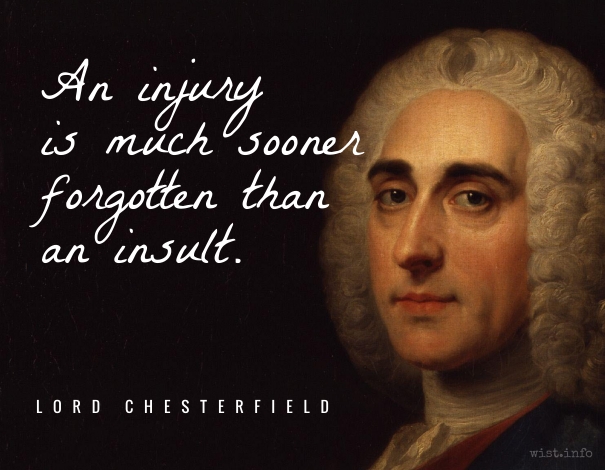
There is nothing that people bear more impatiently, or forgive less, than contempt; and an injury is much sooner forgotten than an insult.
Lord Chesterfield (1694–1773) English statesman, wit [Philip Dormer Stanhope]
Letter to his son, #112 (9 Oct 1746)

Death, like life, is an affair of being more frightened than hurt.
Samuel Butler (1835–1902) English novelist, satirist, scholar
Erewhon (1872)