

The wicked flee when no man pursueth ….
נָ֣סוּ וְאֵין־רֹדֵ֣ף רָשָׁ֑ע
The Bible (The Old Testament) (14th - 2nd C BC) Judeo-Christian sacred scripture [Tanakh, Hebrew Bible], incl. the Apocrypha (Deuterocanonicals)
Book 20. Proverbs 28: 1 (Prov 28:1) [tr. KJV (1611)]
(Source)
(Source (Hebrew)). Other translations:The wicked man flees when no one is after him ....
[JB (1966)]The wicked flees when no one is pursuing ....
[NJB (1985)]The wicked run when no one is chasing them ....
[GNT (1992 ed.)]The wicked run away even though no one pursues them ....
[CEB (2011)]The wicked flee when no one pursues ....
[NRSV (2021 ed.)]A wicked person flees though no one gives chase ....
[RJPS (2023 ed.)]
Quotations about:
guilty conscience
Note not all quotations have been tagged, so Search may find additional quotes on this topic.

Dare not to be guilty of ill Things, tho’ thou wert sure to be secret and unpunished. Conscience will sit upon it, and that is Witness, Jury, Judge, and Executioner.
Thomas Fuller (1654–1734) English physician, preacher, aphorist, writer
Introductio ad Prudentiam, Vol. 2, # 2216 (1727)
(Source)

One can no more keep the mind from returning to an idea than the sea from returning to a shore. For the sailor, this is called the tide; in the case of the guilty, it is called remorse. God stirs up the soul as well as the ocean.
[On n’empêche pas plus la pensée de revenir à une idée que la mer de revenir à un rivage. Pour le matelot, cela s’appelle la marée ; pour le coupable, cela s’appelle le remords. Dieu soulève l’âme comme l’océan.]
Victor Hugo (1802–1885) French writer, journalist, human rights activist, politician
Les Misérables, Part 1 “Fantine,” Book 7 “The Champmathieu,” ch. 3 (1.7.3) (1862) [tr. Wilbour / Fahnestock / MacAfee (1987)]
(Source)
(Source (French)). Other translations:One can no more prevent the mind from returning to an idea than the sea from returning to a shore. In the case of the sailor, this is called the tide; in the case of the guilty, it is called remorse. God upheaves the soul as well as the ocean.
[tr. Wilbour (1862)]It is no more possible to prevent thought from reverting to an idea than the sea from returning to the shore. With the sailor this is called the tide; with the culprit it is called remorse; God heaves the soul like the ocean.
[tr. Wraxall (1862)]One can no more prevent thought from recurring to an idea than one can the sea from returning to the shore: the sailor calls it the tide; the guilty man calls it remorse; God upheaves the soul as he does the ocean.
[tr. Hapgood (1887)]We can no more prevent a thought returning to the mind than we can prevent the sea from rising on the foreshore. To the sailor it is the tide, to the uneasy conscience it is remorse. God moves the soul as He moves the oceans.
[tr. Denny (1976)]The mind is no more to be prevented from returning to an idea than the sea from returning to the shore. For the sailor this is called the tide. For the guilty man, it is called remorse. God stirs the soul as he causes the ocean to swell.
[tr. Donougher (2013)]

A Sunday-school is a prison in which children do penance for the evil consciences of their parents.
H. L. Mencken (1880–1956) American writer and journalist [Henry Lewis Mencken]
A Little Book in C Major, ch. 3, § 3 (1916)
(Source)
Variant:SUNDAY SCHOOL. A prison in which children do penance for the evil conscience of their parents.
A Book of Burlesques, "The Jazz Webster" (1924)

What is blasphemy? I will give you a definition; I will give you my thought upon this subject. What is real blasphemy?
To live on the unpaid labor of other men — that is blasphemy.
To enslave your fellow-man, to put chains upon his body — that is blasphemy.
To enslave the minds of men, to put manacles upon the brain, padlocks upon the lips — that is blasphemy.
To deny what you believe to be true, to admit to be true what you believe to be a lie — that is blasphemy.
To strike the weak and unprotected, in order that you may gain the applause of the ignorant and superstitious mob — that is blasphemy.
To persecute the intelligent few, at the command of the ignorant many — that is blasphemy.
To forge chains, to build dungeons, for your honest fellow-men — that is blasphemy.
To pollute the souls of children with the dogma of eternal pain — that is blasphemy.
To violate your conscience — that is blasphemy.
The jury that gives an unjust verdict, and the judge who pronounces an unjust sentence, are blasphemers.
The man who bows to public opinion against his better judgment and against his honest conviction, is a blasphemer.Robert Green Ingersoll (1833–1899) American lawyer, freethinker, orator
Speech (1887-05) to the Jury, Trial of C. B. Reynolds for Blasphemy, Morristown, New Jersey
(Source)

That must be why some people like dogs; they can be made to feel guilty about anything, including the sins of their owners. Cats refuse to take the blame for anything — including their own sins.
Elizabeth Peters (1927–2013) American author [pseud. of Barbara Mertz, who also wrote as Barbara Michaels]
Trojan Gold (1987)
(Source)

No disease of the imagination is so difficult to cure, as that which is complicated with the dread of guilt: fancy and conscience then act interchangeably upon us, and so often shift their places, that the illusions of one are not distinguished from the dictates of the other.
Samuel Johnson (1709–1784) English writer, lexicographer, critic
The History of Rasselas, Prince of Abissinia, ch. 46 (1759)
(Source)
Sometimes attributed to E. M. Forster, as he transcribed the words in his Commonplace Book.

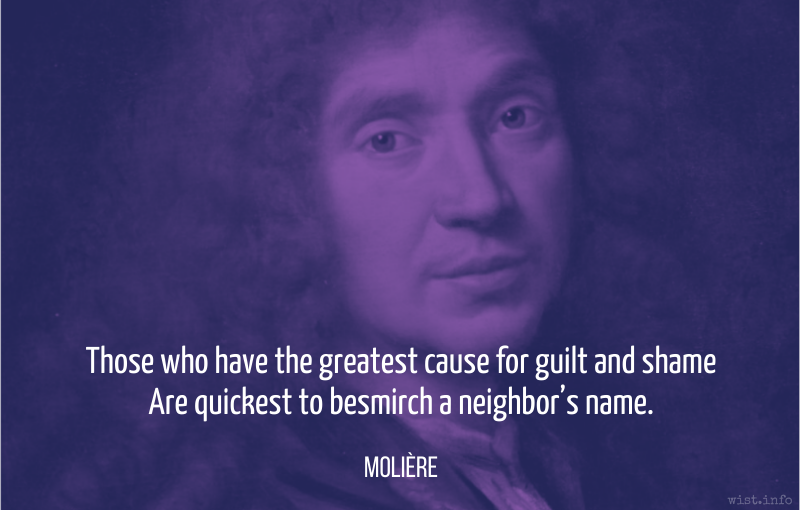
DORINE: Those who have the greatest cause for guilt and shame
Are quickest to besmirch a neighbor’s name.[Ceux de qui la conduite offre le plus à rire
Sont toujours sur autrui les premiers à médire.]
Molière (1622–1673) French playwright, actor [stage name for Jean-Baptiste Poquelin]
Tartuffe, or the Hypocrite [Le Tartuffe, ou L’Imposteur], Act 1, sc. 1 (1669) [tr. Wilbur (1963)]
(Source)
(Source (French)). Other translations:People, whose own Conduct is the most ridiculous, are always readiest to detract from that of others.
[tr. Clitandre (1672)]They whose own conduct is the most ridiculous are always the first to slander others.
[tr. Van Laun (1876)]The people whose conduct offers the greatest hold to ridicule are always the first to speak unkindly of others.
[tr. Wall (1879)]People whose conduct is the most ridiculous, are always the readiest to run down that of others.
[tr. Mathew (1890)]Those who are the most ridiculous in their own conduct are always the first to libel others.
[tr. Waller (1903)]Those whose own conduct's most ridiculous,
Are always quickest to speak ill of others.
[tr. Page (1909)]Those whose behavior is ridiculous
Always are first to see the faults of others.
[tr. Bishop (1957)]Those whose behavior is most asinine
Are always more than ready to malign.
[tr. Frame (1967)]Since they are always talked about,
They're sniffing other scandal out.
[tr. Bolt (2002)]It's always the most ridiculous people who are the first to slander others.
[tr. Steiner (2008)]People with the most to hide are always the worst.
Always the first to criticize others.
[tr. Campbell (2013)]Those whose conduct gives room for talk
Are always the first to attack their neighbors.
[Bartlett's]

By virtue of depression, we recall those misdeeds we buried in the depths of our memory. Depression exhumes our shames.
Emile Cioran (1911–1995) Romanian philosopher and essayist [E.M. Cioran]
Anathemas and Admirations, ch. 11 “That Fatal Perspicacity” (1986) [tr. R. Howard (1991)]
(Source)

The folly which we might have ourselves committed is the one which we are least ready to pardon in another.
Joseph Roux (1834–1886) French Catholic priest
Meditations of a Parish Priest: Thoughts, Part 4, #85 (1886)
(Source)

It really hurts me very much to suppose that I have wronged anybody on earth.
Abraham Lincoln (1809–1865) American lawyer, politician, US President (1861–65)
Speech (1858-10-13), Lincoln-Douglas Debate No. 6, Quincy, Illinois
(Source)

Those whom they have injured they also hate.
Seneca the Younger (c. 4 BC-AD 65) Roman statesman, philosopher, playwright [Lucius Annaeus Seneca]
Moral Essays, “On Anger [De ira],” 2.33.1 [tr. Basore (1928)]
Self-righteousness is a loud din raised to drown the voice of guilt within us.
Eric Hoffer (1902–1983) American writer, philosopher, longshoreman
True Believer: Thoughts on the Nature of Mass Movements, Part 3, ch. 14, § 69 (3.14.69) (1951)
(Source)
Whoever hasn’t sinned should throw the first stone.
[Ὁ ἀναμάρτητος ὑμῶν πρῶτος ἐπ᾽ αὐτὴν βαλέτω λίθον.]
The Bible (The New Testament) (AD 1st - 2nd C) Christian sacred scripture
Book 20. Letter of James 8: 7 (Jas 8:7) (Jesus) [CEB (2011)]
(Source)
Origin of the English phrase "cast the first stone." Said to the accusers of the adulterous woman in the Pericope Adulterae. Most scholars agree this parable was not in the original versions of John's Gospel, but an oral tradition added afterward.
No Synoptic parallels.
(Source (Greek)). Other translations:He that is without sin among you, let him first cast a stone at her.
[KJV (1611)]If there is one of you who has not sinned, let him be the first to throw a stone at her.
[JB (1966)]Let the one among you who is guiltless be the first to throw a stone at her.
[NJB (1985)]Whichever one of you has committed no sin may throw the first stone at her.
[GNT (1992 ed.)]Let anyone among you who is without sin be the first to throw a stone at her.
[NRSV (2021 ed.)]