And then there are the unscrupulous for whom anything goes if it is within the letter of the law, or at least not too far outside; the numerous kind for whom legality and morality are synonyms. “The Fix” has become endemic in our political life.
Adlai Stevenson II (1900–1965) American politician, diplomat, statesman
Speech (1954-03-22), “The Educated Citizen,” Senior Class Banquet, Dillon Gymnasium, Princeton University
(Source)
Quotations about:
scruples
Note not all quotations have been tagged, so Search may find additional quotes on this topic.

Although fear was turning you into a good citizen, fear is only in the short term a teacher of duty; and that unscrupulousness of yours, which never deserts you so long as you are not afraid, has turned you into a scoundrel.
[Quamquam bonum te timor faciebat, non diuturnus magister officii, improbum fecit ea, quae, dum timor abest, a te non discedit, audacia.]
Marcus Tullius Cicero (106–43 BC) Roman orator, statesman, philosopher
Philippics [Philippicae; Antonian Orations], No. 2, ch. 36 / sec. 90 (2.36/2.90) (44-10-24 BC) [tr. Berry (2006)]
(Source)
(Source (Latin)). Other translations:However, the cause of your loyalty was fear, no lasting monitor of duty, while your worthlessness springs from that audacity which is ever present with you while you are free from fear.
[tr. King (1877)]Fear is not a lasting teacher of duty.
[Timor non est diuturnus magister officii.]
[ed. Hoyt (1883)]However, it was fear -- no steadfast teacher of duty -- that made you good: what made you unprincipled was that which, in the absence of fear, never departs from you, audacity.
[tr. Ker (Loeb) (1926)]Although it was fear that was then making you a good citizen, which is never a lasting teacher of duty; your own audacity, which never departs from you as long as you are free from fear, has made you a worthless one.
[tr. Yonge (1903)]Although fear (not a long-lasting teacher of one’s duty) was making you a decent person then, your arrogance, which never leaves you as long as fear is absent, has made you shameless.
[tr. McElduff (2011)]
Madame de Tencin was gentle-mannered but quite unscrupulous, capable of absolutely anything. On one occasion people were praising the gentleness of her nature. “Yes,” an abbé commented, “if it was in her interest to poison you, I’m sure she’d choose the pleasantest poison possible.”
[Mme de Tencin, avec des manières douces, était une femme sans principes et capable de tout, exactement. Un jour, on louait sa douceur: «Oui, dit l’abbé Trublet, si elle eût eu intérêt de vous empoisonner, elle eût choisi le poison le plus doux.»]Nicolas Chamfort (1741–1794) French writer, epigrammist (b. Nicolas-Sébastien Roch)
Products of Perfected Civilization [Produits de la Civilisation Perfectionnée], Part 2 “Characters and Anecdotes [Caractères et Anecdotes],” ¶ 662 (1795) [tr. Parmée (2003), ¶ 455]
(Source)
(Source (French)). Alternate translations:When some one was one day vaunting the affability and softness of manner of Madame de Tencin, the Abbé Trublet replied, "Yes, if it was her interest to poison you she would select the sweetest poison for the purpose."
[tr. Blessington (c. 1869)]Madame de Tencin, with the suavest manners in the world, was an unprincipled woman, capable of anything. On one occasion, a friend was praising her gentleness. "Aye, aye," said the Abbé Imblet, "if she had any object whatever in poisoning you, undoubtedly she would choose the sweetest and least disagreeable poison in the world."
[tr. Mathews (1878)]Madame de Tencin, whose manners were of the sweetest, was a woman of no principles, and capable of anything, precisely. One day someone was extolling her sweetness. "Yes," said the Abbé Trublet, {if she stood to profit by poisoning you, she would choose the sweetest possible poison."
[tr. Merwin (1969)]Mme de Tencin, with the sweetest manners, was a woman without principles and was capable of everything, to be exact. One day someone praised her sweetness: "Yes," said the abbé Trublet, "if she decided to poison you, she would choose the sweetest poison possible."
[tr. Siniscalchi (1994), ¶ 662]

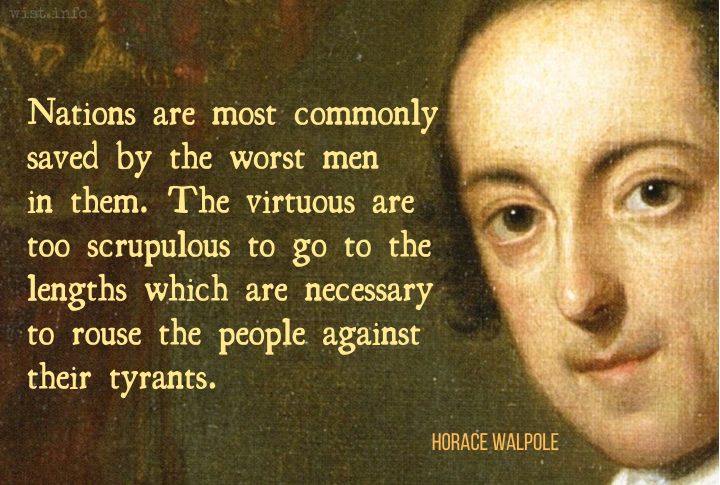
Nations are most commonly saved by the worst men in them. The virtuous are too scrupulous to go to the lengths which are necessary to rouse the people against their tyrants.
Horace Walpole (1717–1797) English novelist, letter writer
Memoirs of the Reign of King George III, Vol. 1, ch. 12 (1859)
(Source)
Variants:
- "The adventurer's career suggests the reflection that nations are usually saved by their worse men, since the virtuous are too scrupulous to go to the lengths needed to rouse the people against their tyrants." (Source)
- "The virtuous are too scrupulous to go to the lengths that are necessary to rouse the people against their tyrants."
- Modern paraphrase: "No great country was ever saved by good men because good men will not go to the lengths necessary to save it."
- Modern paraphrase: "No great country was ever saved by good men, because good men may not go to the lengths that may be necessary."
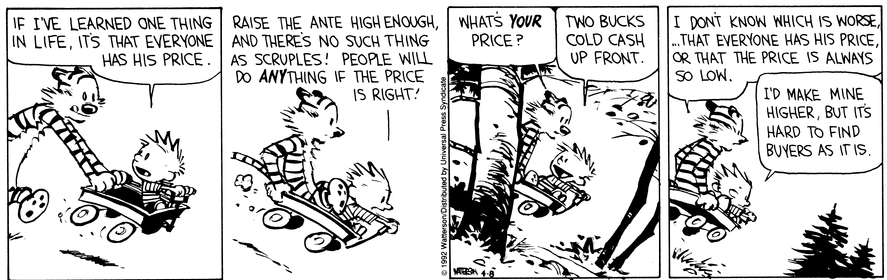
CALVIN: If I’ve learned one thing in life, it’s that everyone has his price. Raise the ante high enough and there’s no such thing as scruples! People will do anything if the price is right!
HOBBES: What’s your price?
CALVIN: Two bucks cold cash up front.
HOBBES: I don’t know which is worse, … that everyone has his price, or that the price is always so low.