My dear fellow, life is infinitely stranger than anything which the mind of man could invent. We would not dare to conceive the things which are really mere commonplaces of existence. If we could fly out of that window hand in hand, hover over this great city, gently remove the roofs, and peep in at the queer things which are going on, the strange coincidences, the plannings, the cross-purposes, the wonderful chains of events, working through generations, and leading to the most outré results, it would make all fiction with its conventionalities and foreseen conclusions most stale and unprofitable.
Arthur Conan Doyle (1859–1930) British writer and physician
Story (1891-09), “A Case of Identity,” [Holmes], The Strand Magazine, Vol. 2, No. 3
(Source)
Quotations about:
real world
Note not all quotations have been tagged, so Search may find additional quotes on this topic.
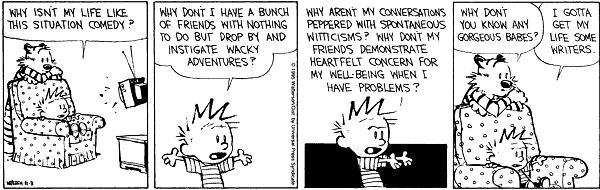
CALVIN: (watching TV) Why isn’t my life like this situation comedy? Why don’t I have a bunch of friends with nothing to do but drop by and instigate wacky adventures? Why aren’t my conversations peppered with spontaneous witticisms? Why don’t my friends demonstrate heartfelt concern for my well-being when I have problems?
HOBBES: Why don’t you know any gorgeous babes?
CALVIN: I gotta get my life some writers.
You can not live at all if you do not learn to adapt yourself to your life as it happens to be.
Eleanor Roosevelt (1884–1962) American politician, diplomat, activist; First Lady of the US (1933–45)
Memoir (1949), This I Remember, ch. 20 “The Last Term: 1944–1945”
(Source)
This passage was not included in her compiled Autobiography (1961).
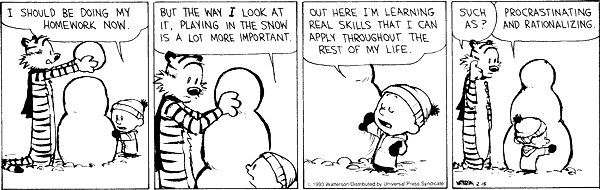
CALVIN: (building a snowman) I should be doing my homework now. But the way I look at it, playing in the snow is a lot more important. Out here I’m learning real skills that I can apply throughout the rest of my life.
HOBBES: Such as?
CALVIN: Procrastinating and rationalizing.
I have known some pacifists who wished history taught without reference to wars, and thought that children should be kept as long as possible ignorant of the cruelty in the world. But I cannot praise the “fugitive and cloistered virtue” that depends upon absence of knowledge. As soon as history is taught at all, it should be taught truthfully. If true history contradicts any moral we wish to teach, our moral must be wrong, and we had better abandon it. I quite admit that many people, including some of the most virtuous, find facts inconvenient, but that is due to a certain feebleness in their virtue. A truly robust morality can only be strengthened by the fullest knowledge of what really happens in the world.
Bertrand Russell (1872–1970) English mathematician and philosopher
Education and the Good Life, Part 2, ch. 11 “Affection and Sympathy” (1926)
(Source)
Grown men, he told himself, in flat contradiction of centuries of accumulated evidence about the way grown men behave, do not behave like this.
Douglas Adams (1952–2001) English author, humorist, screenwriter
Hitchhiker’s Guide No. 4, So Long, and Thanks for All the Fish, ch. 11 [Arthur] (1984)
(Source)

I have a great belief in spiritual force, but I think we have to realize that spiritual force alone has to have material force with it so long as we live in a material world. The two together make a strong combination.
Eleanor Roosevelt (1884–1962) American politician, diplomat, activist; First Lady of the US (1933–45)
Column (1940-05-17), “My Day”
(Source)
The world is a higgledy-piggledy place, containing things pleasant and things unpleasant in haphazard sequence. And the desire to make an intelligible system or pattern out of it is at bottom an outcome of fear, in fact a kind of agoraphobia or dread of open spaces. Within the four walls of his library the timid student feels safe. If he can persuade himself that the universe is equally tidy, he can feel almost equally safe when he has to venture forth into the streets.
Bertrand Russell (1872–1970) English mathematician and philosopher
Conquest of Happiness, Part 2, ch. 12 “Affection” (1930)
(Source)
What is saving my life now is the conviction that there is no spiritual treasure to be found apart from the bodily experiences of human life on earth. My life depends on engaging the most ordinary physical activities with the most exquisite attention I can give them. My life depends on ignoring all touted distinctions between the secular and the sacred, the physical and the spiritual, the body and the soul. What is saving my life now is becoming more fully human, trusting that there is no way to God apart from real life in the real world.
Barbara Brown Taylor (b. 1951) American minister, academic, author
An Altar in the World, Introduction (2009)
(Source)

So, what’s it like in the real world? Well, the food is better, but beyond that, I don’t recommend it.
Bill Watterson (b. 1958) American cartoonist
Commencement Address, Kenyon College (20 May 1990)
(Source)
Anyone who wants to know the human psyche will learn next to nothing from experimental psychology. He would be better advised to [abandon exact science] put away his scholar’s gown, bid farewell to his study, and wander with human heart throughout the world. There in the horrors of prisons, lunatic asylums and hospitals, in drab suburban pubs, in brothels and gambling-hells, in the salons of the elegant, the Stock Exchanges, Socialist meetings, churches, revivalist gatherings and ecstatic sects, through love and hate, through the experience of passion in every form in his own body, he would reap richer stores of knowledge than text-books a foot thick could give him and he will know how to doctor the sick with a real knowledge of the human soul.
The road must be trod, but it will be very hard. And neither strength nor wisdom will carry us far upon it. This quest may be attempted by the weak with as much hope as the strong. Yet such is oft the course of deeds that move the wheels of the world: small hands do them because they must, while the eyes of the great are elsewhere.
J.R.R. Tolkien (1892–1973) English writer, fabulist, philologist, academic [John Ronald Reuel Tolkien]
The Lord of the Rings, Vol. 1: The Fellowship of the Ring, Book 2, ch. 2 “The Council of Elrond” [Elrond] (1954)
(Source)
Possibly the origin of the spurious "Even the smallest person can change the course of the future." This is said by Galadriel, but only in the film version, The Fellowship of the Ring (2001), screenplay by Fran Wash and Philippa Boyens.
More discussion: Not a Tolkien quote: "Even the smallest person can change the course of the future." - thetolkienist.com.
If there was anything that depressed him more than his own cynicism, it was that quite often it still wasn’t as cynical as real life.
Terry Pratchett (1948–2015) English author
Discworld No. 8, Guards! Guards! (1989)
(Source)
Vimes, reflecting.

He that studies books alone, will know how things ought to be; and he that studies men will know how things are.
Charles Caleb "C. C." Colton (1780–1832) English cleric, writer, aphorist
Lacon: Or, Many Things in Few Words, Vol. 1, Preface (1820)
(Source)
Do not imagine that the knowledge, which I so much recommend to you, is confined to books, pleasing, useful, and necessary as that knowledge is: but I comprehend in it the great knowledge of the world, still more necessary than that of books. In truth, they assist one another reciprocally; and no man will have either perfectly, who has not both. The knowledge of the world is only to be acquired in the world and not in a closet. Books alone will never teach it you; but they will suggest many things to your observation, which might, otherwise escape you; and your own observations upon mankind, when compared with those which you will find in books, will help you to fix the true point.
Lord Chesterfield (1694–1773) English statesman, wit [Philip Dormer Stanhope]
Letter to his son, #112 (4 Oct 1746)
(Source)
Studies themselves give forth directions too much at large, except they be bounded by experience.
Francis Bacon (1561–1626) English philosopher, scientist, author, statesman
“Of Studies,” Essays, No. 50 (1625)
(Source)

Do what you need to do.
Graham Ericsson (b. 1961) American technologist, writer, aphorist
Journal (undated)

There is always a “but” in this imperfect world.
Anne Brontë (1820–1849) British novelist, poet [pseud. Acton Bell]
The Tenant of Wildfell Hall, ch. 22 [Helen] (1848)