It is commonly assumed that what human beings want is to be comfortable. Well, we now have it in our power to be comfortable, as our ancestors had not. Nature may occasionally hit back with an earthquake or a cyclone, but by and large she is beaten. And yet exactly at the moment when there is, or could be, plenty of everything for everybody, nearly our whole energies have to be taken up in trying to grab territories, markets and raw materials from one another. Exactly at the moment when wealth might be so generally diffused that no government need fear serious opposition, political liberty is declared to be impossible and half the world is ruled by secret police forces. Exactly at the moment when superstition crumbles and a rational attitude towards the universe becomes feasible, the right to think one’s own thoughts is denied as never before. The fact is that human beings only started fighting one another in earnest when there was no longer anything to fight about.
George Orwell (1903–1950) English journalist, essayist, writer [pseud. of Eric Arthur Blair]
Essay (1946-11-29), “As I Please” column, Tribune Newspaper
(Source)
Quotations about:
possibilities
Note not all quotations have been tagged, so Search may find additional quotes on this topic.
We cannot all do everything.
[Non omnia possumus omnes.]Virgil (70–19 BC) Roman poet [b. Publius Vergilius Maro; also Vergil]
Eclogues [Eclogae, Bucolics, Pastorals], No. 8 “Pharmaceutria,” l. 63 (8.63) (42-38 BC) [tr. Mackail (1899)]
(Source)
Invoking the Pierian Muses to finish the tale, after the singer has given the first half.
(Source (Latin)). Other translations:All cannot all things do.
[tr. Ogilby (1649)]We cannot all do all things.
[tr. Davidson (1854), Wilkins (1873), Greenough (1895), Day Lewis (1963), @sentantiq (2018)]Scarce may all do everything.
[tr. Calverley (c. 1871)]We are not equal all
To every theme.
[tr. Palmer (1883)]All things are not possible to all.
[tr. Bryce (1897)]We cannot all do everything.
[tr. Fairclough (Loeb) (1916)]We are not all sufficient for all things.
[tr. Mackail/Cardew (1908)]No single singer touches all the chords.
[tr. Williams (1915)]We cannot all succeed in every task.
[tr. Rieu (1949)]For none of us all is skilful in all things.
[tr. Johnson (1960)]We are not all capable of all things.
[tr. Kline (2001)]
There is said to be hope for a sick man, as long as there is life.
[Ut aegroto dum anima est, spes esse dicitur.]
Marcus Tullius Cicero (106–43 BC) Roman orator, statesman, philosopher
Epistulae ad Atticum [Letters to Atticus], Book 9, Letter 10, sec. 3 (9.10.3) (49 BC) [tr. Shackleton Bailey (1968), # 177]
(Source)
Cicero says this was his feeling of hope for how things would turn out, as long as Pompey was in Italy -- which he had just evacuated from. Cicero makes it clear this is a common phrase at the time, usually expressed more straightforwardly as "While there is life there is hope" [Dum anima est, spes est.]
(Source (Latin)). Other translations:But as we say of sick people, "while there is life there is hope."
[tr. Jeans (1880), # 63]As in the case of a sick man one says, "While there is life there is hope."
[tr. Shuckburgh (1900), # 364]As a sick man is said to have hope, so long as he has breath.
[tr. Winstedt (Loeb) (1913)]
So it is not a matter of whether it is possible to attain Buddhahood, or if it is possible to make a tile a jewel. But just to work, just to live in this world with this understanding is the most important point, and that is our practice. That is true zazen.
Shunryū Suzuki (1905–1971) Japanese Zen Buddhist master
Lecture in Los Altos, California (1 Sep 1967)
(Source)
A babe is nothing but a bundle of possibilities.
Henry Ward Beecher (1813–1887) American clergyman and orator
Proverbs from Plymouth Pulpit, “Children” (1887) [ed. William Drysdale]
(Source)
“You mean,” said Lucy rather faintly, “that it would have turned out all right—somehow? But how? Please, Aslan! Am I not to know?”
“To know what would have happened, child?” said Aslan. “No. Nobody is ever told that.”
“Oh dear,” said Lucy.
“But anyone can find out what will happen,” said Aslan. “If you go back to the others now, and wake them up; and tell them you have seen me again; and that you must all get up at once and follow me — what will happen? There is only one way of finding out.”
C. S. Lewis (1898–1963) English writer, literary scholar, lay theologian [Clive Staples Lewis]
Prince Caspian (1951)
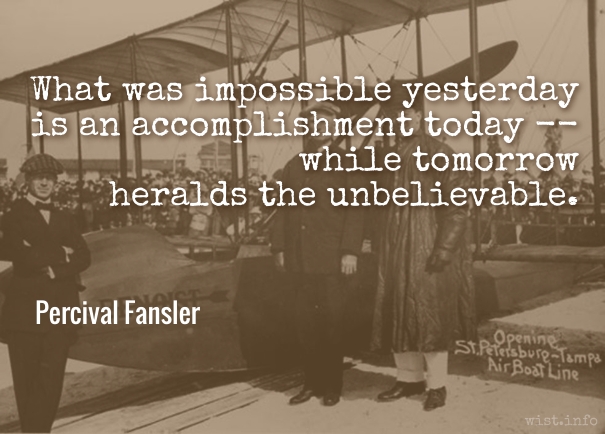
What was impossible yesterday is an accomplishment today — while tomorrow heralds the unbelievable.
Percival E. Fansler (1883–1937) American engineer, businessman, entrepreneur
Speech, First Scheduled Commercial Airline Flight, St. Petersburg, Florida (1 Jan 1914)
Surely, in the light of history, it is more intelligent to hope rather than to fear, to try rather than not to try. For one thing we know beyond all doubt: Nothing has ever been achieved by the person who says, “It can’t be done.”
Eleanor Roosevelt (1884–1962) American politician, diplomat, activist; First Lady of the US (1933–45)
You Learn By Living (1960)
Studies themselves give forth directions too much at large, except they be bounded by experience.
Francis Bacon (1561–1626) English philosopher, scientist, author, statesman
“Of Studies,” Essays, No. 50 (1625)
(Source)
What, after all, has maintained the human race on this old globe, despite all the calamities of nature and all the tragic failings of mankind, if not faith in new possibilities and courage to advocate them?
Jane Addams (1860–1935) American reformer, suffragist, philosopher, author
Peace and Bread in Time of War, ch. 7 “Personal Reactions During War” (1922)
(Source)
A man’s worst difficulties begin when he is able to do as he likes. So long as a man is struggling with obstacles he has an excuse for failure or shortcoming; but when fortune removes them all and gives him the power of doing as he thinks best, then comes the time of trial. There is but one right, and the possibilities of wrong are infinite.
T. H. Huxley (1825–1895) English biologist [Thomas Henry Huxley]
“Address on University Education,” opening ceremonies of Johns Hopkins University, Baltimore (12 Sep 1876)
(Source)
Politics is not the art of the possible. It consists in choosing between the disastrous and the unpalatable.
John Kenneth Galbraith (1908–2006) Canadian-American economist, diplomat, author
Letter (1962-03-02) to Pres. John Kennedy
(Source)
Quoted in Galbraith, Ambassador’s Journal, ch. 15 (1969). On the need to seek a settlement with Hanoi over the growing conflict in Viet Nam.
"Politics is the art of the possible" was a comment by Otto von Bismarck.
Inquiry is fatal to certainty.
William James (Will) Durant (1885–1981) American historian, teacher, philosopher
The Age of Faith, ch. 38 “The Age of Romance” (1950)
(Source)
There is no saint without a past, no sinner without a future.
Mirza Aḥmad Sohráb (1890–1958) Persian-American author, Baháʼí dissident
A Persian Rosary of Nineteen Pearls (1929)
I am unable to find an extant copy of Sohrab's book; despite his involvement with some of the early principals of the Baháʼí faith, he was eventually expelled from the group, and his writings, already marginally published, are now difficult to find. Even the publication dates of various editions of this work are unclear. But there are references to this quote being sourced there (1, 2, 3, 4).
This book should not be confused with the Persian Rosary (1257), a compendium of ethics by Persian poet Eddin Sadi.
Often misattributed to St. Augustine of Hippo, or referred to as being from an "ancient Persian Mass." There is no indication, though, that Sohrab borrowed the phrase from Oscar Wilde's similar statement.
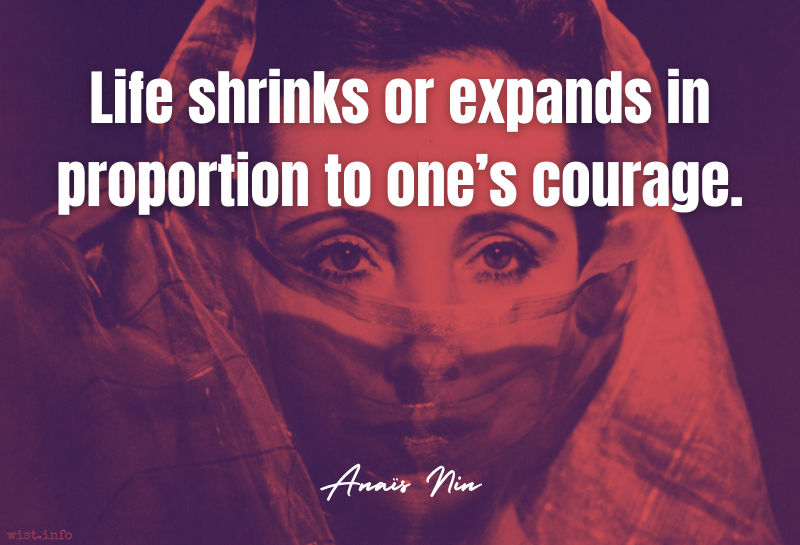
Life shrinks or expands in proportion to one’s courage.
Anaïs Nin (1903–1977) Catalan-Cuban-French author, diarist
Diary (1941-06)
(Source)
In her Diaries [ed. Stuhlmann (1969)].