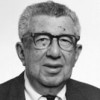
Almost all of us want to be richer than we are, even if we are very rich indeed. To be sure, there are exceptions; saints, ascetics, those who travel light and will not add even the weight of a wallet, a few whose material ambitions are fully satisfied and who therefore truly want nothing further. But the rest of us want more than we have, and the specially thoughtful sometimes wonder whether there could ever come a time when we didn’t.
The crucial question, though, leaving out of consideration the exempted categories, is: what are we willing to do to increase our wealth?Bernard Levin (1928–2004) British journalist, critic, broadcaster, satirist
Essay (1989-03-23), “Do You Seriously Want to Be Swindled?” The Times, London
Collected in Now Read On (1980).
Quotations about:
limits
Note not all quotations have been tagged, so Search may find additional quotes on this topic.

We cannot all do everything.
[Non omnia possumus omnes.]Virgil (70–19 BC) Roman poet [b. Publius Vergilius Maro; also Vergil]
Eclogues [Eclogae, Bucolics, Pastorals], No. 8 “Pharmaceutria,” l. 63 (8.63) (42-38 BC) [tr. Mackail (1899)]
(Source)
Invoking the Pierian Muses to finish the tale, after the singer has given the first half.
(Source (Latin)). Other translations:All cannot all things do.
[tr. Ogilby (1649)]We cannot all do all things.
[tr. Davidson (1854), Wilkins (1873), Greenough (1895), Day Lewis (1963), @sentantiq (2018)]Scarce may all do everything.
[tr. Calverley (c. 1871)]We are not equal all
To every theme.
[tr. Palmer (1883)]All things are not possible to all.
[tr. Bryce (1897)]We cannot all do everything.
[tr. Fairclough (Loeb) (1916)]We are not all sufficient for all things.
[tr. Mackail/Cardew (1908)]No single singer touches all the chords.
[tr. Williams (1915)]We cannot all succeed in every task.
[tr. Rieu (1949)]For none of us all is skilful in all things.
[tr. Johnson (1960)]We are not all capable of all things.
[tr. Kline (2001)]
And though mine arm should conquer twenty worlds,
There’s a lean fellow beats all conquerors.Thomas Dekker (c. 1572–1632) English dramatist and pamphleteer
Old Fortunatus, Act 1, sc. 1, l. 281 (1599)
(Source)

It is the mark of a child not an adult to desire without measure.
[Παιδός, οὐκ ἀνδρὸς τὸ ἀμέτρως ἐπιθυμεῖν.]
Democritus (c. 460 BC - c. 370 BC) Greek philosopher
Frag. 70 (Diels) [tr. @sententiq (2018), fr. 69]
(Source)
People who have never really wielded power always have illusions about how much those who have power can really do.
Thomas Friedman (b. 1953) American journalist, columnist, author
From Beirut to Jerusalem, ch. 8 (1989)
(Source)

Nothing is more dangerous than an idea when it is the only one we have.
[Rien n’est plus dangereux qu’une idée, quand on n’a qu’une idée.]
Alain (1868–1951) French philosopher, journalist, pacifist [pseud. for Émile-Auguste Chartier]
Propos sur la religion, #74 (1938)
Alt. trans.: "Nothing is more dangerous than an idea, when you have only one idea."
Sometimes also quoted as "Rien n'est plus dangereux qu'une idée lorsque c'est la seule idée que vous avez."
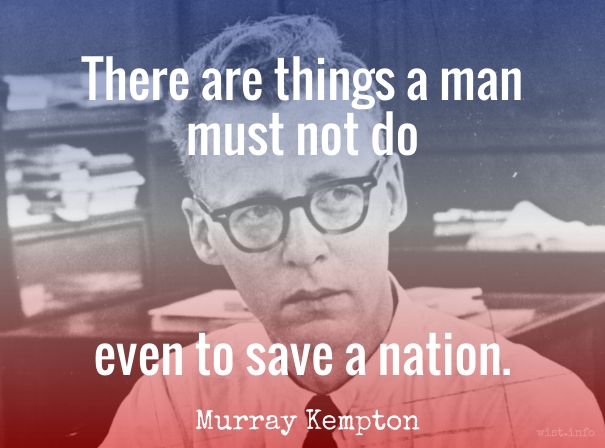
There are things a man must not do even to save a nation.
Murray Kempton (1917–1997) American journalist.
“To Save a Nation,” America Comes of Age (1963)

The enemy of art is the absence of limitations.
Orson Welles (1915–1985) American writer, director, actor
Comment to Henry Jaglom
Quoted by Jaglom in his essay "The Independent Filmmaker" in Jason E. Quire, ed. The Movie Business Book (1992). See here for more information. Sometimes paraphrased in reverse ("The absence of limitations is the enemy of art").
In view of the fact that God limited the intelligence of man, it seems unfair that he did not also limit his stupidity.
Konrad Adenauer (1876–1967) German politician
(Attributed)
Quoted by Dean Atchison in Arthur Schlesinger, A Thousand Days, ch. 11 (1965).
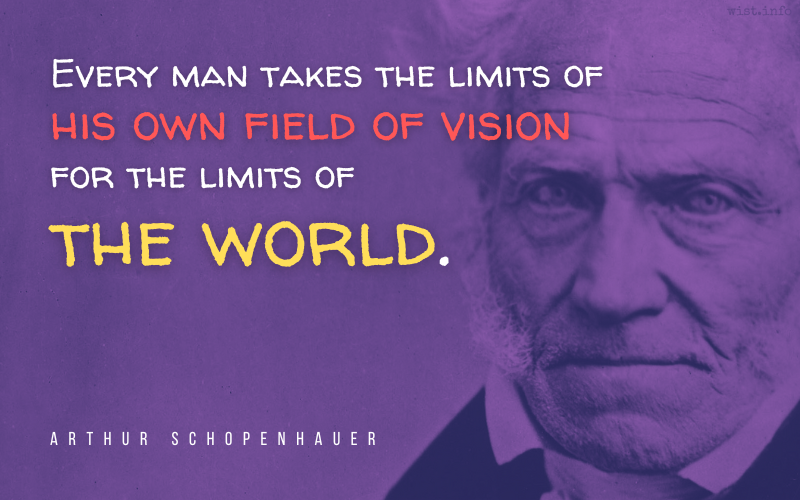
Every man takes the limits of his own field of vision for the limits of the world.
[Jeder hält das Ende seines Gesichtskreises für das der Welt.]
Arthur Schopenhauer (1788–1860) German philosopher
Parerga and Paralipomena, Vol. 2, ch. 26 “Psychological Observations [Psychologische Bemerkungen],” § 338 (1851) [tr. Saunders (1890)]
(Source)
(Source (German)). Another translation:Everyone regards the limits of his field of vision as those of the world.
[tr. Payne (1974)]
If something cannot go on forever, it will stop.
Herb Stein (1916–1999) American economist
Stein’s Law (1980s)
(Source)
This was a frequent statement by Stein. He explained it so:This proposition, arising first in a discussion of the balance-of-payments deficit, is a response to those who think that if something cannot go on forever, steps must be taken to stop it -- even to stop it at once.
Variants:
- "If something can’t go on forever, it won’t."
- Anything that can’t go on, won’t.
- Trends that can't continue won't.