

When we finally got down to something, which the individual says he really wants to do, I will say to him, you do that and forget the money, because, if you say that getting the money is the most important thing, you will spend your life completely wasting your time. You’ll be doing things you don’t like doing in order to go on living, that is to go on doing things you don’t like doing — which is stupid!
Alan Watts (1915–1973) Anglo-American philosopher, writer
Lecture (1969 ca.), “What If Money Was No Object?”
(Source)
Quotations about:
goals
Note not all quotations have been tagged, so Search may find additional quotes on this topic.

The values communicated by status-insecure parents are such that their children learn to put personal success and the acquisition of power above all else. They are taught to judge people for their usefulness rather than their likableness. Their friends, and even future marriage partners, are selected and used in the service of personal advancement; love and affection take second place to knowing the right people. They are taught to eschew weaknesses and passivity, to respect authority, and to despise those who have not made the socio-economic grade. Success is equated with social esteem and material advantage, rather than with more spiritual values.
Norman F. Dixon (1922–2013) British cognitive psychologist, author, military engineer
On the Psychology of Military Incompetence, Part 2, ch. 22 “Authoritarianism” (1976)
(Source)

SARAH JANE: You’re serious, aren’t you?
THE DOCTOR: About what I do, yes. Not necessarily the way I do it.
Doctor Who (1963–1989) British science fiction television series, original run (BBC)
11×01 “The Time Warrior,” Part 3 (1973-12-29) [w. Robert Holmes]
(Source)
(Source (Video)). Often Sarah Jane's line is misquoted as "Doctor, are you serious?"

For my part, the thing that I would wish to obtain from money would be leisure with security. But what the typical modern man desires to get with it is more money, with a view to ostentation, splendour, and the outshining of those who have hitherto been his equals.
Bertrand Russell (1872–1970) English mathematician and philosopher
Conquest of Happiness, Part 1, ch. 3 “Competition” (1930)
(Source)
This is the richest and most powerful country which ever occupied the globe. The might of past empires is little compared to ours. But I do not want to be the President who built empires, or sought grandeur, or extended dominion.
I want to be the President who educated young children to the wonders of their world.
I want to be the President who helped to feed the hungry and to prepare them to be taxpayers instead of tax-eaters.
I want to be the President who helped the poor to find their own way and who protected the right of every citizen to vote in every election.
I want to be the President who helped to end hatred among his fellow men and who promoted love among the people of all races and all regions and all parties.
I want to be the President who helped to end war among the brothers of this earth.Lyndon B. Johnson (1908–1973) American politician, educator, US President (1963–69)
Speech (1965-03-15), “The American Promise,” Joint Session of Congress [43:30]
(Source)

Even within the university world, where the highest calling should be to spark the fires of intellectual exploration and to prepare young minds for engaged and productive participation in our democracy, the mandates of the market have attained prominence. The narrow quest for success crowds out the noble effort to be great — greatness understood as using one’s success to make the world a better place for all.
Cornel West (b. 1953) American philosopher, political activist, social critic
Democracy Matters, ch. 6 (2004)
(Source)
When I was a student, we used to sit around discussing whether a particular end justified a particular means. On the assumption of everyone from Marx or Machiavelli, I thought that was the question. It took me twenty years to figure out that the means are the ends — and vice versa. Whatever means you use become an organic part of the ends you achieve.
Gloria Steinem (1934–2026) American feminist, journalist, activist
Commencement address, Tufts University (1987-05-17)
(Source)

It occurs to me that there is a proper balance between not asking enough of oneself and asking or expecting too much. It may be that I set my sights too high and so repeatedly end a day in depression. Not easy to find the balance, for it one does not have wild dreams of achievement, there is no spur even to get the dishes washed. One must think like a hero to behave like a merely decent human being.
May Sarton (1912–1995) Belgian-American poet, novelist, memoirist [pen name of Eleanore Marie Sarton]
Journal of a Solitude, “February 4th” (1973)
(Source)

What you have become is the price you paid to get what you used to want.
Mignon McLaughlin (1913–1983) American journalist and author
The Neurotic’s Notebook, ch. 5 (1963)
(Source)

Our responsibility is not discharged by an announcement of virtuous ends. Our responsibility is to achieve these objectives with social invention, with political skill, and executive vigor. I believe for these reasons, that liberalism is our best and our only hope in the world today.
John F. Kennedy (1917–1963) American politician, author, journalist, US President (1961–63)
Speech, Liberal Party Nomination, New York (14 Sep 1960)
(Source)

So it is not a matter of whether it is possible to attain Buddhahood, or if it is possible to make a tile a jewel. But just to work, just to live in this world with this understanding is the most important point, and that is our practice. That is true zazen.
Shunryū Suzuki (1905–1971) Japanese Zen Buddhist master
Lecture in Los Altos, California (1 Sep 1967)
(Source)

CHARLIE MCCARTHY: Ambition is a poor excuse for not having sense enough to be lazy.
Edgar Bergen (1903–1978) American actor, radio performer, ventriloquist
(Attributed)

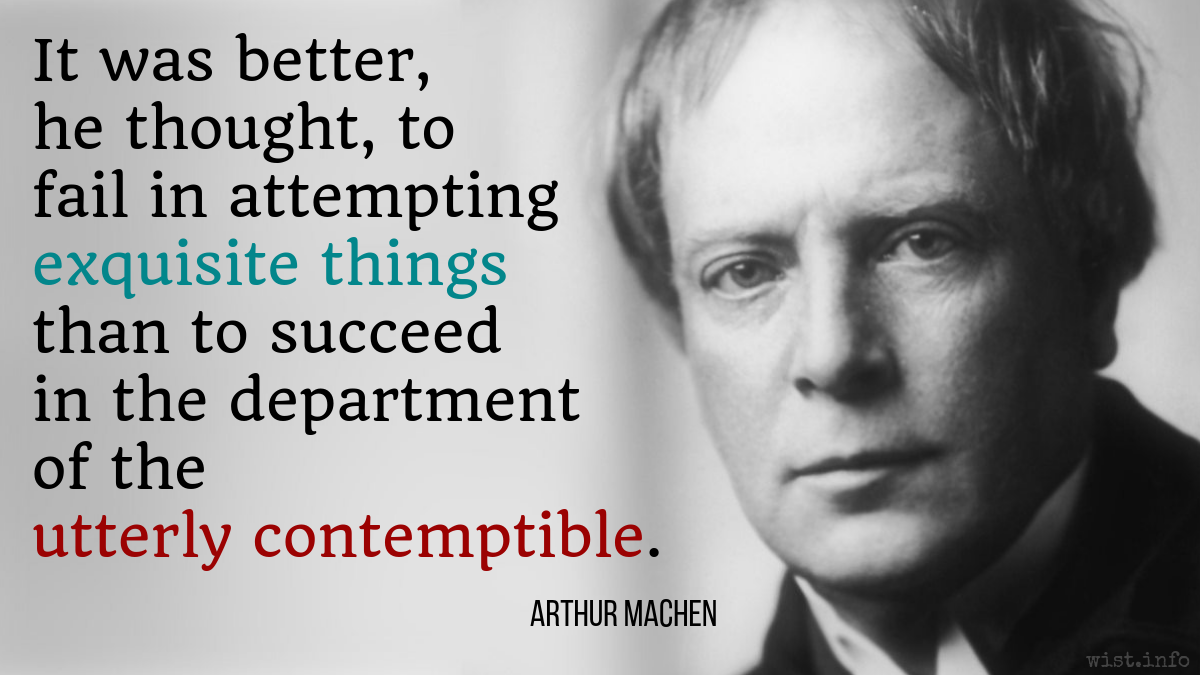
It was better, he thought, to fail in attempting exquisite things than to succeed in the department of the utterly contemptible.

Keep away from people who try to belittle your ambitions. Small people always do that, but the really great make you feel that you, too, can become great.
Mark Twain (1835–1910) American writer [pseud. of Samuel Clemens]
(Attributed)
Quoted in Gay Zenola MacLaren, Morally We Roll Along (1938). A recollection of something Twain said to the author when she was a child. For further discussion, see Quote Origin: Keep Away from People Who Try to Belittle Your Ambitions – Quote Investigator®.

I have tried to make it clear that it is wrong to use immoral means to attain moral ends. But now I must affirm that it is just as wrong, or even more so, to use moral means to preserve immoral ends.
Martin Luther King, Jr. (1929–1968) American clergyman, civil rights leader, social activist, preacher
Letter from Birmingham Jail (16 Apr 1963)
(Source)

The man who sticks to his plan will become what he used to want to be.
James Richardson (b. 1950) American poet
Vectors: Aphorisms and Ten Second Essays, #349 (2001)

There are many who find a good alibi far more attractive than an achievement. For an achievement does not settle anything permanently. We still have to prove our worth anew each day: we have to prove that we are as good today as we were yesterday. But when we have a valid alibi for not achieving anything we are fixed, so to speak, for life. Moreover, when we have an alibi for not writing a book, painting a picture, and so on, we have an alibi for not writing the greatest book and not painting the greatest picture. Small wonder that the effort expended and the punishment endured in obtaining a good alibi often exceed the effort and grief requisite for the attainment of a most marked achievement.
Eric Hoffer (1902–1983) American writer, philosopher, longshoreman
Passionate State of Mind, Aphorism 181 (1955)
(Source)

“Now … if you trust in yourself …”
“Yes?”
“… and believe in your dreams …”
“Yes?”
“… and follow your star …” Miss Tick went on.
“Yes?”
“… you’ll still be beaten by people who spent their time working hard and learning things and weren’t so lazy.”Terry Pratchett (1948–2015) English author
Discworld No. 30, The Wee Free Men (2003)

A politician, for example, is a man who thinks of the next election; while the statesman thinks of the next generation.
James Freeman Clarke (1810–1888) American theologian and author
“Wanted, a Statesman!”, Old and New Magazine (Dec 1870)
(Source)
Often paraphrased: "A politician thinks of the next election; a statesman thinks of the next generation."

Sooner or later, we are all asked to compromise ourselves and the things we care about. We define ourselves by our actions. With each decision, we tell ourselves and the world who we are. Think about what you want out of this life, and recognize that there are many kinds of success.
Bill Watterson (b. 1958) American cartoonist
Commencement Address, Kenyon College (20 May 1990)
(Source)

Higher aims are in themselves more valuable, even if unfulfilled, than lower ones quite attained.
[Die höheren Forderungen sind an sich schon schikbarer, auch unerfüllt, als niedrige, ganz erfüllte.]
Johann Wolfgang von Goethe (1749–1832) German poet, statesman, scientist
Sprüche in Prosa: Maximen und Reflexionen [Proverbs in Prose: Maxims and Reflections] (1833) [tr. Saunders (1893), “Literature and Art,” #500]
(Source)
(Source (German)). Other translations:Aims of a higher order, even though they be not fulfilled, are in themselves more valuable than lower ones entirely fulfilled.
[tr. Rönnfeldt (1900)]Higher demands, even unfulfilled, are in themselves more worthy of esteem than lower demands completely fulfilled.
[tr. Stopp (1995), "Posthumous," #1085]

How dull, how impossible life would be without dreams — waking dreams, I mean — the dreams that we call “castles in the air,” built by the kindly hands of Hope! Were it not for the mirage of the oasis, drawing his footsteps ever onward, the weary traveler would lie down in the desert sand and die. It is the mirage of distant success, of happiness that, like the bunch of carrots fastened an inch beyond the donkey’s nose, seems always just within our reach, if only we will gallop fast enough, that makes us run so eagerly along the road of Life.
Jerome K. Jerome (1859–1927) English writer, humorist [Jerome Klapka Jerome]
“Dreams” (1886)
(Source)
The only index by which to judge a government or a way of life is by the quality of the people it acts upon. No matter how noble the objectives of a government, if it blurs decency and kindness, cheapens human life, and breeds ill will and suspicion — it is an evil government.
Eric Hoffer (1902–1983) American writer, philosopher, longshoreman
Passionate State of Mind, Aphorism 147 (1955)
(Source)
In the tragic days of Mussolini, the trains in Italy ran on time as never before and I am told in their way, their horrible way, that the Nazi concentration-camp system in Germany was a model of horrible efficiency. The really basic thing in government is policy. Bad administration, to be sure, can destroy good policy, but good administration can never save bad policy.
Adlai Stevenson II (1900–1965) American politician, diplomat, statesman
Speech (1952-09-11), “On Political Morality,” Town Hall Luncheon, Biltmore Hotel, Los Angeles
(Source)
There are two things to aim at in life: first, to get what you want; and, after that, to enjoy it. Only the wisest of mankind achieve the second.
Logan Pearsall Smith (1865–1946) American-English essayist, editor, anthologist
Afterthoughts, “Life and Human Nature” (1931)
Far away in the sunshine are my highest aspirations. I may not reach them, but I can look up and see the beauty, believe in them and try to follow where they lead.
Louisa May Alcott (1832–1888) American writer
Work: A Story of Experience ch. 12 [Christie] (1875)
(Source)

If you have built castles in the air, your work need not be lost; that is where they should be. Now put the foundations under them.
Henry David Thoreau (1817–1862) American philosopher and writer
Walden; or, Life in the Woods, ch. 18 “Conclusion” (1854)
(Source)

Happiness is someone to love, something to do, and something to hope for.
Proverbs, Sayings, and Adages
Chinese proverb
Also attributed to T. Bodett, S. Freud, A. Chalmers.

Far better it is to dare mighty things, even though checkered by failure, than to take rank with those who neither enjoy much or suffer much, because they live in the gray twilight that knows not victory nor defeat.
Theodore Roosevelt (1858–1919) American politician, statesman, conservationist, writer; US President (1901–09)
Speech (1899-04-10), “The Strenuous Life,” Hamilton Club, Chicago
(Source)
The empty pageant; a stage play; flocks of sheep, herds of cattle; a tussle of spearmen; a bone flung among a pack of curs; a crumb tossed into a pond of fish; ants, loaded and laboring; mice, scared and capering; puppets, jerking on their strings — that is life.
In the midst of it all you must take your stand, good-temperedly and without disdain, yet always aware that a man’s worth is no greater than the worth of his ambitions.[Πομπῆς κενοσπουδία, ἐπὶ σκηνῆς δράματα, ποίμνια, ἀγέλαι, διαδορατισμοί, κυνιδίοις ὀστάριον ἐρριμμένον, ψωμίον εἰς τὰς τῶν ἰχθύων δεξαμενάς, μυρμήκων ταλαιπωρίαι καὶ ἀχθοφορίαι, μυιδίων ἐπτοημένων διαδρομαί, σιγιλλάρια νευροσπαστούμενα.
χρὴ οὖν ἐν τούτοις εὐμενῶς μὲν καὶ μὴ καταφρυαττόμενον ἑστάναι, παρακολουθεῖν μέντοι, ὅτι τοσούτου ἄξιος ἕκαστός ἐστιν, ὅσου ἄξιά ἐστι ταῦτα περὶ ἃ ἐσπούδακεν.]Marcus Aurelius (AD 121–180) Roman emperor (161–180), Stoic philosopher
Meditations [To Himself; Τὰ εἰς ἑαυτόν], Book 7, ch. 3 (7.3) (AD 161-180) [tr. Staniforth (1964)]
(Source)
(Source (Greek)). Other translations:Public shows and solemnities with much pomp and vanity, stage plays, flocks and herds; conflicts and contentions: a bone thrown to a company of hungry curs; a bait for greedy fishes; the painfulness, and continual burden-bearing of wretched ants, the running to and fro of terrified mice: little puppets drawn up and down with wires and nerves: these be the objects of the world.
Among all these thou must stand steadfast, meekly affected, and free from all manner of indignation; with this right ratiocination and apprehension; that as the worth is of those things which a man doth affect, so is in very deed every man's worth more or less.
[tr. Casaubon (1634)]Gazing after Triumphs, and Cavalcades; the Diversions of the Stage-Farms well stock'd with Flocks and Herds; contests for Victory in the Field; These are the little Pleasures, and concerns of Mortals. Would you have a farther Illustration, and see an Image of them elsewhere? Fancy then that you saw two or three Whelps quarrelling about a Bone; Fishes scrambling for a Bait, Pismires in a peck of troubles about the Carriage of a Grain of Wheat; Mice frighted out of their Wits, and scouring cross the Room; Poppets danced upon a Wire, &c.
And after all, tho' Humane Life is but ordinary, and trifling, a Wise Man must be easie and Good-humour'd, and not grow Splenetick, or Haughty upon the Contemplation. Remembring notwithftanding, that the true Bulk and Bigness of a Man, is to be measur'd by the size of his Business, and the Quality of his Inclinations.
[tr. Collier (1701)]The vain solicitude about shows, scenical representations, flocks and herds, skirmishing, little bones cast in for contention among little dogs, baits cast into a fish-pond, the toiling of Ants, and their carrying of burdens, the fluttering of affrighted flies, the involuntary agitations of puppets by wires!
We ought to persist amidst such things with good-nature, without storming at them; and be persuaded that such is the worth of each person, as is the value of the things he pursues.
[tr. Hutcheson/Moor (1742)]A fondness for pompous processions, grand exhibitions on the stage, or skirmishes in the amphitheatre; the care of flocks and herds; these are some of the solemn amusements of mankind; and are of much the same importance as the quarrelling of dogs for a bone, of fishes catching at a bait, an hillock of ants in an uproar about carrying a grain of corn, of mince scampering across a room in a fright, or puppets danced on wires. Such is the bustle of human life!
Let us, however, amidst this ludicrous scene of things not be out of humour, but contemplate it with complacency and benevolence; remembering always to estimate the value of men by the utility of those employments on which they bestow their attention.
[tr. Graves (1792)]The idle business of show, plays on the stage, flocks of sheep, herds, exercises with spears, a bone cast to little dogs, a bit of bread into fishponds, laborings of ants and burden-carrying, runnings about of frightened little mice, puppets pulled by strings -- [all alike].
It is thy duty then in the midst of such things to show good humor and not a proud air; to understand however that every man is worth just so much as the things are worth about which he busies himself.
[tr. Long (1862)]Gazing after shows, the diversions of the stage, farms well stocked with flocks and herds, contests for victory in the field are all much the same. So, too, a bone thrown to puppies, fishes scrambling for a bait, ants laboriously carrying a grain of wheat, mice frighted out of their wits and running away, puppets danced upon a wire.
And in the midst of them a wise man must be good-humored, and not grow haughty in the contemplation. Remembering, notwithstanding, that the true worth of a man is to be measured by the objects he pursues.
[tr. Collier/Zimmern (1887)]A mimic pageant, a stage spectacle, flocking sheep and herding cows, an armed brawl, a bone flung to curs, a crumb dropped in the fish-tanks, toiling of burdened ants, the scamper of scurrying mice, puppets pulled with strings -- such is life.
In such surroundings you must take your stand, considerate and undisdainful; yet understand the while, that the measure of the man's worth is the worth of his aims.
[tr. Rendall (1898)]Your vain concern for shows, for stage plays, for flocks and herds, your little combats, are as bones cast for the contention of puppies, as baits dropped into a fishpond, as the toil of ants and the burdens that they bear, as the scampering of frightened mice, or the antics of puppets jerked by wires.
It is then your duty amid all this to stand firm, kindly and not proud, yet to understand that a man’s worth is just the worth of that which he pursues.
[tr. Hutcheson/Chrystal (1902)]Empty love of pageantry, stage-plays, flocks and herds, sham-fights, a bone thrown to lap-dogs, crumbs cast in a fish-pond, painful travail of ants and their bearing of burdens, scurryings of scared little mice, puppets moved by strings.
Amid such environment therefore thou must take thy place graciously and not "snorting defiance," nay thou must keep abreast of the fact that everyone is worth just so much as those things are worth in which he is interested.
[tr. Haines (Loeb) (1916)]A procession's vain pomp, plays on a stage, flocks, herds, sham fights, a bone thrown to puppies, a crumb into fishponds, toiling and moiling of ants carrying their loads, scurrying of startled mice, marionettes dancing to strings.
Well, then, you must stand up in all this, kindly and not carrying your head proudly; yet understand that every man is worth just so much as the worth of what he has set his heart upon.
[tr. Farquharson (1944)]The idle pageantry of a procession, plays on the stage, flocks and herds, the clahsing of spears, a bone tossed to puppies, a scrap of bread cast into a fishpond, the wretched labours of overladen ants, the scurryings of stargled mice, puppets pulled about on their strings.
You must take your place, then, in the midst of all this, with a good grace and without assuming a scornful air; and yet, at the same time, keep in mind that a person's worth is measured by the worth of what he has set his heart on.
[tr. Hard (1997 ed.)]Pointless bustling of processions, opera arias, herds of sheep and cattle, military exercises. A bone flung to pet poodles, a little food in the fish tank. The miserable servitude of ants, scampering of frightened mice, puppets jerked on strings.
Surrounded as we are by all of this, we need to practice acceptance. Without disdain. But remembering that our own worth is measured by what we devote our energy to.
[tr. Hays (2003)]The empty pomp of a procession, plays on the stage, flocks and herds, jousting shows, a bone thrown to puppies, tit-bits into the fishponds, ants toiling and carrying, the scurries of frightened mice, puppets dancing on their strings.
Well, amid all this you must keep yourself tolerant -- do not snort at them. But bear in mind that a person’s worth is measured by the worth of what he values.
[tr. Hammond (2006)]The idle pageantry of a procession, plays on a stage, flocks and herds, the clashing of spears, a bone tossed to puppies, a scrap of bread cast into a fishpond, the wretched labours of overladen ants, the scurryings of startled mice, puppets pulled about on their strings.
You must take your place, then in, the midst of all this, with a good grace and without assuming a scornful air; and yet, at the same time, keep in mind that a person's worth is measured by the worth of what he has set his heart on.
[tr. Hard (2011 ed.)]Each man is as worthy as his endeavours are worthy.
[ed. Taplin (2016)]

For myself, I would see the White Tree in flower again in the courts of the kings, and the Silver Crown return, and Minas Tirith in peace: Minas Anor again as of old, full of light, high and fair, beautiful as a queen among other queens; not as a mistress of many slaves, nay, not even a kind mistress of willing slaves. War must be, while we defend our lives against a destroyer who would devour all; but I do not love the bright sword for its sharpness, nor the arrow for its swiftness, nor the warrior for his glory. I love only that which they defend: the city of the Men of Númenor, and I would have her loved for her memory, her ancientry, her beauty, and her present wisdom. Not feared, save as men may fear the dignity of a man, old and wise.
J.R.R. Tolkien (1892–1973) English writer, fabulist, philologist, academic [John Ronald Reuel Tolkien]
The Lord of the Rings, Vol. 2: The Two Towers, Book 4, ch. 5 “The Window on the West” [Faramir] (1954)
(Source)
