A statesman gains little by the arbitrary exercise of iron-clad authority upon all occasions that offer, for this wounds the just pride of his subordinates, and thus tends to undermine his strength. A little concession, now and then, where it can do no harm, is the wiser policy.
Mark Twain (1835–1910) American writer [pseud. of Samuel Clemens]
Novel (1889), A Connecticut Yankee in King Arthur’s Court, Part 3 “The Tale of the Lost Land,” ch. 17 “A Royal Banquet”
(Source)
Quotations about:
statesman
Note not all quotations have been tagged, so Search may find additional quotes on this topic.
Politics is the most hazardous of all professions. There is not another in which a man can hope to do so much good to his fellow creatures; neither is there any in which by a mere loss of nerve he may do such widespread harm. Nor is there another in which he may so easily lose his own soul; nor is there another in which a positive and strict veracity is so difficult. But danger is the inseparable companion of honor. With all the temptations and degradations that beset it, politics is still the noblest career any man can choose.
Andrew Oliver (1706–1774) American Colonial merchant, politician, government official
Speech (1774?)
(Source)
I cannot find an original source for this. It shows up frequently in the US Congressional Record, especially after it was used by Adlai Stevenson in a 1952 campaign speech.
It is also attributed to his same-named son (1731-1799), who founded the Political Journal.
However, it is the Part of a great Politician to make the Character of his People; to extinguish among them the Follies and Vices that he sees, and to create in them the Virtues and Abilities which he sees wanting. I wish I was sure that America has one such Politician, but I fear she has not.
John Adams (1735–1826) American lawyer, Founder, statesman; US President (1797–1801)
Letter (1776-01-08) to Mercy Otis Warren
(Source)
A politician divides mankind into two classes: tools and enemies. That means he knows only one class: enemies.
Friedrich Nietzsche (1844–1900) German philosopher and poet
(Attributed)
(Source)
This is frequently attributed to Nietzsche, without citation -- a clue that it is a paraphrase of a more complex or nuanced passage. I found only one reference online that mentioned a source -- Nietzsche's Human, All Too Human (1880) -- but a search through multiple translations did not uncover this sentiment.
It is difficult to think of any politician who has lived to be eighty and still been regarded as a success. What we call a “great” statesman normally means one who dies before his policy has had time to take effect. If Cromwell had lived a few years longer he would probably have fallen from power, in which case we should now regard him as a failure. If Pétain had died in 1930, France would have venerated him as a hero and patriot. Napoleon remarked once that if only a cannon-ball had happened to hit him when he was riding into Moscow, he would have gone down to history as the greatest man who ever lived.
George Orwell (1903–1950) English journalist, essayist, writer [pseud. of Eric Arthur Blair]
Essay (1946-05), “Second Thoughts on James Burnham,” Polemic Magazine
(Source)
Published separately as a pamphlet, James Burnham and the Managerial Revolution (1946).
A statesman is a man that can do what the politician would like to do but can’t, because he is afraid of not being elected.
These are times in which a Genious would wish to live. It is not in the still calm of life, or the repose of a pacific station, that great characters are formed. Would Cicero have shone so distinguished an orater, if he had not been roused, kindled and enflamed by the Tyranny of Catiline, Millo, Verres and Mark Anthony. The Habits of a vigorous mind are formed in contending with difficulties. All History will convince you of this, and that wisdom and penetration are the fruits of experience, not the Lessons of retirement and leisure. Great necessities call out great virtues. When a mind is raised, and animated by scenes that engage the Heart, then those qualities which would otherways lay dormant, wake into Life, and form the Character of the Hero and the Statesman.
Abigail Adams (1744–1818) American correspondent, First Lady (1797–1801)
Letter to John Quincy Adams (19 Jan 1780)
(Source)
Written when John Quincy was twelve, in Paris with his father for the peace negotiations with Britain.

In retrospect, though many were guilty, none was innocent. The purpose of political activity is to provide peace and prosperity; and in this every statesman failed, for whatever reason. This is a story without heroes, and perhaps even without villains.
A. J. P. Taylor (1906–1990) British historian, journalist, broadcaster [Alan John Percivale Taylor]
The Origins of the Second World War, ch. 1 (1961)
(Source)
Base and absurd requests he should reject, not harshly but gently, informing the askers by way of consolation that the requests are not in accord with their own excellence and reputation.
Plutarch (AD 46–127) Greek historian, biographer, essayist [Mestrius Plutarchos]
Moralia, Vol. 10 “Precepts of Statecraft” (13) [tr. Helmbold (1936)]
The statesman values principles more than measures, and measures more than party. I am afraid the politician reverses this rule, valuing his party most, measures next, and principles least.
James Freeman Clarke (1810–1888) American theologian and author
“Wanted, a Statesman!”, Old and New Magazine (Dec 1870)
(Source)
A politician, for example, is a man who thinks of the next election; while the statesman thinks of the next generation.
James Freeman Clarke (1810–1888) American theologian and author
“Wanted, a Statesman!”, Old and New Magazine (Dec 1870)
(Source)
Often paraphrased: "A politician thinks of the next election; a statesman thinks of the next generation."
I’m proud that I’m a politician. A politician is a man who understands government, and it takes a politician to run a government. A statesman is a politician who’s been dead 10 or 15 years.
Harry S Truman (1884–1972) US President (1945–1953)
Speech, Reciprocity Club, Washington (11 Apr 1958)
See Thomas Reed.
A statesman is a successful politician who is dead.
Thomas Brackett Reed (1839–1902) American politician, Speaker of the House (1889–91, 1895–99)
(Attributed)
Quoted in Henry Cabot Lodge, The Democracy of the Constitution, ch. 7 (1915).
Honest statesmanship is the wise employment of individual meannesses for the public good.
Abraham Lincoln (1809–1865) American lawyer, politician, US President (1861–65)
(Attributed)
(Source)
Attributed in John G. Nicolay and John Hay, Abraham Lincoln: A History, vol. 10, ch. 18 "Lincoln's Fame" (1886).

Saints can be pure but statesmen must be responsible. As trustees for others, they must defend interests and compromise principles. In politics, practical and prudential judgment must have priority over moral verdicts.
Arthur M. Schlesinger, Jr. (1917–2007) American historian, author, social critic
“The Necessary Amorality of Foreign Affairs,” Harper’s (Aug 1971)
A ginooine statesman should be on his guard,
Ef he must hev beliefs, nut to b’lieve ’em tu hard.[A genuine statesman should be on his guard,
If he must have beliefs, not to believe them too hard.]James Russell Lowell (1819–1891) American diplomat, essayist, poet
The Bigelow Papers: Second Series, ch. 5 (1867)
Doubtless he had an ideal, but it was the ideal of a practical statesman, — to aim at the best, and to take the next best, if he is lucky enough to get even that.
James Russell Lowell (1819–1891) American diplomat, essayist, poet
“Abraham Lincoln, 1864-1865” (1869)
(Source)
Printed in The North American Review, #222 (Jan 1869) under the title "Before and After." Sometimes given as "The idea of a practical statesman is to aim ...."
Keep strong, if possible. In any case, keep cool. Have unlimited patience. Never corner an opponent, and always assist him to save face. Put yourself in his shoes — so as to see things through his eyes. Avoid self-righteousness like the devil — nothing is so self-blinding.
B. H. Liddell Hart (1895–1970) English soldier, military historian (Basil Henry Liddell Hart)
Deterrent or Defense (1960)
Advice to statesmen.
He who is firmly seated in authority soon learns to think security, and not progress, the highest lesson of statecraft.
James Russell Lowell (1819–1891) American diplomat, essayist, poet
New England Two Centuries Ago (1865)
Undoubtedly the highest function of statesmanship is by degrees to accommodate the conduct of communities to ethical laws, and to subordinate the conflicting self-interests of the day to higher and more permanent concerns.
James Russell Lowell (1819–1891) American diplomat, essayist, poet
“Abraham Lincoln” (1864)
Today the challenge of political courage looms larger than ever before. … Our political life is becoming so expensive, so mechanized and so dominated by professional politicians and public relations men that the idealist who dreams of independent statesmanship is rudely awakened by the necessities of election and accomplishment.
John F. Kennedy (1917–1963) American politician, author, journalist, US President (1961–63)
Profiles in Courage, Introduction (1956)
It is not possible to lay down an inflexible rule as to when compromise is right and when wrong; when it is a sign of the highest statesmanship to temporize, and when it is merely a proof of weakness. Now and then one can stand uncompromisingly for a naked principle and force people up to it. This is always the attractive course; but in certain great crises it may be a very wrong course. Compromise, in the proper sense, merely means agreement; in the proper sense opportunism should merely mean doing the best possible with actual conditions as they exist.
A compromise which results in a half-step toward evil is all wrong, just as the opportunist who saves himself for the moment by adopting a policy which is fraught with future disaster is all wrong; but no less wrong is the attitude of those who will not come to an agreement through which, or will not follow the course by which, it is alone possible to accomplish practical results for good.
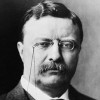
To delight in war is a merit in the soldier, a dangerous quality in the captain, and a positive crime in the statesman.
George Santayana (1863–1952) Spanish-American poet and philosopher [Jorge Agustín Nicolás Ruíz de Santayana y Borrás]
The Life of Reason or The Phases of Human Progress, vol. 2 “Reason in Society,” ch. 3 “Industry, Government, and War” (1905-06)