EPIDEMIC, n. A disease having a sociable turn and few prejudices.
Ambrose Bierce (1842–1914?) American writer and journalist
“Epidemic,” “Devil’s Dictionary” column, San Francisco Wasp (1883-04-28)
(Source)
Not collected in later books.
Quotations about:
sickness
Note not all quotations have been tagged, so Search may find additional quotes on this topic.

Pride and the Gout,
Are seldom cur’d throughout.Benjamin Franklin (1706–1790) American statesman, scientist, philosopher, aphorist
Poor Richard (1747 ed.)
(Source)

You quickly remove something from your eye that hurts it:
if rot is eating at your soul, why postpone the cure a year?[Nam cur
quae laedunt oculum festinas demere; si quid
est animum, differs curandi tempus in annum?]Horace (65–8 BC) Roman poet, satirist, soldier, politician [Quintus Horatius Flaccus]
Epistles [Epistularum, Letters], Book 1, ep. 2 “To Lollius,” l. 37ff (1.2.37-39) (20 BC) [tr. Fuchs (1977)]
(Source)
(Source (Latin)). Other translations:Yea, thoughe thou be awake,
A little mote out of thyne eye why doste thou haste to take?
If oughte there be that noyes thy minde moste parte thou arte contente
Or thou begin to cure the same to seeke an whole yeare spente.
[tr. Drant (1567)]If a Fly
Get in thy Eye, 'tis puld out instantly:
But if thy Mindes Ey's hurt, day after day
That Cure's deferr'd.
[tr. Fanshawe; ed. Brome (1666)]You'l move an Eye-soar streight; and is it sence,
To let the Mind be cur'd a Twelve-moneth hence?
[tr. "Dr. W."; ed. Brome (1666)]For why, when any thing offends thy Eyes,
Dost thou streight seek for ease, and streight advise
Yet if it shall oppress thy Mind, endure
The ills with Patience, and defer the Cure?
[tr. Creech (1684)]For the hurt eye an instant cure you find;
Then why neglect, for years, the sickening mind?
[tr. Francis (1747)]How strange is this! if ought the eye offends,
You straight remove it and the anguish ends;
If ought corrodes the mind, some slight pretence
Serves to protract the cure a twelve-month hence.
[tr. Howes (1845)]For why do you hasten to remove things that hurt your eyes, but if any thing gnaws your mind, defer the time of curing it from year to year?
[tr. Smart/Buckley (1853)]You lose no time in taking out a fly,
Or straw, it may be, that torments your eye;
Why, when a thing devours your mind, adjourn
Till this day year all thought of the concern?
[tr. Conington (1874)]Let but a speck of dust distress your eye,
You rest not till you're rid of it; then why,
If 'tis your mind that's out of sorts, will you
Put off the cure with "Any time will do"?
[tr. Martin (1881)]Anything which injures eyesight you will at once remove, why then, if anything injures the mind, do you delay for a whole year to heal it?
[tr. Elgood (1893)]Why indeed are you in a hurry to remove things which hurt the eye, while if aught is eating into your soul, you put off the time for cure till next year?
[tr. Fairclough (Loeb) (1926)]Why hurry so to take out that mote from your eye,
But put off until next year the time to take steps
To arrest your soul erosion?
[tr. Palmer Bovie (1959)]You run to the doctor if anything sticks in your eye,
But leave your sick soul to be cured some other time,
Some other year!
[tr. Raffel (1983)]If you had a sty, you'd be in a hurry to cure it;
If the sickness is in your soul, why put it off?
[tr. Ferry (2001)]Why so quick to remove
a speck of dirt from your eye? And yet, if anything eats at
your soul, you say: ‘Time enough to attend to it next year’.
[tr. Rudd (2005 ed.)]Why so quick to remove a speck from your eye, when
If it’s your mind, you put off the cure till next year?
[tr. Kline (2015)]
Man seems to be a rickety poor sort of a thing, any way you take him; a kind of British Museum of infirmities and inferiorities. He is always undergoing repairs. A machine that was as unreliable as he is would have no market.
Mark Twain (1835–1910) American writer [pseud. of Samuel Clemens]
Letters from the Earth, “The Damned Human Race,” sec. 5 “The Lowest Animal” (1962) [ed. DeVoto]
(Source)

Men that look no further than their outsides, think health an appurtenance unto life, and quarrel with their constitutions for being sick; but I that have examined the parts of man, and know upon what tender filaments that fabric hangs, do wonder that we are not always so; and considering the thousand doors that lead to death, do thank my God that we can die but once.
[Men that looke no further than their outsides thinke health an appertinance unto life, and quarrell with their constitutions for being sick; but I that have examined the parts of man, and know upon what tender filaments that Fabrick hangs, doe wonder that we are not alwayes so; and considering the thousand dores that lead to death doe thanke my God that we can die but once.]
Thomas Browne (1605–1682) English physician and author
Religio Medici, Part 1, sec. 44 (1643)
(Source)

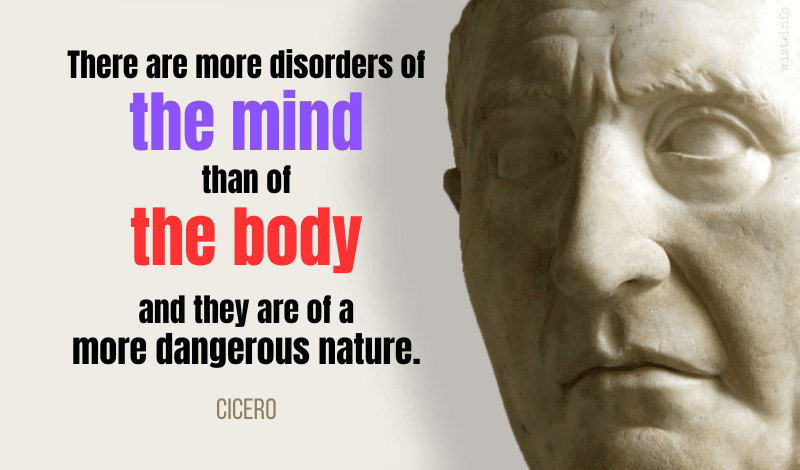
MARCUS: But there are more disorders of the mind than of the body, and they are of a more dangerous nature.
[At et morbi perniciosiores pluresque sunt animi quam corporis; hi enim ipsi odiosi sunt.]
Marcus Tullius Cicero (106–43 BC) Roman orator, statesman, philosopher
Tusculan Disputations [Tusculanae Disputationes], Book 3, ch. 3 (3.3) / sec. 5 (3.5) (45 BC) [tr. Yonge (1853)]
(Source)
(Source (Latin)). Other translations:Whereas, in truth, there are more and more dangerous Diseases of the Soul, than of the Body.
[tr. Wase (1643)]But there are more disorders of the mind than of the body, for the generality, and of a more severe nature.
[tr. Main (1824)]The diseases of the mind are more pernicious, as well as more numerous, than those of the body.
[tr. Otis (1839)]But there are more harmful disorders of the soul than of the body, and more of them.
[tr. Peabody (1886)]The diseases of the mind are more destructive and in greater number than those of the body.
[tr. Taylor/Hunt (1916)]No, the sicknesses of the mind are both more destructive and more numerous than those of the body.
[tr. Graver (2002)]
Health is relative. There is no such thing as an absolute state of health or sickness. Everyone’s physical, mental, and emotional condition is a combination of both.
Theodore Isaac Rubin (1923–2019) American psychiatrist and author
The Angry Book, “Let Freedom Ring” (1970)
(Source)

There is said to be hope for a sick man, as long as there is life.
[Ut aegroto dum anima est, spes esse dicitur.]
Marcus Tullius Cicero (106–43 BC) Roman orator, statesman, philosopher
Epistulae ad Atticum [Letters to Atticus], Book 9, Letter 10, sec. 3 (9.10.3) (49 BC) [tr. Shackleton Bailey (1968), # 177]
(Source)
Cicero says this was his feeling of hope for how things would turn out, as long as Pompey was in Italy -- which he had just evacuated from. Cicero makes it clear this is a common phrase at the time, usually expressed more straightforwardly as "While there is life there is hope" [Dum anima est, spes est.]
(Source (Latin)). Other translations:But as we say of sick people, "while there is life there is hope."
[tr. Jeans (1880), # 63]As in the case of a sick man one says, "While there is life there is hope."
[tr. Shuckburgh (1900), # 364]As a sick man is said to have hope, so long as he has breath.
[tr. Winstedt (Loeb) (1913)]
Health is not valued, till Sickness comes.
Thomas Fuller (1654–1734) English physician, preacher, aphorist, writer
Gnomologia: Adages and Proverbs (compiler), # 2478 (1732)
(Source)

Illness is a convent which has its rule, its austerity, its silences, and its inspirations.
Albert Camus (1913–1960) Algerian-French novelist, essayist, playwright
Notebooks: 1942-1951, Notebook 4, Jan 1942 – Sep 1945 [tr. O’Brien/Thody (1963)
(Source)

It is only when the rich are sick that they fully feel the impotence of wealth.
Charles Caleb "C. C." Colton (1780–1832) English cleric, writer, aphorist
Lacon: Or, Many Things in Few Words, Vol. 1, § 538 (1820)
(Source)