It is a dangerous error to confound truth with matter-of-fact. Our life is governed not only by facts, but by hopes; the kind of truthfulness which sees nothing but facts is a prison for the human spirit. Dreams are only to be condemned when they are a lazy substitute for an effort to change reality; when they are an incentive, they are fulfilling a vital purpose in the incarnation of human ideals. To kill fancy in childhood is to make a slave to what exists, a creature tethered to earth and therefore unable to create heaven.
Bertrand Russell (1872-1970) English mathematician and philosopher
Education and the Good Life, Part 2, ch. 5 “Play and Fancy” (1926)
(Source)
On children's literature.
Quotations about:
dreams
Note not all quotations have been tagged, so Search may find additional quotes on this topic.
Some people see things that are and ask, Why? Some people dream of things that never were and ask, Why not? Some people have to go to work and don’t have time for all that shit.
My dreams are more amorous than my actions have ever been.
Joseph Joubert (1754-1824) French moralist, philosopher, essayist, poet
Pensées [Thoughts], 1805 entry [tr. Auster (1983)]
(Source)
I could not find an analog in other translations of the Pensées.
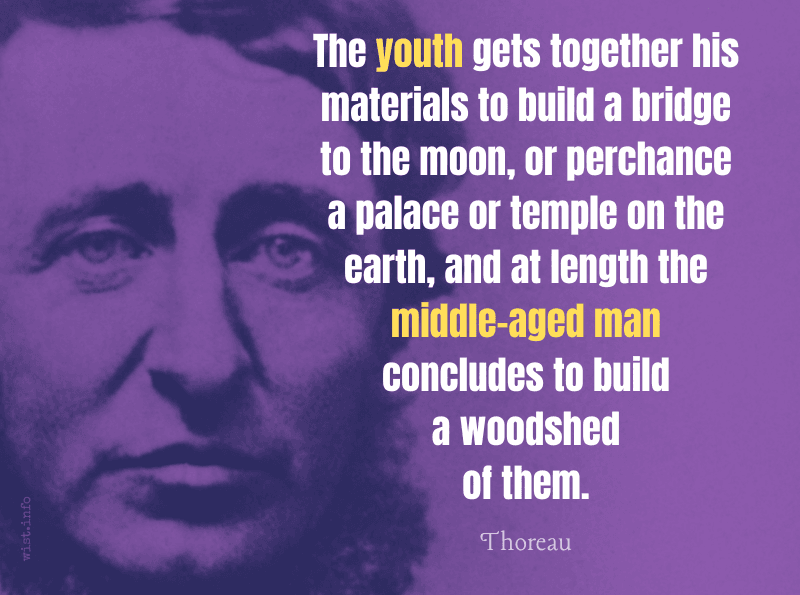
The youth gets together his materials to build a bridge to the moon, or perchance a palace or temple on the earth, and at length the middle-aged man concludes to build a woodshed of them.
Man has always dreamed of power. But damn it, man has always dreamed of love, too, and of the rights of his fellow man. The only power worthy of man is the power of all mankind struggling together toward a goal of unobtainable perfection.
Anthony Boucher (1911-1968) American author, critic, and editor [pseud. of William White; also H. H. Holmes and Herman W. Mudgett]
“The Barrier,” Astounding Science-Fiction, Vol. 30, No. 1 (1942-09)
(Source)

Table talk, lovers’ talk — both are equally elusive. Lovers’ talk is castlebuilding, table talk is pipe-dreaming.
[Propos de table et propos d’amour; les uns sont aussi insaisissables que les autres; les propos d’amour sont des nuées, les propos de table sont des fumées.]
Victor Hugo (1802–1885) French writer, journalist, human rights activist, politician
Les Misérables, Part 1 “Fantine,” Book 3 “The Year 1817,” ch. 6 (1.3.6) (1862) [tr. Donougher (2013)]
(Source)
(Source (French)). Alternate translations:Table talk and lovers' talk equally elude the grasp; lovers' talk is clouds, table talk is smoke.
[tr. Wilbour (1862)]Love talk and table talk are equally indescribable, for the first is cloud, the second smoke.
[tr. Wraxall (1862)]Chat at table, the chat of love; it is as impossible to reproduce one as the other; the chat of love is a cloud; the chat at table is smoke.
[tr. Hapgood (1887)]Table-talk and lovers’ talk, both fleeting as air. Lovers’ talk is the mist and table-talk the scent.
[tr. Denny (1976)]Table talk and lovers' talk are equally elusive; lovers' talk is clouds, table talk is smoke.
[tr. Wilbour/Fahnestock/MacAfee (1987)]
For tho’ I know he loves me,
To-night my heart is sad;
His kiss was not so wonderful
As all the dreams I had.Sara Teasdale (1884-1933) American lyrical poet
“The Kiss,” Helen of Troy and Other Poems (1911)
(Source)

But, as it is in a nightmare, when sleep’s narcotic hand
Is leaden upon our eyes, we seem to be desperately trying
To run and run, but we cannot — for all our efforts, we sink down
Nerveless; our usual strength is just not there, and our tongue
Won’t work at all — we can’t utter a word or produce one sound ….[Ac velut in somnis, oculos ubi languida pressit
nocte quies, nequiquam avidos extendere cursus
velle videmur et in mediis conatibus aegri
succidimus, non lingua valet, non corpore notae
sufficiunt vires, nec vox aut verba sequuntur ….]Virgil (70-19 BC) Roman poet [b. Publius Vergilius Maro; also Vergil]
The Aeneid [Ænē̆is], Book 12, l. 908ff (12.908-912) (29-19 BC) [tr. Day-Lewis (1952)]
(Source)
How Turnus feels, in the middle of combat with Aeneas, with the nightmarish crippling of his abilities by a Fury sent from Jove.
(Source (Latin)). Alternate translations:As when in quiet night, sleepe seiles our eye,
In vain we seeme some earnest flight to trie,
But in the midst we faint, our voice doth faile,
Nor speech, nor words, nor our known strength prevaile.
[tr. Ogilby (1649)]And as, when heavy sleep has clos'd the sight,
The sickly fancy labors in the night;
We seem to run; and, destitute of force,
Our sinking limbs forsake us in the course:
In vain we heave for breath; in vain we cry;
The nerves, unbrac'd, their usual strength deny;
And on the tongue the falt'ring accents die ....
[tr. Dryden (1697)]And as in dreams by night, when languid sleep hath closed our eyes, we seem in vain to make effort to prolong a race on which we are intent, and in midst of our efforts sink down faint; nor power is in the tongue, nor in the body competency of wonted strength, nor voice nor words obey [the dictates of our will] ....
[tr. Davidson/Buckley (1854)]E'en as in dreams, when on the eyes
The drowsy weight of slumber lies,
In vain to ply our limbs we think,
And in the helpless effort sink;
Tongue, sinews, all, their powers bely,
And voice and speech our call defy ....
[tr. Conington (1866)]And as in dreams, when languid sleep at night
Weighs down the eyelids, and in vain we strive
To run, with speed that equals our desire.
But yield, disabled, midway in our course;
The tongue, and all the accustomed forces fail.
Nor voice nor words ensue ....
[tr. Cranch (1872)]And as in sleep, when nightly rest weighs down our languorous eyes, we seem vainly to will to run eagerly on, and sink faint amidst our struggles; the tongue is powerless, the familiar strength fails the body, nor will words or utterance follow ....
[tr. Mackail (1885)]E'en as in dreaming-tide of night, when sleep, the heavy thing,
Weighs on the eyes, and all for nought we seem so helpless -- fain
Of eager speed, and faint and fail amidmost of the strain;
The tongue avails not; all our limbs of their familiar skill
Are cheated; neither voice nor words may follow from our will ....
[tr. Morris (1900)]As oft in dreams, when drowsy night doth load
The slumbering eyes, still eager, but in vain,
We strive to race along a lengthening road,
And faint and fall, amidmost of the strain;
The feeble limbs their wonted aid disdain,
Mute is the tongue, nor doth the voice obey,
Nor words find utterance ....
[tr. Taylor (1907), st. 118, l. 1054ff]But as in dreams,
when helpless slumber binds the darkened eyes,
we seem with fond desire to tread in vain
along a lengthening road, yet faint and fall
when straining to the utmost, and the tongue
is palsied, and the body's wonted power
obeys not, and we have no speech or cry ....
[tr. Williams (1910)]And as in dreams of night, when languorous sleep has weighed down our eyes, we seem to strive vainly to press on our eager course, and in mid effort sink helpless: our tongue lacks power, our wonted strength fails our limbs, nor voice nor words ensue ....
[tr. Fairclough (1918)]As in our dreams at night-time,
When sleep weighs down our eyes, we seem to be running,
Or trying to run, and cannot, and we falter,
Sick in our failure, and the tongue is thick
And the words we try to utter come to nothing,
No voice, no speech ....
[tr. Humphries (1951)]Just as in dreams of night, when languid rest
has closed our eyes, we seem in vain to wish
to press on down a path, but as we strain
we falter, weak; our tongues can say nothing,
the body loses its familiar force,
no voice, no word, can follow ....
[tr. Mandelbaum (1971), l. 1209ff]Just as in dreams when the night-swoon of sleep
Weighs on our eyes, it seems we try in vain
To keep on running, try with all our might,
But in the midst of the effort faint and fail;
Our tongue is powerless, familiar strength
Will not hold up our body, not a sound
Or word will come ....
[tr. Fitzgerald (1981), l. 1232ff]Just as when we are asleep, when in the weariness of night, rest lies heavy on our eyes, we dream we are trying desperately to run further and not succeeding, till we fall exhausted in the middle of our efforts; the tongue is useless; the strength we know we have, fails our body; we have no voice, no words to obey our will ....
[tr. West (1990)]As in dreams when languid sleep weighs down our eyes at night,
we seem to try in vain to follow our eager path,
and collapse helpless in the midst of our efforts,
the tongue won’t work, the usual strength is lacking
from our limbs, and neither word nor voice will come ....
[tr. Kline (2002)]In dreams,
When night's weariness weighs on our eyes,
We are desperate to run farther and farther
But collapse weakly in the middle of our efforts.
Our tongue doesn't work, our usual strength
Fails our body, and words will not come.
[tr. Lombardo (2005)]Just as in dreams
when the nightly spell of sleep falls heavy on our eyes
and we seem entranced by longing to keep on racing on,
no use, in the midst of one last burst of speed
we sink down, consumed, our tongue won’t work,
and tried and true, the power that filled our body
fails -- we strain but the voice and words won’t follow.
[tr. Fagles (2006), l. 1053ff]
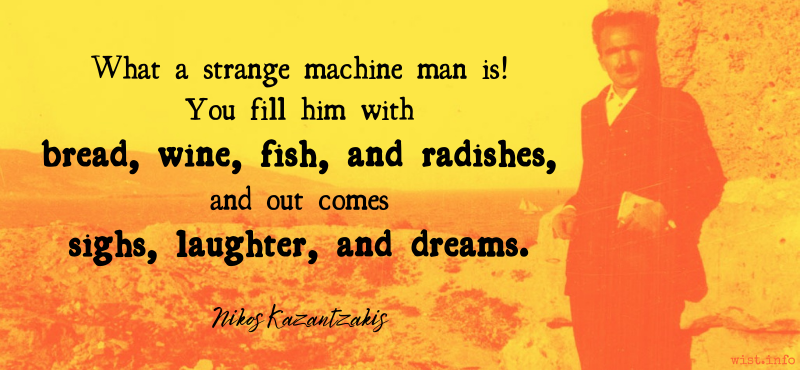
What a strange machine man is! You fill him with bread, wine, fish, and radishes, and out comes sighs, laughter, and dreams.
Nikos Kazantzakis (1883-1957) Greek writer and philosopher
Zorba the Greek, ch. 23 (1946)
Ideas must work through the brains and the arms of good and brave men, or they are no better than dreams.
Ralph Waldo Emerson (1803-1882) American essayist, lecturer, poet
Lecture (1862-01-31), “American Civilization,” Smithsonian Institution, Washington, D. C.
(Source)
“Now … if you trust in yourself …”
“Yes?”
“… and believe in your dreams …”
“Yes?”
“… and follow your star …” Miss Tick went on.
“Yes?”
“… you’ll still be beaten by people who spent their time working hard and learning things and weren’t so lazy.”Terry Pratchett (1948-2015) English author
Discworld No. 30, The Wee Free Men (2003)
How dull, how impossible life would be without dreams — waking dreams, I mean — the dreams that we call “castles in the air,” built by the kindly hands of Hope! Were it not for the mirage of the oasis, drawing his footsteps ever onward, the weary traveler would lie down in the desert sand and die. It is the mirage of distant success, of happiness that, like the bunch of carrots fastened an inch beyond the donkey’s nose, seems always just within our reach, if only we will gallop fast enough, that makes us run so eagerly along the road of Life.
Jerome K. Jerome (1859-1927) English writer, humorist [Jerome Klapka Jerome]
“Dreams” (1886)
(Source)

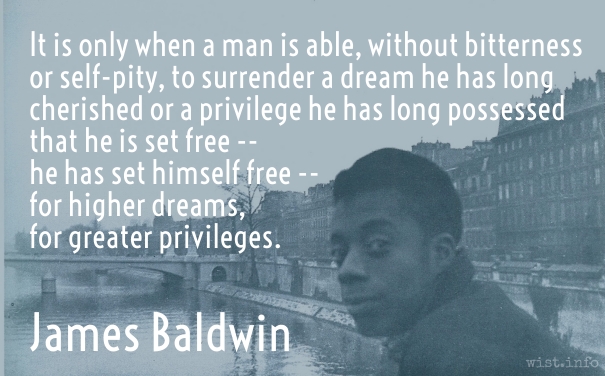
Any real change implies the breakup of the world as one has always known it, the loss of all that gave one an identity, the end of safety. And at such a moment, unable to see and not daring to imagine what the future will now bring forth, one clings to what one knew, or dreamed that one possessed. Yet, it is only when a man is able, without bitterness or self-pity, to surrender a dream he has long cherished or a privilege he has long possessed that he is set free — he has set himself free — for higher dreams, for greater privileges.
James Baldwin (1924-1987) American novelist, playwright, activist
“Faulkner and Desegregation,” Partisan Review (Fall 1956)
When hopes and dreams are loose in the streets, it is well for the timid to lock doors, shutter windows and lie low until the wrath has passed. For there is often a monstrous incongruity between the hopes, however noble and tender, and the action which follows them. It is as if ivied maidens and garlanded youths were to herald the four horsemen of the apocalypse.
Eric Hoffer (1902-1983) American writer, philosopher, longshoreman
True Believer: Thoughts on the Nature of Mass Movements, Part 1, ch. 1, § 5 (1951)
(Source)
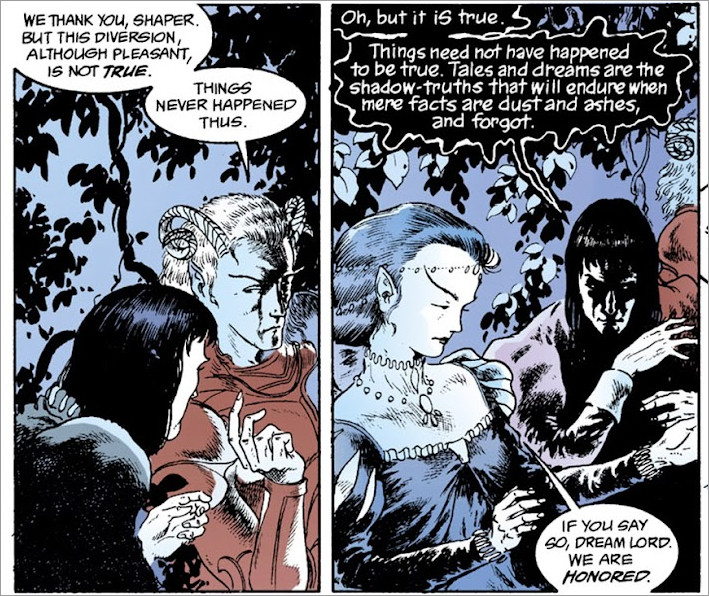
DREAM: Things need not have happened to be true. Tales and dreams are the shadow-truths that will endure when mere facts are dust and ashes, and forgot.
Neil Gaiman (b. 1960) British author, screenwriter, fabulist
Sandman, Book 3. Dream Country, # 19 “A Midsummer Night’s Dream” (1990)
(Source)
THE SERPENT: When you and Adam talk, I hear you say “Why?” Always “Why?” You see things; and you say, “Why?” But I dream things that never were; and I say, “Why not?”
George Bernard Shaw (1856-1950) Irish playwright and critic
Back to Methuselah: A Metabiological Pentateuch, Part 1 “In the Beginning,” Act 1, sec. 1 (1921)
(Source)
The Serpent speaking to Eve.
US President John Kennedy quoted this addressing the Irish Parliament, Dublin (1963-06-28). US Senator Robert Kennedy modified it for his campaign, as quoted by his brother, Senator Edward Kennedy in his eulogy for Robert (1968-06-08): "Some men see things as they are and say, why; I dream things that never were and say, why not?”
If you have built castles in the air, your work need not be lost; that is where they should be. Now put the foundations under them.
Henry David Thoreau (1817-1862) American philosopher and writer
Walden; or, Life in the Woods, ch. 18 “Conclusion” (1854)
(Source)
THESEUS: Lovers and madmen have seething brains,
Such shaping fantasies, that apprehend
More than cool reason ever comprehends.William Shakespeare (1564-1616) English dramatist and poet
Midsummer Night’s Dream, Act 5, sc. 1, l. 4 (5.1.4-6) (1605)
(Source)

Don’t part with your illusions. When they are gone you may still exist, but you have ceased to live.
Mark Twain (1835-1910) American writer [pseud. of Samuel Clemens]
Following the Equator, ch. 59, epigram (1897)
(Source)