

THE DOCTOR: Well, you know how it is: you put things off for a day, next thing you know, it’s a hundred years later.
Doctor Who (1963–1989) British science fiction television series, original run (BBC)
20×01 “Arc of Infinity,” Part 1 (1983-01-03) [w. Johnny Byrne]
(Source)
(Source (Video); dialogue confirmed)
Quotations about:
procrastination
Note not all quotations have been tagged, so Search may find additional quotes on this topic.

On a personal note: I have contracted an outstanding case of breast cancer, from which I intend to recover. I don’t need get-well cards, but I would like the beloved women readers to do something for me: Go. Get. The. Damn. Mammogram. Done.
Molly Ivins (1944–2007) American writer, political columnist [Mary Tyler Ivins]
Essay (1999-12-14), Creators Syndicate column
(Source)
Included in Progressive magazine's memorial article (2007-02) to Ivins, referencing her column in their 2000-02 issue.

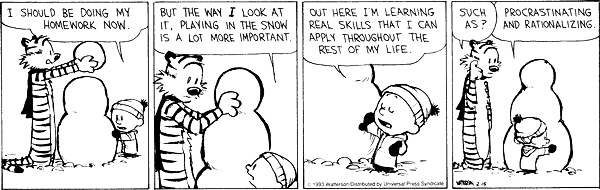
CALVIN: (building a snowman) I should be doing my homework now. But the way I look at it, playing in the snow is a lot more important. Out here I’m learning real skills that I can apply throughout the rest of my life.
HOBBES: Such as?
CALVIN: Procrastinating and rationalizing.
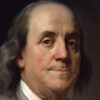
He that resolves to mend hereafter, resolves not to mend now.
Benjamin Franklin (1706–1790) American statesman, scientist, philosopher, aphorist
Poor Richard (1745 ed.)
(Source)
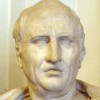
There are greater forces and means for attacking than for defending the State. The reason is, that reckless and abandoned men need only a nod to set them moving, and their own natural disposition incites them against the State; while honest folk somehow or other show less activity, neglect the beginnings of movements, and are aroused to action at the last moment only by simple necessity; so that sometimes, owing to their hesitation and indolence, while they wish still to enjoy peace even with the loss of dignity, through their own fault they lose both.
[Maioribus praesidiis et copiis oppugnatur res publica quam defenditur, propterea quod audaces homines et perditi nutu impelluntur et ipsi etiam sponte sua contra rem publicam incitantur, boni nescio quo modo tardiores sunt et principiis rerum neglectis ad extremum ipsa denique necessitate excitantur, ita ut non numquam cunctatione ac tarditate, dum otium volunt etiam sine dignitate retinere, ipsi utrumque amittant.]
Marcus Tullius Cicero (106–43 BC) Roman orator, statesman, philosopher
Pro Sestio [For Publius Sestius], ch. 47 / sec. 100 (56-02 BC) [tr. Gardner (Loeb) (1958)]
(Source)
(Source (Latin)). Other translations:The constitution is attacked with greater forces and troops than wherewith it is defended; because audacious and reckless characters are set on by a nod, and are even of their own accord incited against the constitution; whilst the good are for some reason or other slacker, and from having neglected the beginnings of things, are at last aroused to action by mere necessity; so that sometimes, while they are willing to retain their tranquility even without freedom, through their own fault they lose both from their hesitation and tardiness.
[tr. Hickie (1888)]The republic is attacked by greater forces and more numerous bodies than those by which it is defended; because audacious and abandoned men are impelled on by a nod, and are even of their own accord excited by nature to be enemies to the republic. And somehow or other good men are slower in action, and overlooking the first beginnings of things, are at last aroused by necessity itself; so that sometimes through their very delays and tardiness of movement, while they wish to retain their ease even without dignity, they, of their own accord, lose both.
[tr. Yonge (1891)]
I do have a compulsion to read in out-of-the-way places, and it is often a blessing; on the other hand, it sometimes comes between me and what I tell the children is “my work.” As a matter of fact, I will read anything rather than work. And I don’t mean interesting things like the yellow section of the telephone book or the enclosures that come with the Bloomingdale bill about McKettrick classics in sizes 12 to 20, blue, brown, or navy @ 12.95 (by the way, did you know that colored facial tissue is now on sale at the unbelievably low price of 7.85 a carton? ). The truth is that, rather than put a word on paper, I will spend a whole half hour reading the label on a milk-of-magnesia bottle. “Philips’ Milk of Magnesia,” I read with the absolute absorption of someone just stumbling on Congreve, “is prepared only by the Charles H. Philips Co., division of Sterling Drug, Inc. Not to be used when abdominal pain, nausea, vomiting, or other symptoms of appendicitis are present, etc.”
Jean Kerr (1922–2003) American author and playwright [b. Bridget Jean Collins]
Essay (1957), “Introduction,” Please Don’t Eat the Daisies
(Source)

There’s only one person who needs a glass of water oftener than a small child tucked in for the night, and that’s a writer sitting down to write.
Mignon McLaughlin (1913–1983) American journalist and author
The Second Neurotic’s Notebook, ch. 7 (1966)
(Source)


You quickly remove something from your eye that hurts it:
if rot is eating at your soul, why postpone the cure a year?[Nam cur
quae laedunt oculum festinas demere; si quid
est animum, differs curandi tempus in annum?]Horace (65–8 BC) Roman poet, satirist, soldier, politician [Quintus Horatius Flaccus]
Epistles [Epistularum, Letters], Book 1, ep. 2 “To Lollius,” l. 37ff (1.2.37-39) (20 BC) [tr. Fuchs (1977)]
(Source)
(Source (Latin)). Other translations:Yea, thoughe thou be awake,
A little mote out of thyne eye why doste thou haste to take?
If oughte there be that noyes thy minde moste parte thou arte contente
Or thou begin to cure the same to seeke an whole yeare spente.
[tr. Drant (1567)]If a Fly
Get in thy Eye, 'tis puld out instantly:
But if thy Mindes Ey's hurt, day after day
That Cure's deferr'd.
[tr. Fanshawe; ed. Brome (1666)]You'l move an Eye-soar streight; and is it sence,
To let the Mind be cur'd a Twelve-moneth hence?
[tr. "Dr. W."; ed. Brome (1666)]For why, when any thing offends thy Eyes,
Dost thou streight seek for ease, and streight advise
Yet if it shall oppress thy Mind, endure
The ills with Patience, and defer the Cure?
[tr. Creech (1684)]For the hurt eye an instant cure you find;
Then why neglect, for years, the sickening mind?
[tr. Francis (1747)]How strange is this! if ought the eye offends,
You straight remove it and the anguish ends;
If ought corrodes the mind, some slight pretence
Serves to protract the cure a twelve-month hence.
[tr. Howes (1845)]For why do you hasten to remove things that hurt your eyes, but if any thing gnaws your mind, defer the time of curing it from year to year?
[tr. Smart/Buckley (1853)]You lose no time in taking out a fly,
Or straw, it may be, that torments your eye;
Why, when a thing devours your mind, adjourn
Till this day year all thought of the concern?
[tr. Conington (1874)]Let but a speck of dust distress your eye,
You rest not till you're rid of it; then why,
If 'tis your mind that's out of sorts, will you
Put off the cure with "Any time will do"?
[tr. Martin (1881)]Anything which injures eyesight you will at once remove, why then, if anything injures the mind, do you delay for a whole year to heal it?
[tr. Elgood (1893)]Why indeed are you in a hurry to remove things which hurt the eye, while if aught is eating into your soul, you put off the time for cure till next year?
[tr. Fairclough (Loeb) (1926)]Why hurry so to take out that mote from your eye,
But put off until next year the time to take steps
To arrest your soul erosion?
[tr. Palmer Bovie (1959)]You run to the doctor if anything sticks in your eye,
But leave your sick soul to be cured some other time,
Some other year!
[tr. Raffel (1983)]If you had a sty, you'd be in a hurry to cure it;
If the sickness is in your soul, why put it off?
[tr. Ferry (2001)]Why so quick to remove
a speck of dirt from your eye? And yet, if anything eats at
your soul, you say: ‘Time enough to attend to it next year’.
[tr. Rudd (2005 ed.)]Why so quick to remove a speck from your eye, when
If it’s your mind, you put off the cure till next year?
[tr. Kline (2015)]
To be suddenly snuffed out in the middle of ambitious schemes, is tragical enough at best; but when a man has been grudging himself his own life in the meanwhile, and saving up everything for the festival that was never to be, it becomes that hysterically moving sort of tragedy which lies on the confines of farce.

It was this fear which led me into the snare of procrastination. But if I make haste now I regain all; if I delay I lose all.
[Hoc verens in hanc tarditatem incidi. Bed adsequar omnia si propero: si cunctor, amitto.]
Marcus Tullius Cicero (106–43 BC) Roman orator, statesman, philosopher
Epistulae ad Atticum [Letters to Atticus], Book 10, Letter 8, sec. 5 (10.8.5) (49 BC) [tr. Jeans (1880), # 71]
(Source)
On the concerning prospect of Caesar and Pompey reconciling while both were irked at Cicero.
(Source (Latin)). Other translations:It was from dread of this that I drifted into this waiting policy. But now I have everything to gain by hastening, everything to lose by delay.
[tr. Shuckburgh (1900), # 391]That fear of mine led me to delay. But I gain all now by haste, and, if I delay, I lose all.
[tr. Winstedt (Loeb) (1913)]This fear led me into such procrastination. But I shall gain all if I make haste; if I delay, I lose all.
[tr. Shackleton Bailey (1968), # 199]
The time to begin most things is ten years ago.
Mignon McLaughlin (1913–1983) American journalist and author
The Second Neurotic’s Notebook, ch. 5 (1966)
(Source)
MERCUTIO:Come, we burn daylight, ho!
ROMEO: Nay, that’s not so.
MERCUTIO:I mean, sir, in delay.
We waste our lights in vain, light lights by day.William Shakespeare (1564–1616) English dramatist and poet
Romeo and Juliet, Act 1, sc. 4, l. 44ff (1.4.44-47) (1595)
(Source)
Other sources give the last line as "... like lamps by day."
Shakespeare is the earliest written source of the phrase "burn(ing) daylight." He used it again two years later in Merry Wives of Windsor (2.1), where Mistress Ford says, "We burn daylight" (without Mercutio's explanation).

Don’t say “When I have time I will learn,” lest you never have time.
[וְאַל תֹּאמַר לִכְשֶׁאִפָּנֶה אֶשְׁנֶה, שֶׁמָּא לֹא תִפָּנֶה:]
Hillel (1st C. BC-1st C. AD) Jewish sage, rabbi [הלל]
Mishna, Seder Nezikin [Order of Damages], Pirkei Avot [Chapters of the Fathers] 2:4
(Source)
(Source (Hebrew)). Alternate translations:Say not, When I have leisure I will study; perchance thou mayest not have leisure.
[tr. Taylor (1897)]Say not: ‘when I shall have leisure I shall study;’ perhaps you will not have leisure.
[tr. Gorfinkle (1913)]Say not: ‘when I shall have leisure I shall study;’ perhaps you will not have leisure.
[tr. Kulp]Do not say: When I can free myself [of my affairs] I shall learn (Torah); perhaps you will not free yourself.
[tr. Shraga Silverstein]Do not say, "When I will be available I will study [Torah]," lest you never become available.
[Open Mishnah]Do not say "When I have leisure, I will study," perhaps you will not have leisure.
[Source]Say not, "When I have free time I shall study"; for you may perhaps never have any free time.
Know the true value of time; snatch, seize, and enjoy every moment of it. No idleness, no laziness, no procrastination: never put off till to-morrow what you can do to-day.
Lord Chesterfield (1694–1773) English statesman, wit [Philip Dormer Stanhope]
Letter (1749-12-26) to his son (#211)
(Source)
Chesterfield either loves the "Never put off" phrase or is very familiar with it: he repeats it a few months later in Letter 216 (1750-02-05), and then a few years later in Letter 309 (1754-02-26).
See Fuller and Franklin.

Never leave that till tomorrow which you can do today.
Benjamin Franklin (1706–1790) American statesman, scientist, philosopher, aphorist
“The Way to Wealth” (1758)
(Source)
Today, this is more commonly given as "Never put off till tomorrow what you can do today."
Franklin had used a different phrasing in Poor Richard (1742 ed.): "Have you somewhat to do To-morrow, do it To-day." That was reprinted in Poor Richard Improved (1758 ed.), but when that latter work was condensed into "The Way to Wealth" that same year, the wording above was used.
As with so many of Franklin's "Poor Richard" aphorisms, this was not original to him. Thomas Fuller uses a similar phrase in 1725.
The sentiment itself has been mocked or modified by others such as Mark Twain, Josh Bilings, Aldous Huxley, Pablo Picasso, and Mignon McLaughlin.

When on all sides you showed me that your words were true, and I was overcome by your truth, I had no answer whatsoever to make, but only those slow and drowsy words, “Right away. Yes, right away.” “Let me be for a little while.” But “Right away — right away” was never right now, and “Let me be for a little while” stretched out for a long time.
[Undique ostendenti vera te dicere, non erat omnino quid responderem veritate convictus, nisi tantum verba lenta et somnolenta: “modo,” “ecce modo,” “sine paululum.” Sed “modo et modo” non habebat modum et “sine paululum” in longum ibat.]
Augustine of Hippo (354–430) Christian church father, philosopher, saint [b. Aurelius Augustinus]
Confessions, Book 8, ch. 5 / ¶ 12 (8.5.12) (c. AD 398) [tr. Ryan (1960)]
(Source)
Augustine writing of his reluctance to convert to Christianity. Sometimes paraphrased "By and by never comes."
(Source (Latin)). Other translations:And when Thou didst on all sides show me that what Thou saidst was true, I, convicted by the truth, had nothing at all to answer, but only those dull and drowsy words, "Anon, anon," "presently," "leave me but a little." But "presently, presently," had no present, and my "little while" went on for a long while.
[tr. Pusey (1838)]And to Thee showing me on every side, that what Thou saidst was true, I, convicted by the truth, had nothing at all to reply, but the drawling and drowsy words: “Presently, lo, presently;” “Leave me a little while.” But “presently, presently,” had no present; and my “leave me a little while” went on for a long while.
[tr. Pilkington (1876)]And to Thee, on all sides showing me that what Thou saidst was true, I, convicted by the truth, had nothing to say in reply, but only drawling and drowsy words, “Presently; yes, presently;” “Wait a little while." But “presently and presently" had no present; and “wait a little while” went on to a long while.
[tr. Hutchings (1890)]On all sides Thou didst show me that Thy words are true, and the truth confounded me, so that I could make no reply but slow and drowsy words: "Presently, O presently; let me be a little while.” But my "presently, presently," had no present, and the little while proved a long while.
[tr. Bigg (1897), 8.5.3]Whereas You showed me by every evidence that Your words were true, there was simply nothing I could answer save only laggard lazy words: “Soon,” “Quite soon,” “Give me just a little while.” But “soon” and “quite soon” did not mean any particular time; and “just a little while” went on for a long while.
[tr. Sheed (1943)]On all sides, thou didst show me that thy words are true, and I, convicted by the truth, had nothing at all to reply but the drawling and drowsy words: “Presently; see, presently. Leave me alone a little while.” But “presently, presently,” had no present; and my “leave me alone a little while” went on for a long while.
[tr. Outler (1955)]You used all means to prove the truth of your words, and now that I was convinced that they were true, the only answers I could give were the drowsy words of an idler -- "Soon," "Presently," "Let me wait a little longer." But "soon" was not soon and "a little longer" grew much longer.
[tr. Pine-Coffin (1961)]And, while you showed me wherever I looked that what you said was true, I, convinced by the truth, could still find nothing at all to say except lazy words spoken half asleep: "A minute," "just a minute," "just a little time longer." But there was no limit to the minutes, and the little time longer went a long way.
[tr. Warner (1963)]Though you showed me on every side that what you said was true, though convinced of that truth, I had nothing at all to answer other than some dull and drowsy words: "Soon," "Coming soon," "Leave me just a little." But my "little while" stretched on and on.
[tr. Blaiklock (1983)]You plied me with evidence that you spoke truly; no, I was convinced by the truth and had no answer except the sluggish, drowsy words, "Just a minute," "One more minute," "Let me have a little longer." But these "minutes" never diminished, and my "little longer" lasted inordinately long.
[tr. Boulding (1997)]

Don’t fool yourself that important things can be put off till tomorrow; they can be put off forever, or not at all.
Mignon McLaughlin (1913–1983) American journalist and author
The Neurotic’s Notebook, ch. 10 (1963)
(Source)
procrastination is the
art of keeping
up with yesterdayDon Marquis (1878–1937) American journalist and humorist
archy and mehitabel, ch. 12 “certain maxims of archy” (1927)
(Source)
There are so many things that we wish we had done yesterday, so few that we feel like doing today.
Mignon McLaughlin (1913–1983) American journalist and author
The Second Neurotic’s Notebook, ch. 10 (1966)
(Source)
Because as writers we’ll do anything — organize the closet, clean the garage — to avoid writing.
Lynn Vincent (b. 1962) American author, journalist
In The New Yorker, “Lives of the Saints” (15 Oct 2012)
(Source)

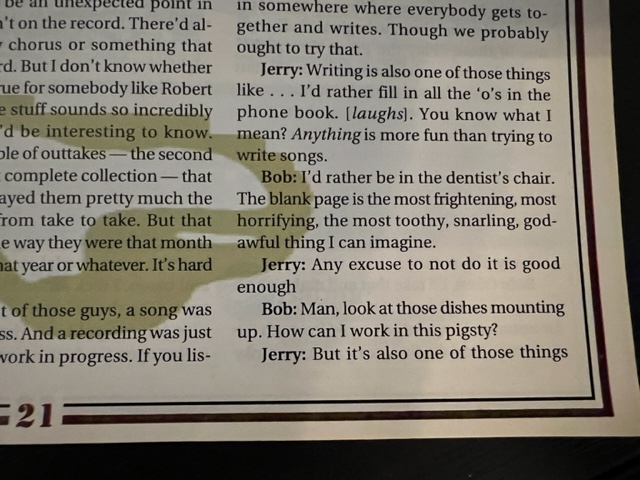
JERRY: Writing is also one of those things like … I’d rather fill in all the “o”s in the phone book. [Laughs]. You know what I mean? Anything is more fun than trying to write songs.
BOB: I’d rather be in the dentist’s chair. The blank page is the most frightening, most horrifying, the most toothy, snarling, god-awful thing I can imagine.
JERRY: Any excuse to not do it is good enough.
BOB: Man, look at those dishes mounting up. How can I work in this pigsty?
Jerry Garcia (1942–1995) American singer-songwriter and guitarist
Interview of Jerry Garcia and Bob Weir by Jon Sievert, Guitar Player Magazine (1993-05-20)
The interview was reprinted in Best of Guitar Player - Grateful Dead (1993-09). (Many thanks to Ryan Curry for sharing the photo.)

By doing just a little every day, I can gradually let the task completely overwhelm me.
Ashleigh Brilliant (b. 1933) Anglo-American epigramist, aphorist, cartoonist
Pot-Shots, #1194

Anyway, if you stop tellin’ people it’s all sorted out after they’re dead, they might try sorting it all out while they’re alive.
Terry Pratchett (1948–2015) English author
Good Omens, 6. “Saturday” [Adam] (1990) [with Neil Gaiman]
(Source)

Work is the greatest thing in the world — so we should save some of it for to-morrow.
If it weren’t for the last minute, nothing would get done.

Man has no greater enemy than himself. I have acted contrary to my sentiments and inclination; throughout our whole lives we do what we never intended, and what we proposed to do, we leave undone.
Francesco Petrarca (1304–1374) Italian scholar and poet [a.k.a. Petrarch]
(Attributed)
(Source)
Quoted in Johann Georg Ritter von Zimmermann, An Examination of the Advantages of Solitude and of Its Operations, ch. 5 (1783) [tr. F.S. (1808)].

There are millions of ways to not be writing.
Rod Serling (1924–1975) American screenwriter, playwright, television producer, narrator
“Rod Serling: The Facts of Life,” Interview with Linda Brevelle (4 Mar 1975)
(Source)
In youth, the years stretch before one so long that it is hard to realize that they will ever pass, and even in middle age, with the ordinary expectation of life in these days, it is easy to find excuses for delaying what one would like to do but does not want to; but at last a time comes when death must be considered.
W. Somerset Maugham (1874–1965) English novelist and playwright [William Somerset Maugham]
The Summing Up, ch. 3 (1938)
(Source)

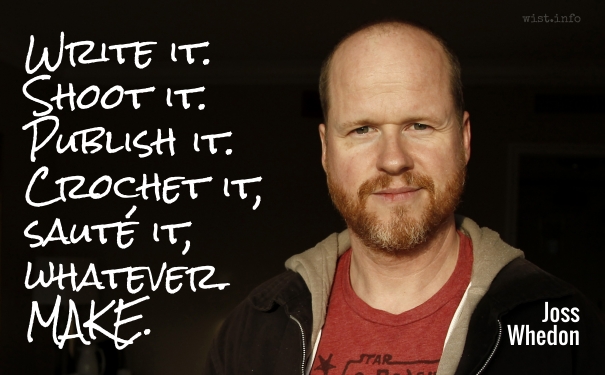
If you have a good idea, get it out there. For every idea I’ve realized, I have ten I sat on for a decade till someone else did it first. Write it. Shoot it. Publish it. Crochet it, sauté it, whatever. MAKE.
Joss Whedon (b. 1964) American screenwriter, author, producer [Joseph Hill Whedon]
“Dollhouse’s Joss Whedon Answers Your Questions,” Hulu Blog (9 Mar 2009)
(Source)

MARIAN: No, please, not tonight. Maybe tomorrow.
HAROLD: Oh, my dear little librarian. You pile up enough tomorrows, and you’ll find you are left with nothing but a lot of empty yesterdays.
Meredith Willson (1902–1984) American composer, songwriter, flutist, conductor, playwright
The Music Man (1957)
One thing that’s good about procrastination is that you always have something planned for tomorrow.
G. B. Stern (1890–1973) British writer [Gladys Bronwyn Stern]
(Attributed)
If you want to make an easy job seem mighty hard, just keep putting it off.
Olin Miller (fl. early 20th C) American humorist
(Attributed)

The secret of my incredible energy and efficiency in getting work done is a simple one. I have based it very deliberately on a well-known psychological principle and have refined it so that it is now almost too refined. I shall have to begin coarsening it up again pretty soon. The psychological principle is this: anyone can do any amount of work, provided it isn’t the work he is supposed to be doing at that moment.
Robert Benchley (1889–1945) American humorist, columnist, actor, wit
“How to Get Things Done,” Chicago Tribune (2 Feb 1930)
At thirty, man suspects himself a fool;
Knows it at forty, and reforms his plan;
At fifty, chides his infamous delay,
Pushes his prudent purpose to resolve;
In all the magnanimity of thought
Resolves, and re-resolves; then dies the same.
And why? Because he thinks himself immortal.
All men think all men mortal but themselves.Edward Young (1683–1765) English poet
Poem (1742-05), “Night the 1st: On Death, Life, and Immortality,” l. 418ff, The Complaint: Or, Night Thoughts, Vol. 1 (1744)
(Source)

To think too long about doing a thing often becomes its undoing.
(Other Authors and Sources)
Eva Young

Every evil in the bud is easily crushed: as it grows older, it becomes stronger.
[Omne malum nascens facile opprimitur; inveteratum fit pleurumque robustius.]
Marcus Tullius Cicero (106–43 BC) Roman orator, statesman, philosopher
Philippics [Philippicae; Antonian Orations], No. 5, ch. 11 / sec. 31 (5.11/5.31) (43-01-01 BC) [ed. Hoyt (1896)]
(Source)
(Source (Latin)). Other translations:Every evil is easily crushed at its birth; when it has become of long standing, it usually gets stronger.
[tr. Yonge (1903)]Every evil at its birth is easily suppressed; but if it be of long standing, it will offer a stouter resistance.
[ed. Harbottle (1906)]Every evil is easily crushed at its birth; become inveterate it as a rule gathers strength.
[tr. Ker (Loeb) (1926)]Every evil is easily nipped in the bud; with age it usually gets stronger.
[tr. Manuwald (2007)]
God has promised forgiveness to your repentance, but He has not promised tomorrow to your procrastination.
Augustine of Hippo (354–430) Christian church father, philosopher, saint [b. Aurelius Augustinus]
(Paraphrase)
This appears to be a heavy paraphrase from Sermon 40.5-6 [tr. Edmund Hill]:"I'm only asking," he says, "to be allowed a little more time." Why? "Because God has promised me pardon." But no one has promised you that you are going to be alive tomorrow. Or else, just as you have read in the prophet, the gospel, the apostle, that when you have turned back to him God will blot out all your iniquities, read out to me where a tomorrow is promised you, and then live in an evil way tomorrow.
For more discussion, see:
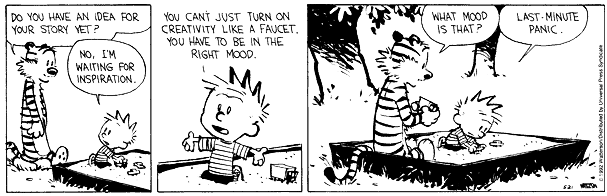
HOBBES: Have you an idea for your story yet?
CALVIN: No, I’m waiting for inspiration. You can’t just turn on creativity like a faucet. You have to be in the right mood.
HOBBES: What mood is that?
CALVIN: Last-minute panic.
I love deadlines. I love the whooshing noise they make as they go by.
Douglas Adams (1952–2001) English author, humorist, screenwriter
Attributed in Richard Dawkins, “A Lament for Douglas Adams,” The Guardian (2001-05-13)
(Source)
Memorial to his friend, Adams; later collected in The Salmon of Doubt, Part 4 "Epilogue" (2002) [ed. Peter Guzzardi]. Many variants exist, e.g., "What I love the most about deadlines is the whooshing sound they make as they go by."


Procrastination and worry are the twin thieves that will try to rob you of your brilliance — but even the smallest action will drive them from your camp.
(Other Authors and Sources)
Gil Atkinson