You couldn’t put off the inevitable. Because sooner or later, you reached the place where the inevitable just went and waited.
Quotations about:
just do it
Note not all quotations have been tagged, so Search may find additional quotes on this topic.
When we finally got down to something, which the individual says he really wants to do, I will say to him, you do that and forget the money, because, if you say that getting the money is the most important thing, you will spend your life completely wasting your time. You’ll be doing things you don’t like doing in order to go on living, that is to go on doing things you don’t like doing — which is stupid!
Alan Watts (1915–1973) Anglo-American philosopher, writer
Lecture (1969 ca.), “What If Money Was No Object?”
(Source)
Let no one delay to study philosophy while he is young, and when he is old let him not become weary of the study; for no man can ever find the time unsuitable or too late to study the health of his soul. And he who asserts either that it is not yet time to philosophize, or that the hour is passed, is like a man who should say that the time is not yet come to be happy, or that it is too late.
[Μήτε νέος τις ὢν μελλέτω φιλοσοφεῖν, μήτε γέρων ὑπάρχων κοπιάτω φιλοσοφῶν: οὔτε γὰρ ἄωρος οὐδείς ἐστιν οὔτε πάρωρος πρὸς τὸ κατὰ ψυχὴν ὑγιαῖνον. ὁ δὲ λέγων ἢ μήπω τοῦ φιλοσοφεῖν ὑπάρχειν ἢ παρεληλυθέναι τὴν ὥραν ὅμοιός ἐστι τῷ λέγοντι πρὸς εὐδαιμονίαν ἢ μήπω παρεῖναι τὴν ὥραν ἢ μηκέτι εἶναι τὴν ὥραν.]
Diogenes Laërtius (fl. 3rd C AD) Greek biographer [Διογένης Λαέρτιος]
Lives and Opinions of Eminent Philosophers, Book 10, “Epicurus,” sec. 122 (3rd C AD) [tr. Yonge (1915), ch. 27]
(Source)
Letter from Epicurus to Menoeceus. (Source (Greek)). Other translations:Let no Man that is Young delay the Study of Philosophy, nor when he is Old, be weary of Philosophers. For no Man can be too early, nor no Man past his Time, in what concerns the Health of the Soul. For he that says, 'tis not yet time to study Philosophy, or that he has past his time, is like to him who says, that the time to attain Happiness is past, or is not yet come.
[tr. Kippmax (1696)]Let no one be slow to seek wisdom when he is young nor weary in the search thereof when he is grown old. For no age is too early or too late for the health of the soul. And to say that the season for studying philosophy has not yet come, or that it is past and gone, is like saying that the season for happiness is not yet or that it is now no more.
[tr. Hicks (Loeb) (1925), sec. 122]No one is to delay studying philosophy in their youth or to weary of it in old age. For no one is either too young or too old to be healthy of soul. Anyone who says it's either too soon or too late to study philosophy is like someone who says it's too soon or too late for happiness.
[tr. White (2020), sec. 122]

MACBETH: If it were done when ’tis done, then ’twere well
It were done quickly.William Shakespeare (1564–1616) English dramatist and poet
Macbeth, Act 1, sc. 7, l. 1ff (1.7.1-2) (1606)
(Source)

So whatever you want to do, just do it. Don’t worry about making a damn fool of yourself. Making a damn fool of yourself is absolutely essential. And you will have a great time.
Gloria Steinem (1934–2026) American feminist, journalist, activist
Commencement address, Tufts University (1987-05-17)
(Source)

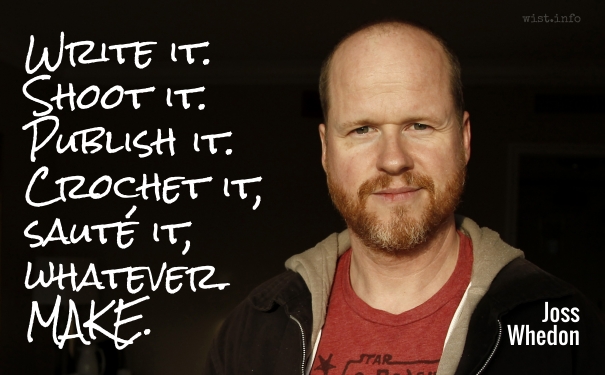
If you have a good idea, get it out there. For every idea I’ve realized, I have ten I sat on for a decade till someone else did it first. Write it. Shoot it. Publish it. Crochet it, sauté it, whatever. MAKE.
Joss Whedon (b. 1964) American screenwriter, author, producer [Joseph Hill Whedon]
“Dollhouse’s Joss Whedon Answers Your Questions,” Hulu Blog (9 Mar 2009)
(Source)

There are many fine things which you mean to do some day, under what you think will be more favorable circumstances. But the only time that is surely yours is the present, hence this is the time to speak the word of appreciation and sympathy, to do the generous deed, to forgive the fault of a thoughtless friend, to sacrifice self a little more for others. Today is the day in which to express your noblest qualities of mind and heart, to do at least one worthy thing which you have long postponed, and to use your God-given abilities for the enrichment of some less fortunate fellow traveler. Today you can make your life big, broad, significant and worthwhile. The present is yours to do with it as you will.
Grenville Kleiser (1868–1953) Canadian-American self-help author
Inspiration And Ideals: Thoughts For Every Day, “August Twenty-Eighth” (1918 ed.)

Better hazard once than be always in fear.
Thomas Fuller (1654–1734) English physician, preacher, aphorist, writer
Gnomologia: Adages and Proverbs (compiler), # 906 (1732)
(Source)


How do you finish them? You finish them. There’s no magic answer, I’m afraid. This is how you do it: you sit down at the keyboard and you put one word after another until it’s done. It’s that easy, and that hard.
Neil Gaiman (b. 1960) British author, screenwriter, fabulist
Blog entry (2004-05-02), “Pens, Rules, Finishing Things, and Why Stephin Merritt is not Grouchy”
(Source)
On finishing stories.
Waste no more time arguing what a good man should be. Be one.
[Μηκέθ̓ ὅλως περὶ τοῦ οἷόν τινα εἶναι τὸν ἀγαθὸν ἄνδρα διαλέγεσθαι, ἀλλὰ εἶναι τοιοῦτον.]
Marcus Aurelius (AD 121–180) Roman emperor (161–180), Stoic philosopher
Meditations [To Himself; Τὰ εἰς ἑαυτόν], Book 10, ch. 16 (10.16) (AD 161-180) [tr. Staniforth (1964)]
(Source)
(Source (Greek)). Other translations:Make it not any longer a matter of dispute or discourse, what are the signs and proprieties of a good man, but really and actually to be such.
[tr. Casaubon (1634), 10.18]Notion without Practice is Impertinence; spend no more time then in stating the Qualifications of a Man of Virtue, but endeavour to get them.
[tr. Collier (1701)]Spend your time no longer, in discoursing on what are the qualities of the good-man; but in actually being such.
[tr. Hutcheson/Moor (1742)]Lose no more time in disputing about the definition of a good man, but endeavour yourself to be one.
[tr. Graves (1792)]No longer talk at all about the kind of man that a good man ought to be, but be such.
[tr. Long (1862)]Spend no more time in stating the qualifications of a man of virtue, but endeavour to get them.
[tr. Collier/Zimmern (1887)]No more mere talk of what the good man should be. Be it!
[tr. Rendall (1898)]Discourse no more of what a good man should be; but be one.
[tr. Hutcheson/Chrystal (1902)]Put an end once for all to this discussion of what a good man should be, and be one.
[tr. Haines (Loeb) (1916)]Don't any more discuss at large what the good man is like, but be good.
[tr. Farquharson (1944)]No more of all this talk about what a good man should be, but simply be one!
[tr. Hard (1997 ed.)]To stop talking about what the good man is like, and just be one.
[tr. Hays (2003)]No more roundabout discussion of what makes a good man. Be one!
[tr. Hammond (2006)]Stop philosophizing about what a good man is and be one.
[tr. Needleman/Piazza (2008)]No more of all this talk about what a good man should be, but simply be one!
[tr. Hard (2011 ed.)]

Approach the easy as though it were difficult, and the difficult as though it were easy; the first, lest overconfidence make you careless, and the second, lest faint-heartedness make you afraid.
[Lo fácil se ha de emprender como dificultoso, y lo dificultoso como fácil. Allí porque la confianza no descuide, aquí porque la desconfianza no desmaye.]
Baltasar Gracián y Morales (1601–1658) Spanish Jesuit priest, writer, philosopher
The Art of Worldly Wisdom [Oráculo Manual y Arte de Prudencia], § 204 (1647) [tr. Fischer (1937)]
(Source)
(Source (Spanish)). Other translations:What is easie ought to be set about, as if it were difficult; and what is difficult as if it were easie. The one for fear of slackening through too much confidence; and the other for fear of losing courage through too much apprehensiveness.
[Flesher ed. (1685)]Attempt easy tasks as if they were difficult, and difficult as if they were easy. In the one case that confidence may not fall asleep, in the other that it may not be dismayed.
[tr. Jacobs (1892)]Undertake the easy as though it were difficult, and the difficult as though it were easy, so as not to grow overconfident or discouraged.
[tr. Maurer (1992)]

Do what you need to do.
Graham Ericsson (b. 1961) American technologist, writer, aphorist
Journal (undated)

Nobody cares if you can’t dance well. Just get up and dance.
Dave Barry (b. 1947) American humorist, author, columnist
“25 Things I Have Learned In 50 Years,” #25 (1997)