Our minds are better employed in bearing the misfortunes that do befall us than in foreseeing those that may.
[Il vaut mieux employer notre esprit à supporter les infortunes qui nous arrivent qu’à prévoir celles qui nous peuvent arriver.]
François VI, duc de La Rochefoucauld (1613–1680) French epigrammatist, memoirist, noble
Réflexions ou sentences et maximes morales [Reflections; or Sentences and Moral Maxims], ¶174 (1665-1678) [tr. Tancock (1959)]
(Source)
Appeared in the 1st edition as this variant:[Il vaut mieux employer notre son esprit à supporter les infortunes qui arrivent qu’à pénétrer celles qui peuvent arriver.]
(Source (French)). Other translations:A mans Wits are Employed to better purpose in bearing up under the misfortunes that lie upon him at present, than in foreseeing those that may come upon him hereafter.
[tr. Stanhope (1694), ¶175]It is a better employment of the understanding to bear the misfortunes that actually befal us, than to penetrate into those that may.
[pub. Donaldson (1783), ¶463; ed. Lepoittevin-Lacroix (1797), ¶167]The understanding is better employed in bearing actual misfortune, than in penetrating into that which possibly may befal us.
[ed. Carvill (1835), ¶393]It is better to employ; our minds in supporting the misfortunes which actually happen, than in anticipating those which may happen to us.
[ed. Gowens (1851), ¶177]It is far better to accustom our mind to bear the ills we have than to speculate on those which may befall us.
[tr. Bund/Friswell (1871), ¶174]We make better use of our abilities by endeavoring to bear our misfortunes, than in seeking to forestall possible catastrophes.
[tr. Heard (1917), ¶174]It is better to devote our minds to endurance of present misfortunes than to anticipation of those which the future may bring.
[tr. Stevens (1939), ¶174]Our wits are better employed in helping us endure present misfortunes than in anticipating those that may yet be to come.
[tr. FitzGibbon (1957), ¶174]It is better for our minds to help us bear existing misfortunes than prevent possible future ones.
[tr. Kronenberger (1959), ¶174]It is better to employ our mind in bearing misfortunes which actually happen to us, than in predicting those which could occur in future.
[tr. Whichello (2016) ¶174]
Quotations about:
immediacy
Note not all quotations have been tagged, so Search may find additional quotes on this topic.


A dramatist is one who believes that the pure event, an action involving human beings, is more arresting than any comment that can be made upon it. On the stage it is always now; the personages are standing on that razor edge, between the past and the future, which is the essential character of conscious being; the words are rising to their lips in immediate spontaneity. […] The theater is supremely fitted to say: “Behold! These things are.”
The only kind of courage that matters is the kind that gets you from one moment to the next.
Mignon McLaughlin (1913–1983) American journalist and author
The Second Neurotic’s Notebook, ch. 4 (1966)
(Source)

Keep cool: it will be all one a hundred years hence.
Ralph Waldo Emerson (1803–1882) American essayist, lecturer, poet
“Montaigne; or, The Skeptic,” Representative Men, Lecture 4 (1850)
(Source)
The heart may think it knows better: the senses know that absence blots people out.

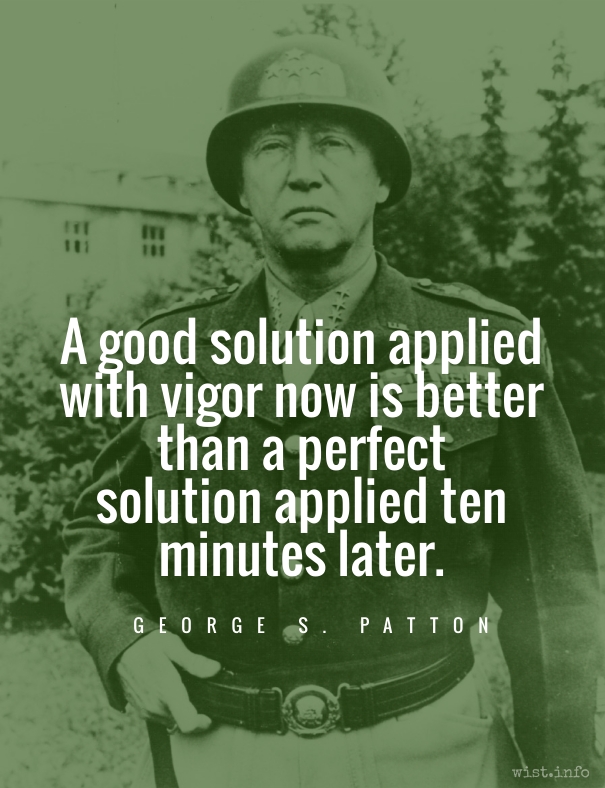
A good solution applied with vigor now is better than a perfect solution applied ten minutes later.
George S. Patton (1885–1945) American soldier
(Attributed)

The salvation of America and of the human race depends on the next Election, if we believe the newspapers.
Ralph Waldo Emerson (1803–1882) American essayist, lecturer, poet
Journal (1848-10)
In every age “the good old days” were a myth. No one ever thought they were good at the time. For every age has consisted of crises that seemed intolerable to the people who lived through them.
Brooks Atkinson (1894–1984) American drama critic and journalist
Once Around the Sun, “February 8” (1951)
(Source)